You are currently browsing the category archive for the ‘Feature Articles’ category.
by Leslie Walker

BAGSC sign at the entrance to the Secret Garden, © DB Shaw, 2010
On October 16, 2010, Botanical Artists Guild of Southern California members, Akiko Enokido, Clara Josephs, Janice Sharp, Deborah Shaw, Leslie Walker, Joan Keesey and her husband John spent the day at the Rancho Los Alamitos Historic Ranch and Gardens, meeting and greeting the attendees to a John Schoustra garden lecture, and hosting an Art Exhibit of members’ work, with botanical art demonstrations and sales by BAGSC.
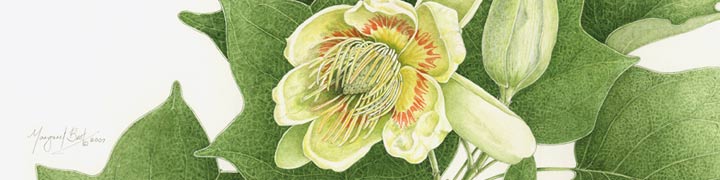
BAGSC artists participating in the exhibition throughout the historic house were: Margaret Best, Akiko Enokido, Clara Josephs, Joan Keesey, Janice Sharp, Deborah Shaw, and Leslie Walker. Clara Josephs’ painting of a Rosa ‘Just Joey’, and Margaret Best’s painting of Hemerocallis thunbergii, Day Lily, were chosen by the Gardens to promote the event.

R to L: Clara Josephs, Akiko Enokido and Janice Sharp demonstrate in the Secret Garden, © DB Shaw 2010
The day was a bit blustery, but we were welcomed by the garden personnel with lunch, then tea and cookies as we began to get chilly in the afternoon. Akiko sold a framed print, and our cards were well-received too! The Rancho Los Alamitos Gardens are building a new classroom, etc., space where they would welcome us for classes. Located just off the 405 freeway in Long Beach we all felt it was a great location. Easy for all of us to get to and the place is lovely — worthy of a visit and support. As Clara Josephs emphatically stated, “it’s MY new FAVORITE place!”

Deb Shaw demonstrates on the Back Patio, © DB Shaw 2010

Joan's husband, John Keesey, joined us to demonstrate plein aire painting in watercolor, © DB Shaw 2010
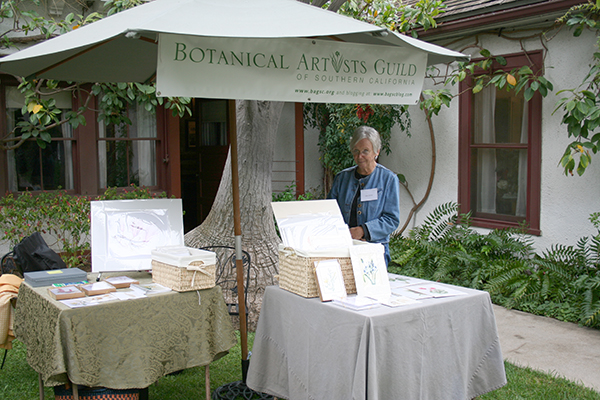
Joan Keesey manning the BAGSC sales table, © DB Shaw 2010

Leslie Walker, bundled up against the drizzle, © DB Shaw 2010
by Deborah Shaw
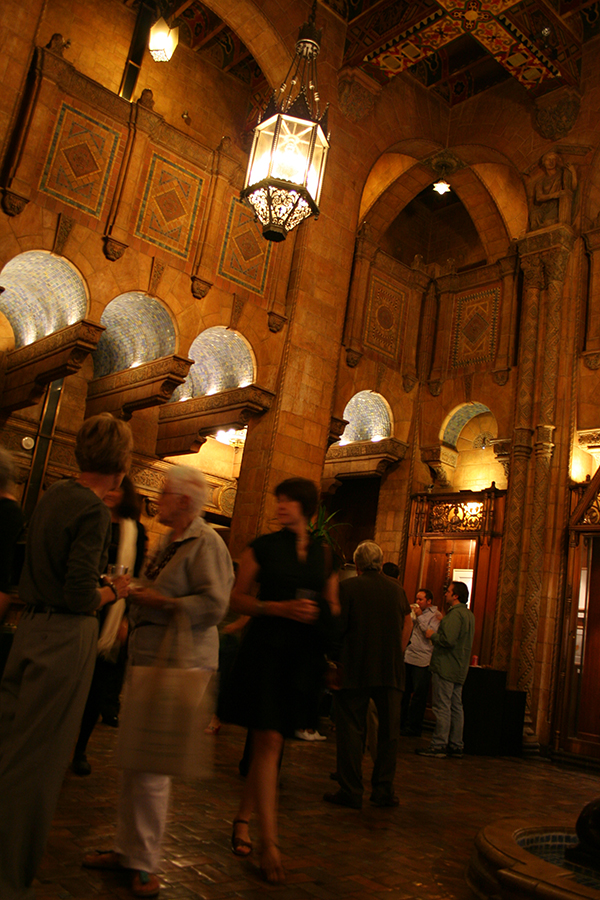
Opening Reception at the Fine Arts Building
The Fine Arts Building, Los Angeles, hosted a wonderful opening reception for the BAGSC exhibit on Thursday, October 14, with catering from our good friends from Burger Continental. BAGSC members (along with their friends and family) at the opening included: Leslie Walker, Janice Sharp, Joan Keesey, Bonnie Born Ash, Veronica Raymond, Morgan Kari, and Deborah Shaw.
The show will be up into November. The building itself is worth the visit, and is an exceptional venue for displaying botanical art. Anyone interested in purchasing artwork will contact the artist directly via email. Leslie will let us know about when the show will come down once the schedule is finalized.
Thank you to all the artists who were able to step up to the plate on such short notice.
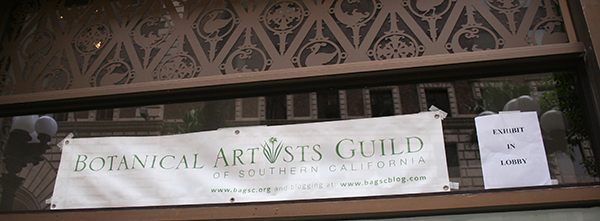
BAGSC Banner in the window of the Fine Arts Building

Left to right: John Keesey, Joan Keesey, Janice Sharp and Dane Hoiberg
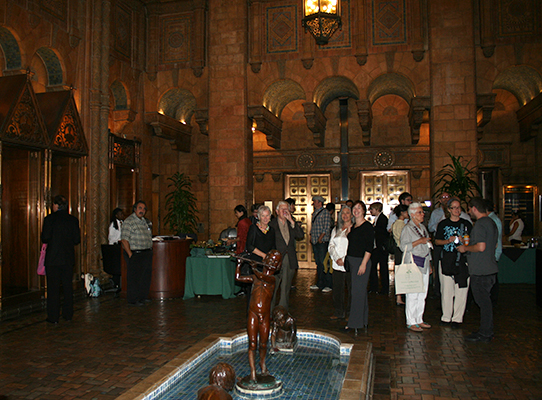
BAGSC members at the start of the opening reception.
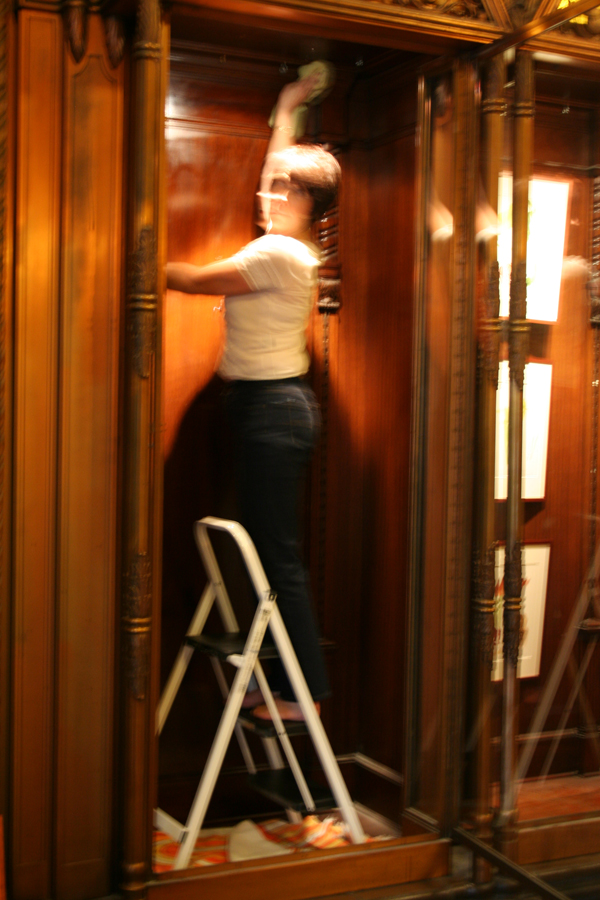
Janice was a whirling dervish during the show hanging on Wednesday, polishing the wood on the inside of all the cabinets.
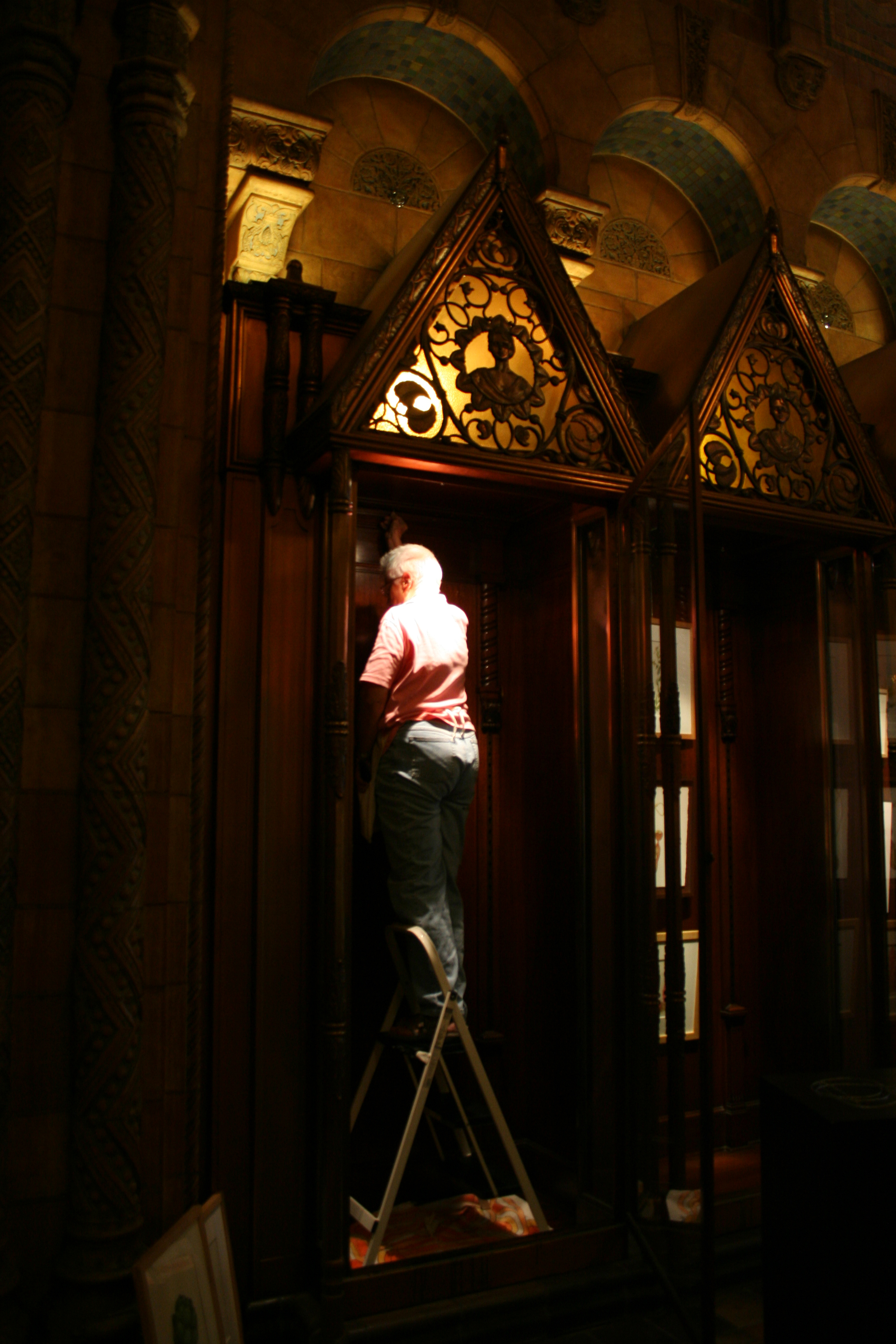
Leslie hanging the wire system during the show set up on Wednesday.
by Deborah Shaw

Kathy Dunham at Watercolor West with her painting of day lilies, "A Love In Bloom"
Leslie Walker, Clara Josephs (and husband Jerry Josephs) were among the many attending the Opening Reception for Watercolor West, where Kathy Dunham exhibited her watercolor, “A Love in Bloom”. Congratulations, Kathy!
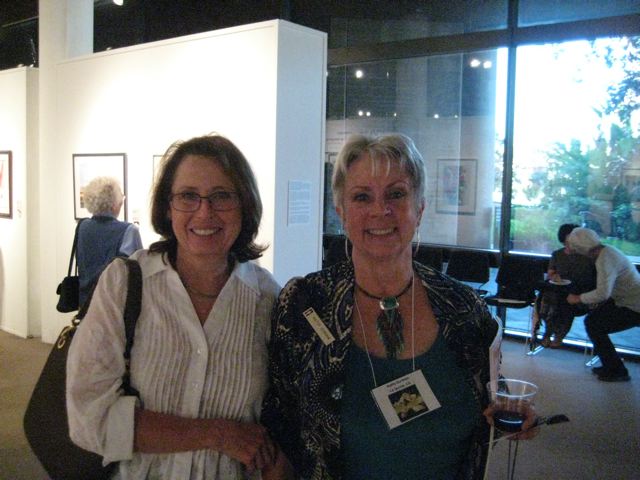
Kathy Dunham and Clara Josephs at the Opening Reception.
by Leslie Walker and Deb Shaw
The Opening Reception for the BAGSC “Fast Track” Show at the Fine Arts Building in Los Angeles will take place during the LA Artwalk on:
October 14, 2010
5 pm – 8 pm
Fine Arts Building
811 West 7th Street (7th east of Figueroa), Los Angeles
The Fine Arts Building is hosting a reception for BAGSC. The LA Artwalk is anticipating more than 20,000 people over the course of the entire walk during the evening. This is a grand event, and an opportunity to see LA in an entirely different light.
Sage advice is to try to get to the downtown area early if possible. The rush of crowds usually starts about 6 pm. As always, parking in downtown LA is a challenge and expensive. Street parking is difficult to come by and fills quickly. There are parking garages in the area, with prices averaging between $8 – $10.00.
There are fantastic restaurants in the areal as well, and the gourmet food trucks come in and participate in the walk too!
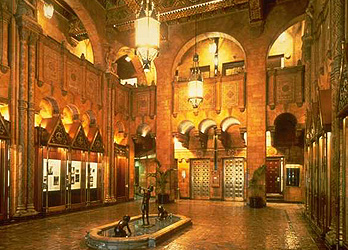
Interior art display area in the Fine Arts Building. Photo courtesy of http://www.ratkovich.net/development/office/fineartsbuilding
BAGSC has the following members exhibiting work:
Margaret Best
Bonnie Born
Kathy Dunham
Cynthia Jackson
Clara Josephs
Morgan Kari
Joan Keesey
Suzanne Kuuskmae
Arillyn Moran-Lawrence
Veronica Raymond
Janice Sharp
Deborah Shaw
Gloria Whea-Fun Teng
Please promote the show (which will be up until mid-November) to colleagues, friends and family. Please have your guests join us for the exciting opening reception and the LA Artwalk on the 14th.
by Leslie Walker
On Thursday, September 30th, I was contacted by the property manager of the Fine Arts Building on 7th St. in downtown LA. She said the lobby showcases were available for us to have a show there. We would hang the show on October 13 and they would host a reception on October 14, the night of The LA City Art Walk. This was presented to the group on Saturday at the BAGSC meeting and everyone thought it was a good opportunity.
Each member may enter four paintings, with no particular framing requirements. There is no entry fee to enter the show. An email blast will be sent to all BAGSC members with the show entry form and delivery details. Members must fill out the show entry form and email or send them to Leslie Walker and Deborah Shaw by Thursday, October 7, 6 pm. All paintings must have show identification labels in place on the back of the painting. Paintings may be delivered to Tania Norris, Leslie Walker, or Deborah Shaw by October 10. Paintings should be in portfolios or boxes with cardboard dividers with the member’s name written on the outside of the portfolio.
The show will be up until the middle of the second week in November. We will provide email addresses of all participants who will handle all sales and delivery after show is taken down. There will be no percentage of sales taken by the gallery.
This is a wonderful opportunity to participate in the LA Art Walk and exhibit in a beautiful, historic LA building!
by Deborah Shaw

Akiko Enokido with her painting at the Hunt opening. Photo by DB Shaw.
Akiko Enokido had her watercolor, Camellia japonica ‘Kramer’s Supreme’ accepted at the Hunt Institute for Botanical Documentation for the 13th International Exhibition of Botanical Art & Illustration. The opening was in conjunction with the ASBA 2010 conference, attended by the following BAGSC members: Akiko Enokido, Olga Eysymontt, Clara Josephs, Tania Norris, Pat Mark, Janice Sharp, and Deborah Shaw.
Akiko also had a piece exhibited in the Thirteenth Annual International Juried Botanical Art Exhibition by the ASBA and The Horticultural Society of New York, her watercolor of Chorisia speciosa, Floss Silk Tree.
Additionally, Akiko presented her portfolio at the ASBA conference portfolio presentation.
Congratulations Akiko!
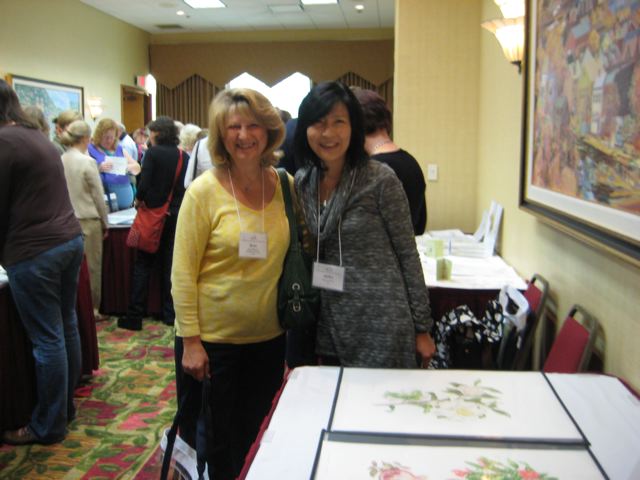
Akiko Enokido and Rose Pellicano at the ASBA Portfolio Presentation. Photo by Clara Josephs.
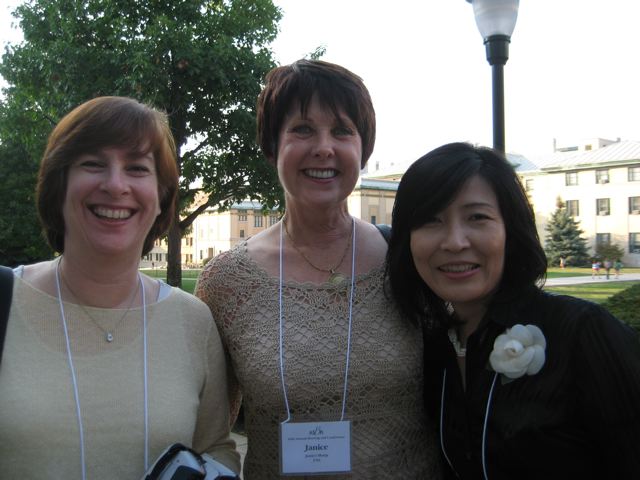
Deborah Shaw, Janice Sharp, Akiko Enokido about to go into the Hunt opening. Photo by Clara Josephs.

Akiko Enokido talking with Lugene Bruno at the well-attended opening. Photo by Clara Josephs.
by Clara Josephs
Without even introducing herself, Karen Kluglein was off and running in her very first sentence instructing the class in the ins and outs of painting on vellum. She gave a short talk and in just a few minutes we were sorting though piles of small pieces of various types of vellum, and trying our hand at as many as we had time to sample. I felt like a kid in a candy store! While we painted, Karen also painted, either demonstrating to four students at time, or working silently on her own piece. We were free to sit with her for as long as needed and then return to our work.
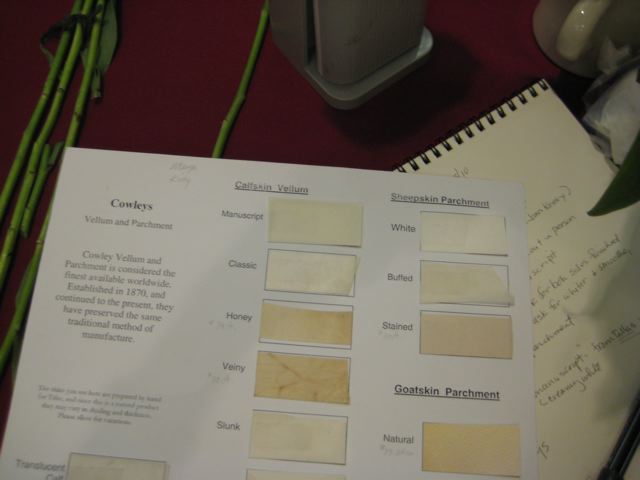
Sample card of different types of vellum
A sales representative from Pergamena was at the conference and provided the 8 x 10″ calf skin piece that was included in the class cost. However, I think that Karen usually gets her calfskin Cowleys manuscript (creamy white) from Talas. It can be ordered by phone if you can’t go to Brooklyn, NY for the fun of picking out your own pieces. Tala also sells a sample card of Cowleys (see the photo).
When picking out pieces consider these points. Look for a flat piece. When framed and hung on a wall, rippling will be accented by overhead lighting. You can request pieces that are finished on both sides or only one side. If you want “veiny vellum” you may want to pick it out in person so as to get a piece that appeals to you or complements the subject. Paint on the top side which is smoother to the touch and may show indentations from the follicles.
Choose thicker pieces that are uniformly thick and even. Store flat. Vellum reacts to humidity. If it curls, it will relax later in the day. Vellum refers to calfskin, while parchment denotes sheep, which is oily and less desirable for our work.

Wash on vellum
Painting on vellum is a pleasure and a torture. The key is mastering the correct amount of water. Karen began with a light wash – slightly stronger than a tea wash-that dried instantly. From then on, it was all dry brush. Our first practice was creating a smooth transition on a 1 x 2 inch scrap using a light wash under cross hatching dry brush. Karen’s demonstration was so smooth it looked printed! (see photo) She uses Series 7 brushes (000 is her favored) to limit the flow of water onto the surface. She fills in tiny gaps with tinier dabs of paint. If you touch the paint with a brush that is too damp, it instantly removes all the under lying paint! Of course, the flip side is that may errors can easily be corrected in the same way.
While you can easily erase graphite from vellum, Karen transfers her finished composition using Seral paper and then lightens with a clean kneaded eraser. She also uses the eraser to remove surface oils in places where the paint beads and refuses to spread evenly. Keep hand oils off the surface to avoid this problem. While paint can be fairly easily lifted, water drops sully the surface permanently and can be seen in side light.
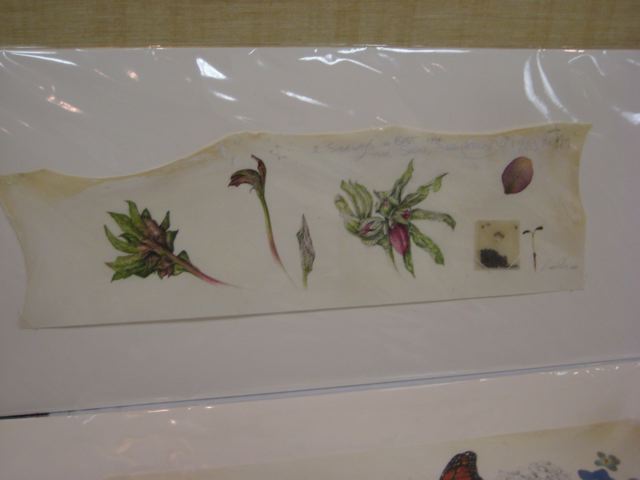
Kate Nessler's stitched vellum piece, © Kate Nessler, photo by Clara Josephs
Frame vellum with an 8 ply mat and at least ½ margin under the mat to allow for some expansion and contraction, or it can be floated. Kate Nessler had several pieces in the Portfolio Show that were stitched onto a backing and floated; the stitching was part of the composition.
I have been fascinated and intimidated by vellum ever since I saw our Morgan Kari’s glowing painting of a clover at a BAGSC meeting several years ago at Norma Sarkin’s home. I was thrilled with this class and with Karen’s expert, content filled instruction.
by Clara Josephs

Phipps Garden Center, photo © Clara Josephs
Hillary Parker’s full day class entitled Composition was held a short bus ride from the hotel in the charming Phipps Garden Center. The class content began with an overview of the elements that Hillary thinks are most important to consider when developing a new composition: balance, movement, light, negative-positive space, and the “voice and vitality of both the artist and the plant”. Some interesting notes from this segment:
- Think early on about how the subject will be lit. Lighting plays a huge roll in composition.
- Balance involves more than just size, also consider color, mass, placement. Balance does not have to be symmetrical.
- Movement calls the viewer in and sustains attention. Be careful about creating square, circle or triangular negative shapes that can trap the eye. Any easily recognized shape can become a trap.
The ability to convey the Voice and Vitality of both the plant and the artist is a hallmark of fine art. Hillary suggests that it is very helpful to do a fair amount of writing about the plant before starting your composition. Once your have written, perhaps several pages about the plant, its habit, what interests you, what are the most outstanding characteristics and the defining traits, then condense that down to one sentence or phrase that you keep on your table and refer to daily to make sure you are portraying those attibutes. Keep referring to the adjectives in your writing – are they coming through in the portrait? We looked at copies of 15 paintings attempting to identify the voice of the plant and artist.
Hillary cautioned that when drawing your subject be sure to use multiple subjects so that you are truly familiar with the species” botanical truths”.

Hillary Parker and students, photo © Clara Josephs
Hillary paints a number of very large (8 feet plus) watercolor commissions for hotels, and a highlight of the class for me was viewing her enormous tracings for a painting of a cotton plant (see the photos). Done on 300 hot press cut from a roll, she used the familiar method of numerous tissue paper iterations. The individual bolls were drawn in final detail on small pieces and taped in place. Since she does not like to paint upside down, she had to carefully lie across the painting to reach into the center areas.
The afternoon concluded with students creating a composition of cotton bolls. I had never seen them up close and was stunned by how beautiful they are. Every angle was captivating. The day was over too soon!

Cotton bolls, photo © Clara Josephs
by Deborah Shaw

"A Love in Bloom", Kathy Dunham, watercolor, © 2010, all rights reserved.
Kathy Dunham is exhibiting her watercolor, “Love in Bloom”, in the:
Watercolor West XLII Annual International Exhibition
Opening Reception: October 9, 2010, 5 – 7 pm
City of Brea Art Gallery
1 Civic Center Circle,
Brea, CA 92821
The juror is Frank Francese. The show will be up October 9 – December 19, 2010 and the demonstration schedule is listed on the Watercolor West website.
by Deborah Shaw
Sally Jacobs will be exhibiting at the TAG Gallery with her collection of works entitled “From the Ground Up”:
November 3 – 27, 2010
Gallery hours: Tuesday – Saturday, 11 am-5 pm
Everyone is invited to the:
Artist’s Reception: Saturday, November 6th, 5 – 8 pm
Artists’ Panel (Interviews with the three participating artists): November 13, 3 pm
TAG Gallery
Bergamot Station D3
2525 Michigan Avenue
Santa Monica, California 90404
310.829.9556
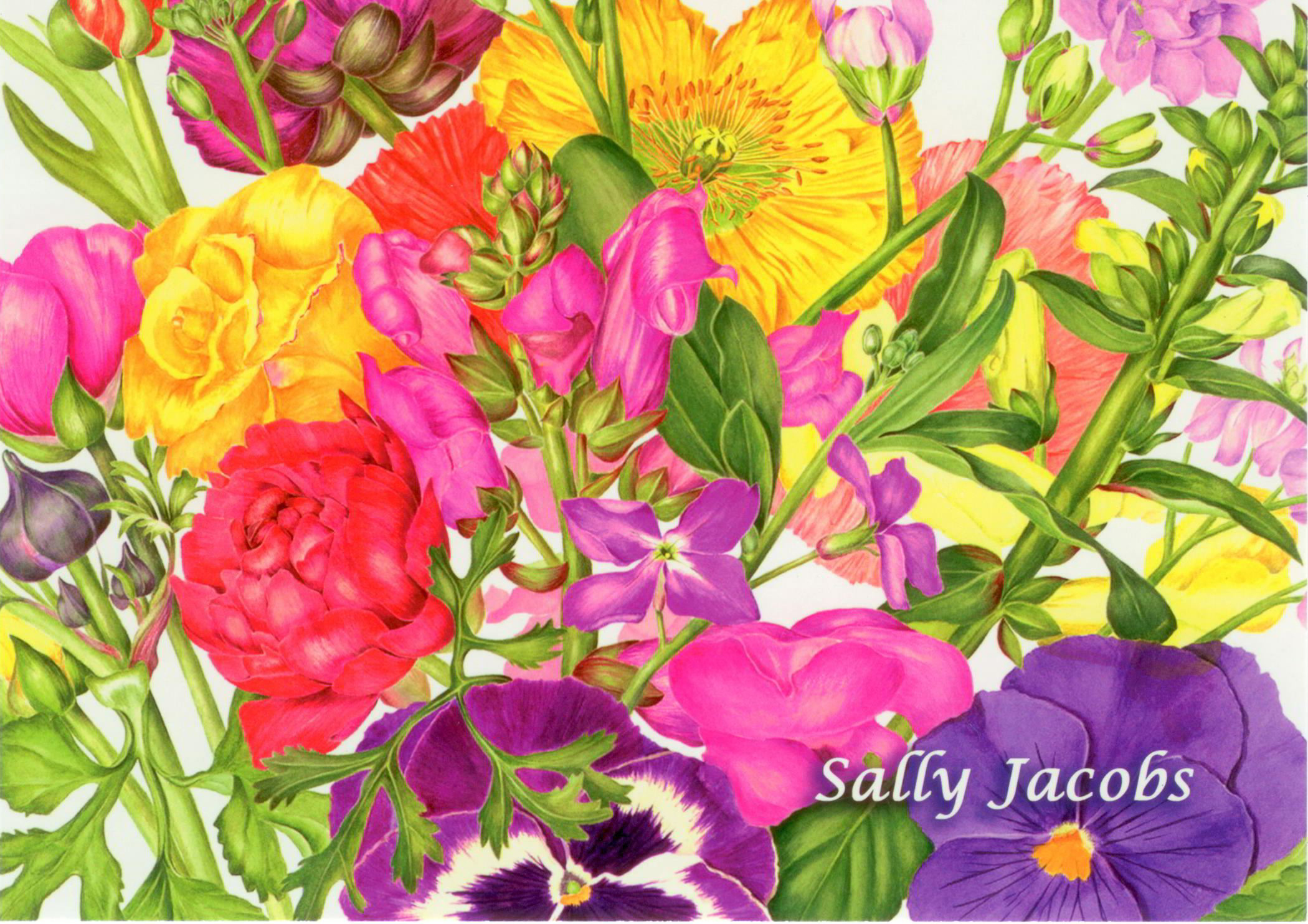
"Garden Flowers", by Sally Jacobs. Postcard invitation from a 27" x 22" watercolor. © 2010, all rights reserved.
Sally will have a dozen new paintings in the show. Two other TAG members will be exhibiting at TAG at the same time.
The TAG Gallery moved to Bergamot in January, into a large space and wonderful site for exhibiting. There are many galleries in the immediate area, so it’s fun to visit several while you’re there.

Sneak preview of one of Sally's new watercolors: "Strawberries", © 2010, all rights reserved.
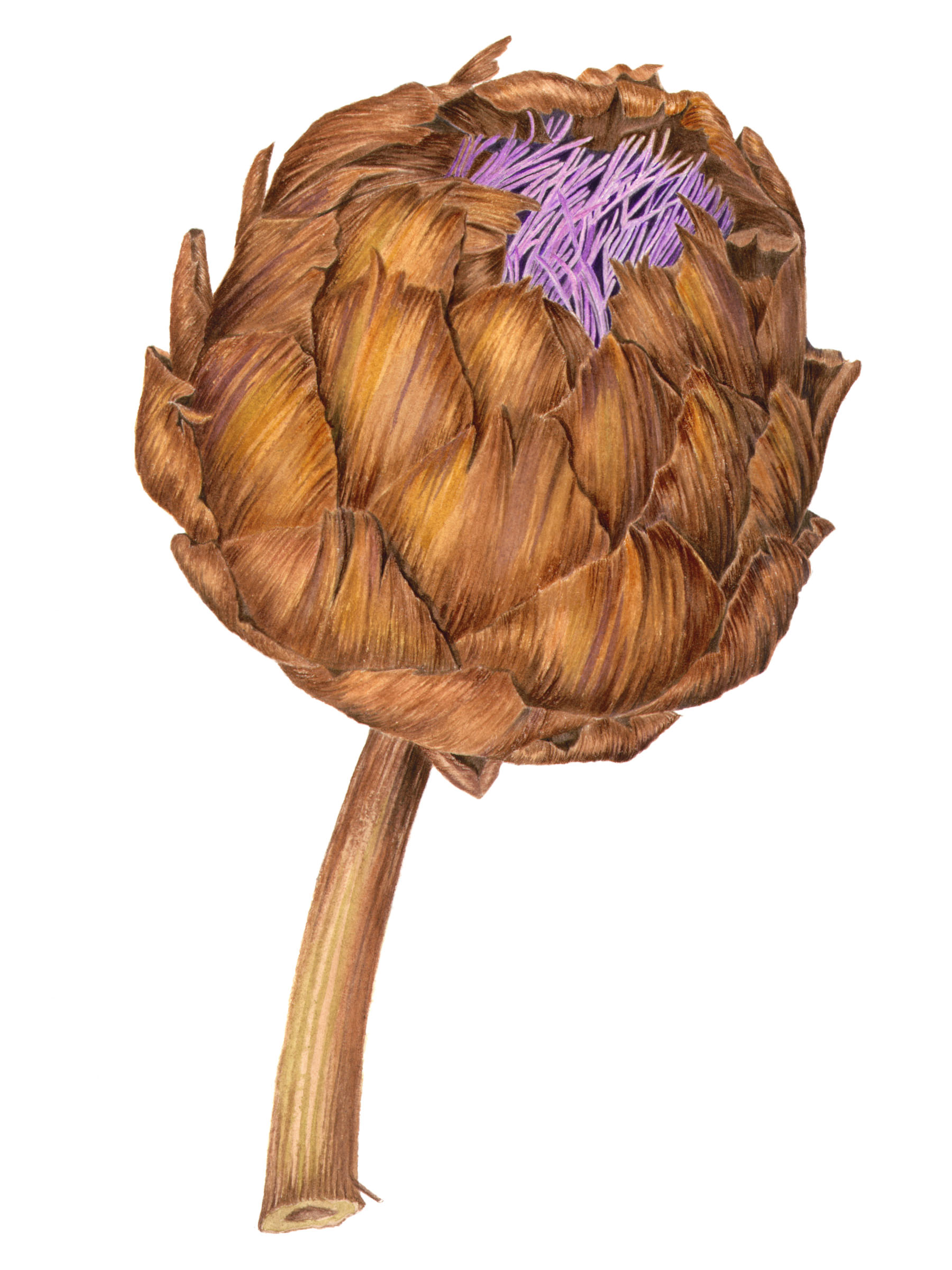
Sneak preview of one of Sally's new watercolors: "Old Artichoke", © 2010, Sally Jacobs, all rights reserved.
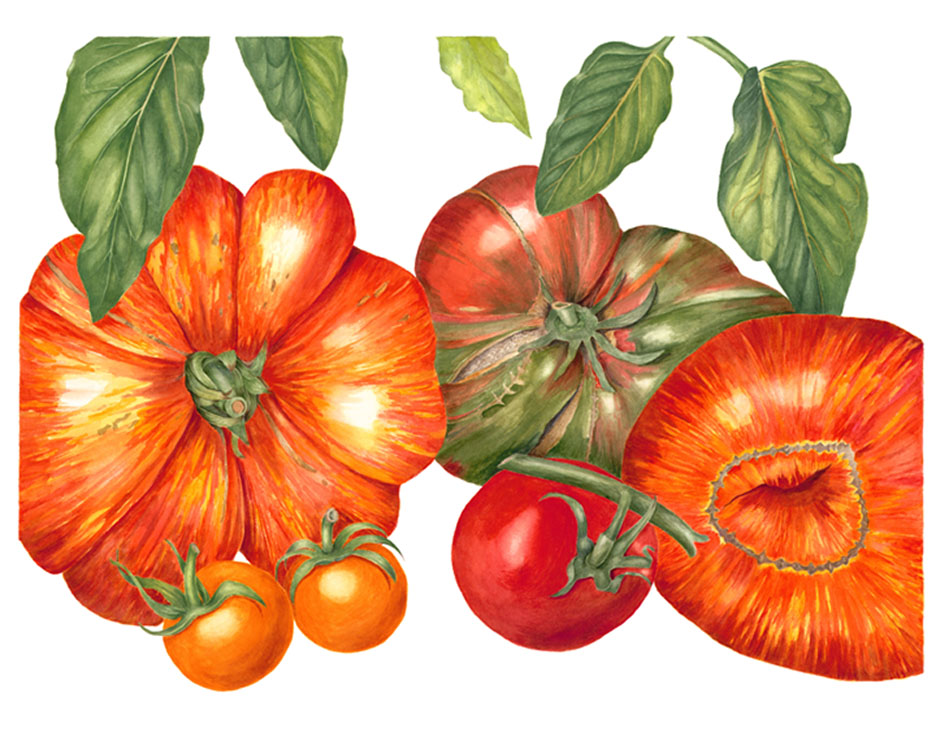
Sneak preview of one of Sally's new watercolors: "Tomatoes", © 2010, Sally Jacobs, all rights reserved.
by Janice Sharp

Deborah Ravin demonstrating technique during her class.
Deborah Ravin taught a BAGSC-sponsored class, August 19 – 21, 2010 at the Huntington Library, Art Collections and Botanical Gardens.
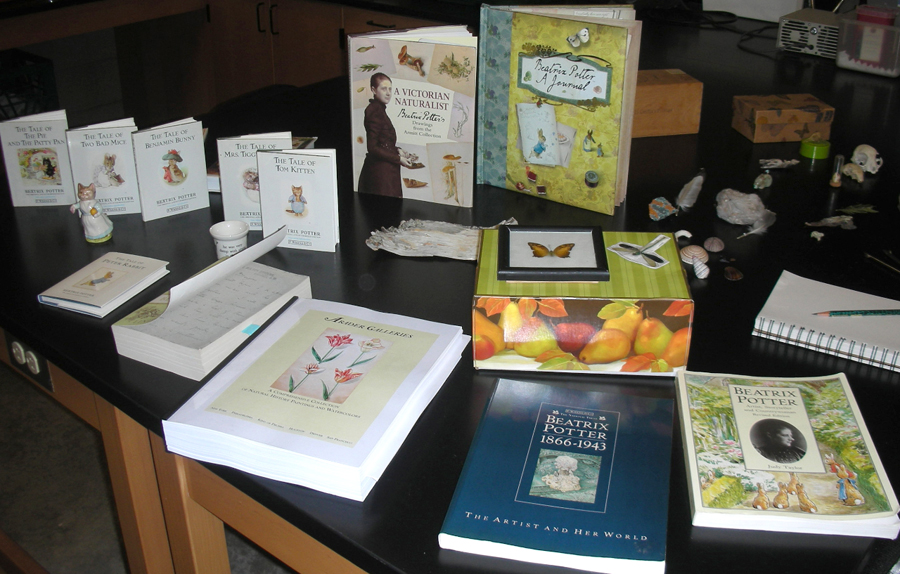
Beatrix Potter display.
Beatrix Potter is well known for her “Peter Rabbit” children’s books featuring her pen and ink/watercolors illustrations, however, Beatrix was also an accomplished botanical artist. Her detailed renderings of fungi and lichens were scientific trendsetters in the era before microscopic photography was an option.
Beatrix Potter’s interests lay with botanical art, particularly in the study of mycology. Her investigation and discovery led her to develop theories expressed in her paper “On the Germination of the Spores of Agaricineae.” (Poculum). Her paper was submitted to the Linnean Society on March 18, 1897. However, her theories, like those of any other woman, were not taken seriously. The paper was withdrawn with the understanding that it needed “more work”. One hundred years later, the Linnean Society wrote an official apology for the sins of historic sexism.
Today, 450 of Beatrix Potter’s scientific, archaeological, and botanical art comprise the Armitt Collection in Cumbria. Tania Norris treated us to a close-up of a Beatrix Potter original that is in her personal art collection.
Deborah led us through a series of a variety of methods for applying ink and watercolor to illustrate our botanical drawings.

Afternoon tea during class.
The class featured a treat of afternoon tea with Almond-Cardamom Scones (baked by Jill Carlson to whom we are all very grateful-the recipe is on the BAGSC Blog under the “Recipes” section or can be viewed by clicking the link).
Deborah also shared a recipe for “Black Walnut Ink” which is also on the BAGSC Blog (or can be viewed by clicking the link).

Our artwork, accomplished during class.
By Joan Keesey

Joan Keesey with Buckeye Painting at Filoli
On July 15th I attended the Artist’s Reception for the FILOLI 12th Annual Botanical Art Exhibition. There were 46 paintings from the United States and Canada; six were by members of BAGSC: Margaret Best, Akiko Enokido, and Joan Keesey. The paintings were beautiful; the Filoli gardens in summer were lovely, and it was a pleasure to talk to other botanical artists with pictures in the exhibit.
I also attended a four-day class on Nepenthes, taught by Hillary Parker. I have admired her work since I first saw it at the ASBA Conference in Pasadena. You can see her work on her website. Her emphasis is on composition and a more conceptual and interpretive rendering of a plant species. While we did use plant specimens, she didn’t want us to “ copy the specimen” but rather to portray the characteristics of the species.
There were six students in the class, three of whom are currently in the Filoli Botanical Art Certification program. We did gesture and contour drawings of six species of Nepenthes, then we each chose a species to paint. We wrote verbal descriptions of the plants and did multiple

Akido Enokido Painting at Filoli
“thumbnail sketches” until we achieved a composition that we thought characterized both the species as well as something of the artist’s reaction to the species. I thought that there were several outstanding compositions as a result of this process. Everyone was very enthusiastic about the class. The certification candidates have requested that she return next summer because they thought the process was so different and produced a more interesting and artistic rendering of a botanical subject. I hope that she is able to teach a class in Los Angeles sometime in the future.
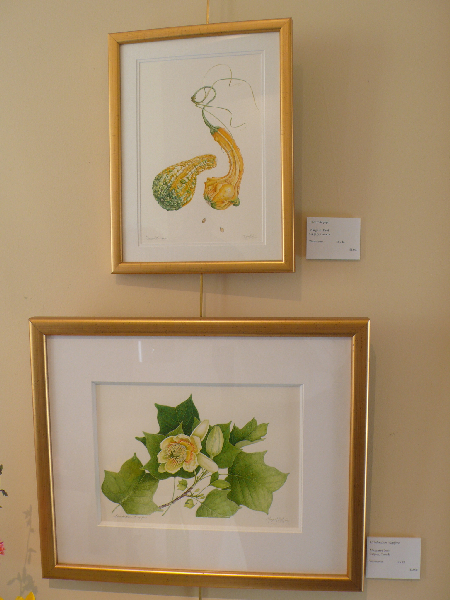
Margaret Best Paintings at Filoli
by Clara Josephs
Through the special efforts of member Diane Daly, BAGSC has received an exciting invitation from Charlene Baldwin, Dean of Leatherby Libraries at Chapman University to conduct an exhibition of members’ works sometime shortly after the new year. Chapman University is located in central Orange County, off the 55, 57, or 22 freeways. This would be the first BAGSC exhibition to be held in Orange County.
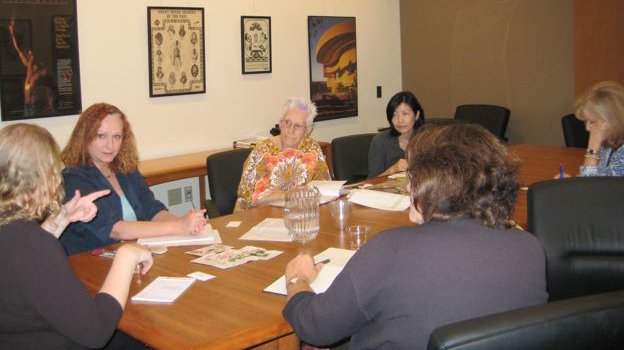
Initial meeting to discuss the show.
On June 15, Leslie Walker, Diane Daly, Akiko Enokido, and Clara Josephs met with university officials to begin discussing arrangements. Leatherby Libraries is located in the center of the campus, with parking nearby. A beautiful, four-story building, it has elegant lecture and exhibition spaces, which are alarmed and insured.
The exhibition space is approximately 60 feet long, and paintings can be double hung. That gives us ample space to showcase the talents of our members. The thinking at this time is to request that all paintings be framed in light natural wood, to unify the appearance of the exhibit. There is room for lectures and demonstrations in an area adjacent to the exhibition area that is beautifully filled with abundant natural light. The library has three locked, rolling display cases which we can use to show botanical books or artist’s equipment.
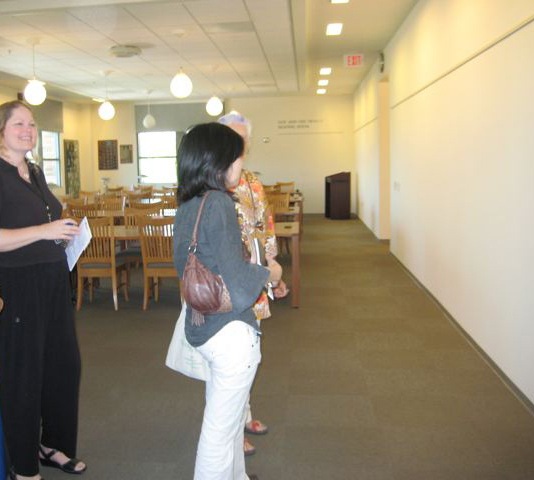
Looking at an area for hanging.
The university has catering which will provide refreshments for an opening reception.
While the university has a professor of botany whose interest is in native California plants, the thinking at this time is to open the exhibit to all botanical subjects.
The exact date for the exhibit opening has not been set, but will most likely be in late January or early February and run for 4-6 weeks. However, now is the time to get planning and painting.
Stayed tuned for dates and details on this wonderful opportunity.
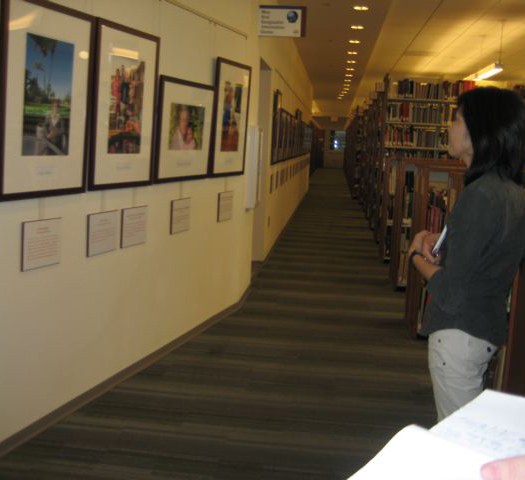
Looking at a current exhibition hanging at Chapman University.
You and your guests are invited to
The Opening Reception for the Botanical Artists Guild of Southern California Art Show at the LA Arboretum Library
Wednesday, April 7, 2010
From 5:00 pm to 7:00 pm.
In the Library at the
Los Angeles County Arboretum & Botanic Garden
301 No. Baldwin Ave., Arcadia CA 91007
Light refreshments will be served.
The Botanical Artists Guild of Southern California Art Show at the Arboretum Library will be on display from April 1 to June 30, 2010.
Parking is in the regular LA Arboretum parking lot for free. Please enter through the green gate next to the green circular exit.
If you have any questions, please contact Janice Sharp.
The following is reprinted here from the LA Arboretum’s email newsletter. The posting can also be seen on the Arboretum’s website, along with Akiko Enokido’s beautiful painting, Silk Floss Tree (Chorisia speciosa).
Open Now – June 30
“Seeing the Details: An Exhibition of Southern California Botanical Art”
April 7 from 5-7pm: Opening Reception
The Botanical Artists Guild of Southern California will be exhibiting their work in The Arboretum Library, April 1 to June 30, 2010. Botanical accuracy and artistic merit will ensure a detailed and breath-taking view of Southern California plants, both native and ornamental. The show will be juried by Olga Eysymontt, Guild Member and Botanical Illustration Instructor at The Arboretum, James E. Henrich, Arboretum Curator of Living Collections, and Susan C. Eubank, Arboretum Librarian. Many works will be available for purchase, with a percentage of sales supporting The Arboretum Library. An opening will be held with the artists, Wednesday, April 7. Watch The Arboretum website for the reception announcement. The Guild is dedicated to encouraging the development of botanical art and the promotion of public awareness of this very old and established artistic tradition. Guild members are committed to improving their artistry and technical abilities through supporting and sponsoring workshops with local experts and visiting lecturers in areas such as drawing and painting botanical subjects, botany, calligraphy, and resources.
Free with admission.
by Sue Kuuskmae
The Pastel Society Show at Manhattan Beach Creative Art Center will be up from April 3 – 17 with the reception on April 9 from 6 – 9:00 p.m. The show set up was on April 1 and the paintings are spectacular. Morgan Kari, Rita Hopper and Suzanne Kuuskmae all have paintings in the show. Come on to Manhattan Beach to see this fabulous show.
 BAGSC News