You are currently browsing the category archive for the ‘Feature Articles’ category.
by Deborah Shaw

For those of you who weren't able to attend the last BAGSC meeting, here's a sample from the same printer of the postcard front for Gloria Whea-Fun Teng's Long Beach show. © 2009, Gloria Whea-Fun Teng
BAGSC members have the opportunity to have their artwork printed on promotional artwork postcards at trade prices in conjunction with our show at the LA Arboretum Library. (Please see the call for entries further down on our BAGSC Blog.) The postcards are on heavy white stock, full color on the front, with a full, glossy, varnish on the color side. The back will be printed one color with the information about the LA Arboretum Library show. You may also order your postcards with a blank back, and only your artwork on the front.
Here’s how it works
1. Send your high-resolution (at least 300 dpi) color-corrected scans of your artwork to Deb on or before 2 March, 2010.
2. Include your name as you want it to appear on the postcard front, along with: the name of the painting (please check spelling carefully, what you send is what is printed); the media (if you want to list that); and, the date of the painting for the copyright line. For example, the information that might appear on the front of the card would be:
Deborah Shaw
Arisaema ringens
Watercolor, © 2009, Deborah Shaw
3. Deb will email you a PDF proof of the front and back of your card on or before 8 March. All approvals are due by noon on 9 March, and the postcards will go to the printer.
4. Postcards will be handed out at the BAGSC meeting at Deb’s house on Saturday, 20 March.
Printing specifications and pricing
Final printed size: 4″ x 6″. Your image can be printed in a horizontal or vertical format. The information about the LA Arboretum Library show will be printed in a horizontal format.
Color(s) and varnish: Full color on the front; the color can bleed off four sides of the card if desired. Printing of black-and-white artwork (graphite or pen-and-ink) will still be done on a full color press, and may have the appearance of a slight color tint. The artwork side of the postcard will have a full coating of a high gloss (UV) varnish.
Paper: 14 pt, white card stock, to meet Post Office regulations for mailing.
Optional copy on the back: All of the backs will be printed with the same information about our LA Arboretum Library show and the reception invitation. You can also elect to have no printing on the back (i.e., the back will be blank), but the cost will be the same.
Costs: The cost below includes printing and shipping to Deb’s house. Deb will set up the artwork for the printer at no charge. Orange County sales tax of 8.75% will be added to the amounts below. Checks should be made out to BAGSC, and received by Deb Shaw by 9 March.
100 quantity: $30.00
250 quantity: $35.00
500 quantity: $40.00
1,000 quantity: $45.00
2,500 quantity: $92.00
5,000 quantity: $128.00
Important Dates to Remember:
2 March, 2010: Scans and copy must be in Deb’s hands
8 March, 2010: Deb will email PDF proofs on (or before) this date
9 March, 2010: Approvals must be received by noon (or before) this date, or the postcards will go to print as is and the artist will be obligated to pay the cost
9 March, 2010: Payment must be received
20 March, 2010: Beautiful cards will be handed out at the BAGSC meeting
We’ve had a lot of interest in these postcards. If successful, we’ll repeat this offer several times each year in conjunction with events or exhibits. If you have any questions, please let Deb know.
by Akiko Enokido
The Hunt Institute for Botanical Documentation at Carnegie Mellon University has an International Exhibition every three years, the opening reception coinciding with the ASBA conference.
They seek fine artists and illustrators who are not represented in their collection. The exhibition for Fall 2010 is the 13th since the Institute was established in 1964.
Sadly, the curator of art, Mr James White has stepped down from his position due to health reasons. His assistant, Ms. Lugene Bruno has taken over his position. I know her only via telephone, but she seems to be a wonderful person.
They requested I send six slides from my works painted within the last two years (they accept up to dozen slides or transparencies), a letter and a resume.
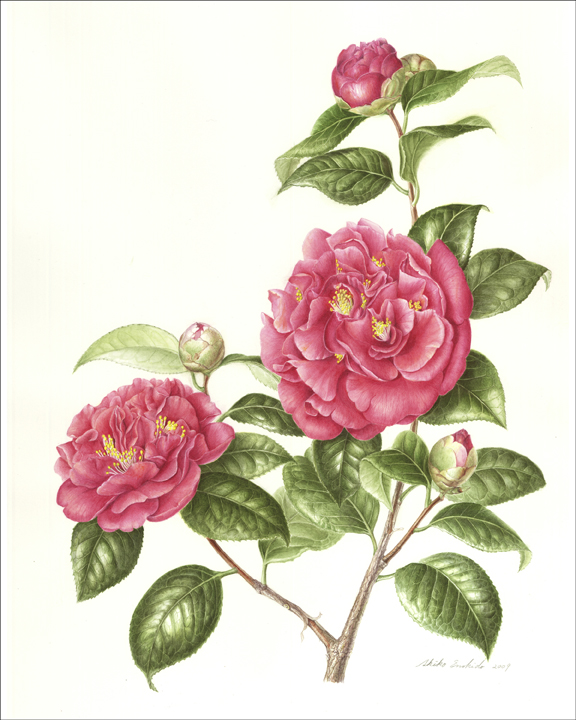
Camellia Japonica, watercolor, © 2009, Akiko Enokido
A week later, I received an e-mail from Ms. Bruno informing me that that they had accepted my Camellia Japonica painting.
I painted this piece last spring. I had painted camellias before, but this time I tried to focus on creating the texture of the shiny leaves in watercolor. I showed my work to Jenny Phillips when I took her class at the Huntington Library. She gave me some advice which was very helpful. Thank you, Jenny.
I’m not perfectly happy yet with this piece but I’m glad my effort was acknowledged.
The opening will be held on September 23 at Hunt Institute Gallery, 5th floor, Hunt Libarary, 4909 Frew Street, Carnegie Mellon University. The artwork will be on display until December 21st. I hope you can come and see the exhibition. The ASBA Annual Conference will be held September 23-25.
by Janice Sharp

Home Tour Program and Ticket
The 42nd Annual Holiday Look In 2009 Home Tour benefiting The Pasadena Symphony Association ran Saturday and Sunday, December 5 and 6 from 9:30 am to 4:30 pm each day in Pasadena. The tour was attended by 2,300 people. BAGSC was invited by Jane Herrmann to hang members’ works in her back stairwell (see initial story below in the BAGSC News blog). Four paintings were sold as a result of the Tour, for a total of just under $3,000.00, including: Gilly Shaeffer’s, Three Hibiscus; Arillyn Moran-Lawrence’s, “White Satin” Still Life of Arum 6 lilies; Cynthia Jackson’s, “Bark”; and Patricia Mark’s, “Persimmon Pair”.
Unfortunately, as sometimes happens in a house built in 1917, a fuse blew and the power was out for a few hours on Sunday. The tour went on without light, but, eventually, the docents at the house were able to set up substitute lamps for the stairwell.

BAGSC Home Tour Catalog: Sample Pages
For the first time, BAGSC printed a catalog with thumbnail images of the artwork, and contact information for each of the artists. Catalogs were handed out to all of the tour participants, so that they would be reminded of the works they had seen. One painting sold after the tour was over, so the concept appears to be successful. We’ll explore more ideas about printing “take-away” pieces for future exhibitions.
The BAGSC show will remain up through the holiday season at Jane’s house, on exhibit during her holiday gatherings. Jane is very supportive of botanical art, with a wonderful collection throughout her lovely home, including antique and modern botanical paintings, including some Martha Kemp pieces.
Thank you to Jane & Carl Herrmann for opening their home. And best wishes to all for a happy holiday season.
I was very interested in the use of vellum prior to going to the conference so I looked for those artists using vellum at the Portfolio Sharing event. I found Jean Emmons and discussed how her work was displayed as it was mounted in an different manner.
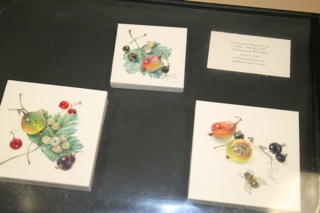
Jean Emmons small works on vellum stretched over Art Boards.
First, these particular pieces were small and were stretched over a small board. Jean explained that the vellum was stretched over Art Boards. She had gessoed the surface of the Art Board so that the vellum was protected. The vellum was then glued over the board and around the sides. Jean uses transparent paint and the work is so gorgeous that it is hard to comprehend how she does it.

The Legacy Exhibition at the ASBA 09 Annual Meeting in Scottsdale. The Maple Leaf by Jean Emmons.
I saw her two pieces in The Legacy exhibition and was fascinated with the maple leaf and the colors that she used. Moving into the Techniques Showcase. Jean Emmons was demonstrating her painting technique. She studied the gourd and found numerous colors and added those to her Bristol board drawing. She explained that her technique is based on medieval manuscript illumination which was learned from Kevin Nicolay, who sadly died at the age of 33. The method is a difficult and time consuming but is a very special way of viewing light moving through plant layers. I watched and photographed her technique and was able to capture one shot of the beginning of her painting as that seemed to be the basis of her incredible technique.
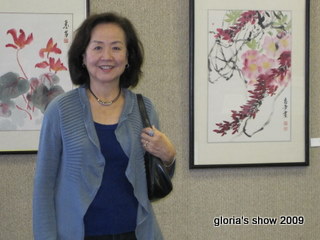
Gloria Whea-Fun Teng, © Gloria Whea-Fun Teng, all rights reserved.
From November 1 to December 31, 2009 Gloria Whea-Fun Teng’s Botanical & Chinese Brush Paintings will be on display at the Main Long Beach Library. The Library is located at 101 Pacific Ave., at Ocean Blvd., Long Beach.
Irene Horiuchi attended the show and sent these images and comment: “Gloria’s show is a wonderful combination of Chinese brush paintings and botanicals. Great show.”

Gloria Whea-Fun Teng's Botanical Painting, © Gloria Whea-Fun Teng, all rights reserved.

Gloria Whea-Fun Teng's Chinese Brush Painting, © Gloria Whea-Fun Teng, all rights reserved.
We’ve put out a call to all BAGSC members that attended the ASBA conference to post their impressions and any images. We’ll post them as they arrive. Keep writing and reading. If you have any questions or comments about techniques, please post them by clicking on “leave a comment” at the top of this article. Feel free to ask participants to give a demonstration of what they learned at a BAGSC quarterly meeting.
It was an honor and a privilege to watch Lizzie Sanders and Jean Emmons work side by side during the techniques showcase session. Each worked with a gourd of the same colors for a subject. It was a study of contrasting different painting techniques, with brilliant and magnificent effect. Lizzie applied paint with very tiny strokes while molding the subject to perfection before moving on to an adjacent small section. She uses a dry brush and doesn’t wash. The four basic colors were naples yellow, new gamboge, cad orange, and indigo all used in various combinations. For shadows she simply puts on more paint. The result was a rich and articulate color that gave form and luminosity. Jean painted her gourd from a butcher tray palette loaded with tiny spots of colorful paint. She likes Holbein paint with a little white in the formula and the Daniel Smith quinacridone color series among other paints. Jean uses optical mixing and impressionist color theory creating 20 to 40 washes of mostly transparent colors. A bright and radiant gourd began to emerge from the surface of her bristol board. Here were two highly accomplished master artists simultaneously demonstrating two very unique approaches to the same subject. It was fascinating to watch them work.
I took Elaine Searle’s classes called Succulents in Watercolor and also her class Painting White Flowers in Watercolor. She was a wonderful teacher giving loads of individual attention and encouraged us to relax, to experiment and to paint without feeling the pressure of a performance. The classes were filled with technique direction, demonstrations, exercises, useful tips, and helpful answers to any question. Her handouts gave colorful illustrations of how to formulate a painting once home. I would highly recommend Elaine for any future workshop and hope to take a class from her again.
We’ve put out a call to all BAGSC members that attended the ASBA conference to post their impressions and any images. We’ll post them as they arrive. Keep writing and reading. If you have any questions or comments about techniques, please post them by clicking on “leave a comment” at the top of this article. Feel free to ask participants to give a demonstration of what they learned at a BAGSC quarterly meeting.
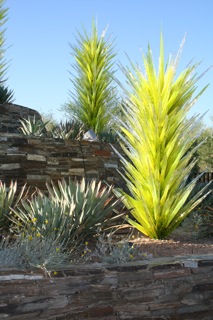
Chihuly glass plants at the Desert Botanical Gardens, photo by Arillyn Moran-Lawrence.
The ASBA conference in Scottsdale, AZ, was my first and I was very impressed. Everything was very well organized and ran smoothly, except for one bus that broke down on the way to the museum exhibition. From the portfolio sharing, the luncheon meeting, the Legacy gallery show, the Techniques Showcase, the Phoenix Art Museum exhibition and the creative hors d’oeuvres and dessert that was presented by the museum, all were exceptionally well done.
The workshop that Elaine Hultgren presented was “The Illuminated Desert”. Prior to the workshop, I learned about sources while purchasing many intriguing items from a NY company. I traveled with my expensive piece of vellum and small dab of 24k gold right next to my side. We chose a desert flower, then a capital letter style relating to the genus of the flower and sent that information on to Elaine. On arrival she had prepared a portfolio for each of us so that we could begin work immediately. We designed the desert flower design around the chosen letter and transfered it to the vellum. We learned to make “skins” of paint to use in painting on the vellum, how to apply the gold and burnish it, and how to draw a ” line” of gold. The workshop was only 7 hours long and most of us did not finish the project, however Elaine has asked us for our finished illumination and she will then send us a slideshow of all of our work.

Portfolio Sharing. Kelly Leahy Redding, her framed vellums and her Artist in Residence Book from her trip to Italy. Photo by Arillyn Moran-Lawrence.

M. Alice Rezende, Brazilian recipient of a Margaret Mee Fellowship to paint endangered species in the Amazon. Shown with Jenevora Searight, from England, who lived in Brazil for 30 years and worked with Margaret Mee. Photo by Arillyn Moran-Lawrence.

Jean Emmons fascinating work on vellum. Photo by Arillyn Moran-Lawrence.
by Akiko Enokido
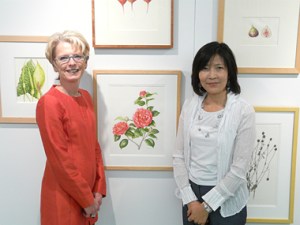
Akiko Enokido and Vicky Obenshain with Akiko's Camellia Japonica.
I sent my work of Camellia Japonica to the Horticultural Society of New York last March. I had just finished painting it so I could only submit one piece.
I was very honored and excited when I found out that my piece made it to the 12th Annual International Juried Botanical Art Exhibition 2009.
The opening reception was September 16. I flew in to New York in the morning of 16th and flew back on the 17th. I wish I could stay longer, but I had not visited New York since I moved to California five years ago, so I was very excited. This was the first time for me to see this Exhibition.
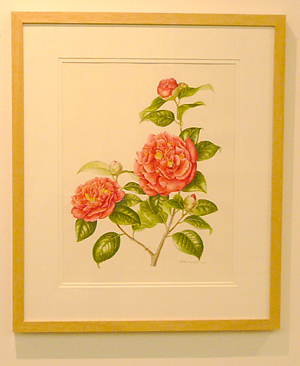
"Camellia Japonica", watercolor by Akiko Enokido, © 2009
The subjects of the paintings were so wide-ranging. The 41 paintings included grasses, leaves, fresh or dry fruit, mushrooms, and bolls. There were not many flowers entered in the exhibit, maybe less than half. Some artists were using vellum. I thought those were technically remarkable.
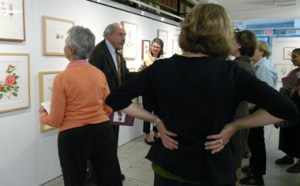
Juror Dick Rauh discusses the paintings at the exhibition.
All of the paintings were high quality and workmanship was precise. HSNY provided magnifying glasses, so we could see the details. I understand composition was an important factor for the judges. I felt I have to work on how I express the characteristic, volume and texture of the subjects.
I was able to talk with a couple artists. Ingrid Finnan from New York, uses oil paint on watercolor paper. She applies gesso on front and back of paper four times then use transparent oil paint. She uses this method to express the deep color of leaves.
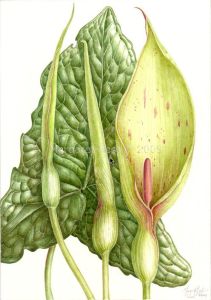
"Lords and Ladies", watercolor by Margaret Best, © 2009
Margaret Best had two paintings in the show, “Rocky Mountain Maple” and “Lords and Ladies”.
Milly Acharya won a couple of awards in this show. She painted Wisteria this time. The flowers of Wisteria are very fragile and short-lived. She said she painted directly on the watercolor paper for 18 hours non-stop.
I really enjoyed the exhibition. Artists shared their pain and pleasure that they went through during the course of painting their subjects.
List of Awards are as follows. You can also find them in the catalog: Best in Show / Lynne Railsback “Purple Fountain Grass”; ASBA Best Painting / Linda Petchnick “Orchid”; NY Central Award / Anne Mcelwain “Mayapple”; Tales Award / Karen Kluglein “Stock”
Ursus Award / Geoge Olson “Dock and Compass Plant”; Honorable mention / Deirdre Bean “Figs”, Mary A. O’Malley “Monterey Pine Cone”, Milly Acharya “Wisteria”
The ASBA and the Horticultural Society of New York sent out a press release about the show. To download and read it, click here: asba_2009_press_release.
By Sue Kuuskmae

Joan Keesey & Sue Kuuskmae with Hibiscus Kokio
The 11th Annual Botanical Art Exhibition opened at Filoli on June 23rd. Participating artists from BAGSC were Peggy Irvine, Joan Keesey, and Suzanne Kuuskmae. Joan Keesey showed her watercolor, Krantz aloe, and Suzanne Kuuskmae showed two watercolors, Lace Cap Hydrangea and Hibiscus kokio. Also hanging was Cyclamen persicum, a watercolor by former member Nancy Boyarsky. I drove up to Woodside to attend the reception and help at the sales table where I was happy to find Joan Keesey and her husband there as well. I was also happily surprised to see Margaret Best who was there enjoying the beautiful botanical art, and we all had a few moments to chat.
The art exhibition this year was held in the Visitor and Education Center rather than in the previous location, the ballroom of the main house. The paintings were hung in the main room as well as two side rooms that are adjacent. At the Artist Reception held on Thursday, July 16 from 5 – 7 p.m. refreshments were served, and the gardens were open for attendees to visit. It was quite a warm evening, so we were all very glad when all the doors of the Center were thrown open to catch the light breezes.
When my shipping box came back several weeks ago, I found that my Lace Cap Hydrangea had been sold, which I guess I should have been happy about, but for me it is always a bitter-sweet experience when I really loved the piece. Knowing me, I will be thinking seriously of painting something similar soon.
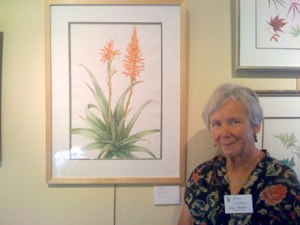
Joan Keesey with her watercolor, Krantz aloe
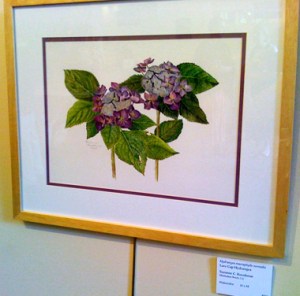
Sue Kuuskmae's watercolor, Lace Cap Hydrangea
By Sue Kuuskamae

Dinner at the Plantation. Wendy Hollender is in the middle.
Early on the morning of August 21 I returned from the island of Kauai where I participated in a two-week colored pencil class given by Wendy Hollender of the New York Botanical Garden. The class was held on the grounds of the National Tropical Botanical Gardens where the students numbering around 13 had the run of the McBryde and Allerton gardens to find interesting plants, trees, or flowers to draw and paint. Also we were lucky to have Dr. David Burney, NTBG Director of Conservation, assisting with various garden plant identification walks, botanical lectures, and a day-long visit to the Makauwahi Cave Reserve where restoration of native plants is in progress.
Thunbergia Sky Vine
Wendy likes to use Faber Castell Polychromos pencils because she can easily reach a rich saturation color without the troublesome buildup that one sometimes gets using waxy pencils. She, like many other colored pencil teachers, stresses that one must keep a very sharp point on one’s pencils. Her method includes careful measuring of the specimen, a light drawing in graphite, a complete under-tone using a sepia pencil always keeping in mind the upper left scientific light source, and using a range of tones from dark to light in overlap areas. She reminded us constantly to keep in mind tone first and color second.

Sue Kuuskmae with colored pencil painting.
The students in the class ranged from those with an extensive background in art to those with little or no experience. Most of the students were either docents at the gardens or interested island residents. Four of the class members were from the mainland. Most were most interested in developing a skill using colored pencils, which many had not used before. The class was not only informative but quite a lot of fun due to Wendy’s great skill as a teacher, her ever present sense of humor, and the rapport that developed among the students. Enrollment in the class was fairly flexible with some taking only the first week, some showing up for only the second week, and a few taking days here and there. I know that Wendy will be traveling out this way several times a year to teach at Filoli in Woodside, CA continuing on to NTBG for follow up classes at the gardens. I know she would love to include a stop here in Los Angeles so hopefully more of us will be able to enjoy learning her methods in the coming years.

Ruth Poulton and Sue Kuuskmae at National Tropical Gardens in Kauai.
August 1 – 3, 2008
Renaissance Hotel
Seattle, WA
By Suzanne Kuuskmae
The evening before classes began the Hospitality Room was a gathering spot for picking up art supplies donated by several vendors as well as an impromtu demonstration by Ester Roi of her Icarus Drawing Board which features two working zones: a warm zone and a cool zone. You can learn more about this technique at: www.icarusart.net or by calling Ester at (949) 481-4010.
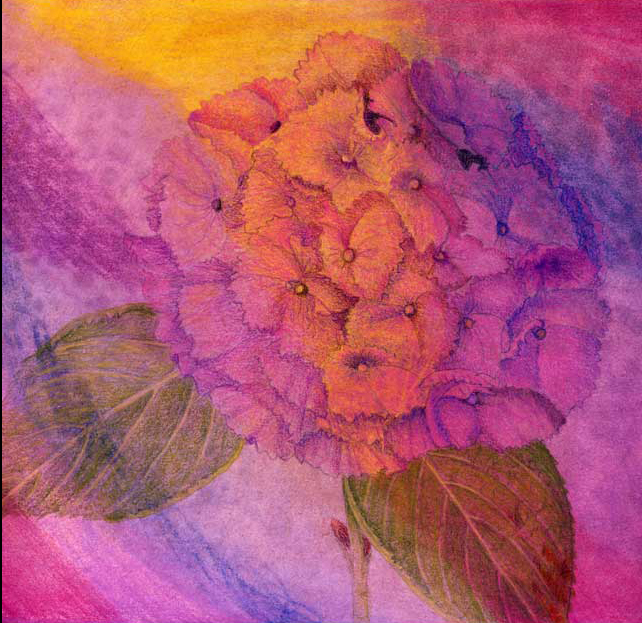
I had signed up for both classes and the first one was with Carlynne Hershberger entitled, “The Unconventional Portrait. We first created a colored background using colored pencils and mineral spirits. All of this was totally new to me because as a botanical artist, I am always working on a white background and the only portrait I am doing is an exact portrayal of plants and flowers. I did a portrait of my granddaughter complete with various symbols of activities that are very important to her at her age of 11. I finished it at home and am happy with the result. Also, I prepared several other sheets of paper with various colors in the background and am working on a huge hydrangea flower; quite a bit off track from my usual work but most rewarding.

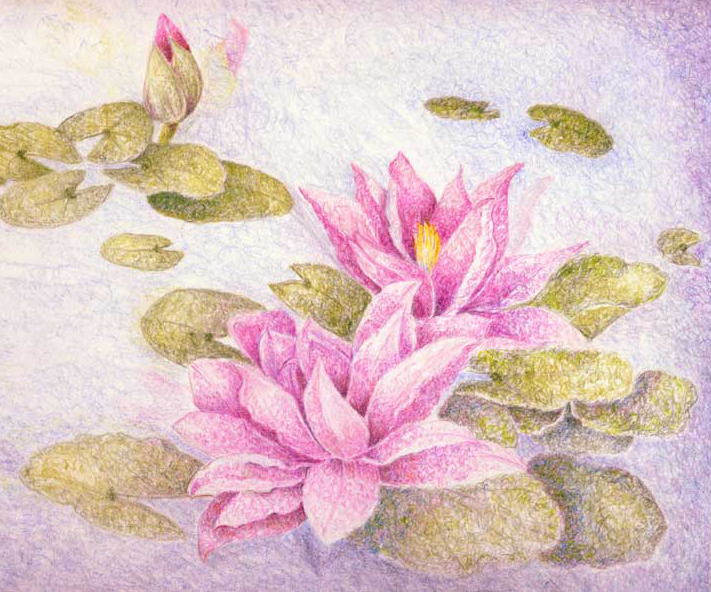
The second class was with John Smolko entitled, “The Scribble – Colored Pencils and the Expressive Line.” In this class we did a very large letter imposed on a circular background of scribbled colors going from light in the center to darker tones toward the outside. After laying down the various fields, then one mixes in the adjacent color to make for a smooth transition. In the afternoon we were free to use the scribble line technique on a painting of our choice. My painting was one of water lilies, which I am working on to finish at home. This is a technique I think would be helpful to work further with as it encourages the artist to add lots of colors, which allows for a most pleasing effect. I know that John has recently retired from teaching and would love to come to Los Angeles to give a week long class. Maybe that will be my project for 2009, planning a class with John Smolko.
The hotel was quite comfortable and the delicious luncheons supplied on the days of the classes was salads and sandwich fixings. The dining room, which was at the top of the hotel, gave us a fantastic view of the surrounding area while we enjoyed eating and talking with our fellow artists. Seattle certainly has quite a bit to offer, and my husband and I did a harbor tour, went to the top of the Space Needle, visited Pike Market, and had an interesting dinner down at Pioneer Square. I cannot report on the banquet because I was not able to attend due to a prior commitment with friends who live outside Seattle.
The art exhibition was spectacular where it was hung at the World Trade Center. The art work displayed showed a good cross section of subjects and did justice to the talented members of CPSA. The convention was a rewarding experience!
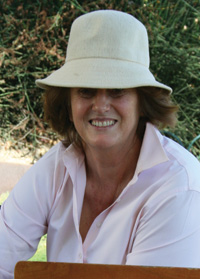
Jenny Phillips in the Getty Garden
This past June, July, and August, BAGSC participated in a variety of educational outreach programs held in conjunction with the Maria Sibylla Merian exhibit, titled “Maria Sibylla Merian & Daughters, Women of Art and Science” at the J. Paul Getty Museum, featuring activities that introduced the public to botanical art, entomology, botany, natural history, and Suriname.
Tania Norris was instrumental in bringing Jenny Phillips to the Getty to explore flower and insect drawings by Merian and her daughters in a Getty “Point of View” lecture. Jenny also demonstrated and lectured in an “Artist at Work” presentation, celebrating the beginning of summer with a one-day demonstration about the art and practice of botanical painting.
Tania provided the voice over for the GettyGuide Audio Tour of the exhibit, as well as the voice-over for the slide show on the web site at www.getty.edu.
Tania was also instrumental in connecting BAGSC with the Getty. BAGSC’s participation began in June when Deborah Shaw and Tania Marien introduced Getty Gallery Teachers to the techniques of botanical illustration and to plant morphology. They also taught a two-week course in June (repeated in July) to the public, designed to introduce participants to botanical illustration, and to provide an experience similar to what Merian must have experienced upon traveling to Suriname and observing unfamiliar plants. The Getty arranged for this class to be taught in conjunction with The Huntington Library, Art Collections, and Botanical Gardens. Jim Folsom, director of the botanical gardens at the Huntington Library, lead tours of the Huntington’s conservatory and greenhouses and introduced participants to how plants work.

Veronica at the BAGSC Family Festival table
BAGSC members participated in two Getty Family Festivals, where they conducted botanical art demonstrations in the Getty’s Central Garden and lead a host of children’s activities. Both festivals were well-attended. Children who visited the BAGSC area had the option of coloring engravings created by Merian, creating a natural history illustration with leaf rubbings, stamping fruits and vegetables with tempera paint to create their own “paintings”, and drawing plants and insects freehand. At other Family Festival venues, children of all ages could make a hat out of ti leaves, assemble floral brooches, create their own butterflies, create picture frames, stamp and mail postcards, and listen to the music of Suriname.
During the entire month of July, BAGSC members demonstrated botanical drawing and painting twice each week in the Getty’s Central Garden.
BAGSC member Kathy Dunham also taught classes at the Getty. Kathy led the Getty’s Drawing Hour and demonstrated how to create a nature journal during three early-evening classes in July and August.

Sally Markel with Deb in the Getty Garden
And, in a true “Small World” moment, Sally Markel ran into Deborah Shaw during one of the botanical art demonstrations. Sally happened to be out visiting friends in Southern California, and came across BAGSC members doing the Getty “Artist at Work” demonstrations. Sally generously donated her pineapple illustration for use on the ASBA Annual Meeting & Conference web site registration.
The exhibition is open at the Getty until the end of August. Information about the exhibition (and Tania’s voice over) can be found on the Getty web site. Once the exhibition is over, information can be found in the Getty web site archives. The exhibition catalog and other books about Maria Sibylla Merian can be found online in the Getty bookstore.
More photos will be published to the blog soon. Stay tuned!
By Margaret Best
I have painted medlars but never tasted one, however that is about to change.
 In September 2006 a small group of artists went to England to paint with renowned botanical artist, Pandora Sellars. I visited her at her charming country home just before the class to discuss final arrangements and to seek suitable subject matter for myself. To my considerable pleasure I discovered she had some very old English medlar trees bearing an abundant crop of fruit in her wonderful garden. I had seen these fruits for the first time when I was looking at William Hooker’s original paintings in the Lindley Library in London in 2004 and discovered them again in southern Spain at the end of 2005.
For those readers who have no idea what the unusual and ancient fruit of a Mespilus germanica looks like, I have attached a section of my painting that resulted from this class. This painting was exhibited at the recent 12th International Botanical Art Exhibition at the Hunt Institute for Botanical Documentation at Carnegie Mellon University in Pittsburgh and is now in the permanent collection.
I decided to reproduce this painting in a set of limited edition prints and when preparing an artist’s statement to accompany the print, I completed some quick research on the tree and fruit. I discovered that medlars are believed to have an ancient history of cultivation originating in Persia and introduced to the Greek and Roman civilizations in approximately 2 BC. The two known European varieties, the Nottingham (English) and Dutch are still grown today for their fruit that when fully ripe and crushed, is somewhat similar in texture to apple sauce. The first written record of this fruit was in 1270 made by a monk working in the garden of Westminster Abbey in London. A medlar is highly revered in France as it forms the basis of the famous and expensive preserve known as cotignac. Apparently it is wonderful when served with cheese and wine!
Shortly after Christmas, Lugene Bruno who is Assistant Curator of Art at Hunt Institute, contacted me to let me know that my painting was enjoyed by 2 ladies at the Pittsburgh chapter of the American Herb Society. These ladies gather the fruit each year from trees in a locally sponsored herb garden and make medlar jelly. Lugene is kindly sending me one of their precious jars of jelly so that finally I can experience the taste.
Deborah Shaw
Note: A longer version of this article with detailed instructions has also been posted as a permanent “page” as one of the links across the top of the blog. Please click on the “How to Blog” tab in the upper right.
It’s finally here. The BAGSC Blog now officially replaces our quarterly newsletter. The advantage of our blog is that it allows us to really be a community — our members can comment and discuss articles; contribute stories and reviews; and let other members know about “calls for entries”, galleries, openings, and learning opportunities.
A big thank you to Sasha McMullen for contributing the funds to secure our blog URL address; to Margaret Best for allowing us to use part of a new painting (that hasn’t even been exhibited yet) for the first header; and to Clara Josephs, Arillyn Moran-Lawrence, and Suzanne Kuuskmae for contributing our first articles. An additional thank you goes to all of you for your patience in the time it’s taken for me (Deborah Shaw) to get this out.
How to read the blog:
We already have quite a bit of content posted. Only ten articles show up in the main window at a time. After that, the information is automatically archived by date and by the categories on the left side. Click on each category name to see all of the articles in that category. You can also search by any keywords you remember. The articles will always be in the archives; you’ll be able to go back and find previous information. Please explore the categories to make sure you don’t miss anything. If you click on the images, they’ll open in a new window at a larger size. (They may take a little while if you have a slower connection.)
In the “How to Blog” tab in the upper right corner, you’ll find instructions on how to:
- Keep in touch
- Please comment
- Become a blogger yourself
- Another way to contribute
- Put your artwork in the header
To our members who aren’t connected to cyberspace:
No worries. We’ll periodically print out the blog and mail it to you.
Happy blogging to all!
This is the process I used for getting involved in the ASBA”Paradise Lost” project that will be due in 2008. It is not mandatory to participate but I found it a fascinating adventure into Hawaiian endangered species.
Arillyn Moran-Lawrence
 The project began by contacting the Ho’omaluhia Botanical Gardens on the windward side of Oahu, near Kaneohe. I had visited that garden the year before and thought they could help me with my project. Ho’omaluhia did not have any endangered species so they referred me to a botanist at the Foster Gardens. I contacted that botanist and discussed the ASBA project with her. She assisted me by informing me about Koko Crater and Lili’uokalani Botanical Gardens. She also provided me with the name of a botanist at Lyon Arboretum, whom I contacted regarding meeting me to introduce me to endangered species in that arboretum. I previously had visited the Waimea Valley Audubon Arboretum, on the North Shore, so called the office and they put me in contact with a very helpful botanist. We kept in touch via email.
My husband and I made plans for the trip to Hawaii in late March/April when the plants would hopefully be flowering. I emailed the botanists regarding my arrival date and worked out a schedule so that I could cover the 4 different botanical areas on the island of Oahu during my week long visit. I would be covering the rain forests, the dry land area and the city environment.
I began an in-depth study of the Hawaiian Endangered Plant Species on the internet. I read about the plants in many books but especially used the book Remains of a Rainbow. I also began sketching plants of interest. I tried to be well informed about the plants that I wanted to see. I found that the task of focusing on a small number of plants overwhelming as Hawaii has more endangered plants than any other state and more and more became of interest.
Most of the arboretums and gardens did not have lists of endangered species that they had in their collection. However, with the help of my books I was able to find species listed in the various gardens and on which islands they were located. This process was most critical as I only had 7 days to study, photograph, sketch and paint the plants.
I carried with me in a backpack, a small ultralight umbrella, insect spray, a W&N traveling watercolor set, water, one very versatile Aquabee 808 sketch book and colored pencils. I had a digital camera in a carrying case around my waist and my helpful husband by my side. I had a small 11″ x 13″ expandable plastic portfolio with cut hot press paper, a note pad, a light plastic ruler and pencils and pens. As a plein air painter of 15 years I thought I was traveling light, organized and well prepared but I wasn’t. The umbrella was very useful as rain is always available. However, sitting perched on a slope, on an uncomfortable volcanic rock, juggling an umbrella, a sketchbook and cameras was not an easy task. Adding rain to the mix really made life difficult. A small portable chair was not an option as the terrain would not have been secure. Not all sites were difficult but some were a challenge in that you had to deal with long walks and carrying a lot of gear would have been a struggle. In most cases you could not have used a wheeled case. I also found the most interesting species at the top of a long uphill walk. The camera became my best friend as did the colored pencils and sketchbook. My husband helped me with noting measurements. Having two people doing this job is perfect especially when your feet are on uneven ground and you are wrapped around rocks and trees and can’t manage writing anything. I also suggest that someone is with you at all times if you are in a remote area. I was so fascinated with a healthy specimen on a lose hillside that I fell down the hill when I turned to leave. The earth was soft and no damage was done but it is best not to investigate some areas alone.
The botanist at the Waimea Audubon Arboretum, showed me around this beautiful and fascinating garden and introduced me to many endangered species in their collection. We traveled in a golf cart but hiked over difficult terrain to remote species. Everything moved along very quickly. I did not have time to make notes so I photographed the plant ID tags. That way I would remember the plants and where they were located. Some were in very difficult locations and you had to climb and watch your feet for fear of stepping on some endangered plants. The botanist spent about 2 hours with me. He helped me over difficult terrain, to photograph plants and kept me from falling down slopes, as well as educating me. I was most impressed with him and his tour. After lunch I returned to study and photograph specific plants of interest, to measure, to sketch and observe.
 I met with the botanist at the Lyon Arboretum, in the Manoa Valley, the next day. The Lyon is a gorgeous rain forest arboretum and is stunningly beautiful and interesting. This garden contains a Hawaiian section, an economic section, a fern valley, gingers and palms and a host of other treasures. I was fascinated by one lone endangered Pritchcardia remota Palm that stood in a marvelous setting. We spent about 2 hours covering an area of mainly native and endangered species. I was also shown the greenhouse and saw some endangered plants of interest and was allowed to photograph them. I was very appreciative of the time that they gave to me as well as the education that I received. Leaving the botanist my husband and I walked up into the valley to the Hawaiian section and I found a Hibiscus clayii. What a thrilling find! After photographing and measuring and sketching this treasure we returned to our hotel where I made notes on the day’s plants and worked on sketches.
Two days later we visited the Koko Crater Botanical Garden. We were on our own in this garden. There was a map to guide you to the Hawaiian Section which was at the highest point in the crater, of course. It was hot and dry in this garden so you needed to be prepared with water and a cell phone as it was not well populated. Because it was virtually empty I would suggest that you not go alone. The Hawaiian section was worth the long walk as I found some very healthy endangered plants and some wonderful endangered palm trees. I was able to photograph, make notes and take measurements. Painting was not an option because I knew that the long up and down walk would be tiring and carrying the gear would be draining. There were some benches in the area and a picnic would have been fun but that was knowledge after the fact. A very nice garden.
Lil’uokalani Botanical Garden is set Honolulu. It is a small but charming botanical garden. The botanist at Foster Gardens helped me by providing me with a map of the species in this garden. I was on my own with the help of my husband who carried things for me and helped me with measurements. I found endangered Hibiscus, Abutilon and Gardenia. I photographed, sketched and measured the focus of my interest.
I returned to all of the gardens for a second visit during the remaining days and I continued to study, sketch and photograph. My only regret is that I did not have a notebook computer with me. It would have been very helpful to have one in the car and at the hotel at the end of the day.
I gave thank you gifts to the botanists who personally helped me and spent so much valuable time educating me.

 BAGSC News