You are currently browsing the category archive for the ‘Member News’ category.
By Sue Kuuskmae

Joan Keesey & Sue Kuuskmae with Hibiscus Kokio
The 11th Annual Botanical Art Exhibition opened at Filoli on June 23rd. Participating artists from BAGSC were Peggy Irvine, Joan Keesey, and Suzanne Kuuskmae. Joan Keesey showed her watercolor, Krantz aloe, and Suzanne Kuuskmae showed two watercolors, Lace Cap Hydrangea and Hibiscus kokio. Also hanging was Cyclamen persicum, a watercolor by former member Nancy Boyarsky. I drove up to Woodside to attend the reception and help at the sales table where I was happy to find Joan Keesey and her husband there as well. I was also happily surprised to see Margaret Best who was there enjoying the beautiful botanical art, and we all had a few moments to chat.
The art exhibition this year was held in the Visitor and Education Center rather than in the previous location, the ballroom of the main house. The paintings were hung in the main room as well as two side rooms that are adjacent. At the Artist Reception held on Thursday, July 16 from 5 – 7 p.m. refreshments were served, and the gardens were open for attendees to visit. It was quite a warm evening, so we were all very glad when all the doors of the Center were thrown open to catch the light breezes.
When my shipping box came back several weeks ago, I found that my Lace Cap Hydrangea had been sold, which I guess I should have been happy about, but for me it is always a bitter-sweet experience when I really loved the piece. Knowing me, I will be thinking seriously of painting something similar soon.
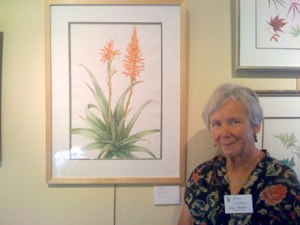
Joan Keesey with her watercolor, Krantz aloe
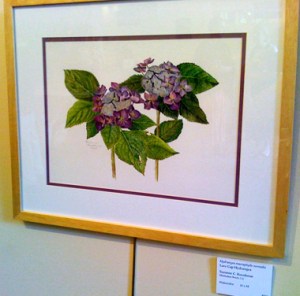
Sue Kuuskmae's watercolor, Lace Cap Hydrangea
By Sue Kuuskamae

Dinner at the Plantation. Wendy Hollender is in the middle.
Early on the morning of August 21 I returned from the island of Kauai where I participated in a two-week colored pencil class given by Wendy Hollender of the New York Botanical Garden. The class was held on the grounds of the National Tropical Botanical Gardens where the students numbering around 13 had the run of the McBryde and Allerton gardens to find interesting plants, trees, or flowers to draw and paint. Also we were lucky to have Dr. David Burney, NTBG Director of Conservation, assisting with various garden plant identification walks, botanical lectures, and a day-long visit to the Makauwahi Cave Reserve where restoration of native plants is in progress.
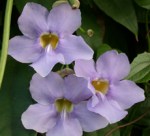
Thunbergia Sky Vine
Wendy likes to use Faber Castell Polychromos pencils because she can easily reach a rich saturation color without the troublesome buildup that one sometimes gets using waxy pencils. She, like many other colored pencil teachers, stresses that one must keep a very sharp point on one’s pencils. Her method includes careful measuring of the specimen, a light drawing in graphite, a complete under-tone using a sepia pencil always keeping in mind the upper left scientific light source, and using a range of tones from dark to light in overlap areas. She reminded us constantly to keep in mind tone first and color second.

Sue Kuuskmae with colored pencil painting.
The students in the class ranged from those with an extensive background in art to those with little or no experience. Most of the students were either docents at the gardens or interested island residents. Four of the class members were from the mainland. Most were most interested in developing a skill using colored pencils, which many had not used before. The class was not only informative but quite a lot of fun due to Wendy’s great skill as a teacher, her ever present sense of humor, and the rapport that developed among the students. Enrollment in the class was fairly flexible with some taking only the first week, some showing up for only the second week, and a few taking days here and there. I know that Wendy will be traveling out this way several times a year to teach at Filoli in Woodside, CA continuing on to NTBG for follow up classes at the gardens. I know she would love to include a stop here in Los Angeles so hopefully more of us will be able to enjoy learning her methods in the coming years.

Ruth Poulton and Sue Kuuskmae at National Tropical Gardens in Kauai.
Compiled by Sue Kuuskmae
Julie Schneider Ljubenkov to start native plant nursery on Rincon Reservation
Julie Schneider Ljubenkov of Pauma Valley (San Diego area) was invited by the
Rincon Indian Tribe’s Environmental Department to start up a native plant nursery on the Reservation. Two acres will be developed to open on Earth Day next Spring.
Sally might have a new address
Sally Jacobs is thinking of moving to Culver City, which will take a bit of planning, so she is not able to spend as much time painting as she usually does.
Arillyn Moran-Lawrence exhibiting at the National Arts Club, New York
Arillyn Moran-Lawrence’s painting of the endangered Hawaiian Hibiscus clayi will be shown in an exhibition of the Catharine Lorillard Wolfe Art Club at the National Arts Club New York City, NY. The National Arts Club is located at 15 Gramercy Park South. The 113th Annual Exhibition runs from October 1-23, 2009. Call the National Arts Club at 212-475-3424 for additional information. Catalog available.
Bonnie Born Ash is exhibiting botanical paintings in watercolor and landscapes in oil at the Thos. Moser Gallery in the Helms building in Culver City. The botanicals were exhibited through April 30th, but her landscape paintings will be up through August.
The Thos. Moser Gallery is located in the historic Helms Bakery Building in Culver City, just west of downtown Los Angeles. The gallery is open Monday – Saturday, 10am – 6pm and Sunday, 11am – 5pm and is located at: 8705 Washington Boulevard (Helms Bakery Building), Culver City, CA 90232, Los Angeles, CA, Phone: 866-708-9816.
Be sure to see Bonnie’s work. Congratulations Bonnie!
by Sue Kuuskmae
If anyone is contemplating a trip to Turkey, and would like to see our write up and pictures, they can take a look at our group web site. The address is: www.walkersandtalkers.com
This trip was done through Grand Circle Overseas Adventure Travel, and we had a great time. If any of you take a trip on Grand Circle, you should give them my name when you sign up; and you will get a reduction in price on your trip.
by Sue Kuuskmae
There will be an art show/sale at Villa del Sol d’Oro in Sierra Madre on Saturday, November 29, 2008, from 12:00 to 6:00. This beautiful Italian-style estate located at 200 N. Michillinda Avenue is rarely open to the public, so come on out to see both the art work and the house. This charity art show is sponsored by ARA Project and will benefit impoverished children in Armenia.
BAGSC members Cristina Baltayian and Suzanne Kuuskmae will be among the exhibitors.
I attended the ASBA Juror training session at the conference in Pasadena and wanted to share the information I obtained with the members of BAGSC. This article presents an overview of the main points presented in the training session.
The Jurors
Artwork submitted for ASBA exhibits is juried by juror teams. The teams are chosen by the exhibition organizer in consultation with personnel at the venue and other members of the Exhibitions Committee. The jurors for each team are chosen based on their stature in their respective fields, so that their decisions engender respect. The ASBA recommends a team of three jurors, including one botanical artist (chosen for their fluency in the art and science of botanical art), one plant scientist or horticulturalist (chosen for their ability to judge the botanical accuracy of a variety of plants), and one person involved in the arts, either as a curator, gallery owner, or arts academic (chosen to bring a dispassionate voice to the judgment of the artistic merit of each piece). When choosing the team consideration is given to how they will work together and the exhibition criteria laid out in the call for entries.
The Process
Prior to meeting, each juror familiarizes themselves with the focus of the exhibition, the size of the space at the venue, artwork size requirements, maximum number of works allowed, etc. as set forth in the call for entries.
Ideally the jurors meet at the venue, which allows the jurors to see the space prior to jurying the exhibition. The ASBA strongly encourages that the jury team meet together so decisions regarding final cuts can be discussed. Usually the exhibition organizer or Exhibition Coordinator receives the digital entries, assembles and records them, and provides them to the jury team ready to view on their computers. At present, the ASBA only accepts digital file entries, which increases the ease in handling, preparation, viewing and examination of the artworks. The Exhibition Organizer’s list includes the artists’ names, artwork titles, sizes, and media for each artwork. The digital images of the artwork provided to the jury team are numbered and artist’s names are removed from the jurors’ digital copies of the artwork. The Exhibition Organizer also makes a preliminary cut of artworks not conforming to show criteria (for example, works that are too large or too small, or the subject matter or media are excluded from the criteria for the exhibit). Works that are clearly outside the show criteria are removed before presentation of the entries to the jurors.
The jurors preview all the entries without scoring them in order to get a sense of all submissions. The jurors then individually evaluate and score each of the entries.
Each juror in the jury team is provided with a tally form that includes the artwork number, title, size, medium and a space for their point score and comments. The jurors assign a score between 1 and 5 for each of the artworks. The scores of each of the jurors are then added together and the artworks for the exhibit are chosen from the highest scorers to fill the spaces available for the exhibit. If there are ties that result in more artworks than spaces available, the venue may be consulted to determine whether additional works can be included. If additional space is not available, the jurors reconsider the tied works and eliminate works until the required number of artworks is achieved. At this stage, jurors may also consider subject matter or overall appearance of the show.
Once all the original artwork that won a place in the exhibition has been received on-site, an additional jurying takes place to verify that the quality of the original is equivalent to the standard seen in the submission, and that presentation requirements are met. If artworks are received that do not conform to presentation requirements (for example the frame is unacceptable), the artist can choose to remove the work from the exhibition, or allow the ASBA to bring the artwork into conformance with their requirements (i.e. reframe), at the artist’s expense. (See “The Botanical Artist” Vol. 13 Issue 4, December 2007, Page 18 for a detailed discussion of the ASBA framing requirements)
The Criteria
All artwork in ASBA exhibitions must be executed by hand in traditional media. Photographic or computer-generated artwork is not accepted. All artwork submitted for ASBA exhibitions is judged on three major criteria. These are:
Scientific Accuracy. Are all the visible plant’s parts shown clearly and accurately? Are all aspects of the plant shown in correct proportion to one another and in correct perspective? Is the artwork structurally correct?
Aesthetic quality. Is the artwork’s composition aesthetically pleasing? Is the three-dimensionality of the plant believably conveyed? If in color, are the colors accurate and lifelike? Do all the elements of the artwork conform to the same high standard?
Artistic proficiency. Has the artist demonstrated a superior control of and comfort with their medium? Has the whole of the work been executed a high standard of practical application of techniques? If in paint, has the artist shown expertise in handling the paint or is the paint blotchy? If in ink, are there blotches or is there shakiness in the lines? Are the techniques well mastered? If in pencil, is there adequate contrast between light and dark, and is refinement shown? If lettering is included, is it proficiently done? When judging artwork, the quality of the artwork is the overriding consideration for selection.
As a special note it was pointed out that many works are rejected as a result of lettering on the artwork that is of poor quality, detracts from the artwork, is cramped to make fit in the space available etc. It is strongly suggested that if in doubt about adding letter to your artwork, it is better to leave it out! This can also include signing the work.
Janice Sharp
August 1 – 3, 2008
Renaissance Hotel
Seattle, WA
By Suzanne Kuuskmae
The evening before classes began the Hospitality Room was a gathering spot for picking up art supplies donated by several vendors as well as an impromtu demonstration by Ester Roi of her Icarus Drawing Board which features two working zones: a warm zone and a cool zone. You can learn more about this technique at: www.icarusart.net or by calling Ester at (949) 481-4010.
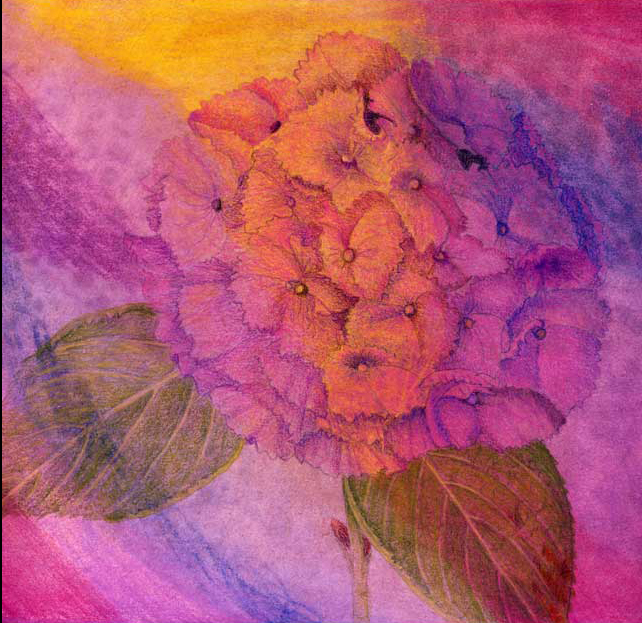
I had signed up for both classes and the first one was with Carlynne Hershberger entitled, “The Unconventional Portrait. We first created a colored background using colored pencils and mineral spirits. All of this was totally new to me because as a botanical artist, I am always working on a white background and the only portrait I am doing is an exact portrayal of plants and flowers. I did a portrait of my granddaughter complete with various symbols of activities that are very important to her at her age of 11. I finished it at home and am happy with the result. Also, I prepared several other sheets of paper with various colors in the background and am working on a huge hydrangea flower; quite a bit off track from my usual work but most rewarding.

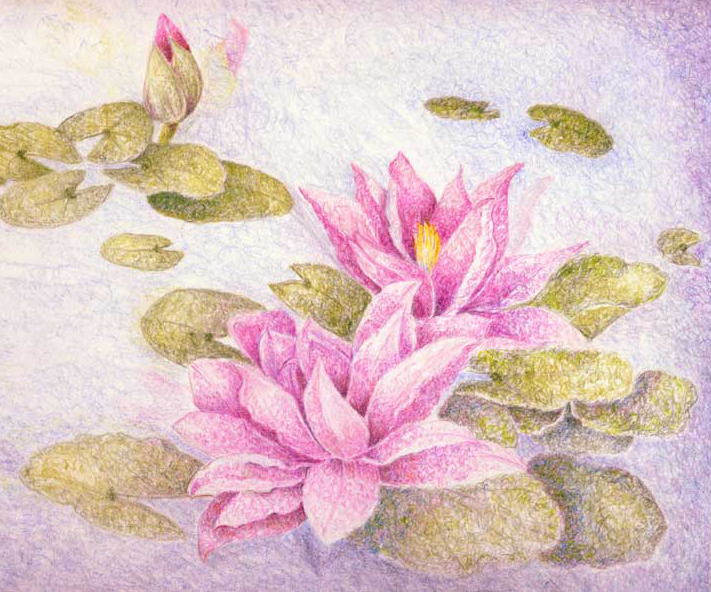
The second class was with John Smolko entitled, “The Scribble – Colored Pencils and the Expressive Line.” In this class we did a very large letter imposed on a circular background of scribbled colors going from light in the center to darker tones toward the outside. After laying down the various fields, then one mixes in the adjacent color to make for a smooth transition. In the afternoon we were free to use the scribble line technique on a painting of our choice. My painting was one of water lilies, which I am working on to finish at home. This is a technique I think would be helpful to work further with as it encourages the artist to add lots of colors, which allows for a most pleasing effect. I know that John has recently retired from teaching and would love to come to Los Angeles to give a week long class. Maybe that will be my project for 2009, planning a class with John Smolko.
The hotel was quite comfortable and the delicious luncheons supplied on the days of the classes was salads and sandwich fixings. The dining room, which was at the top of the hotel, gave us a fantastic view of the surrounding area while we enjoyed eating and talking with our fellow artists. Seattle certainly has quite a bit to offer, and my husband and I did a harbor tour, went to the top of the Space Needle, visited Pike Market, and had an interesting dinner down at Pioneer Square. I cannot report on the banquet because I was not able to attend due to a prior commitment with friends who live outside Seattle.
The art exhibition was spectacular where it was hung at the World Trade Center. The art work displayed showed a good cross section of subjects and did justice to the talented members of CPSA. The convention was a rewarding experience!
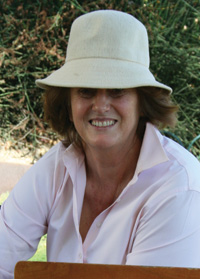
Jenny Phillips in the Getty Garden
This past June, July, and August, BAGSC participated in a variety of educational outreach programs held in conjunction with the Maria Sibylla Merian exhibit, titled “Maria Sibylla Merian & Daughters, Women of Art and Science” at the J. Paul Getty Museum, featuring activities that introduced the public to botanical art, entomology, botany, natural history, and Suriname.
Tania Norris was instrumental in bringing Jenny Phillips to the Getty to explore flower and insect drawings by Merian and her daughters in a Getty “Point of View” lecture. Jenny also demonstrated and lectured in an “Artist at Work” presentation, celebrating the beginning of summer with a one-day demonstration about the art and practice of botanical painting.
Tania provided the voice over for the GettyGuide Audio Tour of the exhibit, as well as the voice-over for the slide show on the web site at www.getty.edu.
Tania was also instrumental in connecting BAGSC with the Getty. BAGSC’s participation began in June when Deborah Shaw and Tania Marien introduced Getty Gallery Teachers to the techniques of botanical illustration and to plant morphology. They also taught a two-week course in June (repeated in July) to the public, designed to introduce participants to botanical illustration, and to provide an experience similar to what Merian must have experienced upon traveling to Suriname and observing unfamiliar plants. The Getty arranged for this class to be taught in conjunction with The Huntington Library, Art Collections, and Botanical Gardens. Jim Folsom, director of the botanical gardens at the Huntington Library, lead tours of the Huntington’s conservatory and greenhouses and introduced participants to how plants work.

Veronica at the BAGSC Family Festival table
BAGSC members participated in two Getty Family Festivals, where they conducted botanical art demonstrations in the Getty’s Central Garden and lead a host of children’s activities. Both festivals were well-attended. Children who visited the BAGSC area had the option of coloring engravings created by Merian, creating a natural history illustration with leaf rubbings, stamping fruits and vegetables with tempera paint to create their own “paintings”, and drawing plants and insects freehand. At other Family Festival venues, children of all ages could make a hat out of ti leaves, assemble floral brooches, create their own butterflies, create picture frames, stamp and mail postcards, and listen to the music of Suriname.
During the entire month of July, BAGSC members demonstrated botanical drawing and painting twice each week in the Getty’s Central Garden.
BAGSC member Kathy Dunham also taught classes at the Getty. Kathy led the Getty’s Drawing Hour and demonstrated how to create a nature journal during three early-evening classes in July and August.

Sally Markel with Deb in the Getty Garden
And, in a true “Small World” moment, Sally Markel ran into Deborah Shaw during one of the botanical art demonstrations. Sally happened to be out visiting friends in Southern California, and came across BAGSC members doing the Getty “Artist at Work” demonstrations. Sally generously donated her pineapple illustration for use on the ASBA Annual Meeting & Conference web site registration.
The exhibition is open at the Getty until the end of August. Information about the exhibition (and Tania’s voice over) can be found on the Getty web site. Once the exhibition is over, information can be found in the Getty web site archives. The exhibition catalog and other books about Maria Sibylla Merian can be found online in the Getty bookstore.
More photos will be published to the blog soon. Stay tuned!
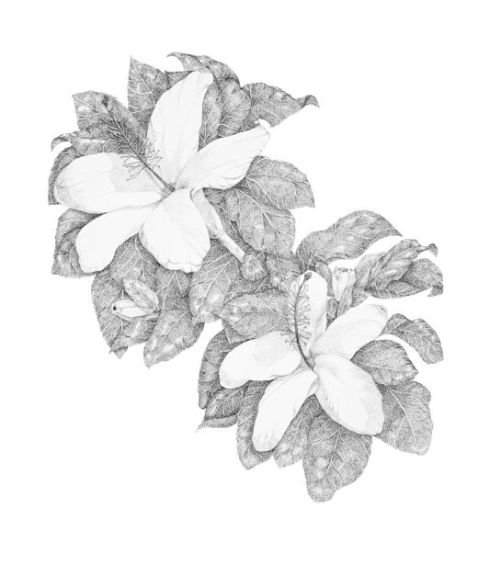 Arillyn Moran-Lawrence’s Hibiscus arnottianus, an endangered Hawaiian Hibiscus, will be in the Wildling Museum’s juried exhibition and competition. Titled “Endangered Species: Flora and Fauna in Peril” will open June 22, 2008 at the Los Olivos site. The show will remain at the Wildling Museum until September 14th. Then the painting, drawings and sculpture will be sent to the Department of the Interior, Washington,DC.
Their exhibition will open November 1, 2008 and close on February 28, 2009. The tour continues on to Denver and the Wildlife Experience Museum. That exhibition opens May 9, and closes July 12, 2009.
Prizes will be announced at the Wildling Museum on June 22, 2008. First Prize is $10,000, Second Prize is $5,000 and Third Prize is $2000.


Gilly Shaeffer has a show entitled “Contemporary Botanical Watercolors” at the Carriage House Gallery (next to the Boddy House) at the Descanso Gardens from April 4 to May 1, 2008. The Gallery is open from 10:00 a.m. to 3:30 p.m. daily.
Descanso Gardens is located at 1418 Descanso Drive, La Canada, California 91011. The Gallery telephone is 818.949.0125.
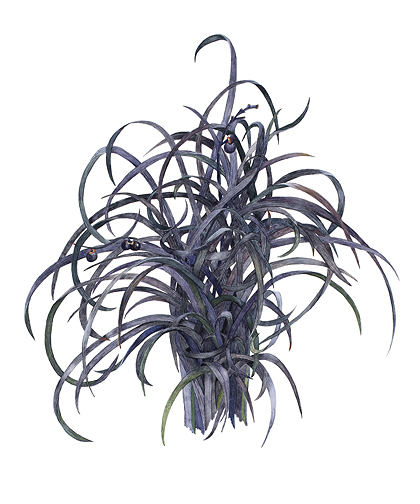
“Seductive Strands”, Watercolor , Ophiopogon planiscapus, Black Mondo Grass
Arillyn Moran-Lawrence’s painting “Seductive Strands” is in the Catharine Lorillard Wolfe Art Club, Members’ Exhibition in the Broome Street Gallery, New York City. “Seductive Strands” is a watercolor botanical painting of Ophiopogon planiscapus, commonly known as Black Mondo Grass. The painting received a second place award in watercolor. This is a Members’ Exhibition that covers all genres, and not a botanical show. The show runs from March 24th to April 13, 2008. The Broome Street Gallery is located at 498 Broome Street, New York City, New York.
Sally Jacobs, posted by DB Shaw
Sally Jacobs, a member of BAGSC for many years and a former officer, is having a show of her new work at the TAG Gallery, February 27-March 22, 2008. The opening reception is Saturday, March 8, 5-8 pm. The address of TAG is 2903 Santa Monica Blvd (at Yale), in Santa Monica. 310-829-9556. She’d love to see you there.
She’ll also be giving an “Artist’s Talk” on March 19 at 7pm. The normal gallery hours are Wed-Sat, 11 am – 5 pm. Questions? Email Sally.

Here’s Kathy Dunham applying some last minute touches to her painting of Matilija Poppies. Her painting was selected as the poster image for the Southwest Arts Festival held in January at the Polo Grounds in Indio, California. The festival is a show place for 260 artists from around the country. This was one of the few watercolors ever selected and fewer yet botanical pieces used for the poster.
 BAGSC News