You are currently browsing the monthly archive for August 2016.
by Deb Shaw
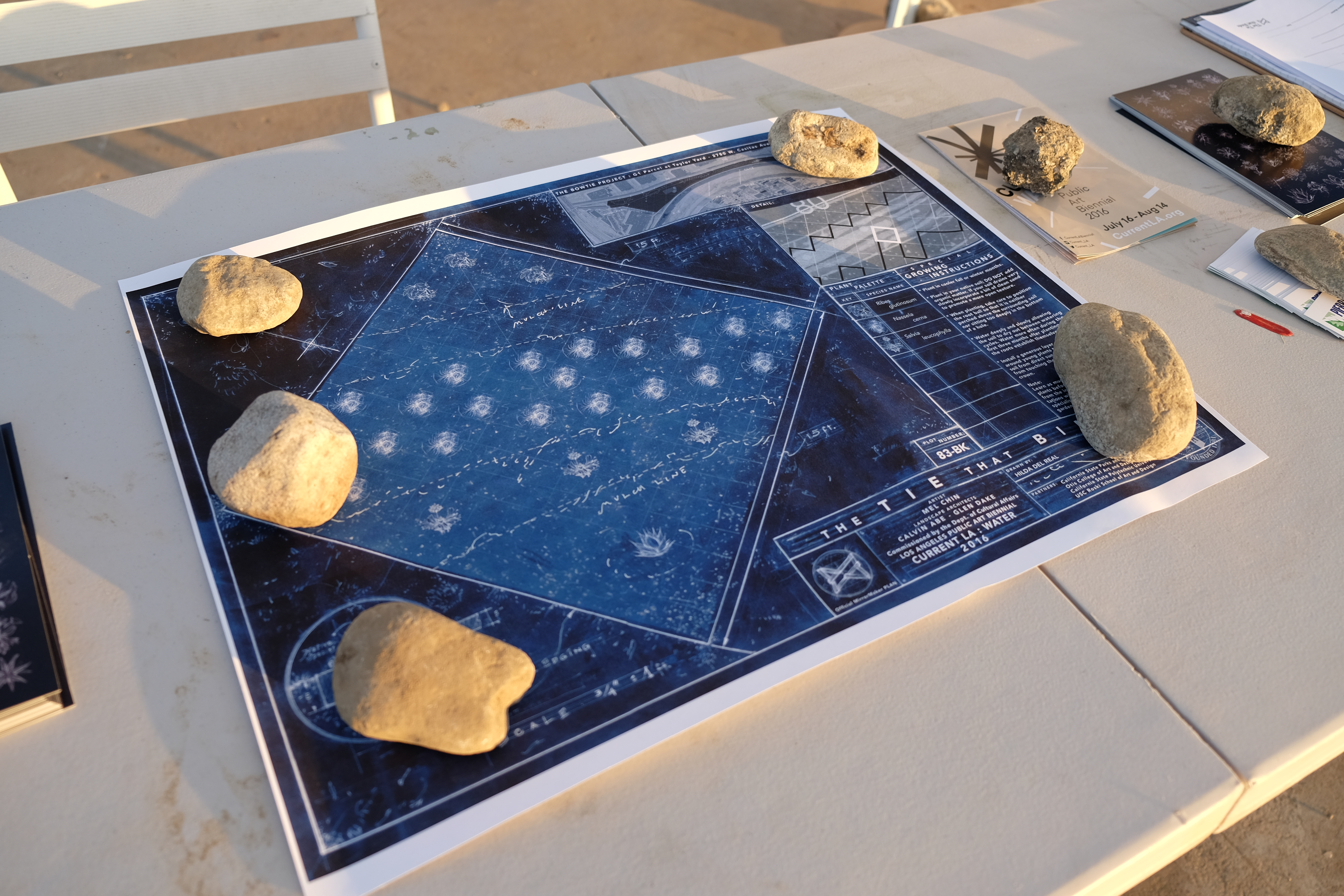
One of 512 Unique Blueprints created by the artist and team to distribute at the Field Office.
Artist Mel Chin has a new Land Art project in Los Angeles, entitled The Tie that Binds. Created for Los Angeles’ CURRENT:LA Water Public Art Biennial, the project invites visitors to connect to the site of the Bowtie Project, to understand water conservation in Southern California and to join hundreds of other LA residents in owning a work of Land Art we can grow in our own yards.
The Bowtie Project envisions a transformation of a stretch of the LA River. Once a railroad yard, this rare, 18-acre part of the River was left completely in its natural state, never transformed by engineers or concrete. Currently overgrown with invasive species, the site is still home to some native plant species, fish and birds.

TTB plot 111-CF, Bowtie demonstration garden and South LA mirror installation.
The Bowtie Project is part of a plan to restore this area of the LA River as an natural, urban state park. The Tie that Binds imagines the future Bowtie Project and the entire city sustained with water-saving, California-native landscapes. Compelled by the beauty of the site and belief that this is a place that should be owned by everyone, The Tie that Binds invites the public to “mirror” this future landscape in hundreds of individual lawns throughout Southern California.
To introduce the project, eight, small Land Art gardens are planted at the Bowtie site to serve as “models”. A field office on site is staffed by “MirrorMakers/Espejeros” and is open Thursday–Sunday evenings through August 14. Private and public locations in diverse neighborhoods of Southern California have already planted exact replicas or “mirrors” of one of the Bowtie Project garden demonstrations.
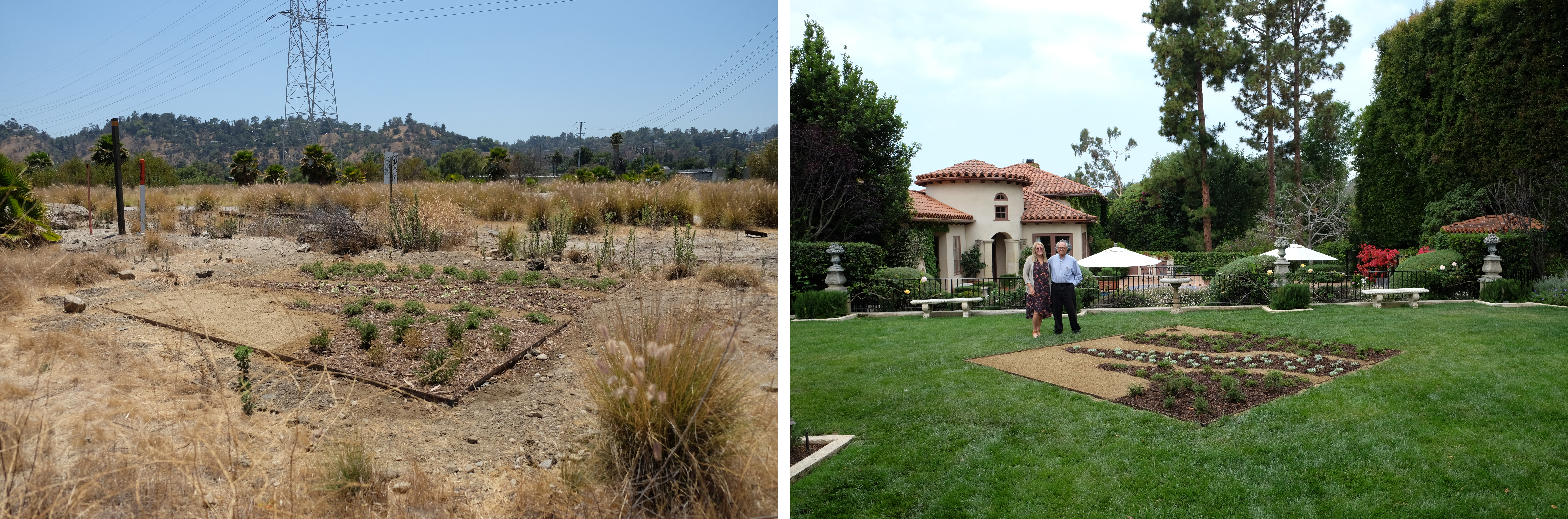
TTB plot 184-DJ, Bowtie demonstration garden and Brentwood mirror installation.
Mel Chin invites Southern California to help realize this Land Art work. Those who commit to growing a The Tie that Binds mirror garden receive a free, unique, artist-designed blueprint, a list of native plant species, and instructions on how to grow a garden that requires little or no watering. These gardens will fulfill the potential of a living sculpture that is collectively owned by the public.
Carolina Miranda wrote a wonderful article for the LA Times about the site, titled “Why Mel Chin is giving away the land art design of his subversively charming CURRENT:LA native garden.” You can see additional photos of the installation, as well as photos of the installation with Miranda’s trusty research assistant, Bonnie, the American Staffordshire Terrier.

MirrorMakers Yrneh and Margo with Roger, a new Tie that Binds blueprint holder (Photo credit: Amanda Wiles, © 2016).
Visiting The Tie that Binds
The Bowtie Project is an 18-acre post-industrial site owned by California State Parks and is located at 2780 Casitas Ave, Los Angeles, CA, 90039. Please enter through the yellow gate and follow directions for parking. The nearly 3/4 mile site is accessed by walking; accommodations will be made for any who need assistance.
The Tie that Binds field office at the Bowtie Project is open 5:30 pm until sunset, Thursday – Sunday through August 14, 2016. Mirror Makers/Espejeros are onsite to talk with visitors about the project.
About the Artist
Mel Chin is from Houston, Texas and is known for the broad range of approaches in his art, including works that require multi-disciplinary, collaborative teamwork and works that conjoin cross-cultural aesthetics with complex ideas. He developed Revival Field (1989-ongoing), a project that pioneered the field of “green remediation,” the use of plants to remove toxic, heavy metals from the soil. A current project, Fundred Dollar Bill/Operation Paydirt, focuses on national awareness and prevention of childhood lead-poisoning through art-making. Mel is also well known for his iconic sculptures and installations, works that often address the importance of memory and collective identity, and for inserting art into unlikely places, including destroyed homes, toxic landfills, and even popular television, investigating how art can provoke greater social awareness and responsibility.

Mirror Garden Host Blueprint Holders from Long Beach (Photo credit: Amanda Wiles, © 2016.)
The Tie that Binds: The Mirror of the Future is produced by Mel Chin in partnership with California State Parks, The Bowtie Project, and Clockshop. It is is commissioned by Department of Cultural Affairs for Current: LA Water Public Art Biennial 2016, and is made possible by the support of the Department of Cultural Affairs, The City of Los Angeles, Bloomberg Philanthropies, and the Ralph M. Parsons Foundation.
by Patricia Mark, posted by Deb Shaw
 The Rancho Santa Ana Botanic Gardens (RSABG) is opening an exhibition entitled On Location: California Native Plants in the Movies. The opening reception will be held on Friday August 19 from 5 pm to 7 pm, at Johnson’s Oval at RSABG. Remarks will be made at 5:30 pm and light refreshments will be served.
 Learn how native plants have shaped movie culture—from Vertigo to Star Wars—in this fun exhibition where botany meets the box office. Discover film stills, posters and other memorabilia from movie culture that spotlight a cast of native floral characters.
RSVP requested by Wednesday, August 17 to development@rsabg.org.
RSABG members are free
Guests of RSABG members: $20 per person
Please contact the Development Office to pay for your guests, via email, or by calling (909) 625-8767, ext. 258.
The Rancho Santa Ana Botanic Gardens are located at: 1500 N. College Ave, Claremont, CA 91711.
Note: if you are interested in sponsoring this exhibition, sponsorships are still available. Contact RSABG via email for more information.
by Deb Shaw
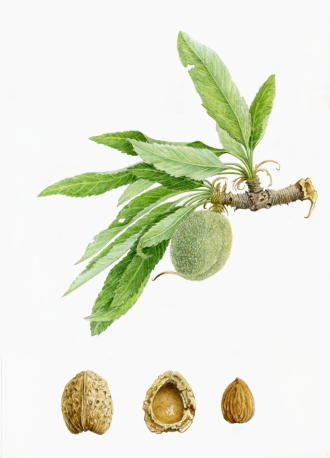
Prunus dulcis, Almond, watercolor by Margaret Best, © 2016, all rights reserved.
BAGSC members Margaret Best, Akiko Enokido, Asuka Hishiki, Mitsuko Schultz, and Deborah Shaw have been accepted into the 19th Annual International American Society of Botanical Artists (ASBA) and The Horticultural Society of New York.
Jurors Susan Fraser (Director, Mertz Library,The New York Botanical Garden), David Horak (Curator of the Aquatic House, Brooklyn Botanic Garden), and Catherine Watters (Botanical Artist) chose 48 artworks from 258 submissions. Works in the exhibition include artists from the United States, Australia, Brazil, Canada, Japan, the Netherlands, and the United Kingdom.
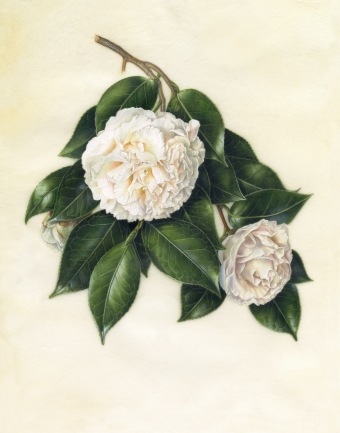
Camellia japonica ‘Hakuho’, Heirloom Camellia ‘Hakuho’ ‘White Phoenix’, watercolor on vellum by Akiko Enokido, © 2015, all rights reserved.
This year’s exhibition is in a new venue: it will be hosted by the New York Design Center and installed in their bright, airy, contemporary gallery space, 1stDibs, on the tenth floor. The Horticultural Society of New York, New York Design Center, and ASBA are designing special outreach events and programs, to be announced in September.
The opening reception will take place on Thursday evening, November 3, 2016 and will be on display through December 30, 2016. The catalog of artwork images will be posted on ASBA’s website the day of the opening. A full-color catalog will be published and available on ASBA’s website, as well as at the 1stDibs Gallery and at The Horticultural Society of New York. For further information please contact ASBA’s Exhibitions Director.
1stDibs is located on the 10th Floor of The New York Design Center, 200 Lexington Avenue, New York, New York, 10018. Gallery Hours are 9:30 – 5:30 Monday – Friday.
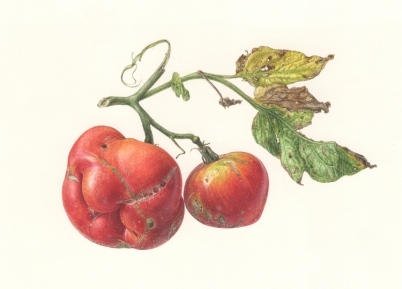
Solanum lycopersicm, Dancing Duo 34-A, Portrait of an Heirloom Tomato, watercolor by Asuka Hishiki, © 2016, all rights reserved.
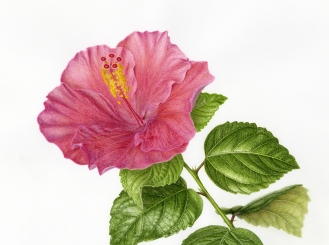
Hibiscus rosa-sinensis, Hibiscus, watercolor by Mitsuko Schultz, © 2016, all rights reserved.
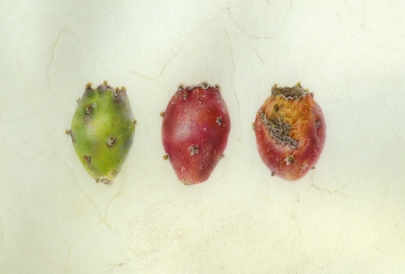
Opuntia spp. Fruit, Tunas or Prickly Pear Cactus Fruit, watercolor on vellum by Deborah Shaw, © 2016, all rights reserved.

California Poppy, 50″x28″, © JW Fike, 2015. Photographed in Miramonte, CA.
by Deb Shaw
There are a wealth of exhibitions this summer in Southern California that are botanically instructive and inspirational.
One is in South Orange County. Soka University in Aliso Viejo is currently showing JW (Jimmy) Fike’s solo exhibition, Photographic Survey of the Wild Edible Botanicals of California, now through August 26, 2016.
Even though his medium is photography, rather than traditional painting or drawing, the intent behind Fike’s large, stark, beautiful photographs is similar to any botanical artist or illustrator:
“Within my system the plant is excavated, arranged in the studio, photographed, then illustrated digitally in such a way as to render the edible parts in color while the remaining parts, less emphatically, read as contact prints.” [Quote from Soka University website.]
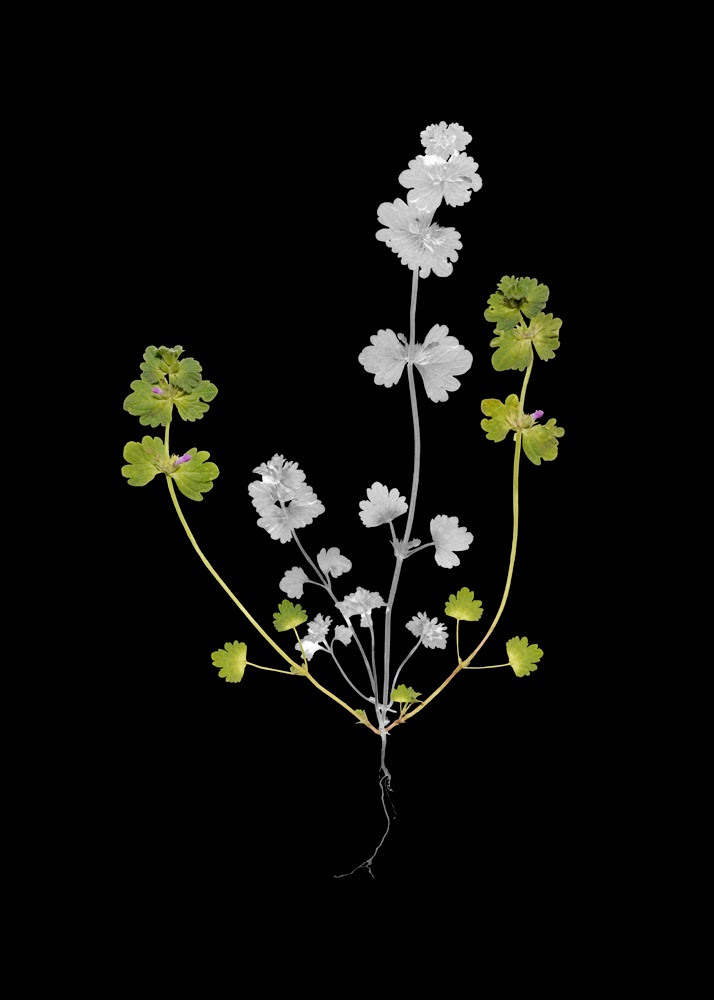
Henbit, 28″x20″, © JW Fike, 2014. Photographed in Miramonte, CA.
After Fike meticulously composes and arranges his specimen to emphasize key plant characteristics, he photographs it and then begins illustrating in Photoshop. Each piece may take up to three or four months to illustrate. (Sound familiar?) Each photograph references scientific illustration, contact prints, and photograms:
“I’m referencing the history of contact prints and photograms from the dawn of photography,” said Fike, noting 19th century English botanist Anna Atkins and pioneering photographer Henry Fox Talbot. “Some of the very first photographs were plant specimens on sensitized paper.” [Quote from LA Times article, Haunting flowers: The eerily beautiful California botanical art of J.W. Fike.]
Fike exhibits a symbiotic collection of edible plants from a geographic area. He has photographed more than ninety plants in “seven different states and plan to continue the survey until I’ve created a collection that spans the continental United States.” [Quote from Soka University website.]

Soap plant, 110″ x 64″, © JW Fike, 2015. Photographed in Miramonte, CA.
Fike’s exhibition has been covered in the LA Times, and on Botanical Art & Artists by Katherine Tyrrell. His photographs and other articles can be found on his blog.
Soka University’s Founders Hall Art Gallery is located at 1 University Drive, Aliso Viejo, CA 92656, 949-480-4000, info@soka.edu
Exhibition now through August 26, 2016
Free Admission
Monday thru Friday, 9:00 a.m. to 5:00 p.m.
Map and directions
 BAGSC News