You are currently browsing the tag archive for the ‘American Society of Botanical Artists’ tag.
by Deb Shaw

Poster for the GNSI 2014 Conference, © 2014, GNSI
Many BAGSC and ASBA members also belong to The Guild of Natural Science Illustrators (GNSI). If you’ve wanted to attend a GNSI Conference, or learn more about this wonderful organization, this is a great year to do so. The GNSI Conference will be held in Boulder, Colorado this year in July and will include a field trip to the Denver Botanical Gardens, as well as presentations, workshops and field trips important to botanical artists.
GNSI 2014 Conference Registration Is Open and Early Bird Discounts go until the end of May!
Join the GNSI in Boulder, where the mountains meet the plains!
Come and enjoy a one of a kind experience and enjoy the camaraderie of fellow illustrators in a beautiful setting. The Conference is filled with presentations, workshops and field trips designed to inspire. Some concentrate on technique, with experts in drawing, painting, scratchboard, block printing, Photoshop, Illustrator, and digital devices sharing their expertise. Others focus on the gritty details of making a living in this challenging, but exciting career. With so many choices, participants can customize their learning experience under the inspirational setting of Boulder’s Flatirons and modern Colorado University campus.
Register before May 30th and SAVE $50 on Full Registration!
Review the offerings on the conference website:
- Live Animal Drawing
- Building Backgrounds for Animal Subjects
- Sculpting Insects in Polymer and Wire
- Beginning Photoshop
- Make Your Own Sketchbook, Then Use It!
- Sketch A Storybook
- Discovering Scratchboard Techniques
- Colored Pencil Possibilities
- Painting Small Animals
- Osteology Sketching
- From Sketch to Print
- Intermediate Photoshop
- Modeling in 3DS Max
- Adobe Illustrator for Science Illust: Symbols
- Sculpting Fossils, 2-day workshop
- Watercolor, 2-day workshop
- Social Media for Artists
- Personal productivity with your iPad
- Contract and Copyright
- Shanahan Ridge
- Dinosaur Ridge
- Eldorado/Fowler Hike
- CU Extravaganza
- Wild Animal Sanctuary
- NOAA Tour
- Celestial/Dushanbe Teahouse
- Avery Brew Pub
- Denver Botanic Gardens/Natural History Museum
- Rocky Mountain National Park, 2-day trip
- Birth of the Beehive’s Mesoamerica Resiste Illustration
- Create Your Own Jobs and Get Paid to Travel
- Using illustration to Teach ‘Critical Looking’ in a Zoology Lab
- Making Photos and Art Press Ready
- Hand-Painted Linoleum Block Prints
- (Not Always) Funny Pages: Science Through Sequential Art
- Marvelous Mucus: Learning about the Little-Known World of Land Snails
- Tactile Graphics: Images for the Blind
- Gyotaku -What your Third Grade Art teacher didn’t tell you
- Japan and its Fish Markets – a look at the fish art and culture of Japan
- Saving a Tropical Jewel in the Heart of Vancouver
- Nature Based Sculpture
- iPad Tips and Tricks
- How to Work Faster Photoshop: Shortcuts and File Setups
- Ready, Set, Sell! Proactive Marketing Strategies
- Teaching Illustration as a Biology Course
- The case of the Missing Beak: Kati the Kea
- Saving the Kakapo from extinction–Expedition to New Zealand
- Creating backgrounds combining traditional and digital techniques
- Art Creation From the Client’s Point of View
- Lighting and Textures: Optimizing Your Renders
- Botanical Illustration–Then and Now
- Illustrating Nature: Stylized Realism for Children’s Books
- An Exploration in Public Health Communication
Hope to see you in Boulder in July!
by Deb Shaw
 The New York Botanical Garden/ASBA Second Triennial Exhibition entitled “Weird, Wild & Wonderful” announced the medal winners for the show. The Gold medal went to Asuka Hishiki for her watercolor of Eutrema japonica (Wasabi Root); silver was awarded to Beverly Allen for Taca integrifolia (White Bat Flower); and Julia Trickey took the bronze for her Polystichum sp. (Fern Crozier).

 The awards jury included: Shirley Sherwood, D. Phil, Caroline A. Wamsler, Ph.D., and Jean Emmons, who met on April 16 to select the medal recipients.
See the ASBA website and The New York Botanical Garden website for more about the exhibition. Catalogs can be ordered through ArtPlantae. Be sure to include your ASBA member discount code at checkout.
Congratulations to all!
by Deb Shaw
The American Society of Botanical Artist’s (ASBA) contemporary botanical art show, entitled “Weird, Wild, & Wonderful” will open on Wednesday, April 16, 2014 in the Arthur and Janet Ross Gallery at The New York Botanical Garden (NYBG). The exhibition will be on display to the public from April 19 – September 21, 2014, and admission is included in any all-garden pass.
The Second New York Botanical Garden Triennial invited artists to seek visually unusual plants and create works of art that celebrate the bizarre, yet beautiful flora of the world.
Jurors Lugene Bruno, Curator of Art, Hunt Institute; Jean Emmons, Botanical Artist; and Marc Hachadourian, Manager of the Nolen Greenhouses, NYBG, pored over the 240 entries, selecting 46 artworks by 45 artists from the United States, Australia, Canada, India, Japan and the United Kingdom. Shirley Sherwood, D. Phil, Caroline A. Wamsler, Ph.D., and Jean Emmons form the Awards Jury, which will meet on April 16 to select recipients of The New York Botanical Garden Gold, Silver, and Bronze Medals. Recipients of The New York Botanical Garden Medals will be presented by NYBG CEO Gregory Long at the opening reception.
More information about the exhibition, including the complete list of accepted artists can be found on the ASBA website. The exhibition catalog is available in The New York Botanical Garden’s shop in the garden, or online from ArtPlantae. ASBA members receive a discount on the catalog.
Five BAGSC members had works accepted into the “Weird, Wild, & Wonderful” exhibition: Margaret Best, Akiko Enokio, Joan Keesey, Lisa Pompelli, and Deborah Shaw.

Margaret Best had her watercolor of Tillandsia bulbosa accepted. Margaret wrote that she wanted to send thanks to Leslie Walker, Debbie Friedman and Deborah Shaw for helping her access Jeffrey Kent’s incredible Bromeliad collection near San Diego, where she discovered this remarkable specimen. This was one of the few paintings of Margaret’s that was not destroyed in the Calgary flood last June, which makes the painting as weird, wild, and wonderful as the subject matter.
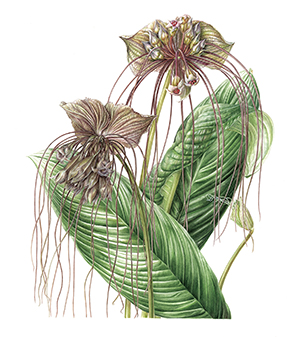
Akiko Enokido, Tacca chantrieri, watercolor. © 2014, all rights reserved.
Akiko Enokido painted Tacca chantrieri, also known as “Cat Whiskers” or the “Bat Flower” in watercolor. She writes that it is named after the long bracts that emanate from the flower scape. This flowering plant is part of the yam family, Dioscoreaceae, which grows in the tropical forest of Yunnan Province, China, India, and East Asia. In such places, the roots are used as food. She found this mysterious plant at The Kyoto Uji-city Botanical Garden in Japan, blooming inside the green house in mid-June. She says, “I was just fascinated by the shape and the process in which the “cat” developed.”
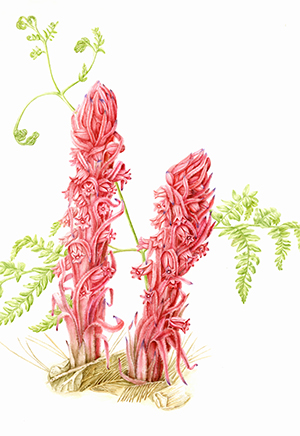
Joan Keesey, Sarcodes sanguinea, watercolor. © 2014, all rights reserved.
Joan Keesey painted a watercolor of Sarcodes sanguinea, the Snow Plant. The Snow Plant, native to Western North America, and found from Oregon through California into Baja California, and is one of the first plants to appear in the Sierra Nevada in early spring just after the snow has melted. Because the landscape is still wintery and bleak, the Snow Plant is a real treat to find. The brilliant red color is quite shocking and unexpected. The botanical name, Sarcodes sanguinea, means bloody flesh. A really good fresh plant can look almost manufactured like a toy made out of bright red, red-orange, or rose-colored plastic.
Joan writes that the Snow Plant is a member of the Heath Family (Ericaceae) and a mycotrophic (fungus eating) plant. It is unable to photosynthesize and is a parasitic plant that derives sustenance from mycorrhizal fungi that attach to the roots of trees. The Snow Plant does not, however, kill the fungi. They have a symbiotic relationship; the Snow Plant provides fixed carbon to the fungus, and in return the fungus provides mineral nutrients, water, and protection from pathogens. The Snow Plant takes advantage of this mutualism by tapping into the network and stealing sugars from the tree, the photosynthetic partner, by way of the fungus.
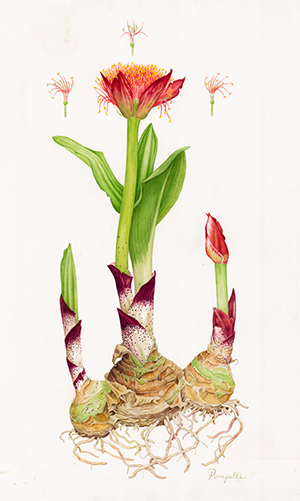
Lisa Pompelli, Scadoxus puniceus, watercolor, © 2014, all rights reserved.
Lisa Pompelli painted Scadoxus puniceus, an African Blood Lily, in watercolor. She stated, “I look forward to seeing this strange flower appear in my garden each year and I hope to get seeds from it someday. This is the first time I have entered one of my botanicals in an ASBA show, and I am thrilled to be included.”
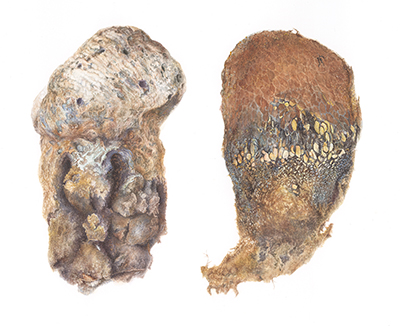
Deborah Shaw, Pisolithus tinctorius, watercolor. © 2014, all rights reserved.
Deborah Shaw painted a watercolor of Pisolithus tinctorius, also know as the Dog Turd Fungus, Dead Man’s Foot, or Dyemaker’s Puffball. Pisolithus tinctorius is frequently described in the literature as the least attractive of all fungi. P. tinctorius starts out as a ball shape when young, but then grows into bizarre monstrous shapes like stumps or giant molars. It is an ectomycorrhizal fungus that gets its nutrition in a mutualistic association with tree roots—an association that helps trees access scarce nutrients such as nitrogen and phosphate. It inhabits poor and disturbed soils, can withstand drought, high temperatures in the summer, acidic soils and soils contaminated with heavy metals and mine tailings. It is so beneficial to tree growth it is widely used in reforestation projects.
Congratulations to all! Weird, Wild & Wonderful promises to be an exciting show!
by Deb Shaw
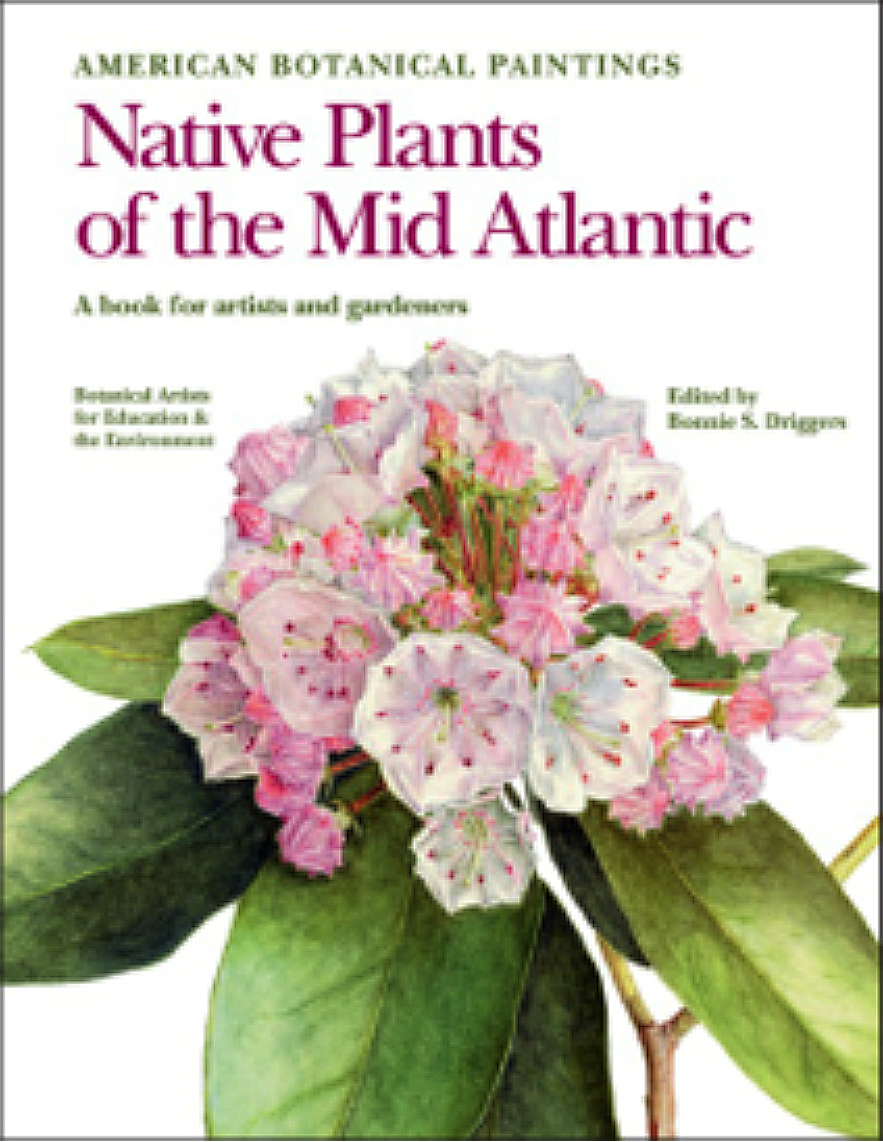
Cover art: American Botanical Paintings: Native Plants of the Mid Atlantic.
The Botanical Artists for Education and the Environment (BAEE) is pleased to announce that their book, American Botanical Paintings: Native Plants of the Mid Atlantic is now available to pre-order.
The book, which was more than three years in the making, contains 60 reproductions of original paintings and drawings of plants and 40 original paintings of butterflies, moths, and other pollinators. Each plant is briefly described with its habitat, and includes relevant information about the plant family and ways in which Native Americans or early settlers used the plants. For plants unsuitable for home gardens, their environmental importance is mentioned, such as food and habitat for birds and animals.
Proceeds from the sale of the book will be used to support native plant education, conservation, and horticulture. Publication costs are covered by donations, including a grant from the American Society of Botanical Artists (ASBA), for which BAEE is most grateful. For additional information about BAEE, please visit the website at www.baeecorp.org.
Pre-Sale Special Offer – Free Shipping. Scheduled for release February 2014. A limited number will be published, selling for only $39.95 plus shipping. Shipping is free on orders received by December 31, 2013 (US only). ORDER your copy today at www.starbooks.biz
An exhibition of the artwork will be held at the U.S. Botanic Garden in Washington, D.C., February 15 through June 15, 2014. Learn more from the USBG website: www.usbg.gov. See the BAEE website for complete details about the project at www.baeecorp.org
Geared toward a broad audience, the book has been well received, and is endorsed by respected authorities in the fields of both art and science, including the following:
This is a delightfully illustrated book, beautifully designed and with lots of variety in the choice of plant subjects. I admired the standard of painting and the fresh, appealing studies that will be attractive to both naturalists and gardeners.
— Dr. Shirley Sherwood, OBE, Botanical art collector
The U.S. Botanic Garden was thrilled to be a part of this book as it embodies what we know to be vital—our world is better and richer with fine botanical art, and the plants in our backyards, in our woods, and along the roadsides are amazing!
— Holly H. Shimizu, Executive Director, U.S. Botanic Garden
Like the exquisitely illustrated floras from past centuries, this volume carries on a rich tradition of detailed and deftly created botanical artistry. Each painting portrays the abundance and diverse beauty of the natural world around us, from early spring ephemerals to the towering monarchs of our deciduous forests.
— Peggy Cornett, Curator of Plants at Monticello
Botanical Artists for Education and the Environment (BAEE) is an incorporated 501(c)(3) Federal tax-exempt nonprofit in Virginia. The book is funded solely through donations. Any profits generated by the sale of the book will benefit nonprofit organizations that support native plant education and conservation.
If you have questions, please contact Judy Rodgers.
by Deb Shaw
The ASBA’s new website now has Online User Accounts for all current members — this includes all current BAGSC members (although very recent members may not yet be in the ASBA system). Your Online User Account allows you to access exclusive “member only” features on the site. You should have received an email from the ASBA with instructions on how to activate your Online User Account. Just in case you haven’t, you’ll find the instructions in this article below.
You must activate your Online User Account in order to register for the ASBA’s 2013 conference in Pittsburgh. Conference registration begins Saturday, 29 June at noon Eastern time, so be sure to activate your Online User Account now to be able to register in a timely manner.
INSTRUCTIONS: Activating your Online User Account is a two-step process:
1) You’ll activate your Online User Account, and;
2) You’ll review and update the information in your “ASBA Member Profile.”
This should take less than 10 minutes.
1) To activate your “Online User Account”
- Go to www.asba-art.org and click on the “Member Login” link in the upper right-hand corner of the homepage. OR, click on this link: www.asba-art.org/user
- Click on “Request New Password.”
- Type in your email address. (Be sure you use the email address you gave to the ASBA when you joined or renewed — that is the email address that was used to enter you into the database.)
- Click “Email New Password.”
- You will immediately receive an email message from asbaonline@asba-art.org, Check your email box. NOTE: there have been reported problems with Verizon email addresses. If you have a verizon.net email address and/or do not receive an email when requesting a new password, please contact webmaster@asba-art.org for assistance.
- Click on the link provided in the email.
- The link will bring you back to the ASBA website. Click on “Login,” enter and confirm a password, and set your time zone setting.
- Click “Save” which returns you to the same screen with the phrase “The changes have been saved.”
(If you ever forget your password, you can always make a new one by repeating the steps above.)
2) Review and update your “ASBA Member Profile”:
- Click on “Edit your ASBA Member Profile” in the list of links under the Individual Member heading.
- Review the information in your member profile. This information can ONLY be viewed by ASBA members:
- Basic Contact Information
- Directory Instructions
- Chapter and Artists’ Circle Affiliation
- Personal Webpage Options
- Optional Profile Information
- Add any missing information
- Correct any erroneous or outdated information
- If you’re unsure, read the hints below each item
- Still have questions? Contact webmaster@asba-art.org
Once you activate your Online User Account, you’ll be able to do the following:
Available NOW
- Update your own membership record: change your address, email, etc.
- Search an interactive list of classes
- Submit articles, class listings and calls for entry to the journal and for the website
- Make donations via credit card
- Renew your membership and pay your dues via credit card
- Search the member directory, by name, chapter, etc. (member-only access)
- Register for the Annual Meeting & Conference
Coming Soon
- Upload exhibition entries, pay the entry fee via credit card, and apply for Artists and Education grants
- View announcements of ASBA volunteer opportunities
- Take a video tutorial
- Update your own Teacher Directory & Member Gallery page
If you haven’t already done so, be sure to activate your Online User Account today!
by Deb Shaw

Aristolochia gigantea, ink on paper, Lesley Randall, © 2013, all rights reserved
Lesley Randall’s Aristolochia gigantea has been accepted into the 14th annual exhibition for the Hunt Institute for Botanical Documentation.
Lesley became interested in botanical illustration while a landscape architecture student at Cornell University. Working at a botanical garden in Hawaii, she found the plants fascinating to draw, and started illustrating professionally after moving to Davis, California in 1986. Lesley won first prize in the 2007 Margaret Flockton Award for Excellence in Botanical Illustration from the Royal Botanic Garden in Sydney, Australia. The award was created to recognize excellence of botanical illustrations in scientific publications and commemorates the contributions Margaret Flockton made to Australian scientific botanical art.
The Hunt established the International Exhibition in 1964 with the hope of supporting and encouraging contemporary botanical artists. Every three years, the International Exhibition features the works of talented botanical artists from around the world. The Hunt Institute for Botanical Documentation will host the 14th International Exhibition of Botanical Art and Illustration in Fall 2013 in conjunction with the annual ASBA conference, September 26 – 28. The exhibition is open to all botanical fine artists and illustrators working in any medium on paper or vellum whose work has achieved a standard of excellence and who have not yet been represented in the Hunt Institute’s series of International Exhibitions.
by Deb Shaw

Elaine Searle, “Rhubarb” (Rheum rhabarbarum), watercolor, © 2013, all rights reserved
Elaine Searle‘s “Rhubarb” (Rheum rhabarbarum), and Joan Keesey‘s “Hummingbird Sage” (Salvia spathacea), were both accepted into the 16th Annual International American Society of Botanical Artists at The Horticultural Society of New York.
Congratulations to both of you!
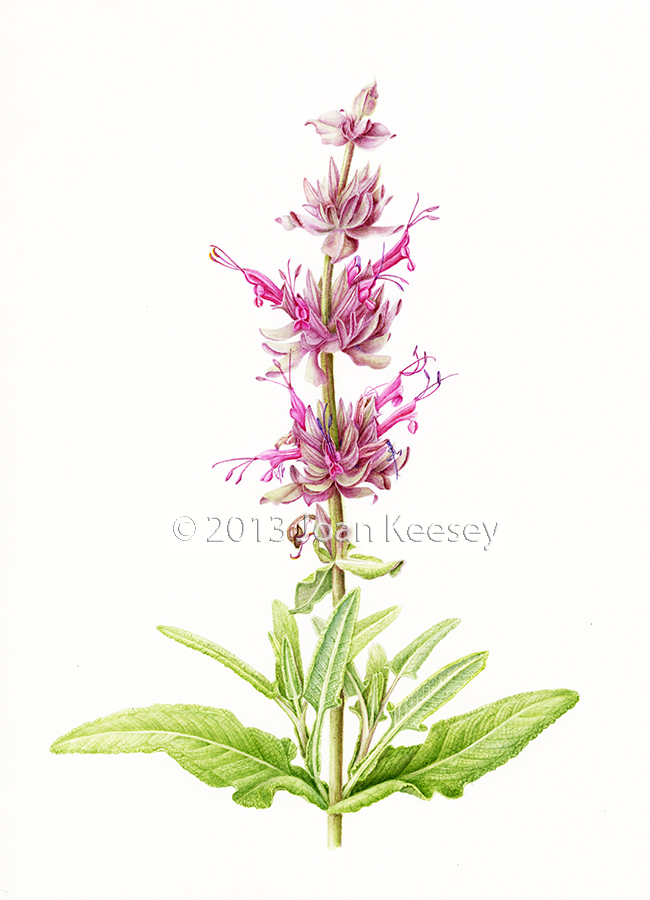
Joan Keesey, “Hummingbird Sage” (Salvia spathacea), watercolor, © 2013, all rights reserved
by Deb Shaw
BAGSC members Akiko Enokido and Mitsuko Schultz have been accepted into the 16th Annual International American Society of Botanical Artists at The Horticultural Society of New York. Congratulations to both of you!

Akiko Enokido, Chrysanthemum morifolium “Kokka Seija”
© 2013
Watercolor, 11″ x 16″
Akiko wrote about her painting:
Since ancient times, Cherry blossoms in Spring and Chrysanthemum in Fall are both loved by the Japanese people. The chrysanthemum enthusiasts put a lot of effort to make straight stems and big beautiful flowers on each of the stems.
Flower exhibitions are held all over Japan during the season. We not only enjoy them for viewing but also for their taste in salads or tea.
I found this particular one in my neighborhood. The flower is not good shaped to show in exhibitions, but I was fascinated by its energy to grow. This will be a memorable piece. My first painting in Japan.
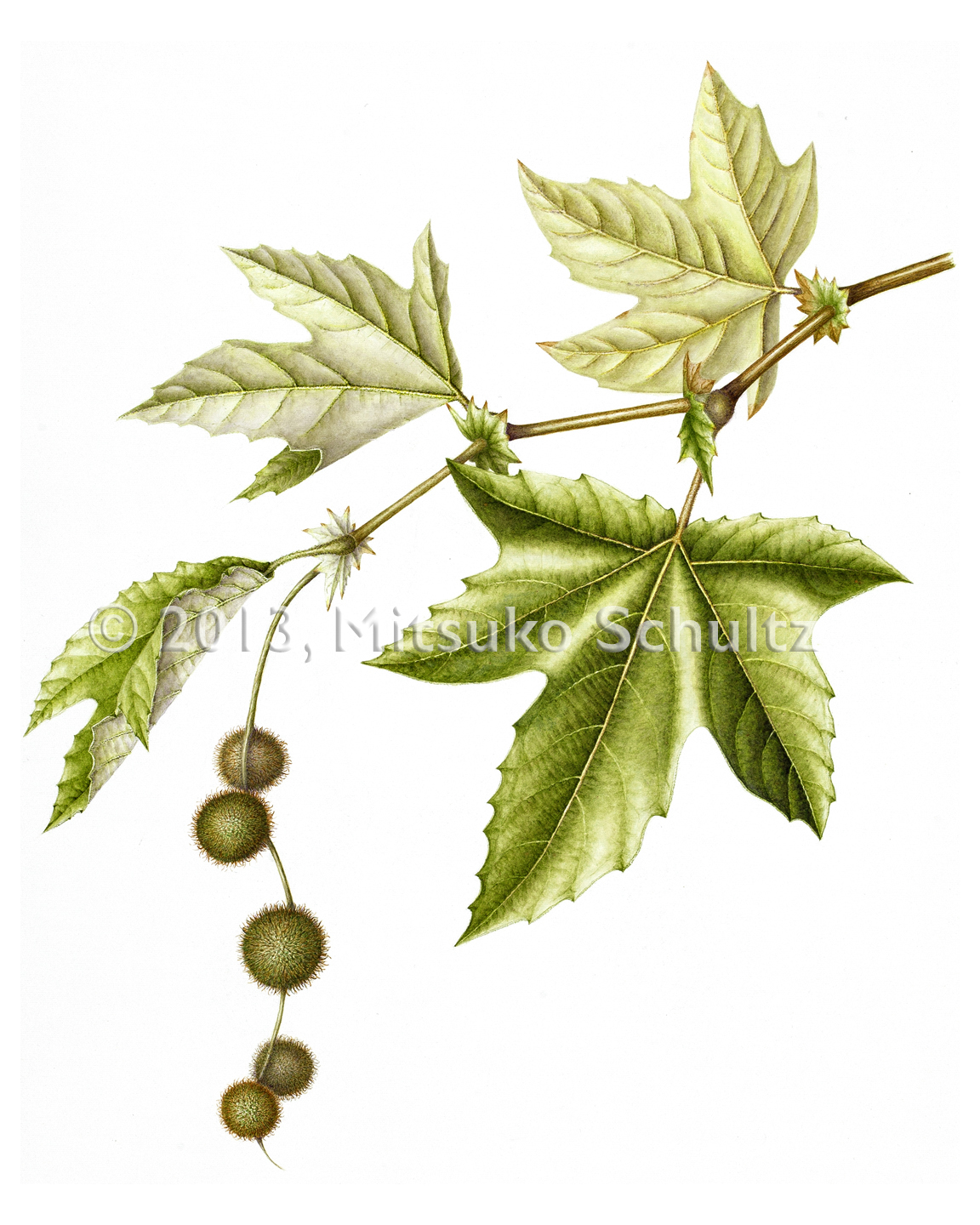
“Plantanus racemosa,” California Sycamore, Watercolor by Mitsuko Schultz, © 2013, all rights reserved.
Mitsuko wrote about her painting:
This is my first time to be accepted to the ASBA Horticulture show and I am so happy and excited. I have been studying watercolor with Akiko Enokido since July 2011 and she helped me immensely and has given me a lot of encouragement.
While painting this sycamore piece, Akiko continued to offer advice and encouragement even though she had returned to Japan. Thank goodness for email!
by Deb Shaw
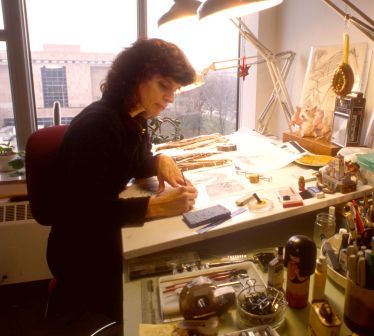
Alice Tangerini
Alice Tangerini, botanical illustrator for the botany department at the Smithsonian National Museum of Natural History, will be exhibiting her work and giving two presentations at the Riverside Metropolitan Museum in Riverside, California as part of their “Smithsonian Week in Riverside.”
The free public programming is related to the “John Muir and the Personal Experience of Nature” exhibit at the Museum. In addition to a display of Alice’s work, the program includes:
“Treasures of Yosemite” Presentation
David Wimpfheimer, Natural History Study Leader, Smithsonian Journeys
Wednesday, April 24
3 pm – 5 pm
Botanical Illustration Demonstration
Alice Tangerini, Botany Staff Scientific Illustrator, Smithsonian National Museum of Natural History
Thursday, April 25
3 pm – 5 pm
“To Reach Perfection — the Challenge of Botanical Illustration” Presentation
Alice Tangerini, Botany Staff Scientific Illustrator, Smithsonian National Museum of Natural History
Thursday, April 25
7 pm – 8:30 pm
If you haven’t had the pleasure of meeting Alice or taking a class from her, you’re in for a rare treat. Alice has illustrated more than 1500 species of plants for the Smithsonian and is also the curator of the 4800 plant drawings currently in the Smithsonian inventory. She is a board member of the American Society of Botanical Artists (ASBA), and is the person to whom we send our information and images to when we want to post them to the Member’s Gallery on the ASBA website. Alice received the American Society of Botanical Artists Award for Excellence in Scientific Illustration in 2008, teaches scientific illustration, and provides educational outreach. She is also a member of the Guild of Natural Science Illustrators (GNSI). You can view Alice’s scientific illustrations from the Catalog of Botanical Illustrations, Department of Botany, Smithsonian Institution online.
More information about the Smithsonian Week at the Riverside Metropolitan Museum is on their website. The museum is located at 3580 Mission Inn Avenue, near Orange Street, right off the 91 Freeway. The phone number is (951) 826-5273.
As long as you’re in Riverside, you might want to plan to arrive early and visit ArtPlantae. Just two blocks away you’ll find ArtPlantae at Aurea Vista Marketplace, at 3498 University Avenue on the corner of Lemon and University. Tania Marien will (of course!) be at the Riverside Metropolitan Museum to see Alice’s presentations, but her two areas in Aurea Vista will be open, and there are lots of other shops to see in Aurea Vista and in the mall in the historic downtown Riverside.
Hope to see you there, and welcome to California, Alice!
by Deb Shaw
We’ve added several new categories to the blog: one of them is a Kudos! section, to announce great things that happen to our members.
Kudos to BAGSC members Margaret Best and Akiko Enokido: both were selected to exhibit in the 15th Annual International exhibition for the American Society of Botanical Artists at The Horticultural Society of New York. And both sold their paintings in the show! Congrats!
Do you have an announcement, or would like to say Kudos! to another BAGSC member? If so, send your information to Deb Shaw, and she’ll make sure it’s posted.
by Deb Shaw
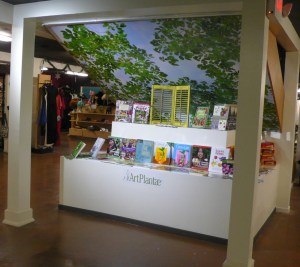
ArtPlantae Display at Aurea Vista in Riverside, California, © 2012 Tania Marien
This weekend ArtPlantae will participate in the First Annual Holiday Party at Aurea Vista, Riverside’s newest shopping destination.
The holidays aren’t the only thing to celebrate this weekend, however.
ArtPlantae is celebrating the launch of a new plant-based education display featuring resources for children, parents and teachers. Dedicated specifically to botany and botanical art education, this section features curriculum by the National Gardening Association, children’s books about plants (in English and Spanish), instructional books about drawing and botanical art, plant identification guides, and the Colorful Edibles coloring book published by the American Society of Botanical Artists.
When visiting ArtPlantae at Aurea Vista, don’t miss the display area upstairs featuring books about contemporary botanical art and botanical art history.
Discover more this Saturday during the holiday party. The festivities begin at 4:00 pm and continue until 9:00 pm. Meet local artists and designers and finish your holiday shopping too. Visit ArtPlantae’s new area about plant-based education and receive a free gift. It is located downstairs across from the children’s boutique.
Stop by on your way to the Festival of Lights and the Artists Collective located just down the street on the Main Street Pedestrian Mall.
Free gifts available while supplies last.
A Little About Aurea Vista
Aurea Vista is located in a building in downtown Riverside, California whose life began in 1927 as a hotel built by architect G. Stanley Wilson. Today the building serves as an exciting new marketplace for local artisans, designers, importers, food sellers and craftspeople.
Visit Aurea Vista and discover many treasures such as delicious olive oils by Beyond the Olive, terrarium designs by Brenda Cook of Botanical Perspective, and yards of inspiration (and classes too!) at Raincross Fiber Arts.
Aurea Vista is located at 3498 University Avenue in Riverside on the corner of Lemon and University. Hours are Monday-Saturday (11-8), Sunday (11-5). Store hours are extended for Riverside’s monthly ArtsWalk and other special events.
Parking: Free customer parking is available across the street in the parking lot with the ballet mural. Aurea Vista customers can park in spaces #1-8 that face University Avenue. Street parking is free after 5 PM Monday-Friday. Street parking also is free on Saturday and Sunday.
by Deb Shaw
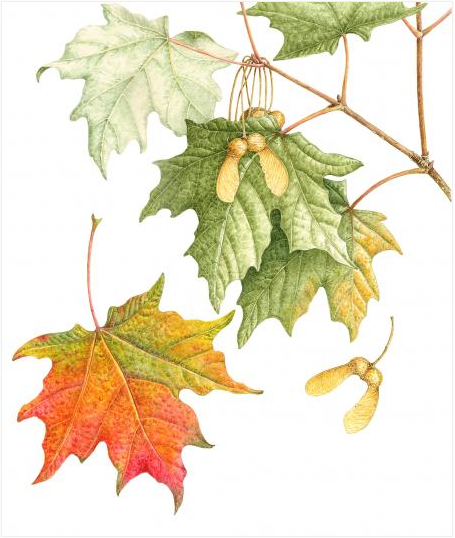
Acer saccharum, Sugar Maple, by Margaret Best, watercolor on paper, © 2012, all rights reserved.
BAGSC members Margaret Best and Akiko Enokido were selected to exhibit in the 15th Annual International exhibition for the American Society of Botanical Artists at The Horticultural Society of New York. The show is comprised of forty-three artworks by thirty-nine different artists from the US, Australia, Brazil, Canada, Japan and the UK.
Jurors Patricia Jonas, Kathie Miranda and Derek Norman had the difficult task of selecting from 192 entries. The artwork in the show can be viewed in the exhibition section on the new ASBA website. Be sure to read interviews with Margaret and Akiko about their work in the show on the website as well.
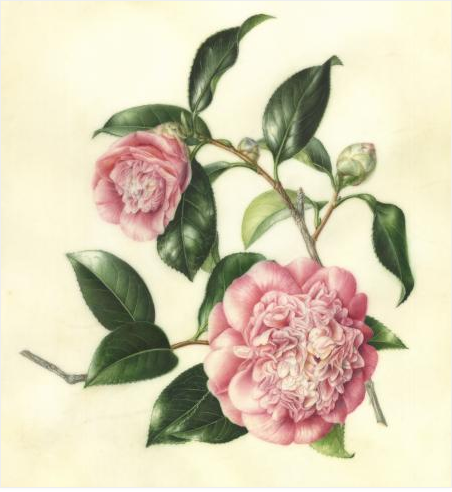
Camellia japonica ‘Chandleri Elegans’, Variegated Camellia, by Akiko Enokido, watercolor on vellum, © 2012, all rights reserved.
Want a catalog of the exhibition? Order from ArtPlantae for $20.
The exhibition will be on display from September 14 – November 21, 2012 at The Horticultural Society of New York, 148 W. 37th Street, 13th Floor, New York, New York, 10018. Gallery hours are Monday – Friday, 10 am to 6 pm.
Congratulations to all!
 BAGSC News