You are currently browsing the category archive for the ‘Resources’ category.
by Deb Shaw
GNSI 2016 Conference Logo, © 2016 GNSI.
The Guild of Natural Science Illustrators (GNSI) will be holding their 38th annual GNSI Conference at the University of California Santa Cruz, July 3-9, 2016.
Home to the infamous Banana Slug mascot, the three-day core conference will be held July 3-6, 2016 on the beautiful Santa Cruz campus. Conference housing will be provided at Cowell College. Most of the conference events will also be conveniently located at Cowell. Rooms will be available in Cowell residence halls or apartments on a first-come, first-serve basis. Each housing package includes a full meal plan in the dining hall and a parking permit.
During the core conference, there will be seven keynote addresses, 37 breakout sessions, an auction, the ever-popular and always inspiring portfolio sharing session and a techniques showcase where illustrators generously share their knowledge with conference attendees.
Plenary speakers include John Muir Laws, nature journaling evangelist, who will present “Your Brain on Paper” and why it is so important for illustrators to have this observation tool. Terryl Whitlatch, artist for Star Wars Episode 1: The Phantom Menace, will share her tips and tricks in novel creature design. David Goodsell, a microbiologist from Scripps Institute of Oceanography, will reveal the world of cells in nanoscale through his watercolor paintings, which are both practical and beautiful.
Wendy Hiller Gee will highlight the importance of science and health literacy through her medical illustration practice. Breck Tyler, a seabird biologist, will share his experiences from 25 years at Midway Atoll observing albatross colonies. Jane Kim, founder of Ink Dwell studio, will share her extraordinary efforts to foster a love and respect for the earth through her Wall of Birds mural, depicting the 375-million-year evolution of birds. More than 260 species of birds are represented, all painted to scale. And Marc Paisin, our favorite art lawyer, will give us the rundown on how to copyright our own work (and how to stay out of trouble).
Presentations, Panels and Mini-Workshops
Following the plenary speakers in the mornings, there will be three afternoons packed with 50-minute presentations and 2-hour mini workshops by more than 45 experts in art, technical and scientific concepts. The presentations will cover a wide variety of topics, ranging from traditional media techniques (waxy pencil, gouache, and watercolor) to digital media (Photoshop and animation). BAGSC’s Tania Marien will be part of the panel for a presentation entitiled “When Good Careers Stall: Working Through the Slump.”
On Monday evening, all conference attendees can participate in illustrating a collaborative chalk mural of either a Kelp Forest or the California Coast Landscape. Expect a delightful evening of drawing, wine and desserts—working along side talented artists. Come prepared with sketches of your favorites from the species list on the website, or not; reference photos will be available. Want to help but not draw? Participants are needed to write species names in the border areas. After the conference, the two murals will hang on public display for about a month at the Sanctuary Exploration Center (SEC), a block from the Municipal Wharf—the heart of Santa Cruz.
Post-Conference Workshops and Field Trips
On July 7 and 8, following the core conference, there will be half-day and full-day workshops exploring traditional and digital media in depth. A few of the traditional media workshops include: silverpoint/pastels; mushrooms in watercolor; field sketching; graphite and pastel dust; and, textures in gouache.
A few of the exciting slate of field trips include: a whale-watching trip; sketching the jewel-like tide pools at Natural Bridges State Park; a behind-the-scenes tour of marine mammal facilities at Long Marine Lab; a day trip to Monterey Bay Aquarium and Cannery Row; and a kayaking trip in Elkhorn Slough. And, of course, what conference in Northern California would be complete without a wine-tasting tour.
Many ASBA and BASGC members also below to GNSI — you will recognize a lot of familiar faces! There is much to see, learn and do. Registrants who sign up before June 5 receive a $50 early bird discount! Hope to see you there!
by Deb Shaw
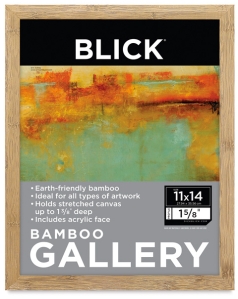
Blick Art Materials Bamboo Gallery Frame. Image courtesy of Blick Art Materials website.
Blick Art Materials is having a sale on a selection of their Bamboo Gallery Frames. Save 60 percent off list price for the 14 x 18, 16 x 20, and 24 x 36 sizes. The 16” x 20” (#18858-7916) is the frame specified for the upcoming BAGSC exhibition “Capturing the Arboretum: The Art of Botanical Illustration.”
Support ASBA while saving money! Go to the ASBA website > Support Us > Shop Dick Blick and click on the link (or click here: https://www.asba-art.org/support-us/dick-blick). ASBA receives a portion of your purchase price at dickblick.com when you link to their website from ASBA’s.
Questions about BAGSC exhibitions and framing? Contact Janice Sharp.
by Janice Sharp, posted by Deb Shaw
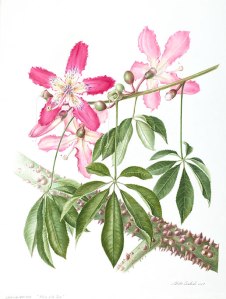
Akiko Enokido painted this watercolor of Chorisia speciosa, Floss Silk Tree, at the Los Angeles County Arboretum. The LA Arboretum has introduced four varieties of Chorisia speciosa. © Akiko Enokido, 2009, all rights reserved.
The Arboretum Library is a wonderful space for exhibiting art. [See the BAGSC News blog posting about the Arboretum Library here.] BAGSC members have been invited to participate in an art show in this newly renovated space. Entitled “Capturing the Arboretum: The Art of Botanical Illustration”, the subject matter is plants growing in the Arboretum. This is a juried show and art will be juried on its botanical accuracy and “art appeal”.
This exhibition will open July 16, 2016 and run until December 29, 2016. A reception will be held in the library on Saturday, July 16, 2016 1:00 pm to 3:00 pm.
Questions? Contact: Janice Sharp.
Complete submission of up to three (3) artworks, forms, digital images and $35 entry fee are due by June 15, 2016. The official “Call for Entries” packet has been emailed to BAGSC members. Please contact Janice if you did not receive the Call for Entries packet.
Happy painting!
by Margaret Best, posted by Deb Shaw
BAGSC member Margaret Best has a painting in the newly released book ‘Florilegium’ to mark the bi-centennial of the Royal Botanical Gardens in Sydney, Australia.
A Florilegium Society for the gardens was formed with Shirley Sherwood as the honorary Patron and Beverly Allen as president. One of the goals of the society was to produce a high quality book containing full-page works by various botanical artists to portray a diverse array of plants of significant importance to the garden. The complete exhibition of works is to be hung at the gardens from the end of July to November and is expected to travel to the Shirley Sherwood gallery in 2018.
This is a project of over three years in the making and the superb volume has just been released. The book showcases works by 41 Australians artists, 13 British artists, two South Africans, two Japanese and one each from the United States, Canada, Netherlands, France, Korea and New Zealand.

Leslie Walker scouting out the tree, Schotia brachypetala at The Huntington Gardens. © 2013, Margaret Best, all rights reserved.
The only Canadian with a painting in the book is Margaret Best. She flew to Los Angeles in 2013, and with the help of Leslie Walker and Janice Sharp, Margaret was able to find a sole specimen of a Schotia brachypetala, in The Huntington Gardens. This is a South African native tree known in Australia as the ‘drunken parrot tree’. Wild parakeets are attracted to the gardens by the clusters of small red flowers that drip nectar. After a short period, the copious quantities of nectar ferments and causes the birds to become intoxicated!

Margaret working in Janice’s studio. © 2013, Janice Sharp, all rights reserved.
Graciously hosted by Janice, Margaret was able to work in her wonderful studio for a week to complete drawings, colour matching of flowers, leaves and pod specimens for a large study. More than year later, Margaret visited a remarkable specimen in Kirstenbosch Gardens in Cape Town. With the help of the curator Ernst Van Jaarsveld, she was able to acquire a small branch from the landmark tree. That caused a last minute composition change to include the textures of bark and new growth emerging from older parts of the tree.
The outstanding book contains many fine works by artists such as Jenny Phillips, Beverly Allen, John Pastorizia-Piñol, Anita Walsmit Sachs and many more notables. [A list of the Florilegium paintings and artists can be found here.] It is most definitely worthy of any serious botanical artist’s book collection. Ask Leslie and Janice – they have heaped accolades on its quality since recently receiving their copies!
The ‘Florilegium’ may be ordered by contacting Angela Lober, international phone 02 9552 1169 or by email. Payment can be made by cheque or direct deposit. Cheques are payable to: The Florilegium Society at the Royal Botanic Gardens Sydney Inc., and can be mailed with your contact and delivery information to: Ms Angela Lober, 12 Allen Street, Glebe NSW 2037
Congrats Margaret!
by Deb Shaw
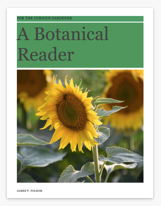
Cover, “A Botanical Reader for the Curious Gardener”, James P. Folsom, © 2016, all rights reserved.
It’s here! Jim Folsom, has just published his ebook as of February 29, 2016: “A Botanical Reader for the Curious Gardener.” The Reader is a wealth of resources; Jim’s Botany for Artists is just one chapter in a line-up of content that Jim lists in his introduction:
- Introductions (Chapters 1, 2, and 3) explain the organization of the Reader, suggest places and activities of interest, and lay out overarching themes that pervade the study and cultivation of plants.
- The Literature Review presents some commonly available texts and resources, suggesting which might be most useful for different readers.
- In Botanical Terms is a series of short essays dedicated to highlights that showcase topics fundamental to plant science and eliminate barriers presented by useful but arcane botanical terminology.
- Conversational Botany is a Primer that tells the story of plants in textbook-style.
- Issues – Plants, Politics, & Practice includes background and discussion of topics that are part of today’s public discourse as well as transcriptions of presentations I give on current topics.
- An annotated Plant Trivia Timeline gives snippets of plant-related stories and discoveries in chronological sequence, so as to provide historical context to plant use and cultivation.”
- Hands-on Discovery suggests particular plants and instructive techniques that will help students make their own observations and learn-through-doing, which is the most effective and delightful method.
Excerpt From: James P, Folsom. “A Botanical Reader.” James P. Folsom, 2016. iBooks. https://itun.es/us/XDT5ab.l
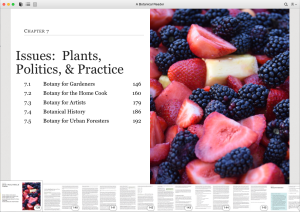
Chapter from “A Botanical Reader”, listing “Botany for Artists” as one of the sections. James P. Folsom, © 2016.
Easy to read, this is a book of RESOURCES. In addition botany, horticulture, gardening, food, and the secret world of plants, Jim introduces his readers to his favorite Plant Destinations (where we can see the “wonders of the plant world”) and compiles a list with descriptions of the books we should have on our shelves and the websites we need to have bookmarked in our browsers.
ASBA and BAGSC members will be treated to a three-part series, starting in the March issue of The Botanical Artist, excerpted from Jim’s chapter, Botany for Artists.
The ebook is downloadable for free from iBooks, at https://itun.es/us/XDT5ab.l It’s listed in the category of Life Sciences, and is a
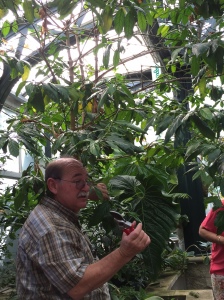
Jim Folsom lecturing during the “Weird, Wild & Wonderful Symposium.” Photo by Clara Josephs, © 2015, all rights reserved.
About Jim Folsom, Telleen/Jorgensen Director of the Botanical Gardens, The Huntington Library, Art Collections, and Botanical Gardens
Jim Folsom, PhD., rides the demographic peak of baby boomers, having been born in southeastern Alabama in 1950. His lifelong love of plants is reflected in a BS in Botany from Auburn University, an MA in Biology from Vanderbilt University, and a PhD in research botany from The University of Texas at Austin. Though his research has centered on the orchid family, with much of the research time spent in Tropical America (including a year in Colombia on a Fulbright Pre-Doctoral Fellowship), Jim’s botanical interests are wide-ranging. As Curator of the Botanical Gardens at The Huntington in San Marino, CA, he dedicates much of his effort to educational programs that increase public interest and understanding of the science, culture, and history of plants and gardens. He lives at The Huntington with his wife, Debra (also a botanist) and children Molly and Jimmy. Jim was recognized as a Friend of the Cactus and Succulent Society of America in 1996, a Member-at-Large of the Garden Club of America in 1998, and presented a Professional Citation by the American Association of Botanical Gardens and Arboreta in 1999. The Garden Club of America awarded him their Medal of Honor in 2007.
by Ted Tegart and Deb Shaw
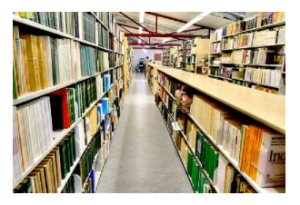
A view down a row of the remodeled Los Angeles Arboretum Library. Photo courtesy of LA Arboretum website, © 2016.
UPDATE TO ORIGINAL POST (by Deb Shaw):
I posted the article below at the beginning of the day (18 February), but then received an email this evening with an invitation to the Library Grand Re-opening on Saturday, February 27, from 1 – 3 pm. Steve Rushingwind will be performing Native American flute music and children can make a toy kaleidoscope. Karen Hochman Brown will be discussing her exhibit, Reflections in the Garden, which is on display in the Library. Free with admission; members free. Please contact Susan Eubank with questions, at 626.821.3213 or susan.eubank@arboretum.org.
The March 3 walk and talk may still be on the schedule; please double check with Susan.
Original Post:
Join Los Angeles Arboretum Librarian Susan Eubank for a walk and talk through and about the Arboretum Library on Thursday, March 3, 2016. After 50 years, the collections have emerged from the dark into a spacious, welcoming reinterpretation of a mid-century modern building, including a new children’s library. The extensive collections date from 1578 to 2016 in all formats and technologies. The Arboretum Library contains a comprehensive collection of resources on gardening, botany, California native plant life, environmental issues, and some agriculture as these subjects relate to the plants native to and planted in Southern California. This includes books, magazines, old seed and plant catalogs, government documents, pamphlets, and audio-visual materials.
The Library is open to everyone, free of charge. Any member of the general public may use library materials on-site. Arboretum Foundation Members may check out books.
NEW to the Arboretum is the capability to access articles online through the new digital archive, covering the development of the gardens, botanical descriptions of plants, background on local history, arboretum staff, exhibitions, lectures, concerts and more! Browse 65 years of Arboretum publications online and view online exhibitions (including botanical art)!
Arboretum Librarian Susan Eubank is a consummate botanical garden librarian who’s passionate about plants, gardens, libraries and helping customers with their quests.
The Arboretum is located at: 301 North Baldwin Ave, Arcadia, CA 91007. For more information about the tour, and for times, call 626.821.3222. The Arboretum Library is located within The Arboretum. To visit the Arboretum Library, go to the entrance rotunda and tell the cashiers you are there to use the library. Go straight through the double doors on the left (east) of the entrance rotunda. Library hours are:
- Tuesday-Friday, 8:30 am to 5:30 pm
- Saturday, 8:30 am to 5:00 pm
- Sunday, 12:00 pm to 4:00 pm
by Maureen Horn, Librarian, Massachusetts Horticulture Society, via email from Danielle Rudeen, The Huntington, posted by Deb Shaw
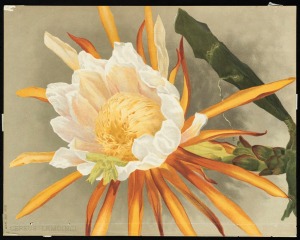
“Cereus lemoinei,” by Mrs. William Duffield, 1892. Massachusetts Horticultural Society Library, Box 9, Repros (shelf locator). Gift of Mrs. Fiske Warren, March, 1943. Permalink: http://ark.digitalcommonwealth.org/ark:/50959/0p097c160 This work is licensed for use under a Creative Commons Attribution Non-Commercial No Derivatives License (CC BY-NC-ND).
The Massachusetts Horticulture Society has announced that its botanical print collection has been digitized at the Boston Public Library and is ready to be viewed online.
The digitizing and posting of the collection is the culmination of three months of collaboration between the Massachusetts Horticultural Society, the Boston Public Library, and Digital Commonwealth. More than 1,000 rare images from the oldest horticultural library in the nation are now available for viewing and use by members, scholars, historians, artists and the general public.
Mass Hort’s Botanical Print Collection contains more than three centuries of botanical illustration, dating from 1620 to 1969, offering an invaluable resource. Artists and the public can explore images that until now have been seen only by experts.
Tom Blake, Digital Projects Manager, Boston Public Library, commented that “Digital Commonwealth enables Massachusetts cultural institutions to develop a virtual presence, enhancing education and research by creating a community of support, offering professional advice, and facilitating collaboration. The Digital Commonwealth portal facilitates worldwide access to the cultural heritage of Massachusetts. Our repository provides an affordable option to organizations that are unable to host one locally.”
The Horticultural Library at Massachusetts Horticultural Society was the first in the United States. It was established soon after the Society was founded in 1829 to share horticulture knowledge and beauty through its prints, books, extensive collection of seed catalogs, and other rare materials.
Noticing an interest in botanical prints, the Society mounted its first major exhibit in 1968. It continued with another exhibition in 1969, when a group of lily prints was shown to the North American Lily Society at its annual meeting.
Today, digitization and online access to special collections is an important strategy for any cultural heritage organization. With the help of Digital Commonwealth, Mass Hort’s Library will meet the 21st Century digital needs of students, researchers, authors and the public.
Massachusetts Horticultural Society’s botanical prints are available online at the Digital Commonwealth repository at https://www.digitalcommonwealth.org/collections/commonwealth:k930hm897 . These images are available for the purposes of viewing and studying and not for commercial use.
Massachusetts Horticultural Society’s Library collection includes more than 20,000 volumes at their library in the Education Center of the Elm Bank horticulture center and gardens. Additionally, the Society maintains 5,000 rare books, manuscripts, prints, seed catalogs, glass slides, and early transactions of horticultural institutions at a separate archival storage facility.
Many of the books transferred to the Chicago Botanical Garden’s Lenhardt Library Rare Book Collection in the early 2000’s by Mass Hort are now available online through the Illinois Digital Archives at http://www.idaillinois.org/cdm/landingpage/collection/ncbglib01; search on “Massachusetts Horticultural Society.”
 BAGSC News