You are currently browsing the category archive for the ‘Exhibitions’ category.
by Deb Shaw

Open Parrot Tulip, oil on paper, © 2016, Ingrid Finnan.
In San Francisco? Arader Galleries is currently exhibiting Outside In: Contemporary Natural History Artworks, from September 9 – October 12, 2016. Original artworks are on display by seven ASBA artists, including Francesca Anderson, Jean Emmons, Monika de Vries Gohlke, Ingrid Finnan, Asuka Hishiki, Catherine Watters and Carol Woodin.
An article by ArtPlantae has information about each artist, with links to their websites.
In addition to the exhibition, Outside In, Arader Galleries will also feature the Highgrove Florilegium at the same time. Both volumes of the Florilegium will be on display, capturing HRH The Prince of Wales’ celebrated garden at Highgrove in 124 paintings by contemporary botanical artists from around the world.
by TAG Gallery and Sally Jacobs, posted by Deb Shaw

Savoy Cabbage, graphite, by Sally Jacobs, © 2016.
BAGSC member Sally Jacobs has an upcoming exhibition of watercolor paintings and graphite drawings entitled “Larger Than Life.” The exhibition at the TAG Gallery in the Bergamot Station Art Center runs from September 27 – October 22, 2016
Opening Reception: Saturday, October 1, 2016 from 5 – 8 pm
Artist Panel: Saturday, October 8, 2016, 3 pm
The following is from the press release, sent out by TAG:
Sally was inspired by the rich arrays of produce and flora found in Los Angeles’ farmers markets. Jacobs zooms in, portraying flowers, vegetables, and fruit with dramatic precision. Jacobs transforms a vegetable we choose for nourishment or a flower for decoration by aiming higher, rendering it’s unique structure eye-catching and explicit, causing the viewer to catch their breath in wonder.
Jacobs uses watercolor or pencil in a unique, graduated way, masterfully capturing the minutest details of her subjects’ anatomy while staying true to the whole. She delves deep into a plant’s structure to reveal striking patterns and colors that seize one’s attention and imagination.
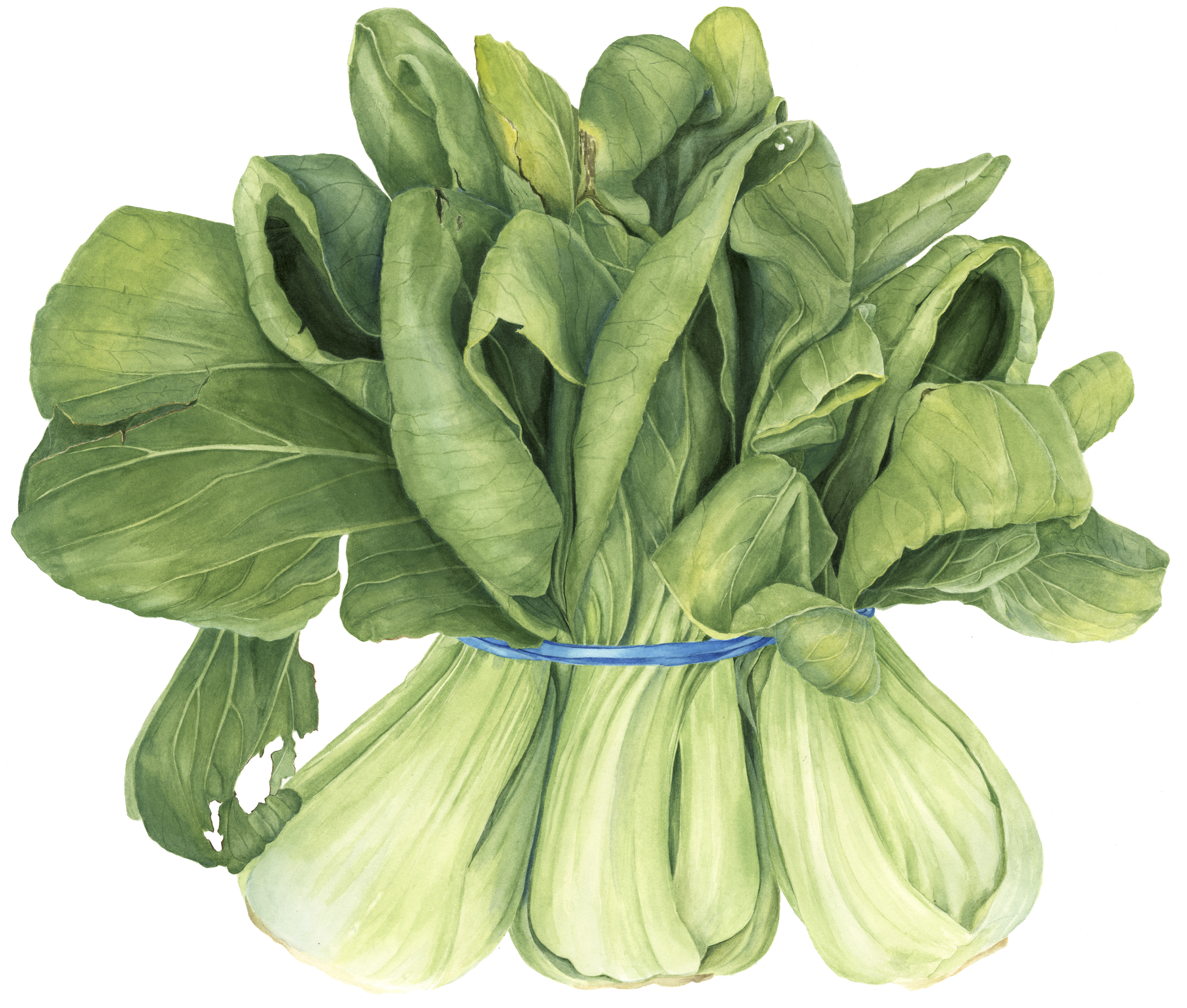
Bok choy, watercolor, by Sally Jacobs, © 2016.
Jacobs is a contemporary botanical artist who has exhibited in numerous juried shows in New York and San Francisco, and at museums in New York, Minneapolis and Phoenix. She was an award winner at the Brand 37 Works on Paper exhibit and is one of the artists included in “Todays Botanical Artists,” a publication of well-regarded nature artists.
About TAG Gallery
Established in 1993 as a not-for-profit corporation, TAG Gallery is a member-owned community of forty artists. Through the physical gallery in Santa Monica’s landmark Bergamot Station as well as lectures from exhibiting and visiting artists, TAG Gallery has become a valuable resource for launching the careers of both emerging and mid-career artists based in the greater Los Angeles area. For more information about TAG Gallery, please visit http://www.taggallery.net. Questions about the exhibition? Please contact Rakeem Cunningham, (310) 829-9556, gallery@taggallery.net
TAG is located at 2525 Michigan Ave., D3, in the Bergamot Station Art Center, Santa Monica, CA 90404, 310. 829.9556.
by Estelle De Ridder, posted by Deb Shaw
The California Islands Symposia have been held more or less, every five years since 1965, to share up-to-date information about the management, scientific research, work in all disciplines of natural and cultural science and general well-being of the California islands.
The 9th California Island Symposium for 2016 is being held at the Marriott Hotel, Ventura, California. One of the less scientific and more entertaining presentations of this symposium will be the Art Exhibit that has been advertised for more than six months. The three jurors worked hard and with diligence to put together a coherent show that will present the Channel Islands to the public in an inviting and interesting manner. After the symposium, the exhibit will be moved to the Santa Barbara Botanic Gardens, where it will be on display for another three weeks.
The Channel Islands of California comprise eight islands located in the Pacific Ocean off the Southern California coast. Five of the islands and the surrounding waters are part of Channel Islands National Park and the Channel Islands National Marine Sanctuary.
The Park is supported by many partners who share the protection of the history and prehistory, the cultural and biological diversity as well as protecting vital habitat for marine, terrestrial plant and animal species.
Public appreciation through education, interpretation and research is widely promoted.
Isolation over many thousands of years has developed unique animals, plants and archeological resources found ONLY on these islands and makes is possible for visitors to experience the western coast of the North America as it used to be.
Visitation has increased dramatically over the years, and with contracted concessionaires, the numbers show how the interest in the islands have grown:
1963 = 1,200
2014 = 342,000

Malva assurgentiflora, the Island Mallow, Mission Mallow, Royal Mallow, Island Tree Mallow. © 2016, Estelle De Ridder, all rights reserved. Watercolor and colored pencil on drafting film and paper.
Flora on the Channel Islands include a unique subspecies of pine, oak and island tree mallow.
Santa Rosa Island holds two groves of the endemic to the island, Torrey pine subspecies Pinus torreyana var. insularis. Torrey pines are the United States’ rarest pine species. The islands also house many rare and endangered species of plants, including the island barberry, the island rush rose, and the Santa Cruz Island lace pod. Giant kelp forests surround the islands and act as a source of nutrition and protection for other animals.
BAGSC members Estelle De Ridder, Mitsuko Schultz and Ellie Tu are participating in the exhibition.
Estelle has illustrated two species: Malva assurgentiflora and Heteromeles abtutifolia.
Malva assurgentiflora, the Island Mallow, Mission Mallow, Royal Mallow, Island Tree Mallow, Malva Rosa is a species of flowering plant in the mallow family. It grows into a strikingly architectural shrub/small tree with beautiful white bark.
It is endemic to California, where it is native only to the Channel Islands. It can also be found growing as an escapee from cultivation in coastal mainland California.
Estelle’s painting of Heteromeles abtutifolia was done on paper with watercolor and colored pencil. Heteromeles abtutifolia, Toyon berry, grows on the north-facing coastal bluffs of Santa Cruz Island. It grows on all the other islands, except Santa Barbara island, and was planted on San Nicolas.

Plantanus racemosa, California Sycamore, Watercolor by Mitsuko Schultz, © 2016, all rights reserved.
Mitsuko Schultz had her Platanus racemosa, California Sycamore accepted to the exhibition.
Ellie Tu has three pieces in the exhibition: Dudleya greenei, Coreopsis, and Leptosyne gigantea Kellogg.
Leptosyne gigantea Kellogg (formerly Coreopsis gigantea), Giant Coreopsis is a strikingly strange plant. It grows on dunes, rocky cliffs and exposed slopes, and has a fleshy trunk and branches. It can reach heights of eight feet with a five inch trunk. It is deciduous and dormant in the dry season, taking on an other worldly appearance when visitors hike through a large stand of them. In spring, however, masses of bright yellow blooms put on quite a show.
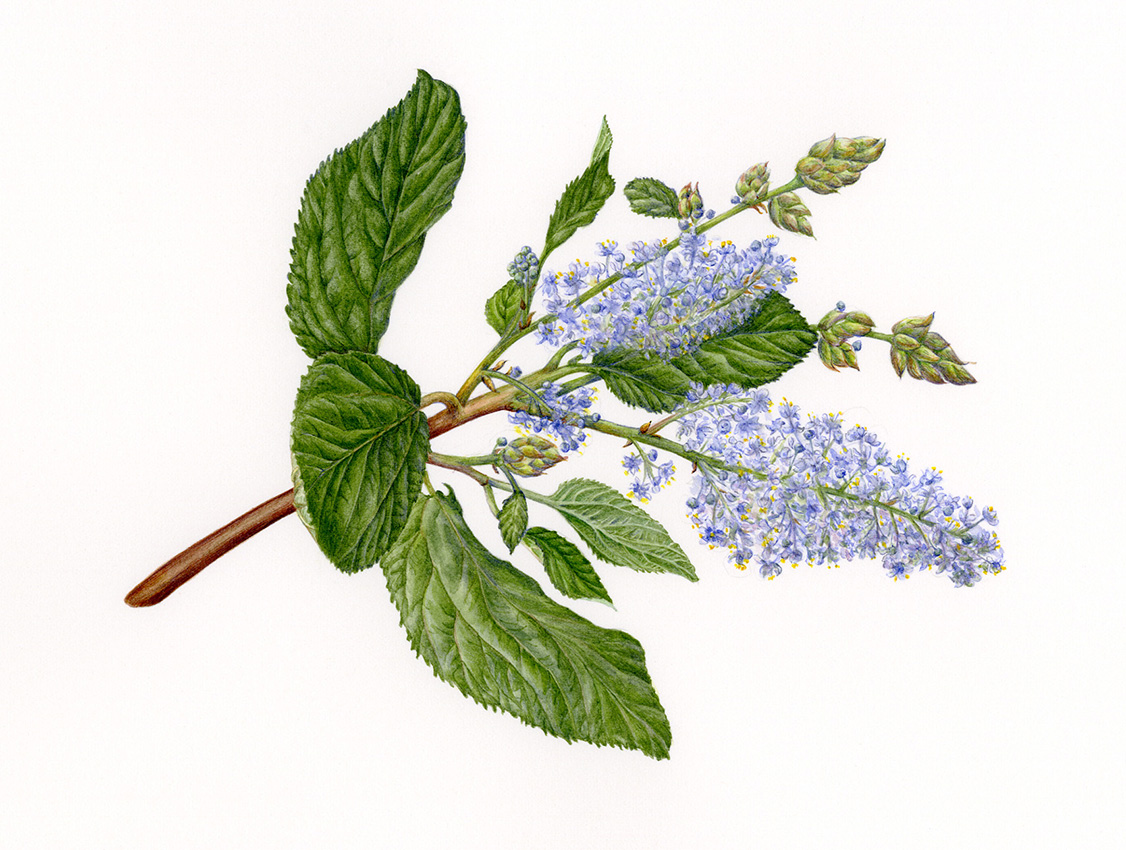
Ceanothus arboreus, Feltleaf Ceanothus, or Island Ceanothus. Watercolor, © 2016, Ellie Tu, all rights reserved.

Leptosyne gigantea Kellogg, (formerly Coreopsis gigantea), Giant Coreopsis, Ellie Tu, colored pencil, © 2016, all rights reserved.
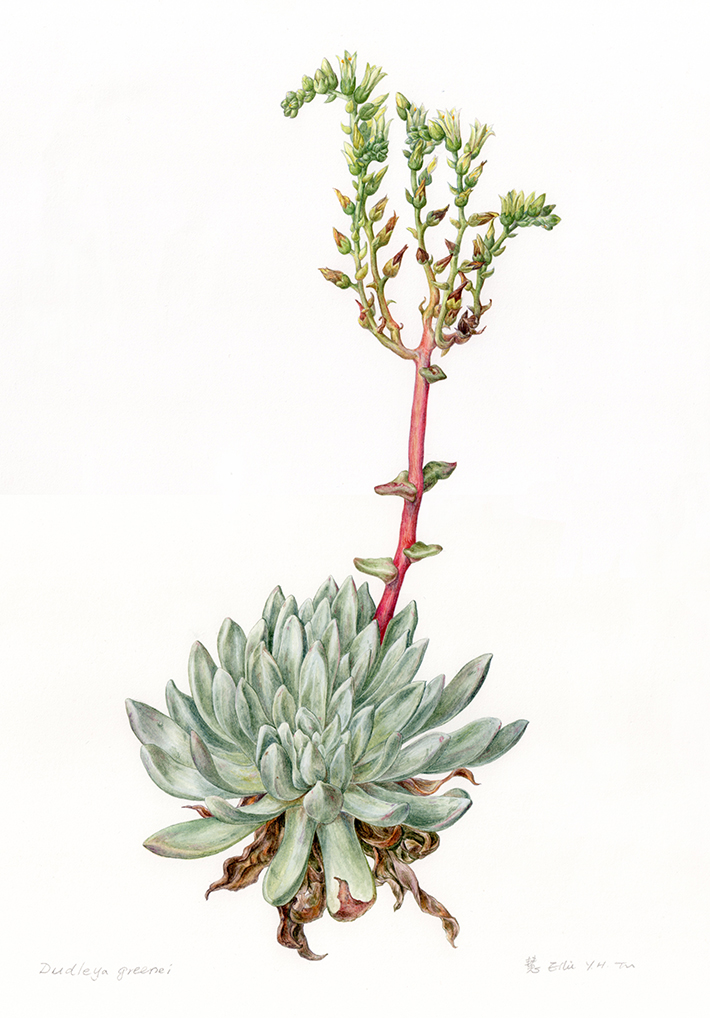
Dudleya greenei, watercolor by Ellie Tu, © 2016, all rights reserved. This plant grows in the Channel Islands National Park.
by Susan Jackson, posted by Deb Shaw
A new exhibit has just opened at the San Diego Natural History Museum in Balboa Park that botanical artists would find quite interesting. It is located in the Eleanor and Jerome Navarra Special Collections Gallery on the third floor of the museum. It is a permanent exhibition called Extraordinary Ideas from Ordinary People: A History of Citizen Science which features rare books, art, photographs, maps and historical documents that pay homage to the past, present, and future of citizen science.
The upper mezzanine features an exhibit that a botanical artist will not want to miss. On display are nine “Plant Portraits” by the early twentieth century painter, A. R. Valentien. He was commissioned by the philanthropist Ellen Browning Scripps to paint California wildflowers. Over a period of ten years, Valentien traveled around California creating exquisite watercolor and gouache scientific illustrations. Part of the collection of 1,094 paintings, all done on 13x 20 paper, will be rotated in this gallery. A book which includes photographs of all the paintings can be found in the gift shop, however, it is no substitute for seeing the real thing. Bring your magnifying glass.
The gallery also has original catalogs from Pierre-Joseph Redoute, William Curtis, Auguste Johann Rosel von Rosenhoff, and John James Audubon. These are huge volumes printed in black ink and then hand colored. They are a reminder of a time before photography when beautiful books were only available to the very wealthy. Although we frequently see prints that originated from these catalogs, there is something very special in actually seeing the originals.
More information about the exhibit and the San Diego Natural History Museum may be found on their website. There is also a short video about the Valentien Collection, which can be seen by clicking on the arrow located on the close up view of the Mariposa Lily. If you decide to visit, plan on spending several hours, because there are lots of other things to see as well.
The San Diego Museum of Natural History is located at 1788 El Prado, Balboa Park, San Diego, CA 92101. The Museum is open daily 10 AM to 5 PM, and until 8 PM on most Fridays this summer. Visit the website for ticket prices and specific daily hours; the Museum may close early on some days.
by Deb Shaw
Hunt 15th International Exhibition of Botanical Art and Illustration
Every three years the American Society of Botanical Artists (ASBA) holds its annual conference in Pittsburgh, PA to coincide with the Hunt Institute’s International Exhibition. This year is no exception: the 15th International Exhibition will open on September 15, and will run through December 15, 2016.
The Hunt Institute for Botanical Documentation established the International Exhibition in 1964 with the purpose of supporting and encouraging contemporary botanical artists. The upcoming exhibition features 43 works by 43 different artists from 15 different countries. A few selected works from the exhibition can be viewed on the website.
![Cover of the Hunt 15th International Exhibition Catalog. Cover art: Soft Tree Fern, Dicksonia antarctica [Dicksonia antarctica Labillardière, Dicksoniaceae], watercolor on paper by Laurie Andrews (1936–), 2008, 76.5 × 56.5 cm, HI Art accession no. 8078, reproduced by permission of the artist.](https://bagscblog.com/wp-content/uploads/2016/08/hibd-15th-international-title.jpg?w=300&h=476)
Cover of the Hunt 15th International Exhibition Catalog. Cover art: Soft Tree Fern, Dicksonia antarctica [Dicksonia antarctica Labillardière, Dicksoniaceae], watercolor on paper by Laurie Andrews (1936–), 2008, 76.5 × 56.5 cm, HI Art accession no. 8078, reproduced by permission of the artist.
The opening reception on October 13, from 6 pm – 9 pm is open to the public, and also is a highlight of the ASBA conference. The curators of the exhibition will give a short introduction to the exhibition in the gallery at 6:30 pm. Catalogues will be available for sale at the opening.
The Hunt Institute is located at: 4909 Frew Street, 5th Floor, Hunt Library. The exhibition will be on display on the 5th floor of the Hunt Library building at Carnegie Mellon University and will be open to the public free of charge. Hours: Monday–Friday, 9 a.m.–noon and 1–5 p.m.; Sunday, 1–4 p.m. (except 20 November and 24–27 November). Because the Hunt’s hours of operation are occasionally subject to change, please call or email before your visit to confirm. For further information, contact the Hunt Institute at 412-268-2434, or email.
Early Bird Registration for the 22nd Annual ASBA Meeting and Conference CLOSES AUGUST 7, 2016!
The deadline for early registration discounts for the 22nd Annual ASBA Meeting and Conference closes on August 7, 2016. Early registration fees (on or before August 7) are $360. Register now online. After August 7, registration jumps to $425. Registration closes September 4, 2016, no exceptions.
Join ten other BAGSC members who have registered for the conference so far. See old friends, meet new friends from all over the world, learn new techniques and get inspired.
The conference will be held at the Wyndham Pittsburgh University Center, just a few blocks from Phipps Conservatory and Botanical Garden, The Carnegie Museum of Natural History, The Carnegie Museum of Art, and the Cathedral of Learning at the University of Pittsburgh. And, of course, there is the Hunt 15th Annual International Exhibition—one of the world’s most prestigious exhibitions of botanical art and a must-see.
BAGSC member Margaret Best will be teaching a one-day workshop on watercolor, “From the Ground Up.” BAGSC member Deborah Shaw will be giving an up-to-the-very-minute lecture about how to protect your images on the web, along with some tips and tricks and a list of helpful and fun apps.
There are still openings in various workshops, including graphite, colored pencil, and pen-and-ink. There are many fascinating lectures available at no additional charge. And there are openings available for a field trip to visit Frank Lloyd Wright’s Fallingwater.
Read about the conference, sessions and instructors on ASBA’s website, make your selections, then go to the online registration site to register.
There are 193 ASBA members who have registered so far. Come join us in Pittsburgh!
by Deb Shaw
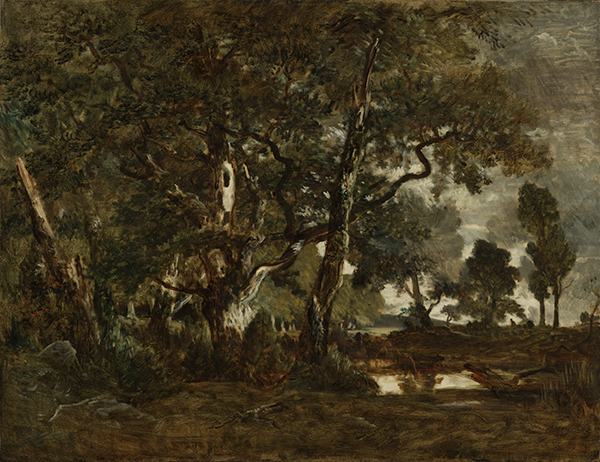
Forest of Fontainebleau, Cluster of Tall Trees Overlooking the Plain of Clair-Bois at the Edge of Bas-Bréau; Théodore Rousseau (French, 1812 – 1867); France; about 1849 – 1852; Oil on canvas; 90.8 × 116.8 cm (35 3/4 × 46 in.); 2007.13
In addition to all the other exciting exhibitions to see in Southern California this summer, The Getty Center currently has a wonderful exhibition titled Unruly Nature: The Landscapes of Théodore Rousseau. On display until September 11, 2016, the exhibition brings together seventy paintings and drawings loaned from museums and private collections from all over the world. It is the first comprehensive exhibition about Rousseau in North America, and the largest Rousseau exhibition since 1967 in Paris.
Personally, it is my favorite type of exhibition, containing working sketches, master works and problematic works spanning Rousseau’s entire career as an artist. Regardless of how you feel about Rousseau’s work, this is one of those spectacularly curated exhibitions that allow us to see into the artist’s techniques, working styles, and artistic demons.
Although severely under-appreciated by the art establishment of his time, Théodore Rousseau was a pivotal figure in the history of art. A leader and founder of the Barbizon School of Painters (named for the village of Barbizon, France, near the Forest of Fontainebleau where he spent much of his career), Rousseau pushed the Romantic art movement towards Realism, and laid the groundwork for the Impressionists who followed.
Rousseau found refuge from external and internal turmoil in nature, in the forests, trees and landscapes around him. The 1800s were a time of rapid change, and a source of anxiety and disappointment for everyone: wars raged across Europe and abroad; the industrial revolution became entrenched in daily life; and Rousseau suffered so many rejections from The Paris Salon, he was given the nickname “le grand refusé” (“the great refused”).
Closer to home, his wife suffered from debilitating bouts of mental illness—called “insanity” at the time. As his wife’s mental health grew more precarious, he took her for treatment. While absent, a young man who was a friend of the family and staying in his Barbizon home committed suicide there. Rousseau’s father (who outlived him), became financially dependent on him and Rousseau’s own health deteriorated. After his death, his lifelong friend and fellow artist, Jean-François Millet, assumed responsibility for Rousseau’s wife.
Rousseau was somewhat of a mystic, and said the trees spoke to him. He took his sketchpads into the forest and drew directly from nature. Unlike other artists of the time, he treated his sketches with the same reverence as he treated his art—as artistic works in their own right. In an effort to capture light and dark, mood and texture, Rousseau used mixed media on a variety of surfaces, allowing his gestures and painterly marks to add to the energy of his art.

Forest in Boisrémond (recto); Cottage in a Forest (verso); Théodore Rousseau (French, 1812 – 1867); 1842; Black chalk on laid paper (recto); graphite (verso); 28.1 × 45 cm (11 1/16 × 17 11/16 in.); 2002.3
Rousseau’s sketches in the exhibition are immediate and visceral. It is wonderful to see how he blocked in the perspective and ignored overlapping lines (which, of course, no one would notice unless you were looking carefully).
One of my favorites in the exhibition is a pairing of a sketch next to the finished oil painting on one wall of the gallery. The detailed sketch, [Under the Birches, Evening, 1842, Black chalk on brown wove paper, Toledo, Museum of Art, Frederick B.and Kate L. Shoemaker Fund, 1976.8, Catalogue number 20] is lively, serene and pleasant. At first glance, the finished oil painting, [Evening (The Parish Priest), 1842–43, Oil on panel, Toledo Museum of Art, gift of Arthur J.Secor, 1933.37, Catalogue number 21] looks to be a faithful studio rendering of the sketch, except that the mood of the painting is substantially different. It’s not simply the addition of color that creates the quiet melancholy. Closer examination between the two reveals where Rousseau changed the mode by subtly changing the details. He removed some leaves from this branch, reduced the size and altered the round shape of one of the trees, slightly reduced the width of the trunks, emphasized the crooks and turns of the trunks, and more, to achieve the effect he wanted, without changing the habit or growth patterns of the trees themselves.
Rousseau was able to complete sketches and drawings outdoors with no problem, but agonized over whether or not a canvas in the studio was finished. A fellow artist and neighbor in Barbizon, Jules Dupré, would sometimes sneak into the studio and take a painting away to prevent Rousseau from overworking it. Many of his canvases have areas that are executed in great detail, while other areas are barely developed.
In the exhibition it is readily apparent (and delightful) to see Rousseau’s finished paintings that are clearly overworked, against those which are not. His overworked paintings are beautifully executed, but clearly have all the life sucked out of them. A brilliant visual lesson for all artists who labor over the “is it done?” question!
Rousseau loved music, especially Beethoven, Mozart and Schumann. Like Beethoven, Rousseau’s inspiration came from long walks in the woods. The Getty has free headphone and players available for use while viewing the exhibition that plays music by composers who inspired Rousseau. Los Angeles Philharmonic guest conductor Nicholas McGegan curated the playlist of works by Mozart, Beethoven, Schumann and others.
In my opinion, Rousseau’s trees are portrayed with weathered wisdom and a great melancholy sadness. They are trees that speak eloquently to our time as well as his.
“I listen to the voices of the trees… I discover their passions.
The artist’s soul must become filled with the infinity of nature.”
—Théodore Rousseau
Unfortunately, the Studio workshop and my Tree Drawing workshop at The Getty in conjunction with the Rousseau exhibition are past. The Getty still has, however, upcoming events related to the exhibition, including:
COMMUNITY PARTNER EVENT
Mozart, Weber and Schumann
Conductor Nicholas McGegan leads the Los Angeles Philharmonic in a program of music inspired by the personal taste of Théodore Rousseau, a true “mélomane,” or music lover. Videos made in collaboration with the J. Paul Getty Museum will provide insight into the artist’s relationship with the music that fired the passions of his Romantic generation.
Thursday, August 18, 8:00 p.m.
Hollywood Bowl
“The Great Landscape Painter of our Time”: Théodore Rousseau and the Imaging of 19th-Century France
Simon Kelly, curator of modern and contemporary art at the St. Louis Art Museum, explores Rousseau’s central position in 19th-century French landscape painting. Kelly questions the dominant narrative of plein-air naturalism surrounding his work, instead arguing for a more complex view of an artist producing deeply meditated imagery, drawing on a broad range of interests that includes literature, music, and philosophy. Kelly also places Rousseau’s output within the context of the Barbizon artistic colony which included his close friend, Jean-François Millet.
Sunday, August 21, 2:00 p.m.
Getty Center: Museum Lecture Hall
The exhibition, Unruly Nature: The Landscapes of Théodore Rousseau, has been co-organized by the J. Paul Getty Museum, Los Angeles and the Ny Carlsberg Glyptotek, Copenhagen.
The J. Paul Getty Museum is located at: North Sepulveda Blvd and Getty Center Dr, Los Angeles, CA 90049. Hours and fees can be found here.
by Deb Shaw
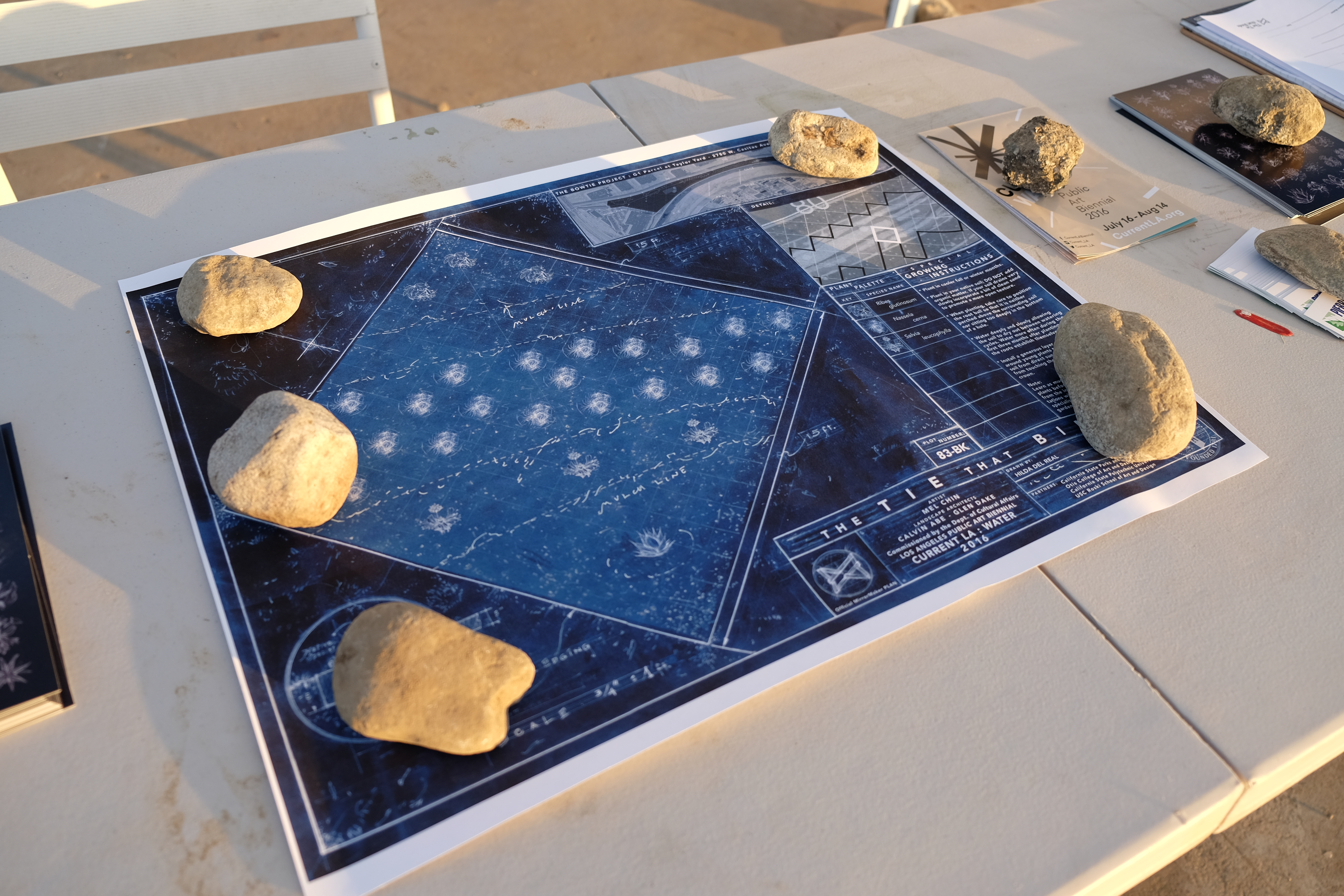
One of 512 Unique Blueprints created by the artist and team to distribute at the Field Office.
Artist Mel Chin has a new Land Art project in Los Angeles, entitled The Tie that Binds. Created for Los Angeles’ CURRENT:LA Water Public Art Biennial, the project invites visitors to connect to the site of the Bowtie Project, to understand water conservation in Southern California and to join hundreds of other LA residents in owning a work of Land Art we can grow in our own yards.
The Bowtie Project envisions a transformation of a stretch of the LA River. Once a railroad yard, this rare, 18-acre part of the River was left completely in its natural state, never transformed by engineers or concrete. Currently overgrown with invasive species, the site is still home to some native plant species, fish and birds.

TTB plot 111-CF, Bowtie demonstration garden and South LA mirror installation.
The Bowtie Project is part of a plan to restore this area of the LA River as an natural, urban state park. The Tie that Binds imagines the future Bowtie Project and the entire city sustained with water-saving, California-native landscapes. Compelled by the beauty of the site and belief that this is a place that should be owned by everyone, The Tie that Binds invites the public to “mirror” this future landscape in hundreds of individual lawns throughout Southern California.
To introduce the project, eight, small Land Art gardens are planted at the Bowtie site to serve as “models”. A field office on site is staffed by “MirrorMakers/Espejeros” and is open Thursday–Sunday evenings through August 14. Private and public locations in diverse neighborhoods of Southern California have already planted exact replicas or “mirrors” of one of the Bowtie Project garden demonstrations.
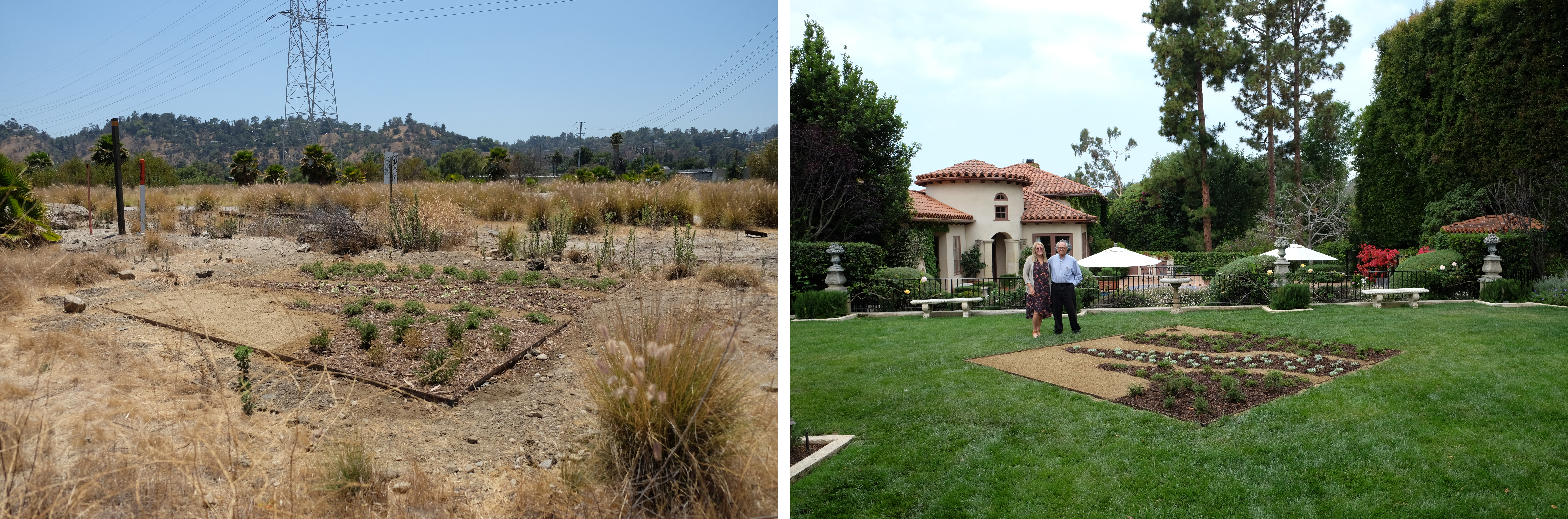
TTB plot 184-DJ, Bowtie demonstration garden and Brentwood mirror installation.
Mel Chin invites Southern California to help realize this Land Art work. Those who commit to growing a The Tie that Binds mirror garden receive a free, unique, artist-designed blueprint, a list of native plant species, and instructions on how to grow a garden that requires little or no watering. These gardens will fulfill the potential of a living sculpture that is collectively owned by the public.
Carolina Miranda wrote a wonderful article for the LA Times about the site, titled “Why Mel Chin is giving away the land art design of his subversively charming CURRENT:LA native garden.” You can see additional photos of the installation, as well as photos of the installation with Miranda’s trusty research assistant, Bonnie, the American Staffordshire Terrier.

MirrorMakers Yrneh and Margo with Roger, a new Tie that Binds blueprint holder (Photo credit: Amanda Wiles, © 2016).
Visiting The Tie that Binds
The Bowtie Project is an 18-acre post-industrial site owned by California State Parks and is located at 2780 Casitas Ave, Los Angeles, CA, 90039. Please enter through the yellow gate and follow directions for parking. The nearly 3/4 mile site is accessed by walking; accommodations will be made for any who need assistance.
The Tie that Binds field office at the Bowtie Project is open 5:30 pm until sunset, Thursday – Sunday through August 14, 2016. Mirror Makers/Espejeros are onsite to talk with visitors about the project.
About the Artist
Mel Chin is from Houston, Texas and is known for the broad range of approaches in his art, including works that require multi-disciplinary, collaborative teamwork and works that conjoin cross-cultural aesthetics with complex ideas. He developed Revival Field (1989-ongoing), a project that pioneered the field of “green remediation,” the use of plants to remove toxic, heavy metals from the soil. A current project, Fundred Dollar Bill/Operation Paydirt, focuses on national awareness and prevention of childhood lead-poisoning through art-making. Mel is also well known for his iconic sculptures and installations, works that often address the importance of memory and collective identity, and for inserting art into unlikely places, including destroyed homes, toxic landfills, and even popular television, investigating how art can provoke greater social awareness and responsibility.

Mirror Garden Host Blueprint Holders from Long Beach (Photo credit: Amanda Wiles, © 2016.)
The Tie that Binds: The Mirror of the Future is produced by Mel Chin in partnership with California State Parks, The Bowtie Project, and Clockshop. It is is commissioned by Department of Cultural Affairs for Current: LA Water Public Art Biennial 2016, and is made possible by the support of the Department of Cultural Affairs, The City of Los Angeles, Bloomberg Philanthropies, and the Ralph M. Parsons Foundation.
by Patricia Mark, posted by Deb Shaw
 The Rancho Santa Ana Botanic Gardens (RSABG) is opening an exhibition entitled On Location: California Native Plants in the Movies. The opening reception will be held on Friday August 19 from 5 pm to 7 pm, at Johnson’s Oval at RSABG. Remarks will be made at 5:30 pm and light refreshments will be served.
 Learn how native plants have shaped movie culture—from Vertigo to Star Wars—in this fun exhibition where botany meets the box office. Discover film stills, posters and other memorabilia from movie culture that spotlight a cast of native floral characters.
RSVP requested by Wednesday, August 17 to development@rsabg.org.
RSABG members are free
Guests of RSABG members: $20 per person
Please contact the Development Office to pay for your guests, via email, or by calling (909) 625-8767, ext. 258.
The Rancho Santa Ana Botanic Gardens are located at: 1500 N. College Ave, Claremont, CA 91711.
Note: if you are interested in sponsoring this exhibition, sponsorships are still available. Contact RSABG via email for more information.
by Deb Shaw
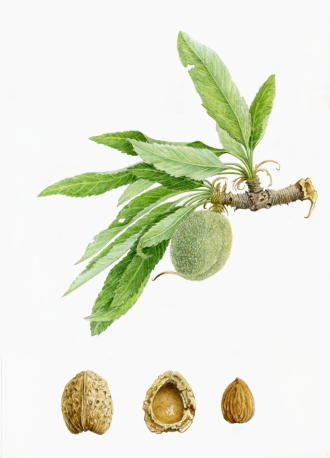
Prunus dulcis, Almond, watercolor by Margaret Best, © 2016, all rights reserved.
BAGSC members Margaret Best, Akiko Enokido, Asuka Hishiki, Mitsuko Schultz, and Deborah Shaw have been accepted into the 19th Annual International American Society of Botanical Artists (ASBA) and The Horticultural Society of New York.
Jurors Susan Fraser (Director, Mertz Library,The New York Botanical Garden), David Horak (Curator of the Aquatic House, Brooklyn Botanic Garden), and Catherine Watters (Botanical Artist) chose 48 artworks from 258 submissions. Works in the exhibition include artists from the United States, Australia, Brazil, Canada, Japan, the Netherlands, and the United Kingdom.
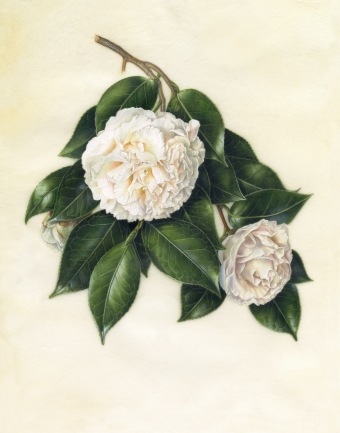
Camellia japonica ‘Hakuho’, Heirloom Camellia ‘Hakuho’ ‘White Phoenix’, watercolor on vellum by Akiko Enokido, © 2015, all rights reserved.
This year’s exhibition is in a new venue: it will be hosted by the New York Design Center and installed in their bright, airy, contemporary gallery space, 1stDibs, on the tenth floor. The Horticultural Society of New York, New York Design Center, and ASBA are designing special outreach events and programs, to be announced in September.
The opening reception will take place on Thursday evening, November 3, 2016 and will be on display through December 30, 2016. The catalog of artwork images will be posted on ASBA’s website the day of the opening. A full-color catalog will be published and available on ASBA’s website, as well as at the 1stDibs Gallery and at The Horticultural Society of New York. For further information please contact ASBA’s Exhibitions Director.
1stDibs is located on the 10th Floor of The New York Design Center, 200 Lexington Avenue, New York, New York, 10018. Gallery Hours are 9:30 – 5:30 Monday – Friday.
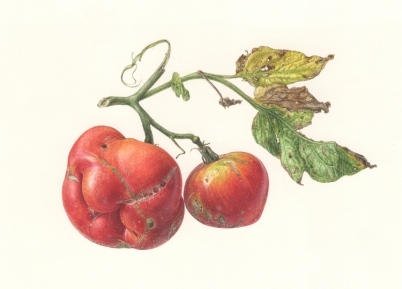
Solanum lycopersicm, Dancing Duo 34-A, Portrait of an Heirloom Tomato, watercolor by Asuka Hishiki, © 2016, all rights reserved.
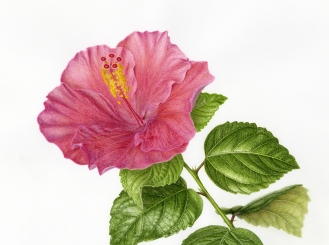
Hibiscus rosa-sinensis, Hibiscus, watercolor by Mitsuko Schultz, © 2016, all rights reserved.
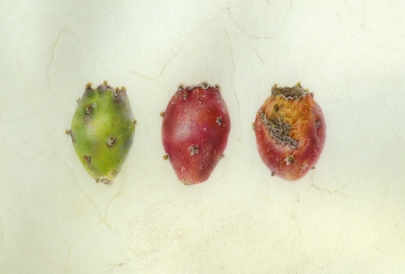
Opuntia spp. Fruit, Tunas or Prickly Pear Cactus Fruit, watercolor on vellum by Deborah Shaw, © 2016, all rights reserved.

California Poppy, 50″x28″, © JW Fike, 2015. Photographed in Miramonte, CA.
by Deb Shaw
There are a wealth of exhibitions this summer in Southern California that are botanically instructive and inspirational.
One is in South Orange County. Soka University in Aliso Viejo is currently showing JW (Jimmy) Fike’s solo exhibition, Photographic Survey of the Wild Edible Botanicals of California, now through August 26, 2016.
Even though his medium is photography, rather than traditional painting or drawing, the intent behind Fike’s large, stark, beautiful photographs is similar to any botanical artist or illustrator:
“Within my system the plant is excavated, arranged in the studio, photographed, then illustrated digitally in such a way as to render the edible parts in color while the remaining parts, less emphatically, read as contact prints.” [Quote from Soka University website.]
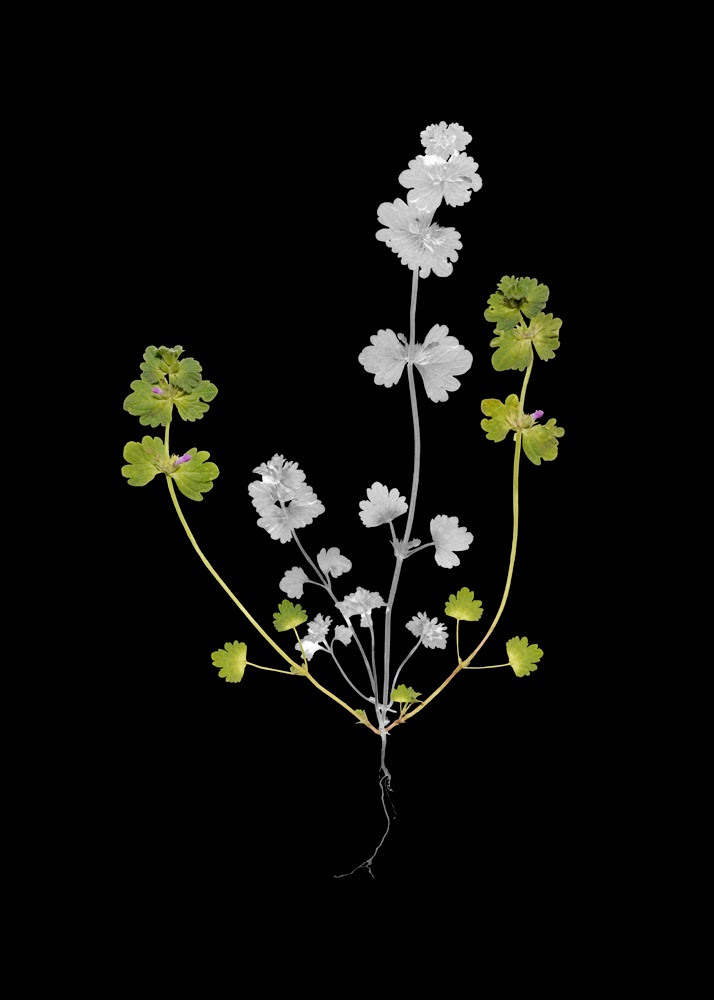
Henbit, 28″x20″, © JW Fike, 2014. Photographed in Miramonte, CA.
After Fike meticulously composes and arranges his specimen to emphasize key plant characteristics, he photographs it and then begins illustrating in Photoshop. Each piece may take up to three or four months to illustrate. (Sound familiar?) Each photograph references scientific illustration, contact prints, and photograms:
“I’m referencing the history of contact prints and photograms from the dawn of photography,” said Fike, noting 19th century English botanist Anna Atkins and pioneering photographer Henry Fox Talbot. “Some of the very first photographs were plant specimens on sensitized paper.” [Quote from LA Times article, Haunting flowers: The eerily beautiful California botanical art of J.W. Fike.]
Fike exhibits a symbiotic collection of edible plants from a geographic area. He has photographed more than ninety plants in “seven different states and plan to continue the survey until I’ve created a collection that spans the continental United States.” [Quote from Soka University website.]

Soap plant, 110″ x 64″, © JW Fike, 2015. Photographed in Miramonte, CA.
Fike’s exhibition has been covered in the LA Times, and on Botanical Art & Artists by Katherine Tyrrell. His photographs and other articles can be found on his blog.
Soka University’s Founders Hall Art Gallery is located at 1 University Drive, Aliso Viejo, CA 92656, 949-480-4000, info@soka.edu
Exhibition now through August 26, 2016
Free Admission
Monday thru Friday, 9:00 a.m. to 5:00 p.m.
Map and directions
by Bonnie Born Ash, photos by Janice Sharp, posted by Deb Shaw
On Saturday afternoon, July 16, 2016, a festive opening reception for “Capturing the Arboretum: the Art of Botanical Illustration” was held in the newly renovated Arboretum Library. Participating BAGSC artists were Cristina Baltayian, Bonnie Born Ash, Diane Nelson Daly, Estelle DeRidder, Nancy Grubb, Cynthia Jackson, Arillyn Moran-Lawrence, Marilyn Parrino, Mitsuko Schultz, Janice Sharp, Deborah Shaw, and Beth Stone.
Artists and guests enjoyed viewing twenty-three fine works of art depicting plants of the Arboretum. Individual works were enhanced by comments from Jurors James Henrich, Arboretum’s Curator of Living Collections; Arboretum Librarian Susan Eubank; and Olga Eysymontt, Botanical Art Teacher. In addition, artwork signage gives the specific location in the reference library to find additional information on each plant illustrated.
Throughout the reception, Estelle DeRidder and Mitsuko Schultz demonstrated botanical art techniques. Additional artist demonstrations are planned in the Library on two Saturdays, August 27 and September 24. The exhibition continues through December 29. Many thanks to our jurors, volunteers, and congratulations to all participating artists!
Library Location
The Arboretum Library is located within The Arboretum. Go straight through the double doors on the left (east) of the entrance rotunda.
Library Hours
Tuesday-Friday 8:30 am to 5:30 pm
Saturday 8:30 am to 5:00 pm
Sunday 12:00 pm to 4:00 pm
Susan Eubank, Librarian
Phone: (626)821-3213
Fax: (626)445-1217
The Los Angeles County Arboretum and Botanic Garden is located at 301 North Baldwin Ave, Arcadia, CA 91007.
Click on an image below to enlarge and view through a slide show format.

Photo by Janice Sharp, © 2016.

Photo by Janice Sharp, © 2016.

Photo by Janice Sharp, © 2016.

Photo by Janice Sharp, © 2016.

Photo by Janice Sharp, © 2016.

Photo by Janice Sharp, © 2016.
By Tania Marien and Estelle DeRidder, posted by Deb Shaw
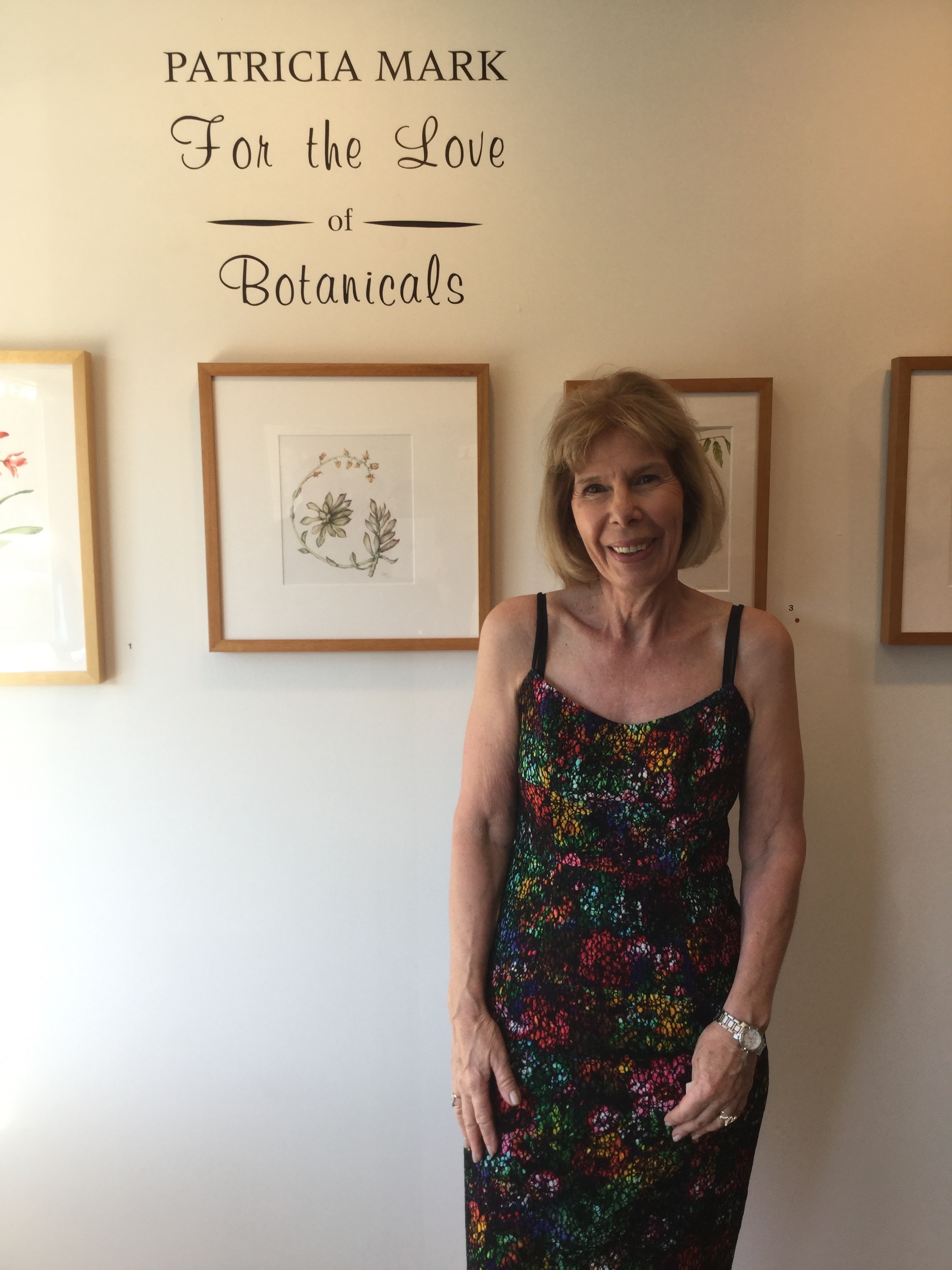
Patricia Mark at the opening reception “For the Love of Botanicals.” Photo credit: Tania Marien, © 2016.
This month BAGSC President Patricia Mark shared her passion for plants, gardens and art in her solo exhibition For the Love of Botanicals.
Twenty drawings and paintings adorned the walls of Bunny Gunner Gallery, a bright and airy gallery located along the quaint tree-lined streets of the historic Claremont Village, in Claremont, California.
The exhibition opened with a very successful reception on July 2. The gallery filled immediately with admiring and enthusiastic guests. Guests included members of the public, friends and current and former Guild members.
Patricia’s paintings were rendered on archival cotton rag in watercolor, colored pencil and graphite. The paintings range in size from approximately 10″ x 10″ to 16″ x 20″. With good street exposure, the artwork is clearly visible from outside the intimate gallery, which attracted members of the public who might not have had intentions of visiting a botanical art exhibition. During the reception the guests spent time examining the artwork up-close and admiring the detail. Many of the pieces have sold.
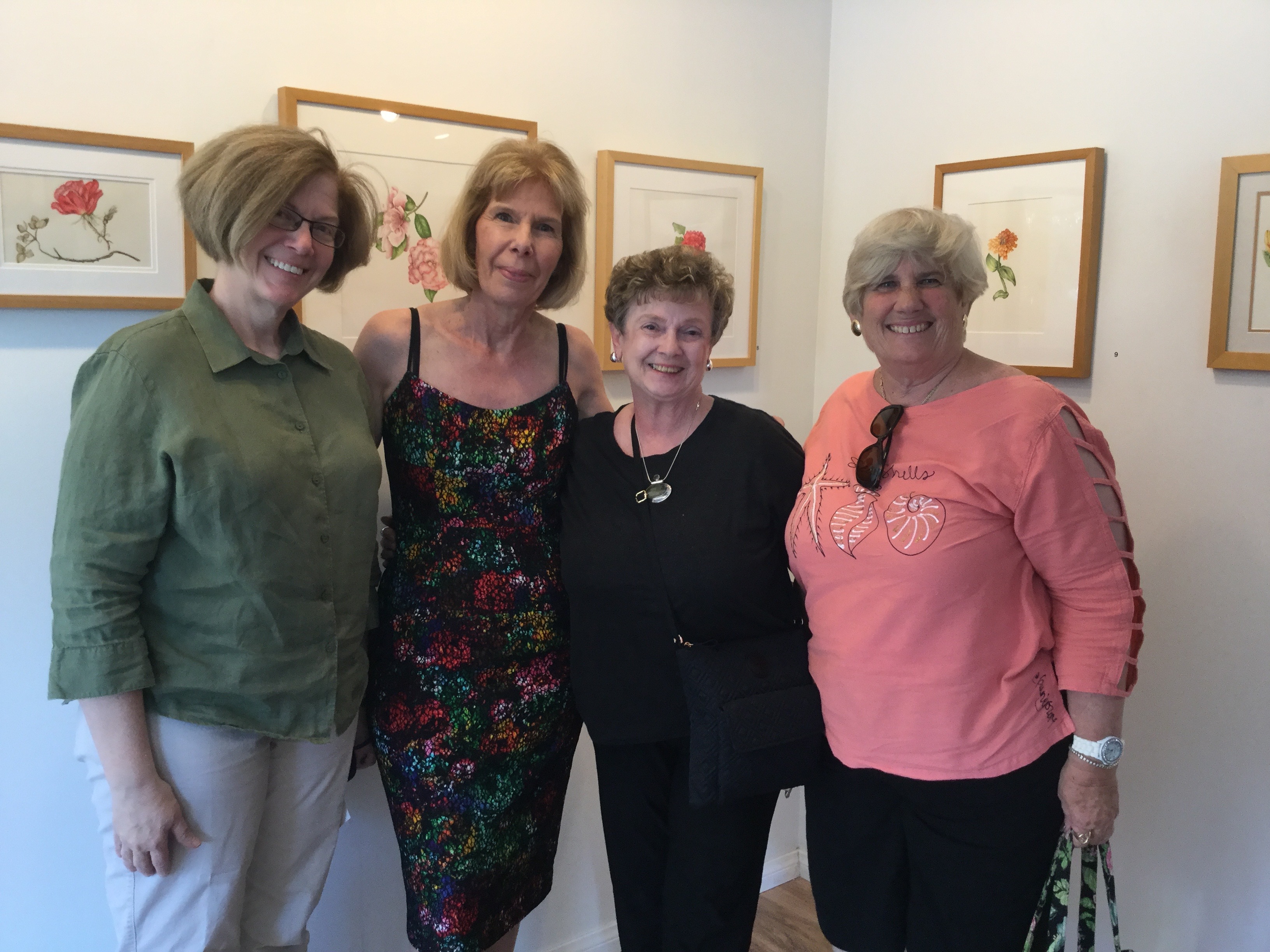
BAGSC members at Patricia Mark’s opening reception included (from left to right): Melanie Campbell-Carter, Patricia Mark, Marilyn Parrino, and Nancy Beckham. Photo credit: Tania Marien, © 2016.
Patricia earned a Botanical Art Certificate at Filoli. Her work has been shown at Filoli, Descanso Gardens, Chapman University Leatherby Library, Roger’s Garden, the Pasadena Showcase House, the Theodore Payne Gallery and the Los Angeles County Arboretum and Botanic Garden.
This exhibit has been extended till August 3rd, with an additional Artists’ Reception on Saturday, July 30 from 6 pm – 9 pm.
The Bunny Gunner Gallery is located at 230 West Bonita Avenue, Claremont, California, 91711, 909.624.7238. The gallery is open:
Tuesday: 12 – 6 pm
Wednesday – Friday: 10 am – 6 pm
Saturday: 12 am – 4 pm
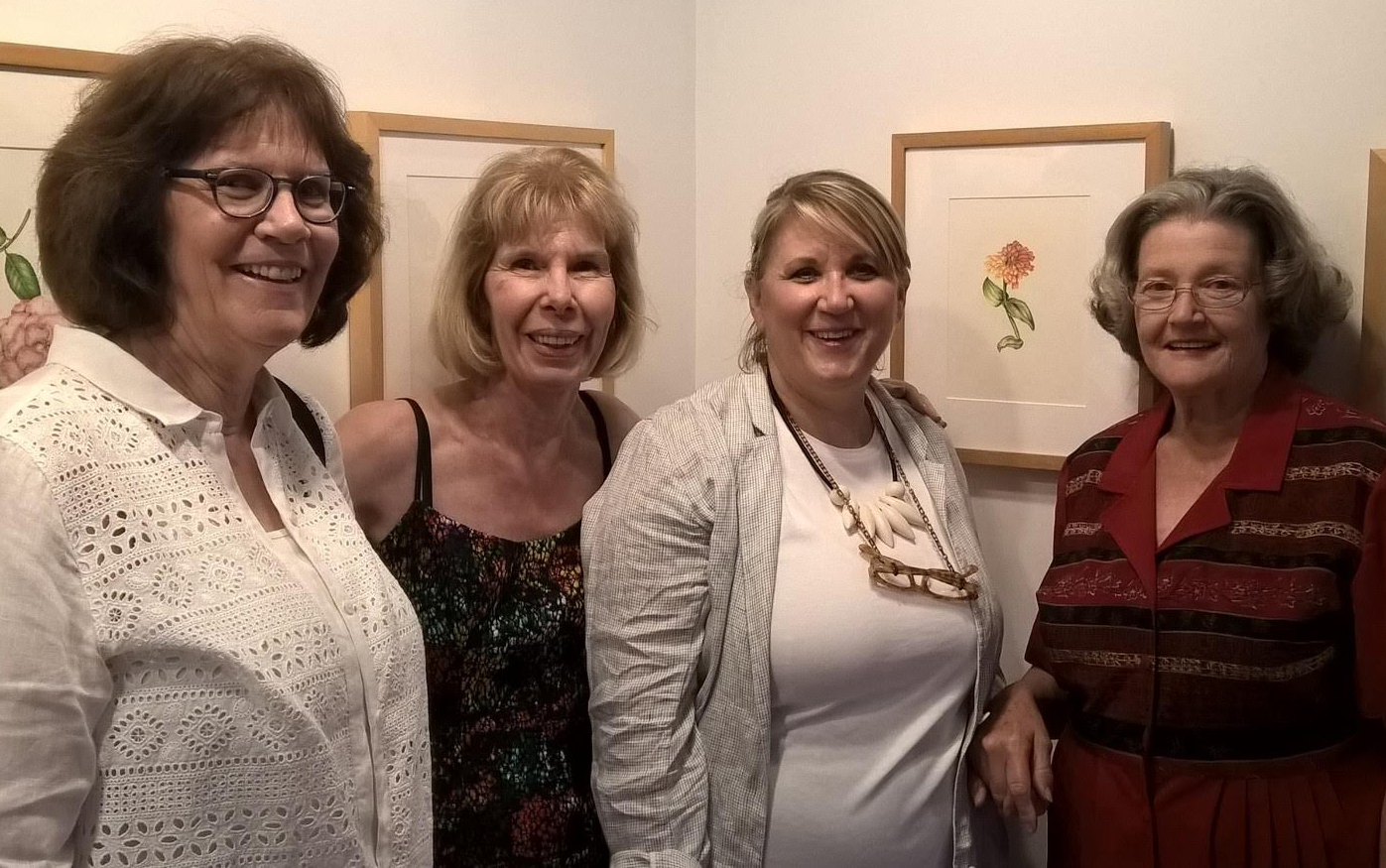
Patricia Mark with BAGSC member guests (left to right): Diane Daly, Patricia Mark, Olga Eysymont, and Estelle DeRidder. Photo credit: Jack Daly, © 2016.

This notice of the Art Show appeared in the latest issue of the Arboretum Newsletter. Artwork by Diane Daly, © 2016, all rights reserved.
by Janice Sharp, posted by Deb Shaw
The Botanical Artists Guild of Southern California will present an exhibit of their work depicting Arboretum trees and flowers from July 16 to December 29 in the Arboretum Library at the Los Angeles County Arboretum and Botanic Garden. Meet the artists featured in Capturing the Arboretum: The Art of Botanical Illustration at a reception:
Saturday, July 16, 2016
1 pm – 3 pm in the Arboretum Library
Members of the local chapter of the American Society of Botanical Artists will demonstrate botanical art techniques including graphite, colored pencil and watercolor in the Library on two Saturdays, August 27 and September 24. Prints and cards will be sold during demonstrations, with a portion of the proceeds to benefit the Los Angeles Arboretum.
The Guild promotes public awareness of this artistic tradition.
BAGSC artists participating in The Art of Botanical Illustration include: Bonnie Born Ash, Cristina Baltayian, Diane Nelson Daly, Estelle DeRidder, Nancy Grubb, Cynthia Jackson, Arillyn Moran-Lawrence, Marilyn Parrino, Mitsuko Schultz, Janice Sharp, Deborah Shaw, and Beth Stone. Congrats to all!
The Los Angeles County Arboretum and Botanic Garden is located at: 301 North Baldwin Ave, Arcadia, CA 91007, 626.821.3222.
The Arboretum Library is located within The Arboretum. Go straight through the double doors on the left (east) of the entrance rotunda.
Library Hours are from:
Tuesday-Friday 8:30 am to 5:30 pm
Saturday 8:30 am to 5:00 pm
Sunday 12:00 pm to 4:00 pm
by Deb Shaw
 The deadline for submission to The California Islands Symposium Art Exhibition has been extended to July 19, 2106!
The California Islands Symposium Art Exhibition will be held October 3 – 7, 2016 in Ventura, California during the Symposium and then moved to the Santa Barbara Botanical Garden in Santa Barbara, California, where it will be on display for one month, from October 9 – November 6, 2016.
Artists are invited to enter original artwork in any two-dimensional medium that reflects the beauty and uniqueness of the California Islands. One source of the flora found on the islands is: https://www.nps.gov/chis/learn/nature/plants.htm. Submissions are not limited to the plant life, but can include marine life, shells, birds and fauna. The only qualifier for content is that the subject matter must be connected to the California Channel Islands. Many of the plants that grow on the Channel Islands also grow on the mainland. Check the lists; if you’ve painted any California natives, you may already have a painting in the drawer that qualifies for submission.
Entries are accepted through http://www.onlinejuriedshows.com and the deadline is July 19th. The symposium website can be found at: http://www.californiaislands.net/island-art-exhibition/. There will be prize money for the top three artists.
“We believe that including the arts in the international island symposium is a critical component in cultivating a greater appreciation of the unique California islands. The juried Art Exhibition is a special event associated with the scientific symposium.”
Questions? Contact the 9th California Islands Symposium Planning Committee at: californiaislands@gmail.com
by Patricia Mark, posted by Deb Shaw
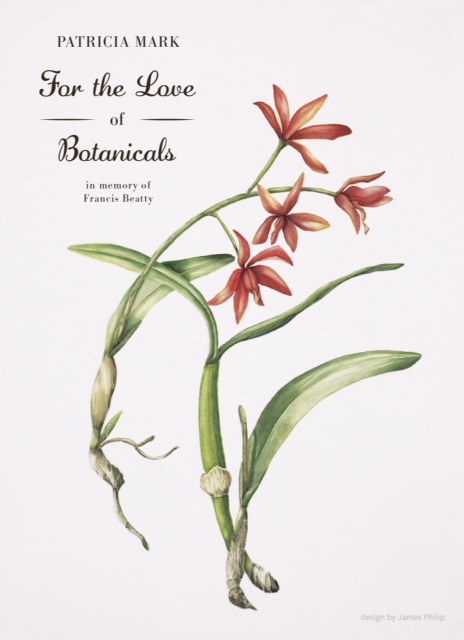
Invitation postcard for Patrica Mark’s exhibition, “For the Love of Botanicals.” Artwork by Patricia Mark, © 2016, all rights reserved.
BAGSC President Patricia Mark will be having a solo exhibition at the Bunny Gunner Gallery, in Claremont, California, in the Village. Entitled “For the Love of Botanicals,” the exhibition is in memory of Francis Beatty.
Opening night reception:
July 2, 6 – 9 pm
Exhibition:
July 2 – July 8, 2016
The Bunny Gunner Gallery is located at 230 West Bonita Avenue, Claremont, California. Hours are:
Tuesday, Noon – 6 pm
Wednesday – Friday, 10 am – 6 pm
Saturday, Noon – 4 pm
Closed Sunday and Monday
 BAGSC News