You are currently browsing the category archive for the ‘News Updates’ category.
by Cordelia Donnelly, posted by Deb Shaw
On June 4, 2016, BAGSC members had the wonderful opportunity to tour Cordelia’s garden, home and view her artwork. It was an enlightening meeting, and one that has generated a lot of discussion about our connections to place and garden, water conservation, design and aesthetics. Pacific Horticulture magazine published an article by Cordelia in their fall, 2016 issue, entitled, “My Horticultural Odyssey: An interdisciplinary approach to designing my garden“. This link goes to the full article, with images of the garden (a few of which are reproduced below).
Cordelia wrote the following for BAGSC News publication. Thank you for your work and inspiration! —Deb Shaw

Standing stones in the completed front garden are reclaimed Kansas fence posts, pieces of ancient ocean limestone bed, used to mark farm boundaries in a prairie ecosystem lacking trees. Photo © 2016, Cordelia Donnelly.
Water scarcity is shifting the paradigm of how to live and garden in Southern California. I completed my first garden renovation in San Marino in 2011 in order to close the building permit for a 1926 Spanish house renovation on a plot of land measuring 57 by 119 feet. A childhood of extensive blue water sailing across the South Pacific with my family prepared me well for these land-based adventures in engineering, science, law, code compliance, community design review, culture, horticulture, garden aesthetics, craftsmanship, and storytelling. Water was finite onboard our boat, and this set the stage for my interest in water conservation, reclamation and recycling. My garden teaches continuously and its story is still unfolding to my wonderment, to 1,200 visitors and counting.
I was educated in liberal arts in the true sense: fine art, applied design, education, ecology, land and water management, and writing. Work in these fields helped me recognize the potential significance of this interdisciplinary garden voyage. It is said that writing is thinking. Now I have learned very well that gardening is thinking. My garden design involved ideas about craftsmanship, where form follows function. I prioritized this garden design around water use, including capturing and redirecting water, and gradually practicing deep and infrequent watering as plants’ root systems get established. A site condition, such as the pronounced slope in the front yard, lends itself very well to growing Proteas and Banksias.
The chemistry of water enables life. Life in its diversity has adapted on Earth to different states and forms of water. Yet, we live in a remarkable age of science when it is theorized with high probability that the most common form of precipitation in our universe does not exist as water, but as diamonds, raining down on planets such as Saturn and Jupiter. While concepts of valence, polarity, surface tension, and cohesion describe atomic and molecular attributes of water, they also describe the human condition. We are One—with Water!
Plants, cyanobacteria, and algae, too, have special relationships with not only water, but also with light and darkness, in oxygenic processes to manufacture chemical energy. Science has discerned how these organisms have customized their methods of photosynthesis, for example, to explain why Agaves using CAM (Crassulacean Acid Metabolism) reactions are so well adapted to desert climates. To give an idea of the atmospheric scale significance of oxygenic processes, it is estimated that if such oxygen-giving processes by these life forms were to halt, the oxygen in Earth’s atmosphere might run out in a few thousand years. Discoveries are unfolding about significant anoxygenic processes found in various bacteria, which rely on chemical conversions in water, without sunlight but with other kinds of radiation, since the visible spectrum is only one type of light. The diversity and virtuosity of these mechanisms suggest that other planets in our universe may indeed contain very strong forms of Life.
Recently, Dr. Dianne Newman at Caltech has discovered, in the new field of molecular geomicrobiology she created, that bacteria in ocean sediments photosynthesize using iron instead of water. It is appropriate to be awed by intricacies of today’s science, which are uncovering some of the most ancient survival mechanisms on Earth, and spurring innovations in medicine by attending to how natural systems work. Furthermore, she has applied geoscience to solving a problem of chronic medical infections in humans. Dr. Newman has found that in a chronic infection such as cystic fibrosis, Pseudomonas aeruginosa (a long studied bacterium) produces pherazines which promote biofilm development in the lungs, inhibiting pathways for antibiotics to clear such infections. Logically understanding that the growth of P. aeruginosa is controlled in nature by a natural mechanism, she then searched for and found both P. aeruginosa and a coevolved bacterium, just in the soil outside her lab! This coevolved bacterium produces an enzyme which is able to degrade pherazines produced by P. aeruginosa, thereby rendering a chronic infection by P. aeruginosa more treatable by antibiotics. Human therapies for chronic infections based on her research will be available in a decade! It is time to bring our awe back to our gardens and to think of native plants as forms of technology—which are already adapted for our current climate conditions.
This garden project required extensive research. Attending a course taught by Lili Singer at Theodore Payne convinced me to rip out the conventional grass lawn as a first step. Ruth Shellhorn’s climate appropriate landscape design in 1982 for my parents’ home had also influenced my thinking about the potential for this garden project. My mother gave me Thomas Church’s Your Private World. San Marino’s Planning Department supported my renovation ideas, for which I am grateful. Government entities play a primary role in implementing sustainability, and California has made major changes to its Building Codes, which will soon become much stricter. But tensions certainly exist because of the need for change, and certain laws soon may apply sustainability mandates to all homeowners, not just to those renovations and new construction.

Antique wrought iron gates and several cloud form cast metal panels from a disassembled Chinese pavilion in Bel Air were found on Craigslist and repurposed in the finished landscape as gates and wall pieces. Photo © 2016, Cordelia Donnelly.
My project demonstrated to San Marino how garden beauty can be created using concepts of sustainability. I did not pour cement in the front yard garden because cemented hardscape is viewed as unsustainable—and thus also avoided design review. Concrete for my house renovation was poured only where required by Building Codes. As a foundation for steps leading into the garden from the street, green-treated wood beams are skewered into the slope by steel rods, a method used for building steps on hiking trails in US National Parks. The next layers use Stabiligrid tile, clad with copper as the riser material, hardwood planks for treads, finished by quartzite pavers set in sand. A liquid acrylic polymer was used to harden the sand while also providing permeability.
In the spirit of sustainable recycling, I tried where possible to reclaim assorted left-over or salvaged materials from craigslist to use in this project. The antique terra cotta riser tiles in the backyard are from France, by way of a tile setter who had completed a project in Malibu, and advertised his extra tiles on craigslist. Luckily, I also bought a pair of antique wrought iron Chinese gates and several Chinese cloud form cast metal panels, from a contractor who had disassembled a Chinese pavilion in Bel Air and listed these materials on craigslist.
I felt a solidarity with my Chinese neighbors, who supported me from the very beginning. I decided to align my aesthetic values for this project to honor the rich heritage of Chinese gardening. Chinese landscape design’s majestic history brings together Confucian, Daoist, and Buddhist influences. The spiritual depth appeals as much as the aesthetics, and the interdisciplinary wisdom thrills. This path of mastery involves concurrent mastery of poetry, calligraphy, and landscape painting—understanding the influences each of these disciplines has on the others, thus making a garden a living vignette of nature’s lyrical beauty. I fell in love with the idea of views in a Chinese garden unfurling gradually to the viewer, much like the scrolls of a Chinese landscape painting. The viewer takes a journey through such a garden in order to enjoy the different vantage points.
One of my goals in renovating the house was to make the house relate directly to the garden, and this new relationship can be enjoyed through a series of large windows, including the very large arched window in the living room, and three different sets of glass sliding doors looking out onto different garden views. As the sun travels throughout the day, the house itself becomes the garden sundial. I intuitively planned my garden design for the passage of light across the various spaces, influenced by my years of landscape painting. I sought consciously to unify the values of the green colors of plants in order to allow texture and temperature to operate to the eye—this is a strategic lesson from painting applied to gardening.
Another major influence on my thinking was the Mediterranean Garden Society/Pacific Horticulture 2010 Symposium at the Los Angeles Arboretum. This Symposium’s speakers, the local garden tours, the gorgeous Australian plants grown by Jo O’Connell, and conversations with people about gardens changed my life, within the already transformative context of researching Chinese gardens. These experiences convinced me to install drip irrigation for the entire garden. “Woolly Pockets” I saw at the Symposium helped me create vertical gardens on walls and balconies, and further online searches led me to “Smart Pots,” made of recycled plastic bottles, to use as larger containers. I decided to use Australian native plants for my garden upon seeing their poetic textures, remembering them from my childhood, recognizing their symbolic otherness, and their significance to plant evolution and the geologic history of our planet. These plants evoke ideas held in the Dreamtime: origin stories of creation, ancestral voices, relationships between humans and nature, and spiritual quests toward Oneness.
A dry stream bed, using native granite rocks rescued from the basement excavation, invokes the memory of water in this native landscape. Inspired by Jeffrey Bale’s colored pebbles, I used polished coral pebbles in the bottom of the stream bed as a color contrast to the pea gravel on the garden paths. When it rains, the dry stream becomes very colorful. I planned the stream bed to cross the front garden approach, in an informal X, as in X marks the spot on a treasure map. Here, too, is the satisfying idea that one must cross over the stream on the journey to the front door. This spring I was very pleased to take my mom on a driving tour to see eight neighboring gardens installed since I completed this one, in which the homeowners chose a similar theme of dry stream bed crossing the front path approach in an informal X. As an artist and designer, I think asymmetry plays a very important role in leading one’s eye through a composition, whether in a painting or in a garden. The front garden was made more mountainous by adding soil to match the slope of the neighbor’s garden, as allowed by the Grading and Drainage Permit. The aim was to create a relationship between mountain and water, and to honor the spiritual significance of this relationship as articulated by Confucius. Another practical goal was to raise the soil level because hedge height can be measured from the higher soil level, and furthermore, because specimen plants can be grown here without a height limit to cushion the front yard garden from the busy street.
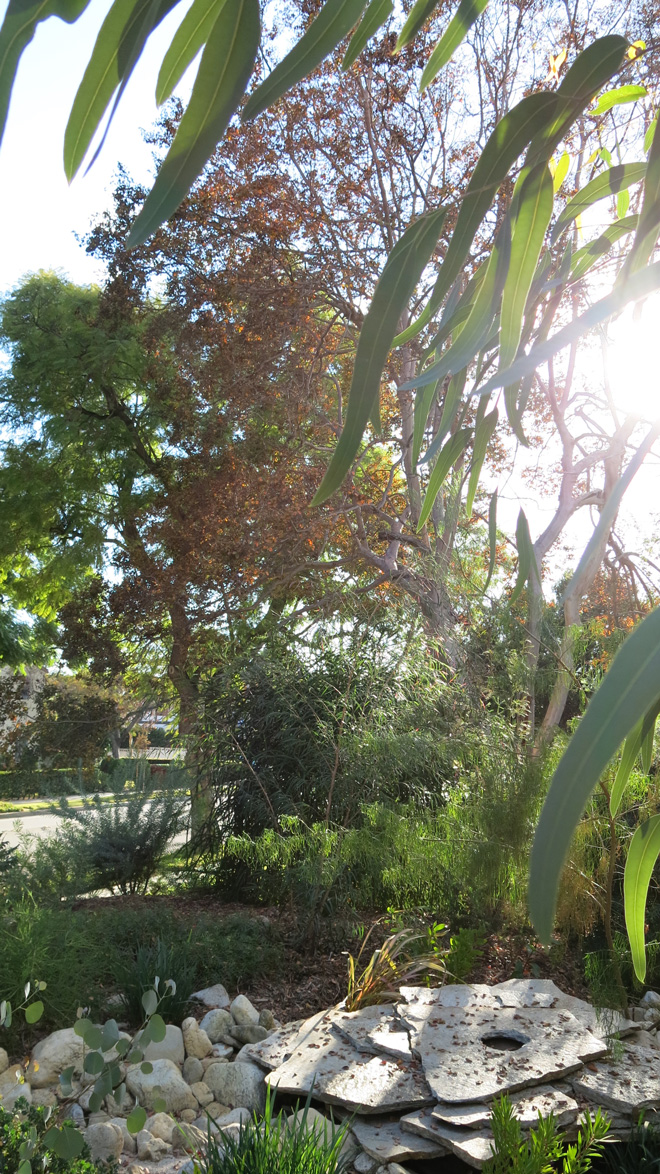
A sound sculpture in the front garden activates with rain. Water is harvested from gutters on the house and garage and pumped into the sculpture before draining through a perforated drainage grid. Photo © 2016, Cordelia Donnelly.
An integrated drainage system, the first of its kind to be permitted in my city, orders this garden universe. My sister gave me Brad Lancaster’s Rainwater Harvesting for Drylands and Beyond, which I used to do the engineering to secure a Grading and Drainage Permit. This plot of land is blessed with incredibly advantageous riverine geology, once part of extensive orange groves, and a slope of 4-1/2 feet from the backyard to the front yard. She encouraged me to add a unique water feature to the drainage system, and reaching beyond exhaustion, I resolved to think carefully about this. So, I designed a “sound sculpture” in the dry stream bed. Rainwater flows passively from house and garage gutters, collects in an underground basin and is pumped up into the sound sculpture. Sufficient rain creates the sound of rushing water in the sound sculpture. Then this water drains passively underneath the entire front garden through a perforated drainage grid. A key feature of the sound sculpture is that it only works when it is raining. Another aspect of its design was to stack a series of quartzite flagstones on top of the sound sculpture basin, to create a Goldsworthy-like nest form in order to hide the brownish rain gutter water from view.

Permeable gravel surfaces finished with StabiliGrid tiles hold gravel in place and provide ADA-compliant wheelchair accessibility for the driveway and garden. Photo © 2016, Cordelia Donnelly.
The permeable gravel driveway was finished with Stabiligrid tiles to hold the gravel in place. The Stabiligrid tiles filled with gravel also give the driveway and garden ADA-compliant wheelchair accessibility. Indeed, less concrete used in my whole garden renovation allows greater permeability: there is no runoff from the property. An outdoor soaking tub stands dry and covered, relies on zero chemicals, and is tied into the drainage system. A backyard pond is designed with an herbaceous border and contains chemically treated water. This pond drains itself separately from the drainage system, and is designed to drain passively into a deep french drain. Integrated drainage systems have been built since ancient times across diverse civilizations, and at different levels of complexity and cost. Even if we are not building drainage for an extensive palace, such as that found at Knossos on Crete, and at Machu Picchu in Peru, we need to do whatever we can to save water. These ideas are ancient, but feel new to our suburban gardening culture.
Recently, I installed an Australian-designed, gravity-fed, gray water drip system. I specified an Aqua2Use gravity filter with IrriGray drip components, which is distributed by WaterRenu.com in the USA. My system satisfies CA Building Codes and involves no modification of existing plumbing. It allows upstairs bathtubs to drain into the garden, via manual siphon into heat-proof Pex pipe going through the exterior wall. This drainage into my garden is encouraged provided that only low-sodium, pH neutral, bio-degradable soap is used (Dr. Bronner’s). To avoiding over-watering with supplementary water, this system sends water to general front garden beds, instead of to specific plants, and serves the major purpose of allowing this water to infiltrate back into the land.
Reflecting upon this garden odyssey, these journeys within journeys, I realize I have honored not only great cultural and aesthetic traditions, but also those of my ancestors. My great grandfather and grandfather developed diverse industrial uses of diatomaceous earth, an ingredient in the cactus mix I use for planting. I also have honored my parents: my mother, a teacher, and my father, a builder-developer in Pasadena, California. This garden honors a growing global awareness about the need for sustainable water use and climate appropriate plants in every garden.
It is a miracle to witness how beauty transforms awareness, invites conversation, and inspires!
NOTE: BAGSC News previously published a plant list from Cordelia’s beautiful garden. Click on the words “plant list” in the previous sentence to view it, along with some pictures from the tour.
by Jennifer Lazar, 101 San Diego; and Lisa Reynolds, San Diego Botanic Garden; posted by Deb Shaw

BAGSC’s exhibition “Cornucopia” at the San Diego Botanic Garden is on the home page of San Diego Media Marketing’s website. The link has more information about the exhibition and a coupon for $2 off admission to the Garden.
San Diego Media Marketing has promoted BAGSC’s exhibition Cornucopia at the San Diego Botanic Garden in their 101 Things To Do in San Diego update.
Cornucopia: A Botanical Art Exhibit at San Diego Botanic Garden is one of the “Featured Slides” on their home website from October 31 – November 6, 2016. They have also scheduled Facebook and Twitter posts for November 2!
Clicking the link from the home page calls up a page with more information about the San Diego Botanic Garden and the Cornucopia exhibition. The page also includes a coupon for a $2 discount on adult admission to the Garden, limit of four (4) adults. The coupon is good through December 31, 2016.
by Asuka Hishiki, posted by Deb Shaw
Flora Japonica opened mid-September, 2016 at the Royal Botanic Gardens, Kew, in London. Before the opening, I personally felt very overwhelmed and was worried about how we would be received. It turned out GREAT! The people at the Kew were so nice and friendly. When Dr. Shirley Sherwood congratulated us at the opening speech, I felt so honored to be a part of the celebrated show.
There is so much to tell about the exhibition. There are, however, so many good writings about the show already available. Instead of summarizing those good reads, I thought I would make a list of the links for you to visit. Meanwhile, I would love to share my thoughts on several specific artworks. This are just my opinions and maybe rather boring ones at that, but I hope you enjoy walking with me through the show.
I have mentioned that these are just my opinions. Keep in mind, my bold statement is this: I think that most Japanese endemic plants are rather unflattering. Meaning that they are not obviously gorgeous like roses, tulips or tropical plants. Maybe this is the case not only with Japanese native plants; perhaps many endemic plants appear very humble looking. Well, really? It could be because these plants are not looked at properly.
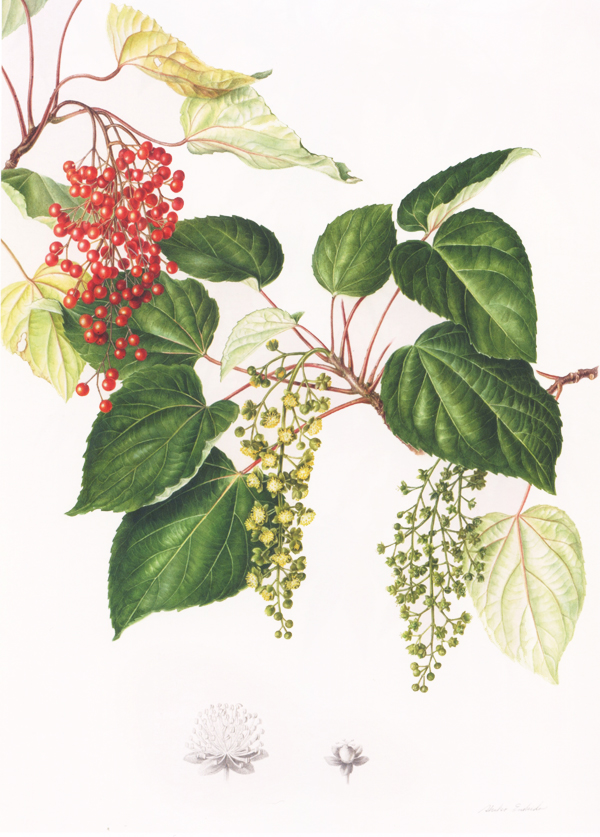
Idesia polycarpa, watercolor on paper, © 2016, Akiko Enokido.
Take a look at the watercolor Idesia polycarpa by Akiko Enokido. I think the actual plant (not her painting!) is very modest looking. Its male and female flowers are especially small and plain. However, if you look at it up-close as Akiko did, it is obvious that the flower clusters are very gorgeous! Akiko successfully converted the modest look of the plant into a dynamic figure using her vivid and strong color. The beauty is sometimes there in front of us, but it doesn’t reveal itself until we open our eyes properly. I think as artists we have the wonderful power to help open the secret door, clearing the smoke that hides nature’s beauty.
Speaking of color, I thought many of the artists’ subjects held a very clean but pastel color. I wondered how they achieved their shades. On first look, I thought perhaps the artwork was done in color pencil, but no, it was watercolor. In some parts, I saw tiny, tiny brush strokes. Instead of washing those stitches out, the artists kept them, floating them onto white paper, like a Georges Seurat painting. I couldn’t get an answer about this technique from my fellow artists, so I will tell you when I find out.
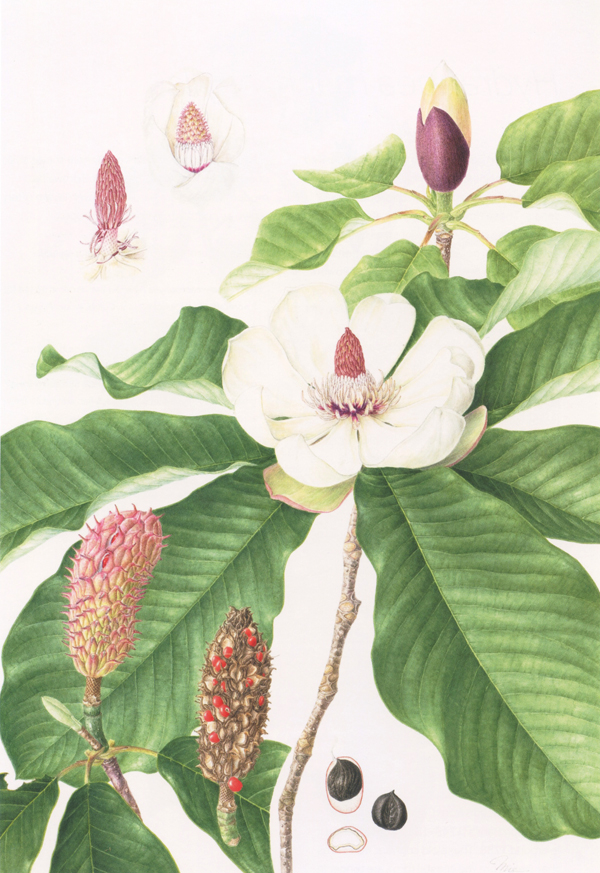
Magnolia obovata, watercolor on paper, © 2016, Mieko Konishi.
You may have the same question I have: how to portray something huge like a whole tree, or a plant like Magnolia obovata, which has leaves that grow up to 45 cm long and 25 cm wide? Two fantastic artists had the answers for me in this show.
The way Mieko Konishi portrayed Magnolia obovata was awesome! She positioned a main flower right up the center, and from it huge leaves spread in all directions. The leaves are cropped off in the middle. Only the two front leaves show almost the complete leaf shape, but even these leaves are cropped off at the tips. This is a huge painting already, but Mieko uses cropping and composition to indicate that the plant is too big to fit the paper. Her image reminded me the surprise I had when I picked up a Magnolia obovata leaf from the ground. I knew it was big, but seeing the actual leaf and holding it gave me additional amazement.
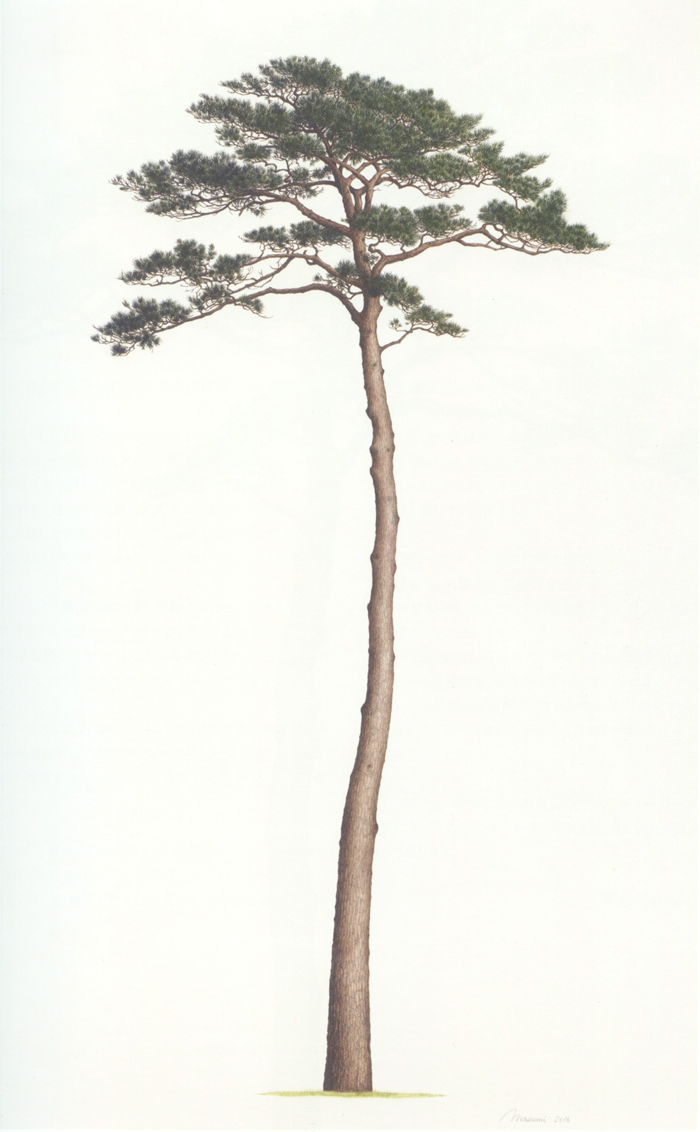
Pinus x densithunbergii, watercolor on paper, © 2016, Masumi Yamanaka.
The other example is done by Masumi Yamanaka. Unfortunately, I couldn’t see her Pinus x densithunbergii in person. It was planed to be exhibited at the Japanese embassy in London a few weeks after I visited. This tree is known as the “Miracle Pine”, which survived the devastating tsunami that accompanied the Great East Japan Earthquake in March 2011 and somehow remained standing, even though the entire 70,000-tree pine forest along the beach was uprooted.
I had a privilege, however, to visit her studio in Kew Garden where she works with other official botanical illustrators of Kew. I could go on and on about the visit, but I would like to go back to her tree painting. I wondered how she created the tree painting without the actual tree in front of her. I watched her short documentary about the painting. Yes, she had many many references of the tree. Yes, she visited the actual tree and made the color samples at the site. But if she had had only those references, the tree would not be portrayed as accurately as it is in her artwork. What her painting contains is her experience and knowledge as a botanical illustrator. She has studied hundreds and thousands of plants with her keen observation and has painted them. This wisdom is laid on underneath the image.
I think the time we spend on a painting is not only spent on that specific artwork, but the knowledge we gain remains and accumulates in us as wisdom.
When I walked in the Kew garden and bumped into one of the trees Yamanaka had portrayed, I had a warm sensation as if I had just run into someone I knew.
Lastly, I couldn’t pass up telling you about what I do not know how to explain. Confusing, yes.
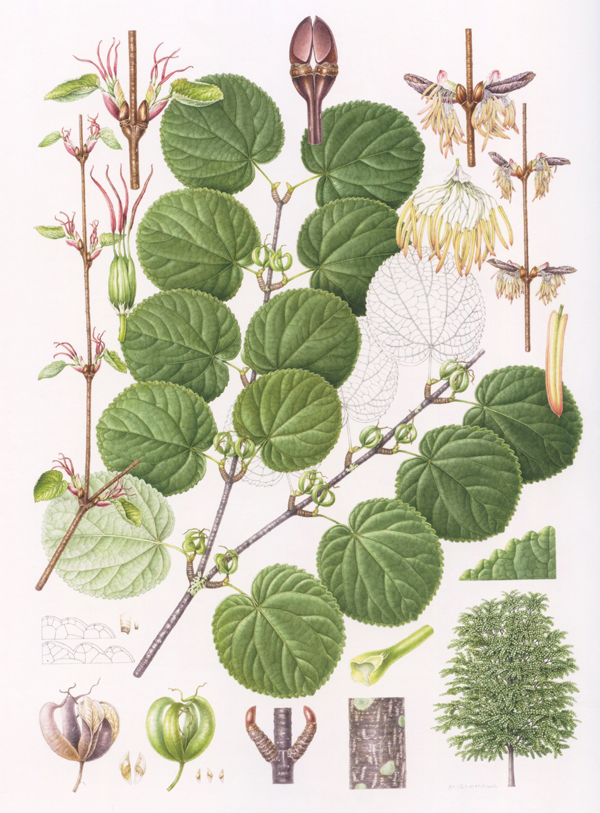
Cercidiphyllum magnificum, watercolor on paper, © 2016, Mieko Ishikawa.
I just had a “wow” when I saw Mieko Ishikawa’s Cercidiphyllum magnificum. The plant itself is again, very humble looking at first glance. Yet it grabbed my attention immediately. What captured me the most is the perfection of the drawing, The leaves look soft and slightly rounded, and the male and female flowers are delicate, yet lively. It is extremely realistic, yet informative. Even though she includes many details in various sizes and different angles, everything fits fantastically into one frame. In her illustration, I think that Art and Science meets in a precise middle point and keep a golden balance. Well, to be honest with you, I have no background nor knowledge of the science of botany, so I may have no idea what I am talking about. There are just so many things in this one painting to gaze at, to be amazed by, to learn, and questions to pose and think about.
“Good artists copy; great artists steal.” This is a famous quote by Picasso. I simply wish he also told us how to steal it.
The Flora Japonica exhibition is open from 17 September 2016 to 5 March 2017, 10 am to 5:30 pm in the Shirley Sherwood Gallery of Botanical Art at the Royal Botanic Garden, Kew, London, UK. Price is included with entry to the Gardens.
This exhibition includes about one hundred Japanese wild, native, endemic plants, portrayed by 36 of the most eminent contemporary Japanese botanical artists. The exhibition also features historic drawings and paintings by some of Japan’s most revered botanists and artists such as Dr. Tomitaro Makino (1863-1957), Sessai Hattori and Chikusai Kato (Edo period artists 1603-1868).
Additionally, works from Kew’s Illustration and Economic Botany collections also are on display, including an early Japanese botanical illustration, Honzō Zufu by Kanen Iwasaki (1786–1842), an illustrated encyclopaedia of medicinal plants from 1828, and Japanese wood panels by Chikusai Kato (1878), which are made from the wood and framed with the bark of the trees that they depict.
Royal Botanic Gardens, Kew is located at: Kew, Richmond TW9 3AB, United Kingdom, +44 20 8332 5655.
Find information about Flora Japonica on Kew’s website.
Two press releases about the exhibition can be found here, and here.
Purchase the Flora Japonica catalogue.
Read the DAIWA Foundation article about the exhibition.
Read about the Flora Japonica exhibition on Asuka’s website and view Asuka’s artworks and exhibitions.
by Deb Shaw

Aristolochia gigantea, ink on paper, Lesley Randall, © 2013, all rights reserved
The 14th International Exhibition of Botanical Art and Illustration by The Hunt Institute for Botanical Documentation has been traveling around the United States for the past two years. Its final stop is at the Petaluma Arts Center in Petaluma, California, for a botanical art exhibition entitled Floribunda, which will run from October 16, 2016 through December 11, 2016.
Floribunda is a celebration of all things floral, featuring the 36 artists from nine countries in The 14th Hunt exhibition, including BAGSC members Leslie Randall and Deborah Shaw. Additionally, the Petaluma Arts Center will feature the work of Aimee Baldwin, Evan Kolker and Randy Strong—three Bay Area artists who create three-dimensional representations of flowers.
“This exhibition is designed as a source of inspiration and an invitation to see the natural world around us in distinct ways, to illuminate the relationship between art and science,” explained Petaluma Arts Center Exhibitions Manager Kim Chigi. “With Botany as one of the sciences, we are excited about the juxtaposition of traditional botanical illustration with the contemporary three-dimensional creations, working in tandem, to explore the connections between the creativity of both artist and nature.”
The Petaluma Arts Center will host a series of events related to the exhibition, including artists’ talks, studio workshops, and botanical art demonstrations:
- Saturday, November 5: Botanical Art Demonstrations with BAGSC member Nina Antze, and Martha Kemp, Lucy Martin and Vi Strain, 1:00 pm, FREE
- Thursday, November 10: Artists’ Talk with Evan Kolker and Randy Strong, 7:00 pm; doors open at 6:30 pm.
- Sunday, November 12 -13: Watercolor Botanical Workshop with Amber Turner
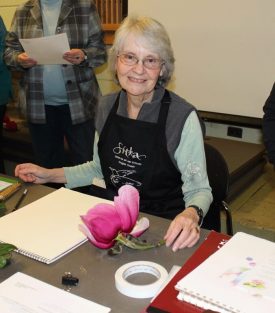
Nina Antze, Martha Kemp, Lucy Martin and Vi Strain, will demonstrate botanical art in a variety of media starting at 1:00 pm on Saturday, November 5, 2016. The demonstrations are free.
Details and ticket information can be found on the Events page on the Petaluma Arts Center’s website. To arrange for group visits or school tours, email or call Kim at (707) 762-5600 x104.
Following the 14th International Exhibition at the Hunt, the travel exhibition went to the Southern Alleghenies Museum of Art—Loretto and was on display from October 18 through December 6, 2014. The exhibition then traveled to the Fellows Riverside Gardens in Youngstown, Ohio where it was on display until January 10, 2016.
The Petaluma Arts Center is located in the historic train depot at 230 Lakeville St, Petaluma, California, 94952. Gallery Hours are: Thursday through Monday, 11 am-5 pm. The gallery is closed Tuesday, Wednesday and holidays.

Prosopis pubescens seed pod (Screwbean Mesquite, or Tornillo), watercolor and graphite on honey vellum, © 2012, Deborah Shaw, all rights reserved.
Admission to the Petaluma Arts Center is $5 for general admission and $4 for seniors. Students, teachers, military, and PAC members are free.
by Jude Wiesenfeld and Janice Sharp
Last April Alexander Viazmensky (Sasha) and his students held their first Botanical Art Exhibition in St. Petersburg, Russia (see the article on page 9 of The Botanical Artist, the journal of the American Society of Botanical Artists (ASBA) for June 2016, Volume 22, Issue 2, ISSN 1523-5165*).

Sasha Viazmensky demonstrating initial watercolor technique for painting a mushroom.
This October 19 – 21, 2016, Sasha came to teach a workshop about painting mushrooms for BAGSC artists. Held at the Los Angeles County Arboretum and Botanic Garden in Arcadia, California, Sasha brought with him a wealth of knowledge on his speciality. His technique is largely wet on wet. He reiterated often that we should get ready to put the paint on the paper, then STOP and think about where we will place the paint before proceeding.
One thing we learned to observe is how many more gills appear at the edge of the mushroom that are thinner and closer together than the ones near the stem.
Sasha was an excellent and affable teacher. Each day we watched him demonstrate the techniques for different types of mushrooms. He spent a great deal of his time individually guiding each of us.
* The Botanical Artist is a quarterly publication for members of ASBA. Back publications are available to members for purchase. View a sample of The Botanical Artist.
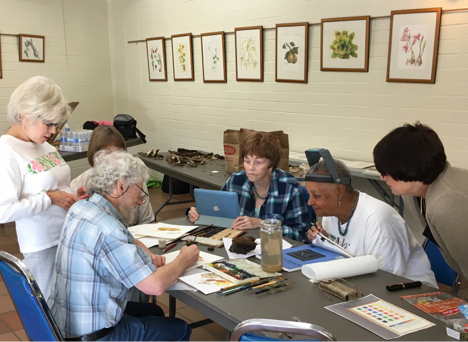
Sasha demonstration of a Polypore Mushroom (fungi that grow on tree trunks).
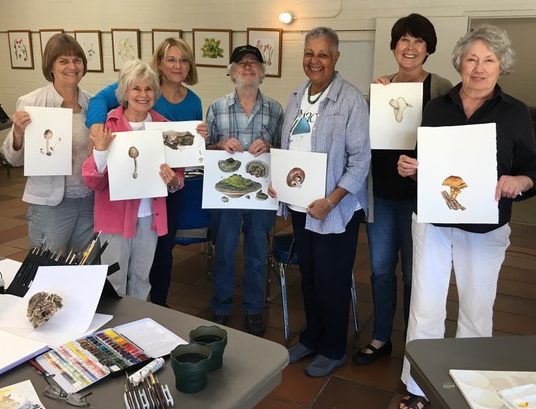
Those in attendance were (from left to right):
Beth Stone, Gilly Shaeffer, Olga Eysymontt, Sasha, Cynthia Jackson, Janice Sharp and Bonnie Ash (missing from the photo are Pat Mark, Kathy Morgan and Jude Wiesenfeld).

These are examples of our work!
by Deb Shaw
Cristina Baltayian will continue her monthly series of botanical art classes at the LA Arboretum through the Fall:
4 Tuesdays per session per month
10am – 2pm (includes lunch break) / Oak Room
The Fall session dates are:
October 4, 11, 18, 25
November 1, 8, 15, 22
December 6, 13, 20, 27
Costs are $275 for Arboretum members per month / $295 non-members per month (includes Arboretum Admission).
To register, please call the LA Arboretum Education Department at 626.821.4623 or pay at the class.
These classes will explore color pencil, graphite, pen and ink, and watercolor on various papers, vellum and other surfaces. The emphasis will be on plant observation, drawing, composition, color theory and matching, and medium techniques. In conjunction with the Botanical Artists Guild of Southern California, students will be studying and portraying many of the Arboretum plant introductions from the last 50 years. The goal is to build a collection of paintings that will celebrate and document the invaluable contribution of the Los Angeles Arboretum to the state of California.
The LA Arboretum is located at: 301 North Baldwin Ave, Arcadia, CA 91007.
by Sally Jacobs, posted by Deb Shaw
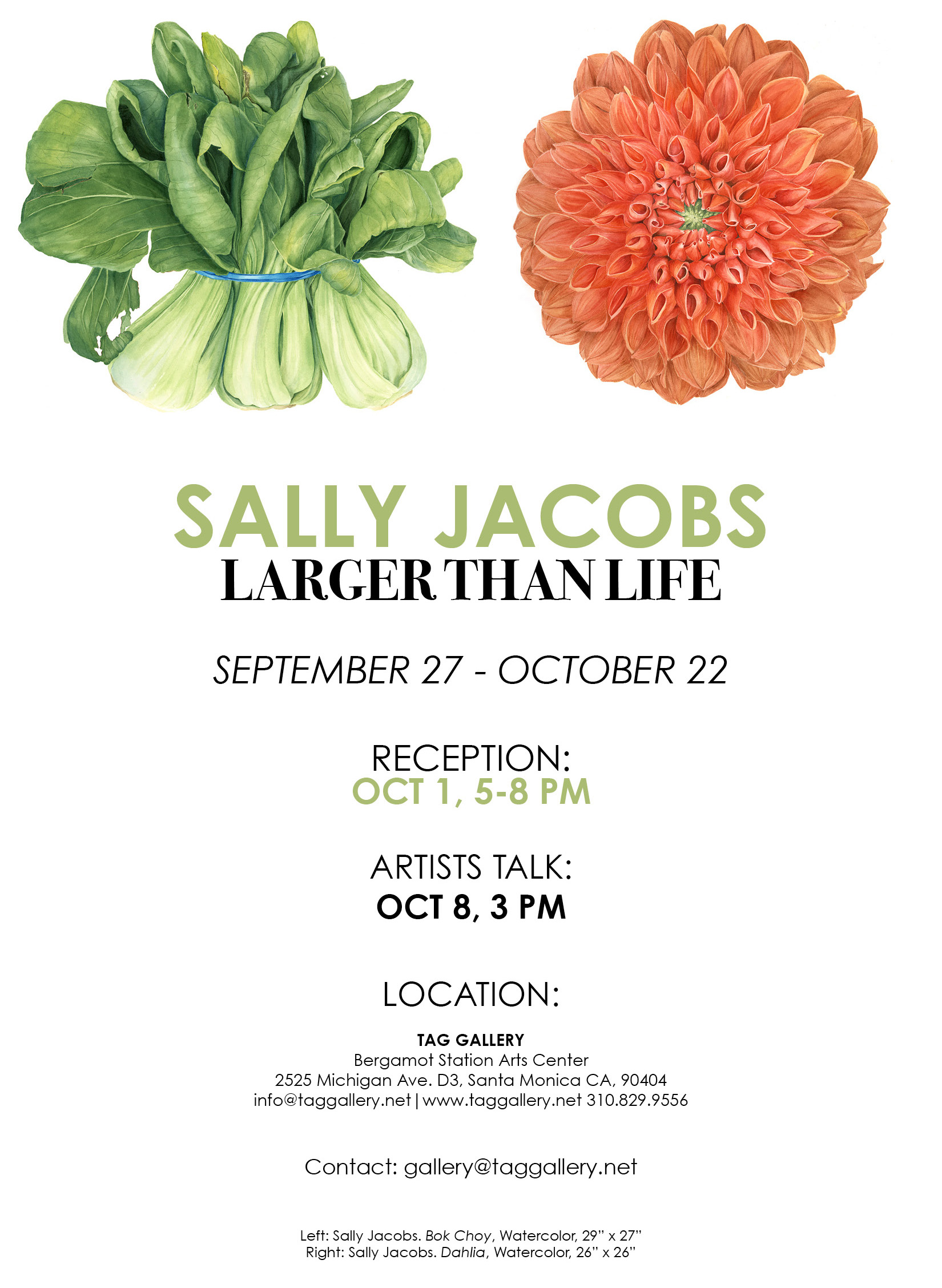
E-invite for Sally Jacobs exhibition, Larger than Life at TAG Gallery.
Sally Jacobs will be giving an “Artists’ Panel” for her exhibition, Larger than Life this Saturday, October 8, 2016 at 3:00 pm at the TAG Gallery in Bergamot Station Arts Center. It’s a great way to see the show and hear about her approach, technique, and more.
The Los Angeles Times gave the show a great review! See the LA Times review of Larger than Life here: http://www.latimes.com/home/la-hm-sally-jacobs-20160926-snap-story.html
The gallery is located at:
TAG Gallery
Bergamot Station Arts Center
2525 Michigan Ave., D3, Santa Monica, CA 90404
310.829.9556
Contact: gallery@taggallery.net | http://www.taggallery.net
by Estelle DeRidder, posted by Deb Shaw
As part of the 9th California Island Symposium, the Island Art Exhibition now moves from the Ventura Beach Marriott to the Santa Barbara Botanic Garden.
The public is invited to the opening reception of the Island Art Exhibition at the Pritzlaff Conservation Center at the Santa Barbara Botanic Garden on October 11 from 6 – 7:30 pm. Guests will be able to enjoy the art and views of the Channel Islands. Light appetizers and refreshments will be served. The event is free, but registration is required. The exhibition will be on display at the Garden from October 11 through November 6, 2016.

Plantanus racemosa, California Sycamore, Watercolor by Mitsuko Schultz, © 2016, all rights reserved.
First place went to an acrylic painting by Marcia Burtt that depicts Prisoners Harbor on Santa Cruz Island. Nicole Strasburg won second place with a gouache etching of Scorpion Valley on Santa Cruz Island. Third place winner Estelle DeRidder used colored pencil to illustrate a native Toyon. An honorable mention was awarded to Mitsuko Schultz for her watercolor of a California Sycamore.
Registration and information for the opening reception at the Santa Barbara Botanic Garden is available on their website.
About the Island Art Exhibition:
The Island Art Exhibition explores creative practices at the intersection of art and science as a component of the California Islands Symposium. The Islands Symposia have been held every five years since 1965, and present recent work in all disciplines of natural, environmental, and cultural science on the California Islands, which include all of the islets, rocks, and islands off the Pacific coast of California and Baja California, Mexico. This juried art exhibition encourages a greater understanding and appreciation of the unique California Islands. The display features original paintings, watercolors, and pen and ink drawings that reflect the beauty of the islands.
About the Santa Barbara Botanic Garden:
The Santa Barbara Botanic Garden is a 78-acre nonprofit educational and scientific institution that conserves California’s native plants through gardens, research, education, and sustainable practices. The Garden was founded in 1926 and is one of the nation’s oldest botanical gardens focused exclusively on native plants.
by Janice Sharp
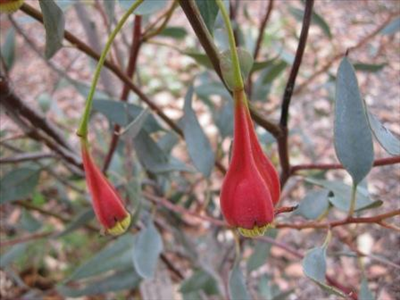
Eucalyptus forrestiana, photo courtesy of Australian Native Plants, © 2016.
Unfortunately, due to unforeseen circumstances, the Australian Native Plants Fall Plant Yard Sale has been cancelled. Australian Native Plants is still open by appointment, however, and they have a wonderful selection of Australian and South African native plants, from ground covers to trees and everything in between. They also have a great selection of pots, furniture and gifts.
Australian Native Plants is located at 9040 North Ventura Avenue, Casitas Springs, CA 93001. (The nursery entrance is off of Nye Road.) Make an appointment via email, or by calling 805.649.3362.
by Deb Shaw
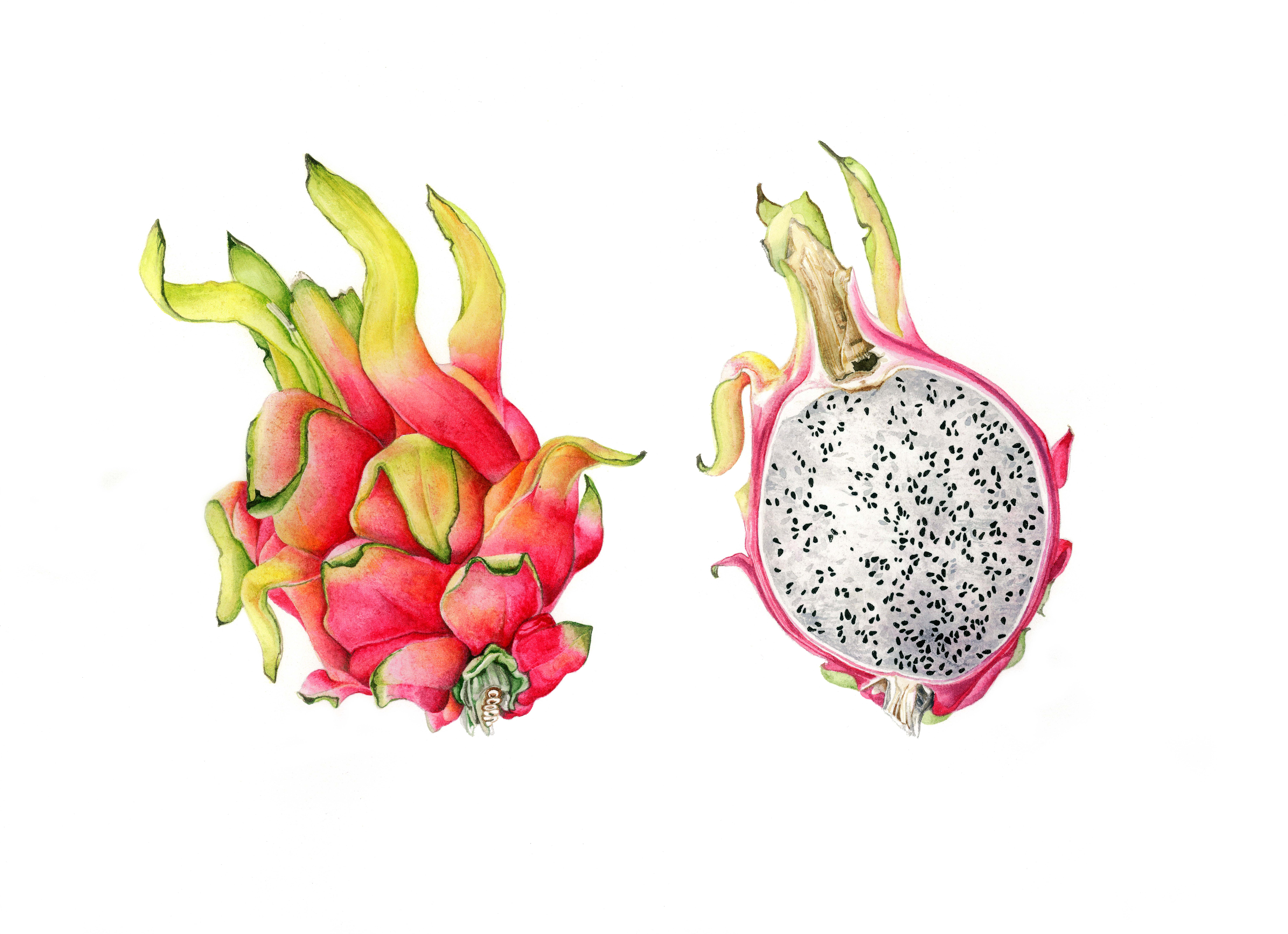
Hylocereus undatus pitahayas, Pitaya or Dragon Fruit, watercolor by Diane Nelson Daly, © 2016. The dragon fruit is the fruit of a cactus species indigenous to the Americas. The fruit is sweet and crunchy with a flavor that is a cross between kiwi and pear.
Cornucopia, a botanical art exhibition of all things edible by the Botanical Artists Guild of Southern California (BAGSC) will open Friday, September 23 in the Ecke Building at the San Diego Botanic Garden (SDBG). The exhibit runs from September 23 – November 18, and includes 47 artworks by 21 BAGSC artists, illustrating the diverse plants that people use all over the world for food, drink and flavorings. The paintings are accompanied by descriptions, stories or recipes written by the artists.

Broccoli, watercolor by Asuka Hishiki, © 2016.
The opening reception will be Friday, September 23, from 3:30 pm – 6:30 pm. The public is invited; the exhibition is free with paid admission or membership.
Artists in the exhibition include: Bonnie Born Ash, Nancy Beckham, Jan Clouse, Diane Nelson Daly, Estelle DeRidder, Asuka Hishiki, Cynthia Jackson, Susan Jackson, Clara Josephs, Teresa Kuwahara, Patricia A. Mark, Arillyn Moran-Lawrence, Kathy Morgan, Terri Munroe, Alyse Ochniak, Mitsuko Schultz, Janice Sharp, Deborah Shaw, Ellie Yun-Hui Tu, Leslie Walker, Jude Wiesenfeld.

Rosa californica, California Rose, watercolor by Estelle DeRidder, © 2016.
The San Diego Botanic Garden is located at 230 Quail Gardens Drive, Encinitas, California 92024, 760.436.3036. Directions can be found on the SDBG website. Download the postcard invitation featuring a watercolor by Teresa Kuwahara: cornucopia-invitation-postcard.
by Margaret Best, posted by Deb Shaw

“The Art of the Tulip” Select River Cruises with Margaret Best, Artist-in-Residence.
BAGSC member Margaret Best will be the Artist in Residence on a unique river cruise through the Low Countries focusing on “The Art of the Tulip.”
Onboard the MS Select Bellejour, participants will enjoy lectures about the history and cultural impact of the tulip. Demonstrations will be combined with botanical art instruction, including one-on-one attention from the instructor.
Margaret is a regular teacher at the Dundas Valley School of Art in Canada. She is one of three teachers at the school selected to be an Artist in Residence on Select River Cruises in 2017.

Margaret Best teaching.
To coincide with Tulip Time in April, Margaret will be offering lectures on the Art of the Tulip from the Ottoman era to contemporary portrayal, while traveling luxuriously on the waterways of the region. She will be also offering instruction on keeping an illustrated journal of this memorable trip with spectacular tulip specimens and other seasonal flowers both on board and in famous gardens, like Keukenhof to name but one.
For non-artist partners, friends or spouses there are a wide range of small-group tours to choose from to soak up the European culture and to partake in the unique food and beverage offerings. Like specialty cheese, chocolate, beer and a visit to the Delft China factory.
Seeing this remarkable spectacle of color is on most plant lover’s bucket list. For botanical artists, combining Margaret’s tuition with expert tour guides on a Select Cruise line famous for a more personalized treatment of guests, it will be unforgettable.
Tour dates: March 30 – April 7, 2017
Cost: $3,190
Download “The Art of the Tulip” PDF information flyer: art-of-the-tulip-20062016
Includes airport transfers, pre-cruise hotel and excursions, unique excursions with tour escort and Artist in Residence, onboard lectures and demonstrations, house wine and beer, gourmet meals, gratuities, and partner program options.
For more information and reservations, contact Sandie Harman, 416.407.1830 or 705.657.7196.
by Estelle De Ridder, posted by Deb Shaw
The California Islands Symposia have been held more or less, every five years since 1965, to share up-to-date information about the management, scientific research, work in all disciplines of natural and cultural science and general well-being of the California islands.
The 9th California Island Symposium for 2016 is being held at the Marriott Hotel, Ventura, California. One of the less scientific and more entertaining presentations of this symposium will be the Art Exhibit that has been advertised for more than six months. The three jurors worked hard and with diligence to put together a coherent show that will present the Channel Islands to the public in an inviting and interesting manner. After the symposium, the exhibit will be moved to the Santa Barbara Botanic Gardens, where it will be on display for another three weeks.
The Channel Islands of California comprise eight islands located in the Pacific Ocean off the Southern California coast. Five of the islands and the surrounding waters are part of Channel Islands National Park and the Channel Islands National Marine Sanctuary.
The Park is supported by many partners who share the protection of the history and prehistory, the cultural and biological diversity as well as protecting vital habitat for marine, terrestrial plant and animal species.
Public appreciation through education, interpretation and research is widely promoted.
Isolation over many thousands of years has developed unique animals, plants and archeological resources found ONLY on these islands and makes is possible for visitors to experience the western coast of the North America as it used to be.
Visitation has increased dramatically over the years, and with contracted concessionaires, the numbers show how the interest in the islands have grown:
1963 = 1,200
2014 = 342,000

Malva assurgentiflora, the Island Mallow, Mission Mallow, Royal Mallow, Island Tree Mallow. © 2016, Estelle De Ridder, all rights reserved. Watercolor and colored pencil on drafting film and paper.
Flora on the Channel Islands include a unique subspecies of pine, oak and island tree mallow.
Santa Rosa Island holds two groves of the endemic to the island, Torrey pine subspecies Pinus torreyana var. insularis. Torrey pines are the United States’ rarest pine species. The islands also house many rare and endangered species of plants, including the island barberry, the island rush rose, and the Santa Cruz Island lace pod. Giant kelp forests surround the islands and act as a source of nutrition and protection for other animals.
BAGSC members Estelle De Ridder, Mitsuko Schultz and Ellie Tu are participating in the exhibition.
Estelle has illustrated two species: Malva assurgentiflora and Heteromeles abtutifolia.
Malva assurgentiflora, the Island Mallow, Mission Mallow, Royal Mallow, Island Tree Mallow, Malva Rosa is a species of flowering plant in the mallow family. It grows into a strikingly architectural shrub/small tree with beautiful white bark.
It is endemic to California, where it is native only to the Channel Islands. It can also be found growing as an escapee from cultivation in coastal mainland California.
Estelle’s painting of Heteromeles abtutifolia was done on paper with watercolor and colored pencil. Heteromeles abtutifolia, Toyon berry, grows on the north-facing coastal bluffs of Santa Cruz Island. It grows on all the other islands, except Santa Barbara island, and was planted on San Nicolas.
Plantanus racemosa, California Sycamore, Watercolor by Mitsuko Schultz, © 2016, all rights reserved.
Mitsuko Schultz had her Platanus racemosa, California Sycamore accepted to the exhibition.
Ellie Tu has three pieces in the exhibition: Dudleya greenei, Coreopsis, and Leptosyne gigantea Kellogg.
Leptosyne gigantea Kellogg (formerly Coreopsis gigantea), Giant Coreopsis is a strikingly strange plant. It grows on dunes, rocky cliffs and exposed slopes, and has a fleshy trunk and branches. It can reach heights of eight feet with a five inch trunk. It is deciduous and dormant in the dry season, taking on an other worldly appearance when visitors hike through a large stand of them. In spring, however, masses of bright yellow blooms put on quite a show.
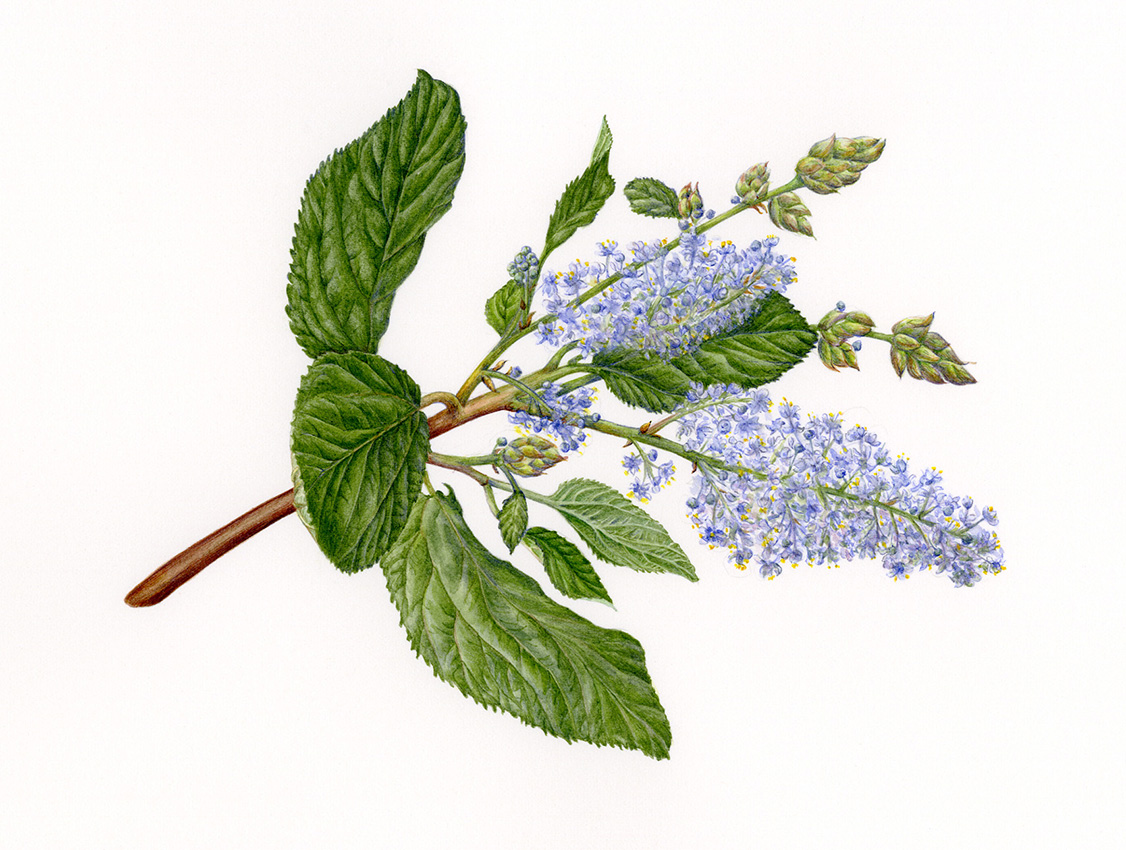
Ceanothus arboreus, Feltleaf Ceanothus, or Island Ceanothus. Watercolor, © 2016, Ellie Tu, all rights reserved.

Leptosyne gigantea Kellogg, (formerly Coreopsis gigantea), Giant Coreopsis, Ellie Tu, colored pencil, © 2016, all rights reserved.
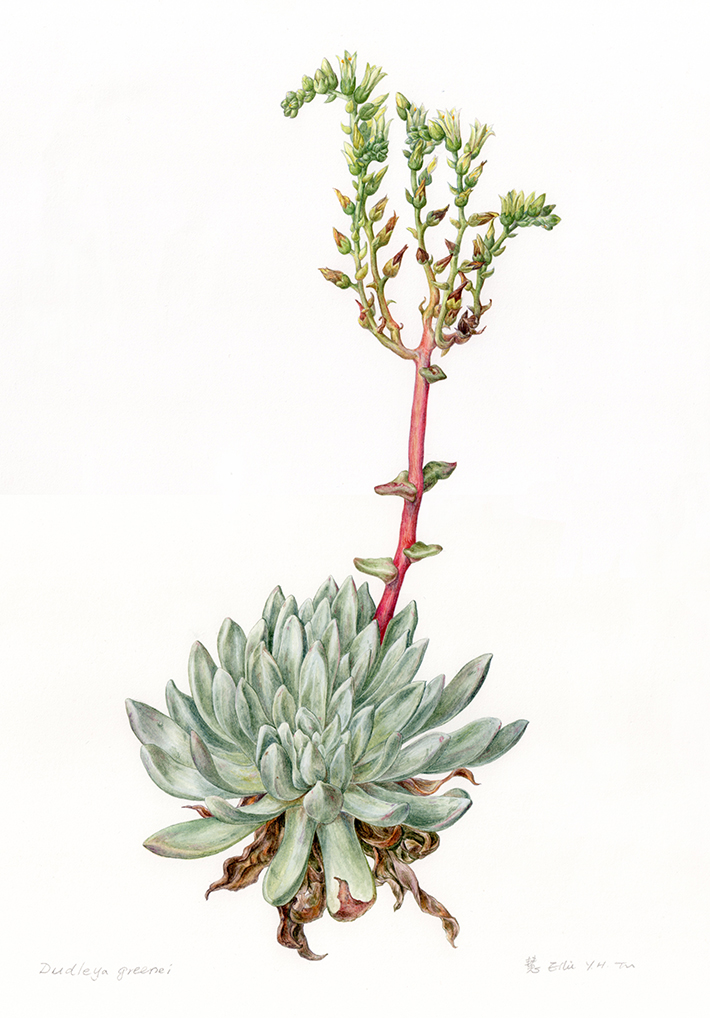
Dudleya greenei, watercolor by Ellie Tu, © 2016, all rights reserved. This plant grows in the Channel Islands National Park.
by John Pastoriza-Piñol, Jude Wiesenfeld and Deb Shaw
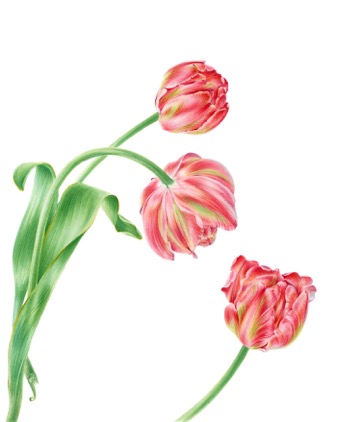
Tulipa x hybrida, watercolor by John Pastoriza-Piñol, © 2016.
BAGSC will be offering a Masterclass with Australian botanical artist John Pastoriza-Piñol in November, 2016. Students will learn the intricacies of achieving fine detail with watercolour masking fluid and NEEF ¼ Comb, invaluable tools for contemporary botanical artists. As a result, your paintings will be brought to a new level of realism and detail. Students should have skills in drawing and watercolor. Over three days, John will assist you with painting the chosen class subject. John will show how masking fluid can be used to achieve very fine detail and will instruct students how to use the NEEF ¼ Comb.
November 8, 9 and 10, 2016
9:30 am – 4:00pm each day
The Huntington Library, Art Collections, and Botanical Gardens
Cost: BAGSC Members: $300; Non-Members: $330
Maximum Registration: 16 students
To register:
Send a check for your $50 non-refundable deposit fee (or payment in full), made out to BAGSC, to BAGSC Education Chair, Jude Wiesenfeld. Please write “JohnPP” on the memo line of the check. Payment in full is due by Monday, October 25, 2016.
Bring your lunch, or purchase lunch at The Huntington Cafes, at The Huntington.
Questions about the Workshop? Contact the BAGSC Education Chair.

Fragaria x ananassa, Strawberry, watercolor by John Pastoriza-Piñol, © 2016.
Learning Objectives:
Students who enroll in this workshop would have completed some level of introduction to Botanical Art and be at an intermediate to advanced level. The structure of the class involves a three-day painting project and the demonstrator assists each student with composition, painting techniques, colour theory which will be offered in class and assigned for homework.
Download a PDF of the materials list: John Pastoriza Pinol Materials list 2016
About the Instructor:
Rich luminous hues and gorgeously exotic and rare botanical specimens epitomize John’s work, however his are much more than mere flower paintings:closer inspection reveals a certain ambiguity of form and intent directing us towards a complex narrative.

John Pastoriza-Piñol, © 2016.
A master of his medium, his perfectly executed watercolours remain true to the accuracy that is vital to botanical illustration yet they have a fluidity and sensuality that stirs the viewer to experience more than a mere marveling of technique.
The artist suggestively urges us to look beyond the aesthetic and move into slightly more uneasy territory as his work inhabits a territory somewhere between scientific analysis and symbolic realism, prompting a reading that goes beyond the purely representational and literal. The artist intends for literal and subversive elements to coexist uneasily on the same plane, while the aesthetics will remain true to the fundamental principle of objective observation of the natural world.
Location:
The workshop will be held at The Huntington Library, Art Collections, and Botanical Gardens, in the Botanical Education Center. The Huntington is located at: 1151 Oxford Road, San Marino, CA 91108.
by Deb Shaw
We were working on the house, with KPCC (89.3) on the radio in the background. The Dinner Party Download (American Public Media) came on. They were re-playing an old episode (Episode 341) from March 25, 2016.
Graphic novelist Daniel Clowes was a featured guest. In answer to the statement “Tell us something we don’t know about you,” he told how he searched for years for the perfect pen — the pen that the comic artists he most admired must have used to create those beautiful lines. Much to his surprise, he found out it wasn’t a pen at all, but a watercolor brush, specifically, a Kolinsky Sable brush. It was a struggle for him to learn to be proficient with the brush. Once mastered, he couldn’t conceive of using anything else. Then he spoke about how we couldn’t get them here in the US for a period of time, and all about the Russian Siberian Weasel (including the scientific name).
A reference right there on the radio, about an obscure subject that consumed our artists’ community!
by Beth Stone, posted by Deb Shaw
Passion Flower study, Olga Eysymontt, © 2008, all rights reserved.
It’s time to register for BAGSC Founder and Member Olga Eysymont’s next series at the Los Angeles County Arboretum and Botanic Garden. Registration is through the Otis website. Here’s the link: http://www.otis.edu/ce-course?crs=828
Don’t worry that the class description on the Otis website reads the same as Olga’s previous sessions. Olga says “For my returning students, I will be giving them other projects to work on.”
New students will explore the subject of plant families, with the goal of demonstrating both correct representation of the specimen, as well as a good compositional design. An emphasis on correct placement of light on form will be emphasized, in order to produce an authentic and realistic illustration.
“Botanical Illustration: Plant Studies,” in graphite, will meet for six Sundays, from 9:30 am – 3:30 pm, beginning Sunday, September 18, 2016, and then on the following five Sundays: October 2, October 16, October 30, November 6 and November 20.
Registration
Register online through Otis College of Art and Design Continuing Education. All classes will be held at the Los Angeles County Arboretum and Botanic Garden. The course is non-credit, although certificate and credit options are available for additional cost.
The Los Angeles County Arboretum and Botanic Garden is located at: 301 North Baldwin Ave, Arcadia, CA 91007.
Workshop Discounts
A $50 discount on the course registration is available until August 21. Senior discounts also are available; check with Otis to see if they can be used in combination with the early registration discount.
Class Materials:
14″ x 17” Strathmore Drawing Pad Series 400, Medium or equivalent. (You may use another brand, but please, no sketch or recycled paper.
14” x 17” Medium Weight Tracing Paper (any brand)
Drafting Pencil with Holder and Sharpener
HB and 2B leads (at least 2 each)
Eraser Stick
Erasing Shield
Drafting Brush
Mars Drafting Dots (masking tape)
Portable Task Light (Ott-Lite)
(Vis a Vis wet erase fine point marker, Clip, 8″ x 10″ Plexi and 8″ x 10″ format supplied by teacher for $10.00)
 BAGSC News