You are currently browsing the tag archive for the ‘botanical art class’ tag.
by John Pastoriza-Piñol, Jude Wiesenfeld and Deb Shaw
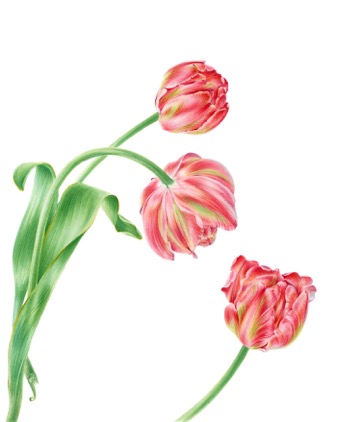
Tulipa x hybrida, watercolor by John Pastoriza-Piñol, © 2016.
BAGSC will be offering a Masterclass with Australian botanical artist John Pastoriza-Piñol in November, 2016. Students will learn the intricacies of achieving fine detail with watercolour masking fluid and NEEF ¼ Comb, invaluable tools for contemporary botanical artists. As a result, your paintings will be brought to a new level of realism and detail. Students should have skills in drawing and watercolor. Over three days, John will assist you with painting the chosen class subject. John will show how masking fluid can be used to achieve very fine detail and will instruct students how to use the NEEF ¼ Comb.
November 8, 9 and 10, 2016
9:30 am – 4:00pm each day
The Huntington Library, Art Collections, and Botanical Gardens
Cost: BAGSC Members: $300; Non-Members: $330
Maximum Registration: 16 students
To register:
Send a check for your $50 non-refundable deposit fee (or payment in full), made out to BAGSC, to BAGSC Education Chair, Jude Wiesenfeld. Please write “JohnPP” on the memo line of the check. Payment in full is due by Monday, October 25, 2016.
Bring your lunch, or purchase lunch at The Huntington Cafes, at The Huntington.
Questions about the Workshop? Contact the BAGSC Education Chair.

Fragaria x ananassa, Strawberry, watercolor by John Pastoriza-Piñol, © 2016.
Learning Objectives:
Students who enroll in this workshop would have completed some level of introduction to Botanical Art and be at an intermediate to advanced level. The structure of the class involves a three-day painting project and the demonstrator assists each student with composition, painting techniques, colour theory which will be offered in class and assigned for homework.
Download a PDF of the materials list: John Pastoriza Pinol Materials list 2016
About the Instructor:
Rich luminous hues and gorgeously exotic and rare botanical specimens epitomize John’s work, however his are much more than mere flower paintings:closer inspection reveals a certain ambiguity of form and intent directing us towards a complex narrative.
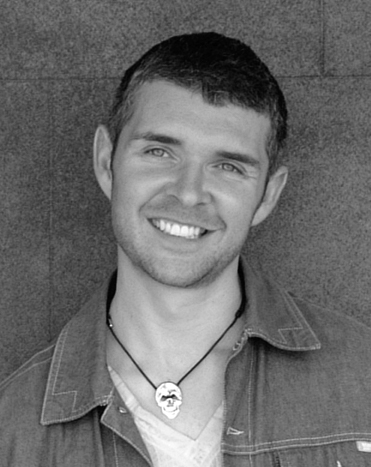
John Pastoriza-Piñol, © 2016.
A master of his medium, his perfectly executed watercolours remain true to the accuracy that is vital to botanical illustration yet they have a fluidity and sensuality that stirs the viewer to experience more than a mere marveling of technique.
The artist suggestively urges us to look beyond the aesthetic and move into slightly more uneasy territory as his work inhabits a territory somewhere between scientific analysis and symbolic realism, prompting a reading that goes beyond the purely representational and literal. The artist intends for literal and subversive elements to coexist uneasily on the same plane, while the aesthetics will remain true to the fundamental principle of objective observation of the natural world.
Location:
The workshop will be held at The Huntington Library, Art Collections, and Botanical Gardens, in the Botanical Education Center. The Huntington is located at: 1151 Oxford Road, San Marino, CA 91108.
by Jude Wiesenfeld and Deb Shaw
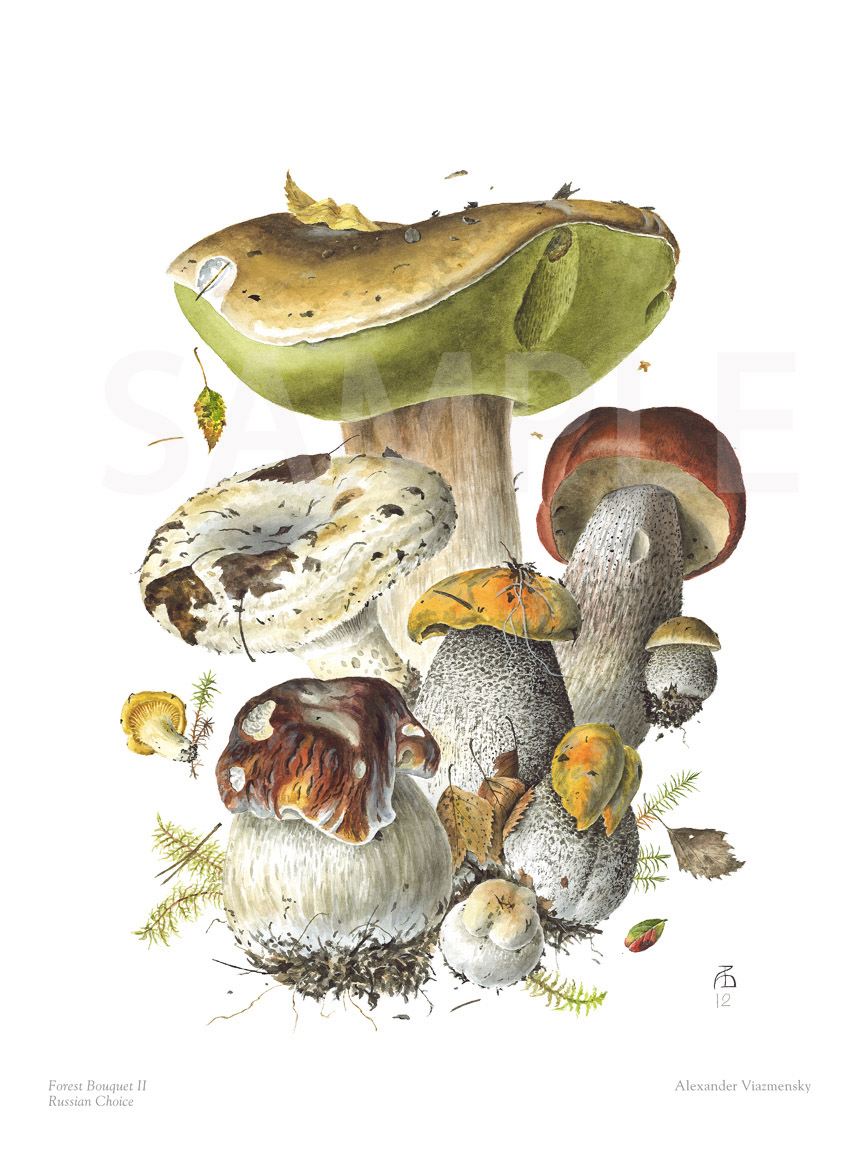
“Forest Bouquet, Russian Choice,” watercolor by Alexander Viazmensky, © 2016, all rights reserved.
Alexander (Sasha) Viazmensky will be returning to Southern California from St. Petersburg, Russia to teach a three-day, BAGSC-sponsored workshop, Mushroom Portraits in Watercolor.
Wednesday, October 19 – Friday, October 21, 2016
9:30 am – 4:00 pm each day
Los Angeles County Arboretum, Oak Room
$300 for BAGSC members; $330 for non-members
Class limit: 16 students
Workshop Description:
Mushroom hunting is a passionate, national pastime in Russia, and Sasha’s paintings capture the spirit of the fungi and the forest. Painted life sized, he calls his paintings “Portraits of Mushrooms.” The class will consist of the following steps:
- Composition.
- How to properly place your subject: lights, shadows, reflections.
- Creating the shape from light to dark.
- Creating various textures with dry brush.
- Using white gouache.
- Final details.
Download the materials list: sashaMaterialsList
To Register:
Send a check for your $50 non-refundable deposit fee (or payment in full), made out to BAGSC, to BAGSC Education Chair Jude Wiesenfeld. Please write “Sasha” on the memo line of the check. Payment in full is due by Monday, October 3, 2016.
Bring your lunch, or purchase lunch at the Peacock Café, on the Arboretum grounds.
The Los Angeles County Arboretum and Botanic Garden is located at: 301 North Baldwin Ave, Arcadia, CA 91007.

Alexander Viazmensky in the woods. © 2016.
About the Instructor:
Sasha Viazmensky was born and lives in St. Petersburg, Russia, and specializes in painting fungi. Although he has a Master’s Degree in Electrical Engineering, he has devoted his life to painting, studying, and picking mushrooms. His work is included in the collections of the Hunt Institute for Botanical Documentation in Pittsburgh, the Minneapolis Institute of Arts, the Shirley Sherwood Collection and the Komarov Botanical Institute in St. Petersburg, among others, and in private collections all over the world. You can read an article Sasha wrote about picking mushrooms in Russia, published in MUSHROOM, The Journal of Wild Mushrooming, here.
by Beth Stone, posted by Deb Shaw
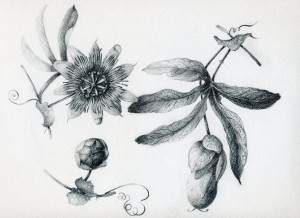
Passion Flower study, Olga Eysymontt, © 2008, all rights reserved.
It’s time to register for BAGSC Founder and Member Olga Eysymont’s next series at the Los Angeles County Arboretum and Botanic Garden. Registration is through the Otis website. Here’s the link: http://www.otis.edu/ce-course?crs=828
Don’t worry that the class description on the Otis website reads the same as Olga’s previous sessions. Olga says “For my returning students, I will be giving them other projects to work on.”
New students will explore the subject of plant families, with the goal of demonstrating both correct representation of the specimen, as well as a good compositional design. An emphasis on correct placement of light on form will be emphasized, in order to produce an authentic and realistic illustration.
“Botanical Illustration: Plant Studies,” in graphite, will meet for six Sundays, from 9:30 am – 3:30 pm, beginning Sunday, September 18, 2016, and then on the following five Sundays: October 2, October 16, October 30, November 6 and November 20.
Registration
Register online through Otis College of Art and Design Continuing Education. All classes will be held at the Los Angeles County Arboretum and Botanic Garden. The course is non-credit, although certificate and credit options are available for additional cost.
The Los Angeles County Arboretum and Botanic Garden is located at: 301 North Baldwin Ave, Arcadia, CA 91007.
Workshop Discounts
A $50 discount on the course registration is available until August 21. Senior discounts also are available; check with Otis to see if they can be used in combination with the early registration discount.
Class Materials:
14″ x 17” Strathmore Drawing Pad Series 400, Medium or equivalent. (You may use another brand, but please, no sketch or recycled paper.
14” x 17” Medium Weight Tracing Paper (any brand)
Drafting Pencil with Holder and Sharpener
HB and 2B leads (at least 2 each)
Eraser Stick
Erasing Shield
Drafting Brush
Mars Drafting Dots (masking tape)
Portable Task Light (Ott-Lite)
(Vis a Vis wet erase fine point marker, Clip, 8″ x 10″ Plexi and 8″ x 10″ format supplied by teacher for $10.00)
by Olga Eysymont and Beth Stone, posted by Deb Shaw
Passion Flower study, Olga Eysymontt, © 2008, all rights reserved.
BAGSC Founder and Member Olga Eysymont will begin her next six-week graphite pencil workshop this coming Sunday, June 12, 2016 at the Los Angeles County Arboretum and Botanic Garden. Entitled “Botanical Illustration: Plant Studies,” this workshop will explore the subject of plant families, with the goal of demonstrating both correct representation of the specimen, as well as a good compositional design. An emphasis on correct placement of light on form will be emphasized, in order to produce an authentic and realistic illustration.
The fundamental necessary skills to accomplish this begins with a 3-step process:
- contour drawing on tracing paper,
- compositional layout and value studies of the specimens on tracing paper, and, finally,
- a transfer of the tracing onto drawing paper for a final rendering.
Students will be expected to bring all of their own plant material after the first class.
“Botanical Illustration: Plant Studies,” in graphite, will meet for six Sundays, from 9:30 am – 3:30 pm, beginning Sunday, June 12, 2016. Sundays: 6/12, 6/19, 6/26, 7/10, 7/24, and 8/7.
Registration
Register online through Otis College of Art and Design Continuing Education. All classes will be held at the Los Angeles County Arboretum and Botanic Garden. The non-credit course (#25440) is $435 plus fees of $25 registration, $14 insurance and 2.75% on-line convenience, for a total of $487. Certificate and Credit options are also available for additional cost.
The linked page also has an option (see lower left) to register offline (PDF), if preferred. This PDF form includes email, FAX and phone registration information.
The Los Angeles County Arboretum and Botanic Garden is located at: 301 North Baldwin Ave, Arcadia, CA 91007.
Workshop Outline
Session 1: Apples or Pears
Session 2: Nuts or Seeds and Pods
Session 3: Root Vegetables
Session 4: Leafy Greens or Herbs
Session 5: Mushrooms
Session 6: Succulents
Class Materials:
14″ x 17” Strathmore Drawing Pad Series 400, Medium or equivalent. (You may use another brand, but please, no sketch or recycled paper.
14” x 17” Medium Weight Tracing Paper (any brand)
Drafting Pencil with Holder and Sharpener
HB and 2B leads (at least 2 each)
Eraser Stick
Erasing Shield
Drafting Brush
Mars Drafting Dots (masking tape)
Portable Task Light (Ott-Lite)
(Vis a Vis wet erase fine point marker, Clip, 8″ x 10″ Plexi and 8″ x 10″ format supplied by teacher for $10.00)
by Lesley Randall, posted by Deb Shaw

Nepenthes, mixed media by Lesley Randall, © 2016, all rights reserved.
BAGSC member Lesley Randall will be teaching a mixed media class at San Diego Botanic Garden this July, 2016. The class will focus on the bold nature of pen and ink. Using ink, students will use strong lines to enhance shape and create movement. By adding watercolor, colored pencil or both, students will develop a striking design reminiscent of a woodcut. No experience is necessary for this class.
Mixed Media Botanical Art
Instructor: Lesley Randall
Saturday July 30th 9 am-4 pm
Cost: $75.00 for SDBG members; $90.00 for non-members
Register Online at www.sdbgarden.org
The San Diego Botanic Garden is located at: 230 Quail Gardens Drive, Encinitas CA 92024, 760/ 436-3036.
by Deb Shaw

Aristolochia californica, California Pipevine, watercolor by Lee McCaffree, © 2016, all rights reserved. This painting by Lee was part of the “Weird, Wild & Wonderful” exhibition.
The schedule for Lee McCaffree’s workshops, A Painting! What do you See? and Completing a Painting have been changed: both workshops have been rolled into one day, one workshop, on Saturday, March 19. The workshop will still be held at the Los Angeles Arboretum, from 9:30 am to 3:30 pm.
There are still a few seats available. If you would like to take the workshop, but have not yet registered, please email BAGSC Treasurer Janice Sharp to let her know and make arrangements to send a check and/or bring it to the workshop on Saturday.
Cost: BAGSC members, $100.00/non-members, $120.00
Maximum number of participants (in each class): 15
You can see the original BAGSC News blog posting about the class here, including materials list and Lee McAffree’s bio. Don’t miss this great opportunity to take this rare workshop.
by Leslie Walker, posted by Deb Shaw
In a wonderful surprise, I found Margaret Best’s botanical art trip in October, 2016 announced in the Sunday LA Times, March 6, 2016, Travel Section. Entitled, [click the title to read] “Capture this on canvas: Painting workshop in Italy beckons artists,” by LA Times contact reporter Anne Harnagel, the article highlights Quench’s trip and Margaret’s botanical art class.
I can recommend this venue and teacher since I went there last Spring. I am going back this Fall to experience the area in a different season. Margaret is a great botanical artist and teacher and I’m looking forward to sharpening my skills in October.
Read Jan Clouse’s article and see pictures about Margaret’s last trip to Puglia on our BAGSC News blog. Details about the Puglia trip can be found at Quench.
by Patricia A. Mark, posted by Deb Shaw
Aristolochia californica, California Pipevine, watercolor by Lee McCaffree, © 2016, all rights reserved. This painting by Lee was part of the “Weird, Wild & Wonderful” exhibition.
Do not miss out on two classes coming soon to the LA Arboretum, taught by Lee McCaffree: A Painting! What do you See? and Completing a Painting. I had the opportunity to take these classes from Lee at Filoli, and are excited about taking them again.
These classes are both exceptionally informative! “A Painting! What do you See?” will cover a variety of techniques to view paintings (both yours and others) with objective eyes. Every picture tells a story. As individual artists it’s easy to miss issues related to composition, specimen accuracy, painting skills, light source, focal point, and color. Gentle, kind (and fun) guidance will open your critical eye, enabling you to identify issues and improve your work. Class time will be spent on viewing paintings from the botanical art world, and examining our own works. We will have class time to make adjustments on our works in progress.
Completing a Painting is a “must attend”! As an artist I find myself continuously asking,”is this complete”? “Have I overworked an area? What have I missed? Is the form strong, not only on individual leaves or flowers, but on the painting as a whole? Is the perspective accurate? Do areas transition from light to dark smoothly? Are brush strokes visible, the shadows appropriate, my edges clean? How do I sign and label my work for a juried exhibition or for a commissioned sale? And what are those jurors looking for anyway?” So many questions, all focusing on completing a wonderful painting! There will be class time available during this workshop to work individually on any of your present works-in-progress.
Saturday, March 19, 2016
A Painting! What Do You See?
Sunday, March 20, 2016
Completing a Painting
Both classes will be held at the Los Angeles Arboretum, from 9:30 am – 3:30 pm. Each of these important subjects will be conducted in a friendly, Participants can take one class or both!
Cost: One class: BAGSC members, $100.00/non-members, $120.00, Both classes: BAGSC members, $200.00/non-members, $240.00
Maximum number of participants (in each class): 15
To Register: Send checks, made out to BAGSC, in full, to BAGSC Treasurer Janice Sharp. Cancellations up to two weeks before the class date will be charged a $30.00 cancellation fee.
You can see the original BAGSC News blog posting about the class here, including materials list and Lee McAffree’s bio. Don’t miss this great opportunity to take this rare workshop.
by Deb Shaw

Diane Daly demonstrating at last year’s “Day of Art” at Roger’s Gardens. Photo by Deborah Shaw, © 2015, all rights reserved.
Botanical Artists Guild of Southern California (BAGSC) artists will be participating again in Roger’s Gardens 4th Annual Day of Art this coming Saturday, February 27, 2016 from 10 am – 4 pm. The event is free, and open to the public. In case of rain (a lovely thought, but, unfortunately for our water shortage, unlikely!) the event will be rescheduled.
BAGSC artists have participated each year since its inception; 50 botanical and plein air artists paint and draw in the Gardens for the day. Each of the participating artists will have an original painting on display (available for purchase). Judges will present awards and recognition for paintings in the exhibition.
Participating BAGSC artists include: Melanie Campbell-Carter, Clara Josephs, Suzanne Kuuskmae, Patricia Mark, Arillyn Moran-Lawrence, Terri Munroe, Diane Nelson Daly, Alyse Ochniak, Mitsuko Schultz, Deborah Shaw, and Ellie Yun-Hui Tu. BAGSC also will have a table available with information about BAGSC, American Society of Botanical Art (ASBA), and botanical art.
Schedule
Free workshops are open to the public and BAGSC members:
Printmaking Workshop: Printing Posies and Plants, 10 am – 1 pm, in the Amphitheater
Local artists Sheryl Seltzer and Carol Kreider will teach participants how to draw and transfer to a small relief plate, and “pull” their own monoprint. All skill levels and ages welcome.
Awards Ceremony, 12 pm, in the Outdoor Living area
Ten awards of excellence will be presented to artists participating in the exhibition. This year’s Judge is Gil Dellinger, a retired professor of art of the University of the Pacific, Signature Member of The Pastel Society of America, California Art Club, and PAPA, Plein Air Painters of America. [Last year BAGSC members Diane Daly and Deborah Shaw received awards of excellence.]
Drawing Workshop: Journal your Garden through Art / Drawing Leaves and Flowers in the Garden, 2 pm – 3:30 pm, in the Amphitheater
Learn to draw leaves and flowers and create a garden journal from BAGSC members Deborah Shaw, Clara Josephs, and Diane Daly. This is a great workshop for the whole family, as no art experience is required.
Hope to see you there!
by Lee McCaffree and Lesley Randall, posted by Deb Shaw
Aristolochia californica, California Pipevine, watercolor by Lee McCaffree, © 2016, all rights reserved. This painting by Lee was part of the “Weird, Wild & Wonderful” exhibition.
BAGSC member Lee McCaffree will be teaching two botanical art classes in March: one about how to finish a painting; the other about how to critique a work of art (and self-critique your own).
Both classes will be held at the Los Angeles Arboretum, from 9:30 am – 3:30 pm. Each of these important subjects will be conducted in a friendly, supportive, congenial atmosphere. Participants can take one class or both!
Cost:
One class: BAGSC members, $100.00/non-members, $120.00Both classes: BAGSC members, $200.00/non-members, $240.00
Maximum number of participants (in each class): 15
Saturday, March 19, 2016
A Painting! What Do You See?
We will investigate ways to critique a work of art. Personal experience shapes what we see. By using different techniques to view paintings the observer will have more ways to analyze with objective eyes. We will use many published works as well as class members’ works to practice these methods. Topics will include subject matter, botanical accuracy, painting skills, light source, color, form and compositional structure, balance and space. We will work cooperatively by sharing ideas to make this a positive experience for each artist to learn about their own work. Class time will include individual opportunities for making improvements on work in progress.
Materials list:
- Copies of 2 paintings (not yours) that you like
- 2 paintings (of yours), unfinished or finished, to share in critiques
- Tracing paper
- Your usual art supplies for your paintings, any media
Sunday, March 20, 2016
Completing a Painting
How do you know your art work is finished? Sometimes it is just a feeling that the painting is finished or something isn’t quite right. Good observation helps one see if a painting needs improvement, whether it is nearly finished or in progress. It is important to keep a freshness and avoid overworking. The artist needs to be objective in looking at their images. We will work with each other to see our work through another’s eye. Questions to consider will include: Where is my focal point? Do I have enough value change? Do the plant parts have volume and perspective? Are they botanically correct? Where has the paint or pencil gone astray either on my plant edges or in the negative space?
Class members will apply these observations to their paintings along with techniques in completing details such as dry brush, washes or corrections. This will include ways to change or clean up places to make your painting details more realistic. After identifying ways to finish your painting(s), there will be time in class to work on these details.
We will complete the process by discussing labeling. We will look at ways to present your piece with mats and frames depending on your intended goal for display.
Please bring the following materials:
- 1 or 2 paintings that you want to finish
- Usual art supplies in your media choice, including a magnifier
- Tracing paper
To Register:
Send checks, made out to BAGSC, in full, to BAGSC Treasurer Janice Sharp. Cancellations up to two weeks before the class date will be charged a $30.00 cancellation fee.
Bring your lunch, or purchase lunch at the Peacock Café, on the Arboretum grounds.
The Los Angeles County Arboretum and Botanic Garden is located at: 301 North Baldwin Ave, Arcadia, CA 91007.
About the instructor:
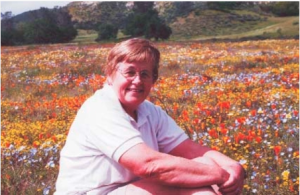
Lee McCaffree
Lee McCaffree is a botanical illustrator in watercolor. She shares the coordination and implementation of the Filoli Botanical Art Certificate Program and is a primary instructor. She served on the Board of Directors of The American Society of Botanical Artists. She gives regular private classes in the Bay area and instructed at the ASBA Annual meetings and the UC Berkeley Botanical Garden. She supports botanical artists by participating in coordinating teams for art exhibits and jurying.
She began her career in London, England studying under Christabel King of Kew Gardens. She received Medals for showing her “Pinus” series and “Plants in Peril” series at the Royal Horticultural Society exhibitions in London. Her works are in the permanent collections of the Royal Botanic Gardens at Kew Collection, London, the Filoli Florilegium and Hunt Institute of Botanical Documentation; Lee won Best of Show at the Northwest ASBA Exhibition in Portland, OR. Her showings include juried exhibitions at Contemporary Art Center, MOMA-New York; Longwood Gardens; Hunt Institute, Pittsburgh; Seattle Science Center; Flinn Gallery Greenwich, CT; Horticultural Society of New York; Missouri, Chicago, Denver and UC Berkeley Botanical Gardens; Strybing Arboretum, CA; Arizona Desert Museum, New York State Museum; Johnson & Johnson Headquarters; Oakland Museum; Loveland Museum (Colorado); Filoli exhibits and Florilegium; Northern California Society of Botanical Artist’s Alcatraz Florilegium and other venues. She created the poster for the California Native Plant Sale for the East Bay for ten years. Her work is published in Curtis’s Botanical Magazine, England and Today’s Botanical Artist. Her work was included in “Losing Paradise”, an exhibit of endangered species illustrations which traveled throughout the U.S and to the Shirley Sherwood Gallery at Kew Gardens, London. Currently, she is exhibiting in the Weird, Wild and Wonderful Traveling Exhibit from the New York Botanical Gardens.
Lee’s work concentrates on native plants which she hopes will increase their visibility and use in public and private landscaping. Her skill as a botanical artist allows her to focus her creativity on the finest details of each plant she paints. Her enthusiasm inspires her students to develop their own skills and enjoy the creative process.
by Cristina Baltayian, posted by Deb Shaw
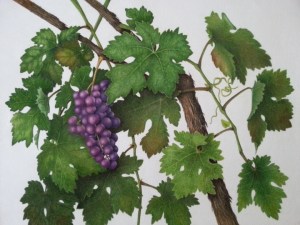
Grapes and vine, Cristina Baltayian, © 2015, all rights reserved.
Cristina Baltayian will be resuming her popular series of Botanical Art and Illustration classes at the LA County Arboretum and Botanic Gardens on January 5, 2016.
The classes are held on the first four Tuesdays of each month, 10 am – 2 pm, in the Oak Room. Cristina’s first six-week unit will be Aerial (atmospheric) Perspective. Create “flat-free” paintings! Students will explore depth of composition, showing distinct foreground, middle ground, and background with a variety of techniques.
Enrollment is open to the public through the Education Department at the Arboretum, 301 N Baldwin Ave, Arcadia CA 91007. Tuition is discounted for Arboretum members. Call the Arboretum at 626-821-3222 or email Cristina for more information.
P.S. from Deb Shaw: Apologies to all for the late posting on this. It was emailed to me while I was on the road, and I wasn’t able to post it on short notice. If you are interested in Cristina’s classes, please contact the LA Arboretum with the information above, or click on Cristina’s name to email her.
by Gilly Shaeffer, posted by Deb Shaw

Gilly Shaeffer, “Camellia,” watercolor on paper, 2015, all rights reserved.
Gilly Shaeffer, long time member of BAGSC, will be holding four Wednesday morning classes in January, 2016 at her home studio in “Botanical Drawing and Watercolor Basics.” This is a great opportunity for beginners and intermediates to perfect their drawing skills and also a preparation for doing botanical watercolor painting. It is perfect for those who like a small group experience with a lot of individualized attention. It will consist of a cumulative series of exercises to improve observational and drawing skills, as well as, preparing students to create three dimensional form through light to dark shading. Those who complete the drawing exercises with Gilly will move on to the study of botanical watercolor painting. The understanding and skills gained through these classes can be applied when doing all types of drawing and painting.
Visit Gilly Shaeffer’s website to see samples of her work and read her “Bio” to learn about her educational background, teaching experiences and accomplishments in botanical art.
Four Wednesdays in January, 2016: January 6, 13, 20, 27
10:00 a.m. to 1:00 p.m.
Fee:$160
Locations: Gilly’s Home Studio
For address, directions, and answers to any questions, please Gilly’s email address.
by Beth Stone
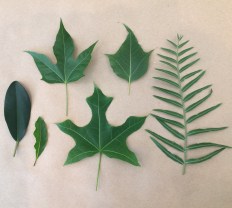 A wonderful series of weekly classes has just concluded at the LA Arboretum and Botanic Garden. This Otis College course was taught by Olga Eysymontt. Each class in the series built upon the preceding progressing from contour drawing to shading exercises then on to visualizing basic forms as they apply to increasingly complex botanical subjects. Artistic composition was also a theme throughout.
 For some students the material was brand new, for others it was review, for myself it certainly filled in some gaps. Without question, all the subject matter and techniques which Olga covered are foundational to botanical art.
Olga makes great use of a combination of demonstration, class discussion and one-on-one guidance. Each class included at least one opportunity to share our progress with and learn from one another. Each session concluded with a homework assignment. I found this particularly valuable and just the right level of effort to keep me engaged between classes. Practicing the concepts on my own really helped to reinforce each lesson.


By the end, each of us had several completed works…and one more work in progress to keep that momentum going.
Watch for Olga’s next series coming up in January 2016. I highly recommend it!
by Alyse Ochniak, posted by Deb Shaw
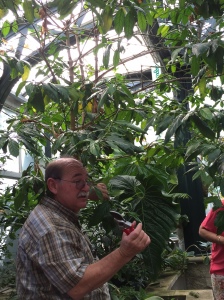
Jim Folsom lecturing during the “Weird, Wild & Wonderful Symposium.” Photo by Clara Josephs, © 2015, all rights reserved.
More looking forward to the next New York Botanical Garden Triennial, “Out of the Woods”:
Jim Folsom, Marge and Sherm Telleen Director of the Botanical Gardens, will be teaching two workshops about the structure of trees at The Huntington Library, Art Collections, and Botanical Gardens, on:
October 24, 2015 (limit 30 students) in the Brody Teaching Lab, from 8:30 am – 12:00 pm, and
January 17, 2016 (limit 20 students) in the Engemann Applied Tech Lab, from 8:30 am – 12:00 pm
Cost is $10.00 each session, payable at the workshop. Reservations are required, however; please RSVP to Alyse Ochniak. Reservations are first come, first served.
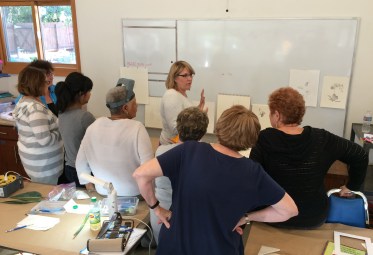
Come to one or both! Each session will be a 3-hour demonstration/workshop. Students will use dissection and compound microscopes to examine tree architecture, growth patterns, and structural characteristics using fresh and prepared material (provided by the Gardens). Discussion will include characteristics and terminology used to describe trees, and most useful in identification. Instruction will give particular attention to natural growth patterns and specific details of tree morphology and anatomy that would impact veracity of depiction.
Workshops only require pencil/pen and sketchbooks for taking notes, although artists are welcome to bring whatever materials they would like to use. Attendees are welcome to stay and draw in the Gardens after the class.
For more information about the New York Botanical Garden Triennial “Out of the Woods, Celebrating Trees in Public Places” visit the ASBA website.
The Huntington is located at: 1151 Oxford Road, San Marino, California, 91108.
About the instructor:
Jim Folsom, PhD., rides the demographic peak of baby boomers, having been born in southeastern Alabama in 1950. His lifelong love of plants is reflected in a BS in Botany from Auburn University, an MA in Biology from Vanderbilt University, and a PhD in research botany from The University of Texas at Austin. Though his research has centered on the orchid family, with much of the research time spent in Tropical America (including a year in Colombia on a Fulbright Pre-Doctoral Fellowship), Jim’s botanical interests are wide-ranging. As Curator of the Botanical Gardens at The Huntington in San Marino, CA, he dedicates much of his effort to educational programs that increase public interest and understanding of the science, culture, and history of plants and gardens. He lives at The Huntington with his wife, Debra (also a botanist) and children Molly and Jimmy. Jim was recognized as a Friend of the Cactus and Succulent Society of America in 1996, a Member-at-Large of the Garden Club of America in 1998, and presented a Professional Citation by the American Association of Botanical Gardens and Arboreta in 1999. The Garden Club of America awarded him their Medal of Honor in 2007.
by Gilly Shaeffer, posted by Deb Shaw
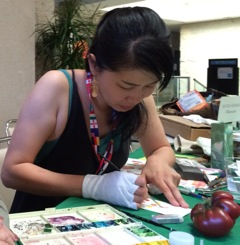
Asuka Hishiki demonstrating during the “Weird, Wild & Wonderful” Symposium at The Huntington, July 2015. Photo by Gilly Shaeffer, © 2015.
During the recent “Weird, Wild & Wonderful” Symposium at The Huntington, I watched Asuka Hishiki as she demonstrated how she would paint a segment of an heirloom tomato skin. Here are my impressions of the way she went about developing this small sample of the tomato skin with paint.
- Asuka says every time she approaches her subject it is new for her.
- Asuka starts sketches on tracing paper.
- She uses a wood pencil in a pencil holder which she sharpens with a box cutter.
- She goes over her pencil lines with a lighter color paint or yellow ochre. So she will have thin lines in watercolor for her drawing.
- At this point she erases any pencil lines.
- She covers the entire form with a Chinese white wash. (The Chinese white that she likes is the Holbein brand.) She says one should stay very light when applying the first layer of this white paint. This Chinese white wash acts as a protection for the paper. Much of it gets taken off during the removal of the masking fluid (to be mentioned later).
- Asuka will add more Chinese white paint on the places where she wants the paint to bleed to create soft color transitions. She also mentions the importance of keeping harmony in the colors used as the form develops.

Asuka Hishiki masking fluid technique. Photo by Gilly Shaeffer, © 2015.
- She mixes three colors together in a small amount to be used to develop the form using the dry brush technique. She uses Interlon brand brush #3/0 for her dry brush work.
- In preparing to use masking fluid to prevent certain areas of the paper from getting painted, she would prime the brush to be used with liquid soap. The soap helps to keep the masking fluid brush in good shape for future use. This brush is used exclusively for masking fluid.
- She will use the masking fluid to hold the places that she does not want to get painted—in this case the place where a leaf would be (which looks like a skinny wiggly line in the photos), where the highlights would be and where imperfections would be found on the tomato skin.

Asuka Hishiki masking fluid technique. Photo by Gilly Shaeffer, © 2015.
- Asuka stipples on the masking fluid with a very skinny brush on the section that she has begun to paint.
- She uses tissue to blot any extra paint from her paper.
- Then she adds a second layer of masking fluid. So, this layer of masking fluid dots will have more tone than the first layer of dots that she applied that prevent any paint from getting through to the paper.
- She always makes sure that the paint and the masking fluid that she has applied are absolutely dry before proceeding.
- She says that you can lift paint more easily when you have first applied a Chinese white wash to the paper.
- She applies a layer of Yellow Ochre wash.
- She continues to develop the form through her dry brush technique. At this point the masking fluid remains on the painted area.

Asuka Hishiki masking fluid technique. Photo by Gilly Shaeffer, © 2015.
- Asuka uses Winsor Newton Series 7 brushes, #5 and #3 for the colored washes.
- She adds a third layer of masking fluid dots.
- With WN Series 7 #5 brush, she puts a colored wash on the section that she had previously dry brushed. This makes any lines from dry brushing disappear.
- Now she lifts the masking fluid dots. When she does this she is also lifting the Chinese white paint that was applied to the paper at the very start. The white of the paper now shows through in the places that had masking fluid on them.
- She decides that she wants to apply another layer (this would be the fourth layer) of masking fluid dots. This will make the dots appear lighter and less visible than the layers applied earlier.
- Next more dry brushing with a deeper color paint. Some stippling is used. Then some more wet strokes (colored washes) to further the development of the form.
- When she removes the fourth layer of masking fluid, it is easy to see the section of the heirloom tomato skin developing on the paper with its highlights, its shiny smooth skin, its roundness, its imperfections and its rich colors of orange, red, and purple.
 BAGSC News