You are currently browsing the tag archive for the ‘botanical art’ tag.
by Susan Eubank, posted by Deb Shaw
Peacock! Plant! The Los Angeles County Arboretum & Botanic Garden is hosting an Open Art Exhibits Call at an:
Artists’ Open House at the Gallery in the Arboretum Library
Saturday, January 14, 2016, 1-4 p.m., and
Saturday, January 28, 2016, 1-4 p.m.

Logo for the Los Angeles County Arboretum & Botanic Garden.
There’s a new art space in town and the Arboretum Library is looking for artists. This open house is to encourage artists of all media to view the newly renovated Arboretum Library exhibit space and the Arboretum grounds for inspiration. Details of exhibit requirements will be discussed at the open house.
The first exhibition will run March 1 – June 30, 2017 and will use the word “Peacock” as the inspirational word for the exhibition. All media will be considered.
The second exhibition will be from October 1 – December 30, 2017 and will use plants as the theme. All media will be considered.
Deadline for art submissions for both shows is February 11, 2017. Proposals to exhibit should include at least three (3) digital scans or images of the proposed art, no larger than a total of 9 MB, submitted via email to Susan Eubank. A jury of art and plant professionals will choose the exhibiting artists and artworks. Artists will be notified by February 15, 2017. Solo shows or collaborative groups will be preferred.
Past exhibits in the Arboretum Library include: Karen Hochman Brown’s Kaleidoscopes, the Botanical Artists Guild of Southern California, and a Multicultural Weaving Exhibit. The Library contains a comprehensive collection of resources on gardening, botany, California native plants, and environmental issues as these subjects relate to the plants native to and planted in Southern California. This includes books, e-books, magazines, government documents, pamphlets, and audio-visual materials.
Light refreshments will be provided. Please RSVP to the Arboretum Librarian, Susan Eubank, by email, or by calling 626-821-3213 to attend the open house or to ask questions about this open exhibit call. BAGSC members may contact Janice Sharp with questions or comments; Janice is BAGSC’s liaison with the LA Arboretum.
The LA Arboretum is located at: 301 North Baldwin Ave, Arcadia, CA 91007, 626.821.3222.
by Asuka Hishiki, posted by Deb Shaw
Flora Japonica opened mid-September, 2016 at the Royal Botanic Gardens, Kew, in London. Before the opening, I personally felt very overwhelmed and was worried about how we would be received. It turned out GREAT! The people at the Kew were so nice and friendly. When Dr. Shirley Sherwood congratulated us at the opening speech, I felt so honored to be a part of the celebrated show.
There is so much to tell about the exhibition. There are, however, so many good writings about the show already available. Instead of summarizing those good reads, I thought I would make a list of the links for you to visit. Meanwhile, I would love to share my thoughts on several specific artworks. This are just my opinions and maybe rather boring ones at that, but I hope you enjoy walking with me through the show.
I have mentioned that these are just my opinions. Keep in mind, my bold statement is this: I think that most Japanese endemic plants are rather unflattering. Meaning that they are not obviously gorgeous like roses, tulips or tropical plants. Maybe this is the case not only with Japanese native plants; perhaps many endemic plants appear very humble looking. Well, really? It could be because these plants are not looked at properly.
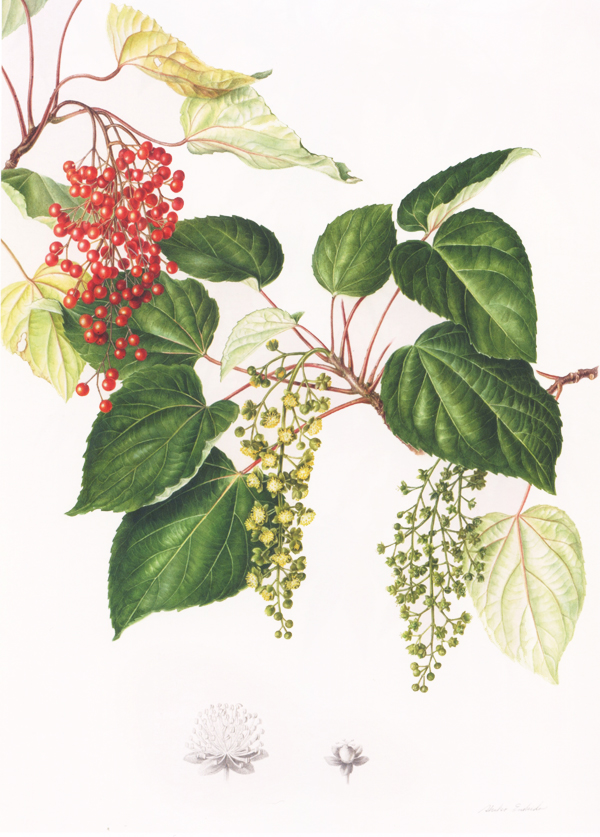
Idesia polycarpa, watercolor on paper, © 2016, Akiko Enokido.
Take a look at the watercolor Idesia polycarpa by Akiko Enokido. I think the actual plant (not her painting!) is very modest looking. Its male and female flowers are especially small and plain. However, if you look at it up-close as Akiko did, it is obvious that the flower clusters are very gorgeous! Akiko successfully converted the modest look of the plant into a dynamic figure using her vivid and strong color. The beauty is sometimes there in front of us, but it doesn’t reveal itself until we open our eyes properly. I think as artists we have the wonderful power to help open the secret door, clearing the smoke that hides nature’s beauty.
Speaking of color, I thought many of the artists’ subjects held a very clean but pastel color. I wondered how they achieved their shades. On first look, I thought perhaps the artwork was done in color pencil, but no, it was watercolor. In some parts, I saw tiny, tiny brush strokes. Instead of washing those stitches out, the artists kept them, floating them onto white paper, like a Georges Seurat painting. I couldn’t get an answer about this technique from my fellow artists, so I will tell you when I find out.
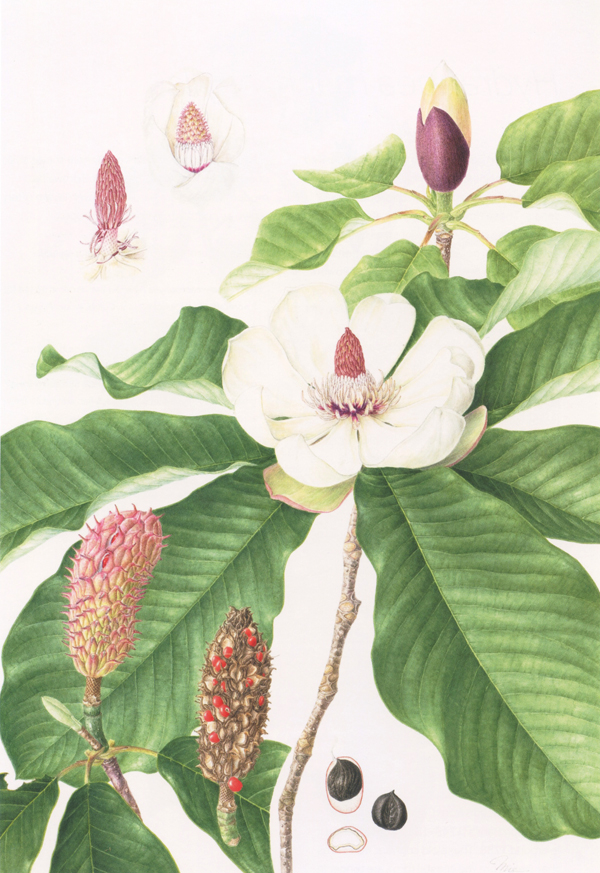
Magnolia obovata, watercolor on paper, © 2016, Mieko Konishi.
You may have the same question I have: how to portray something huge like a whole tree, or a plant like Magnolia obovata, which has leaves that grow up to 45 cm long and 25 cm wide? Two fantastic artists had the answers for me in this show.
The way Mieko Konishi portrayed Magnolia obovata was awesome! She positioned a main flower right up the center, and from it huge leaves spread in all directions. The leaves are cropped off in the middle. Only the two front leaves show almost the complete leaf shape, but even these leaves are cropped off at the tips. This is a huge painting already, but Mieko uses cropping and composition to indicate that the plant is too big to fit the paper. Her image reminded me the surprise I had when I picked up a Magnolia obovata leaf from the ground. I knew it was big, but seeing the actual leaf and holding it gave me additional amazement.
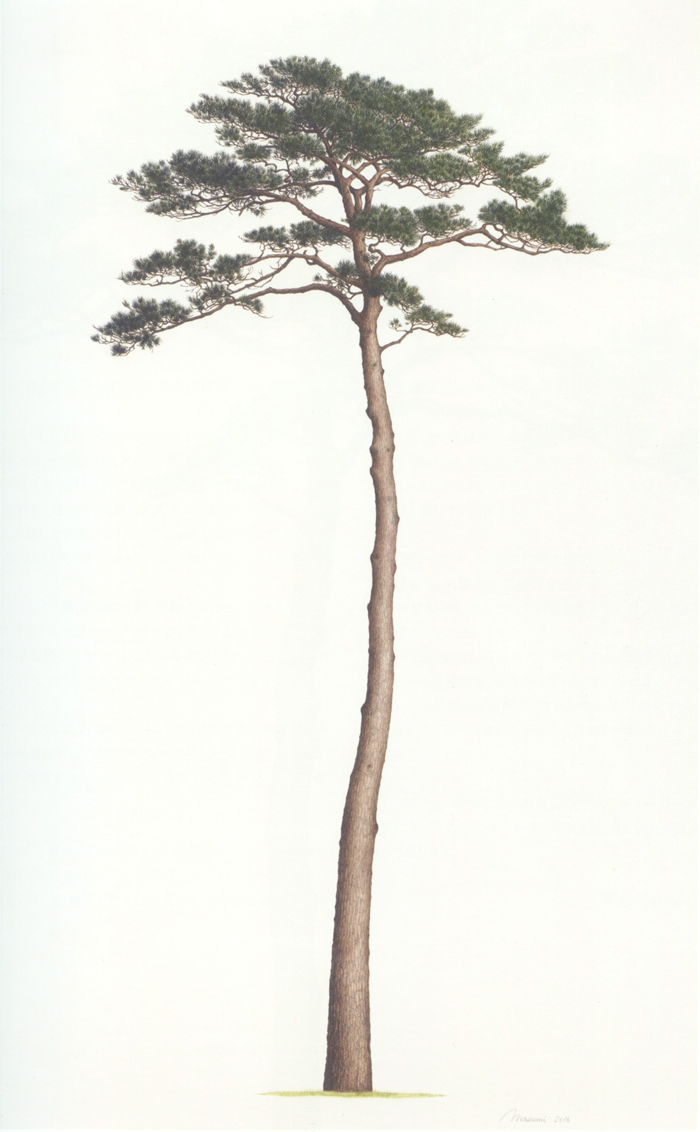
Pinus x densithunbergii, watercolor on paper, © 2016, Masumi Yamanaka.
The other example is done by Masumi Yamanaka. Unfortunately, I couldn’t see her Pinus x densithunbergii in person. It was planed to be exhibited at the Japanese embassy in London a few weeks after I visited. This tree is known as the “Miracle Pine”, which survived the devastating tsunami that accompanied the Great East Japan Earthquake in March 2011 and somehow remained standing, even though the entire 70,000-tree pine forest along the beach was uprooted.
I had a privilege, however, to visit her studio in Kew Garden where she works with other official botanical illustrators of Kew. I could go on and on about the visit, but I would like to go back to her tree painting. I wondered how she created the tree painting without the actual tree in front of her. I watched her short documentary about the painting. Yes, she had many many references of the tree. Yes, she visited the actual tree and made the color samples at the site. But if she had had only those references, the tree would not be portrayed as accurately as it is in her artwork. What her painting contains is her experience and knowledge as a botanical illustrator. She has studied hundreds and thousands of plants with her keen observation and has painted them. This wisdom is laid on underneath the image.
I think the time we spend on a painting is not only spent on that specific artwork, but the knowledge we gain remains and accumulates in us as wisdom.
When I walked in the Kew garden and bumped into one of the trees Yamanaka had portrayed, I had a warm sensation as if I had just run into someone I knew.
Lastly, I couldn’t pass up telling you about what I do not know how to explain. Confusing, yes.
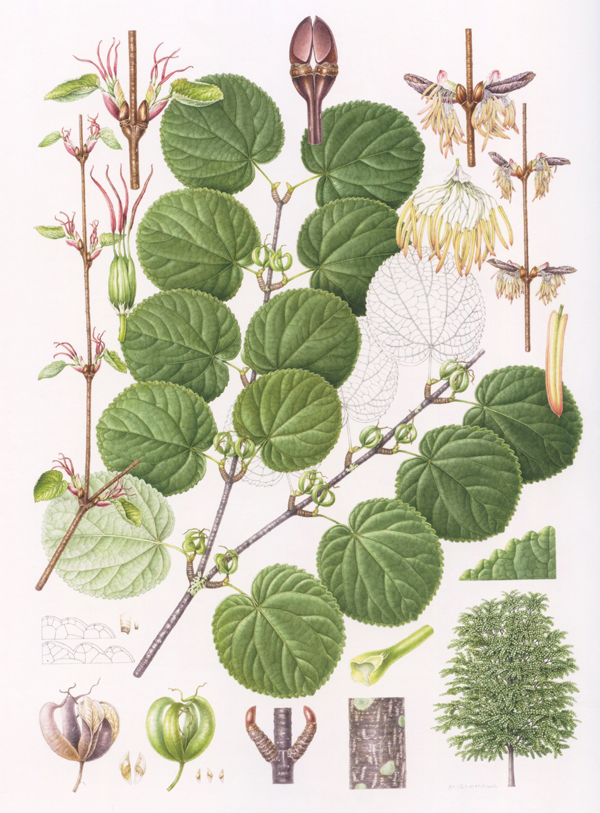
Cercidiphyllum magnificum, watercolor on paper, © 2016, Mieko Ishikawa.
I just had a “wow” when I saw Mieko Ishikawa’s Cercidiphyllum magnificum. The plant itself is again, very humble looking at first glance. Yet it grabbed my attention immediately. What captured me the most is the perfection of the drawing, The leaves look soft and slightly rounded, and the male and female flowers are delicate, yet lively. It is extremely realistic, yet informative. Even though she includes many details in various sizes and different angles, everything fits fantastically into one frame. In her illustration, I think that Art and Science meets in a precise middle point and keep a golden balance. Well, to be honest with you, I have no background nor knowledge of the science of botany, so I may have no idea what I am talking about. There are just so many things in this one painting to gaze at, to be amazed by, to learn, and questions to pose and think about.
“Good artists copy; great artists steal.” This is a famous quote by Picasso. I simply wish he also told us how to steal it.
The Flora Japonica exhibition is open from 17 September 2016 to 5 March 2017, 10 am to 5:30 pm in the Shirley Sherwood Gallery of Botanical Art at the Royal Botanic Garden, Kew, London, UK. Price is included with entry to the Gardens.
This exhibition includes about one hundred Japanese wild, native, endemic plants, portrayed by 36 of the most eminent contemporary Japanese botanical artists. The exhibition also features historic drawings and paintings by some of Japan’s most revered botanists and artists such as Dr. Tomitaro Makino (1863-1957), Sessai Hattori and Chikusai Kato (Edo period artists 1603-1868).
Additionally, works from Kew’s Illustration and Economic Botany collections also are on display, including an early Japanese botanical illustration, Honzō Zufu by Kanen Iwasaki (1786–1842), an illustrated encyclopaedia of medicinal plants from 1828, and Japanese wood panels by Chikusai Kato (1878), which are made from the wood and framed with the bark of the trees that they depict.
Royal Botanic Gardens, Kew is located at: Kew, Richmond TW9 3AB, United Kingdom, +44 20 8332 5655.
Find information about Flora Japonica on Kew’s website.
Two press releases about the exhibition can be found here, and here.
Purchase the Flora Japonica catalogue.
Read the DAIWA Foundation article about the exhibition.
Read about the Flora Japonica exhibition on Asuka’s website and view Asuka’s artworks and exhibitions.
by Deb Shaw

Aristolochia gigantea, ink on paper, Lesley Randall, © 2013, all rights reserved
The 14th International Exhibition of Botanical Art and Illustration by The Hunt Institute for Botanical Documentation has been traveling around the United States for the past two years. Its final stop is at the Petaluma Arts Center in Petaluma, California, for a botanical art exhibition entitled Floribunda, which will run from October 16, 2016 through December 11, 2016.
Floribunda is a celebration of all things floral, featuring the 36 artists from nine countries in The 14th Hunt exhibition, including BAGSC members Leslie Randall and Deborah Shaw. Additionally, the Petaluma Arts Center will feature the work of Aimee Baldwin, Evan Kolker and Randy Strong—three Bay Area artists who create three-dimensional representations of flowers.
“This exhibition is designed as a source of inspiration and an invitation to see the natural world around us in distinct ways, to illuminate the relationship between art and science,” explained Petaluma Arts Center Exhibitions Manager Kim Chigi. “With Botany as one of the sciences, we are excited about the juxtaposition of traditional botanical illustration with the contemporary three-dimensional creations, working in tandem, to explore the connections between the creativity of both artist and nature.”
The Petaluma Arts Center will host a series of events related to the exhibition, including artists’ talks, studio workshops, and botanical art demonstrations:
- Saturday, November 5: Botanical Art Demonstrations with BAGSC member Nina Antze, and Martha Kemp, Lucy Martin and Vi Strain, 1:00 pm, FREE
- Thursday, November 10: Artists’ Talk with Evan Kolker and Randy Strong, 7:00 pm; doors open at 6:30 pm.
- Sunday, November 12 -13: Watercolor Botanical Workshop with Amber Turner
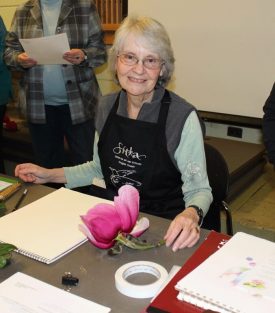
Nina Antze, Martha Kemp, Lucy Martin and Vi Strain, will demonstrate botanical art in a variety of media starting at 1:00 pm on Saturday, November 5, 2016. The demonstrations are free.
Details and ticket information can be found on the Events page on the Petaluma Arts Center’s website. To arrange for group visits or school tours, email or call Kim at (707) 762-5600 x104.
Following the 14th International Exhibition at the Hunt, the travel exhibition went to the Southern Alleghenies Museum of Art—Loretto and was on display from October 18 through December 6, 2014. The exhibition then traveled to the Fellows Riverside Gardens in Youngstown, Ohio where it was on display until January 10, 2016.
The Petaluma Arts Center is located in the historic train depot at 230 Lakeville St, Petaluma, California, 94952. Gallery Hours are: Thursday through Monday, 11 am-5 pm. The gallery is closed Tuesday, Wednesday and holidays.

Prosopis pubescens seed pod (Screwbean Mesquite, or Tornillo), watercolor and graphite on honey vellum, © 2012, Deborah Shaw, all rights reserved.
Admission to the Petaluma Arts Center is $5 for general admission and $4 for seniors. Students, teachers, military, and PAC members are free.
by Deb Shaw
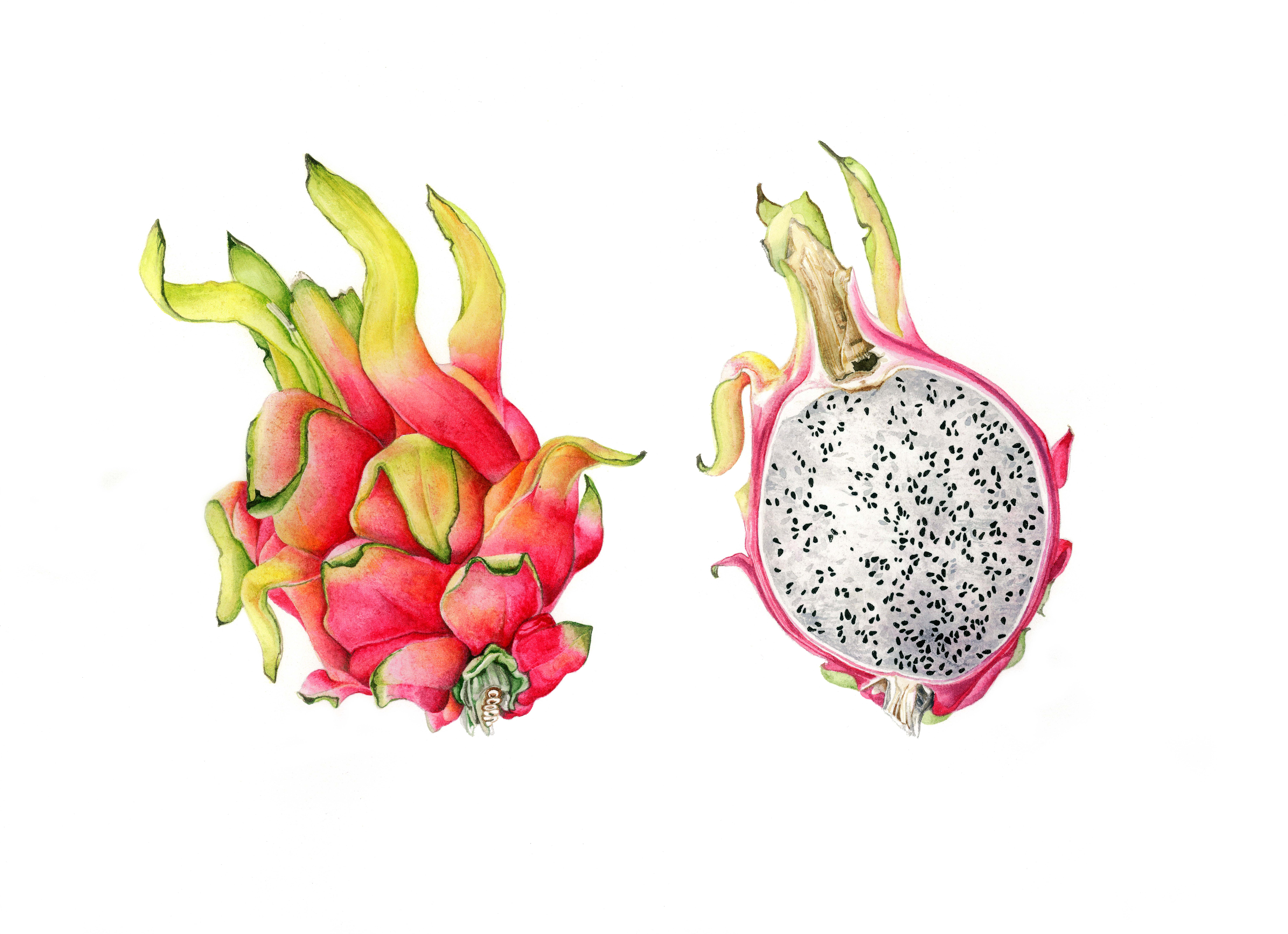
Hylocereus undatus pitahayas, Pitaya or Dragon Fruit, watercolor by Diane Nelson Daly, © 2016. The dragon fruit is the fruit of a cactus species indigenous to the Americas. The fruit is sweet and crunchy with a flavor that is a cross between kiwi and pear.
Cornucopia, a botanical art exhibition of all things edible by the Botanical Artists Guild of Southern California (BAGSC) will open Friday, September 23 in the Ecke Building at the San Diego Botanic Garden (SDBG). The exhibit runs from September 23 – November 18, and includes 47 artworks by 21 BAGSC artists, illustrating the diverse plants that people use all over the world for food, drink and flavorings. The paintings are accompanied by descriptions, stories or recipes written by the artists.

Broccoli, watercolor by Asuka Hishiki, © 2016.
The opening reception will be Friday, September 23, from 3:30 pm – 6:30 pm. The public is invited; the exhibition is free with paid admission or membership.
Artists in the exhibition include: Bonnie Born Ash, Nancy Beckham, Jan Clouse, Diane Nelson Daly, Estelle DeRidder, Asuka Hishiki, Cynthia Jackson, Susan Jackson, Clara Josephs, Teresa Kuwahara, Patricia A. Mark, Arillyn Moran-Lawrence, Kathy Morgan, Terri Munroe, Alyse Ochniak, Mitsuko Schultz, Janice Sharp, Deborah Shaw, Ellie Yun-Hui Tu, Leslie Walker, Jude Wiesenfeld.

Rosa californica, California Rose, watercolor by Estelle DeRidder, © 2016.
The San Diego Botanic Garden is located at 230 Quail Gardens Drive, Encinitas, California 92024, 760.436.3036. Directions can be found on the SDBG website. Download the postcard invitation featuring a watercolor by Teresa Kuwahara: cornucopia-invitation-postcard.
by Estelle De Ridder, posted by Deb Shaw
The California Islands Symposia have been held more or less, every five years since 1965, to share up-to-date information about the management, scientific research, work in all disciplines of natural and cultural science and general well-being of the California islands.
The 9th California Island Symposium for 2016 is being held at the Marriott Hotel, Ventura, California. One of the less scientific and more entertaining presentations of this symposium will be the Art Exhibit that has been advertised for more than six months. The three jurors worked hard and with diligence to put together a coherent show that will present the Channel Islands to the public in an inviting and interesting manner. After the symposium, the exhibit will be moved to the Santa Barbara Botanic Gardens, where it will be on display for another three weeks.
The Channel Islands of California comprise eight islands located in the Pacific Ocean off the Southern California coast. Five of the islands and the surrounding waters are part of Channel Islands National Park and the Channel Islands National Marine Sanctuary.
The Park is supported by many partners who share the protection of the history and prehistory, the cultural and biological diversity as well as protecting vital habitat for marine, terrestrial plant and animal species.
Public appreciation through education, interpretation and research is widely promoted.
Isolation over many thousands of years has developed unique animals, plants and archeological resources found ONLY on these islands and makes is possible for visitors to experience the western coast of the North America as it used to be.
Visitation has increased dramatically over the years, and with contracted concessionaires, the numbers show how the interest in the islands have grown:
1963 = 1,200
2014 = 342,000

Malva assurgentiflora, the Island Mallow, Mission Mallow, Royal Mallow, Island Tree Mallow. © 2016, Estelle De Ridder, all rights reserved. Watercolor and colored pencil on drafting film and paper.
Flora on the Channel Islands include a unique subspecies of pine, oak and island tree mallow.
Santa Rosa Island holds two groves of the endemic to the island, Torrey pine subspecies Pinus torreyana var. insularis. Torrey pines are the United States’ rarest pine species. The islands also house many rare and endangered species of plants, including the island barberry, the island rush rose, and the Santa Cruz Island lace pod. Giant kelp forests surround the islands and act as a source of nutrition and protection for other animals.
BAGSC members Estelle De Ridder, Mitsuko Schultz and Ellie Tu are participating in the exhibition.
Estelle has illustrated two species: Malva assurgentiflora and Heteromeles abtutifolia.
Malva assurgentiflora, the Island Mallow, Mission Mallow, Royal Mallow, Island Tree Mallow, Malva Rosa is a species of flowering plant in the mallow family. It grows into a strikingly architectural shrub/small tree with beautiful white bark.
It is endemic to California, where it is native only to the Channel Islands. It can also be found growing as an escapee from cultivation in coastal mainland California.
Estelle’s painting of Heteromeles abtutifolia was done on paper with watercolor and colored pencil. Heteromeles abtutifolia, Toyon berry, grows on the north-facing coastal bluffs of Santa Cruz Island. It grows on all the other islands, except Santa Barbara island, and was planted on San Nicolas.

Plantanus racemosa, California Sycamore, Watercolor by Mitsuko Schultz, © 2016, all rights reserved.
Mitsuko Schultz had her Platanus racemosa, California Sycamore accepted to the exhibition.
Ellie Tu has three pieces in the exhibition: Dudleya greenei, Coreopsis, and Leptosyne gigantea Kellogg.
Leptosyne gigantea Kellogg (formerly Coreopsis gigantea), Giant Coreopsis is a strikingly strange plant. It grows on dunes, rocky cliffs and exposed slopes, and has a fleshy trunk and branches. It can reach heights of eight feet with a five inch trunk. It is deciduous and dormant in the dry season, taking on an other worldly appearance when visitors hike through a large stand of them. In spring, however, masses of bright yellow blooms put on quite a show.
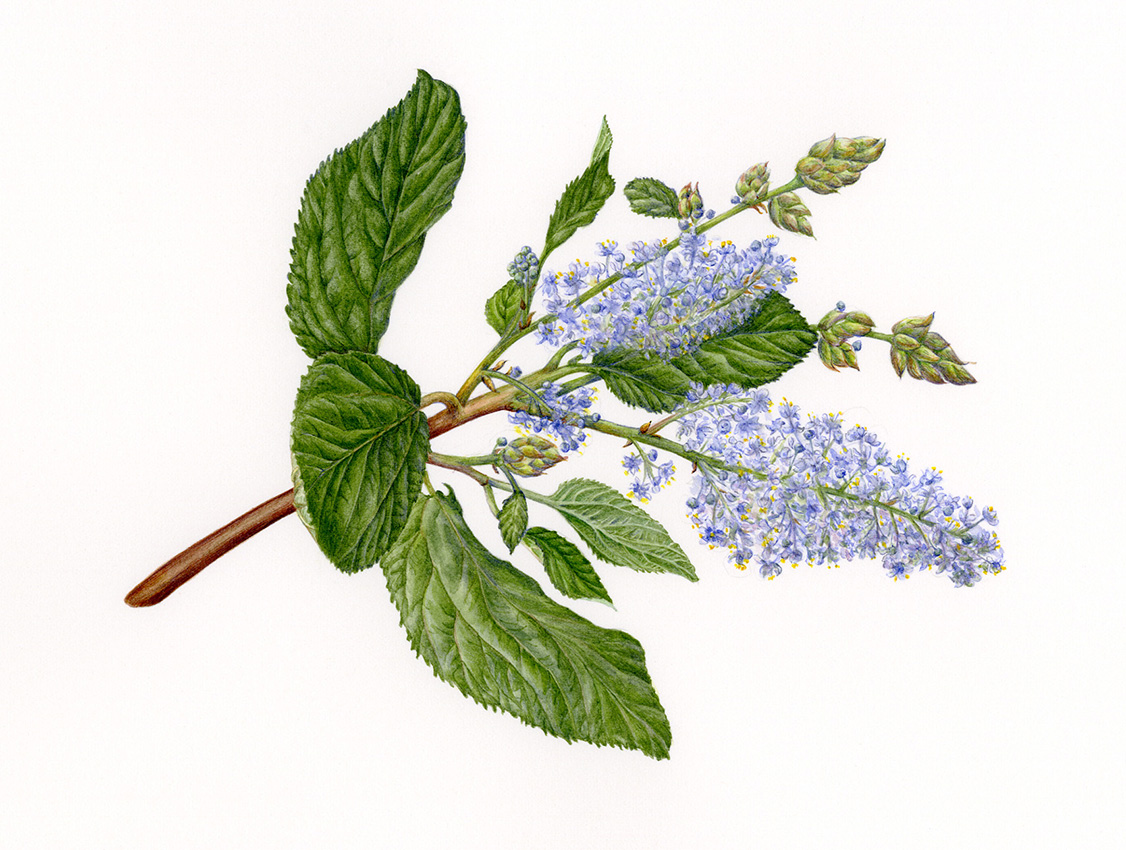
Ceanothus arboreus, Feltleaf Ceanothus, or Island Ceanothus. Watercolor, © 2016, Ellie Tu, all rights reserved.

Leptosyne gigantea Kellogg, (formerly Coreopsis gigantea), Giant Coreopsis, Ellie Tu, colored pencil, © 2016, all rights reserved.
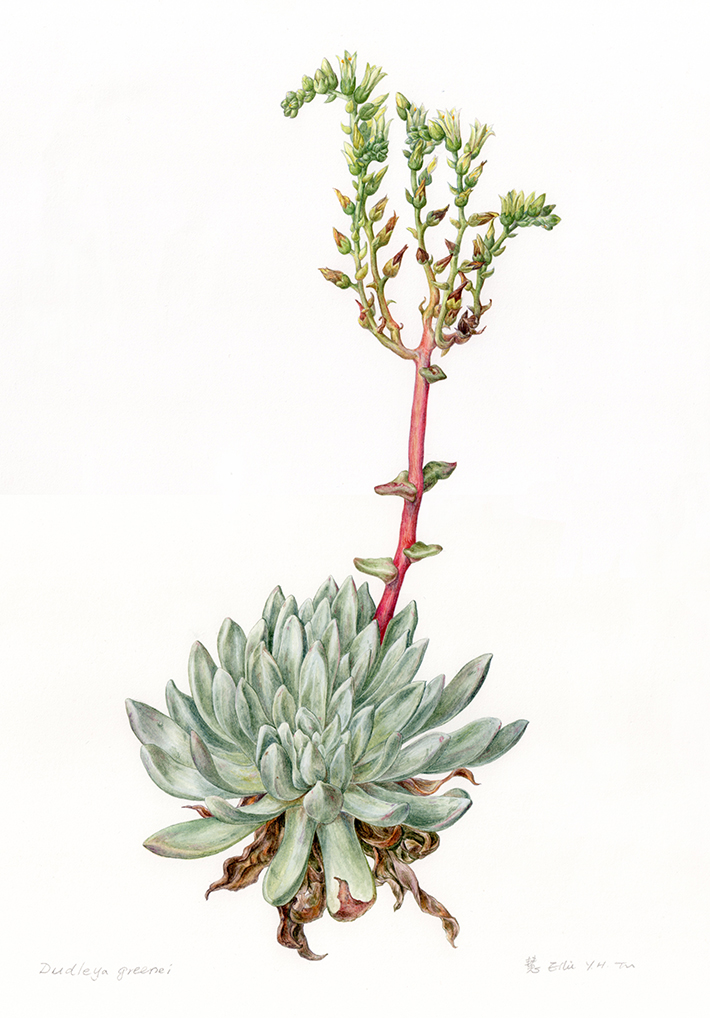
Dudleya greenei, watercolor by Ellie Tu, © 2016, all rights reserved. This plant grows in the Channel Islands National Park.
by John Pastoriza-Piñol, Jude Wiesenfeld and Deb Shaw
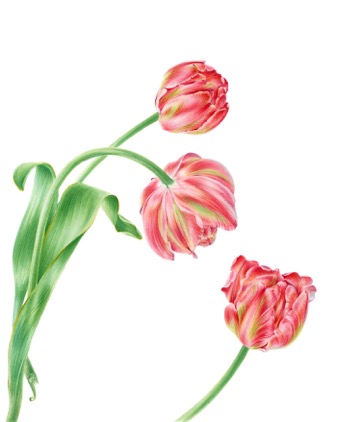
Tulipa x hybrida, watercolor by John Pastoriza-Piñol, © 2016.
BAGSC will be offering a Masterclass with Australian botanical artist John Pastoriza-Piñol in November, 2016. Students will learn the intricacies of achieving fine detail with watercolour masking fluid and NEEF ¼ Comb, invaluable tools for contemporary botanical artists. As a result, your paintings will be brought to a new level of realism and detail. Students should have skills in drawing and watercolor. Over three days, John will assist you with painting the chosen class subject. John will show how masking fluid can be used to achieve very fine detail and will instruct students how to use the NEEF ¼ Comb.
November 8, 9 and 10, 2016
9:30 am – 4:00pm each day
The Huntington Library, Art Collections, and Botanical Gardens
Cost: BAGSC Members: $300; Non-Members: $330
Maximum Registration: 16 students
To register:
Send a check for your $50 non-refundable deposit fee (or payment in full), made out to BAGSC, to BAGSC Education Chair, Jude Wiesenfeld. Please write “JohnPP” on the memo line of the check. Payment in full is due by Monday, October 25, 2016.
Bring your lunch, or purchase lunch at The Huntington Cafes, at The Huntington.
Questions about the Workshop? Contact the BAGSC Education Chair.

Fragaria x ananassa, Strawberry, watercolor by John Pastoriza-Piñol, © 2016.
Learning Objectives:
Students who enroll in this workshop would have completed some level of introduction to Botanical Art and be at an intermediate to advanced level. The structure of the class involves a three-day painting project and the demonstrator assists each student with composition, painting techniques, colour theory which will be offered in class and assigned for homework.
Download a PDF of the materials list: John Pastoriza Pinol Materials list 2016
About the Instructor:
Rich luminous hues and gorgeously exotic and rare botanical specimens epitomize John’s work, however his are much more than mere flower paintings:closer inspection reveals a certain ambiguity of form and intent directing us towards a complex narrative.
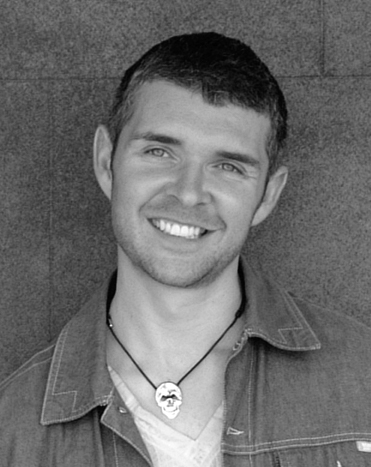
John Pastoriza-Piñol, © 2016.
A master of his medium, his perfectly executed watercolours remain true to the accuracy that is vital to botanical illustration yet they have a fluidity and sensuality that stirs the viewer to experience more than a mere marveling of technique.
The artist suggestively urges us to look beyond the aesthetic and move into slightly more uneasy territory as his work inhabits a territory somewhere between scientific analysis and symbolic realism, prompting a reading that goes beyond the purely representational and literal. The artist intends for literal and subversive elements to coexist uneasily on the same plane, while the aesthetics will remain true to the fundamental principle of objective observation of the natural world.
Location:
The workshop will be held at The Huntington Library, Art Collections, and Botanical Gardens, in the Botanical Education Center. The Huntington is located at: 1151 Oxford Road, San Marino, CA 91108.
by Jude Wiesenfeld and Deb Shaw
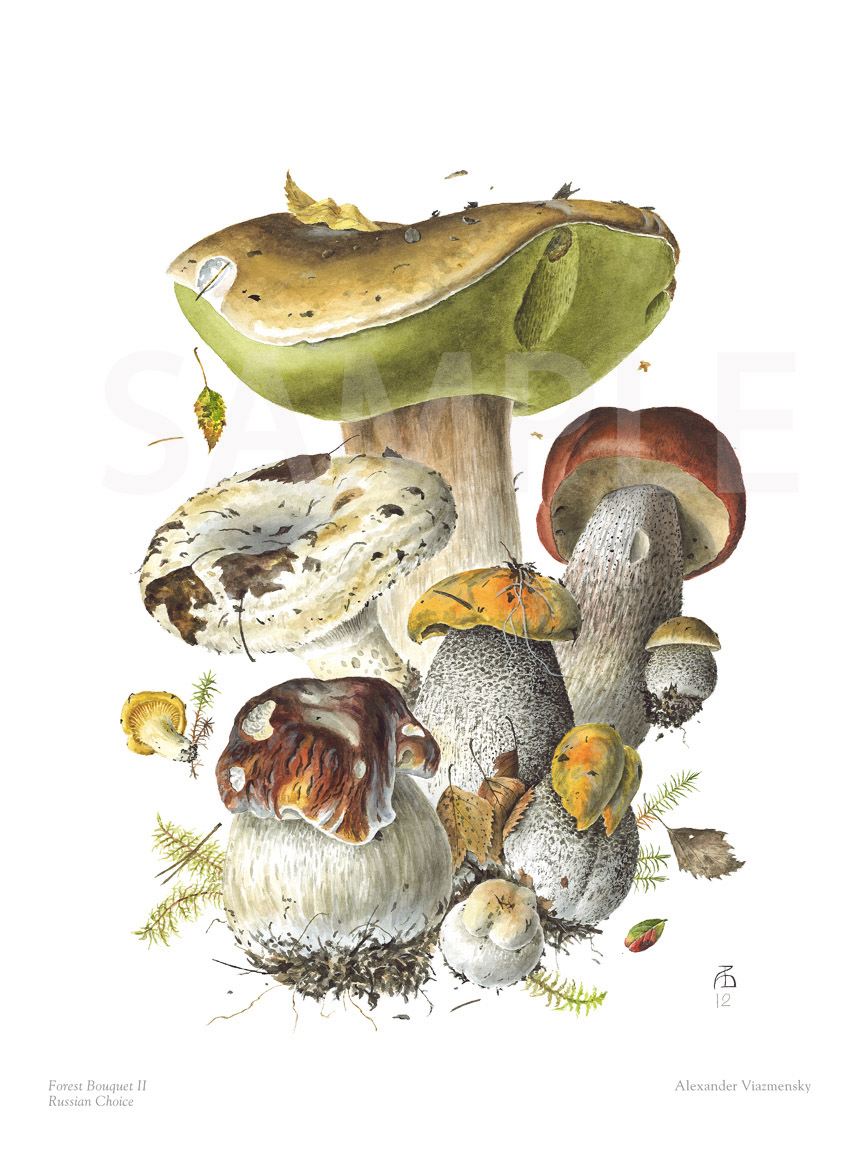
“Forest Bouquet, Russian Choice,” watercolor by Alexander Viazmensky, © 2016, all rights reserved.
Alexander (Sasha) Viazmensky will be returning to Southern California from St. Petersburg, Russia to teach a three-day, BAGSC-sponsored workshop, Mushroom Portraits in Watercolor.
Wednesday, October 19 – Friday, October 21, 2016
9:30 am – 4:00 pm each day
Los Angeles County Arboretum, Oak Room
$300 for BAGSC members; $330 for non-members
Class limit: 16 students
Workshop Description:
Mushroom hunting is a passionate, national pastime in Russia, and Sasha’s paintings capture the spirit of the fungi and the forest. Painted life sized, he calls his paintings “Portraits of Mushrooms.” The class will consist of the following steps:
- Composition.
- How to properly place your subject: lights, shadows, reflections.
- Creating the shape from light to dark.
- Creating various textures with dry brush.
- Using white gouache.
- Final details.
Download the materials list: sashaMaterialsList
To Register:
Send a check for your $50 non-refundable deposit fee (or payment in full), made out to BAGSC, to BAGSC Education Chair Jude Wiesenfeld. Please write “Sasha” on the memo line of the check. Payment in full is due by Monday, October 3, 2016.
Bring your lunch, or purchase lunch at the Peacock Café, on the Arboretum grounds.
The Los Angeles County Arboretum and Botanic Garden is located at: 301 North Baldwin Ave, Arcadia, CA 91007.

Alexander Viazmensky in the woods. © 2016.
About the Instructor:
Sasha Viazmensky was born and lives in St. Petersburg, Russia, and specializes in painting fungi. Although he has a Master’s Degree in Electrical Engineering, he has devoted his life to painting, studying, and picking mushrooms. His work is included in the collections of the Hunt Institute for Botanical Documentation in Pittsburgh, the Minneapolis Institute of Arts, the Shirley Sherwood Collection and the Komarov Botanical Institute in St. Petersburg, among others, and in private collections all over the world. You can read an article Sasha wrote about picking mushrooms in Russia, published in MUSHROOM, The Journal of Wild Mushrooming, here.
by Susan Jackson, posted by Deb Shaw
A new exhibit has just opened at the San Diego Natural History Museum in Balboa Park that botanical artists would find quite interesting. It is located in the Eleanor and Jerome Navarra Special Collections Gallery on the third floor of the museum. It is a permanent exhibition called Extraordinary Ideas from Ordinary People: A History of Citizen Science which features rare books, art, photographs, maps and historical documents that pay homage to the past, present, and future of citizen science.
The upper mezzanine features an exhibit that a botanical artist will not want to miss. On display are nine “Plant Portraits” by the early twentieth century painter, A. R. Valentien. He was commissioned by the philanthropist Ellen Browning Scripps to paint California wildflowers. Over a period of ten years, Valentien traveled around California creating exquisite watercolor and gouache scientific illustrations. Part of the collection of 1,094 paintings, all done on 13x 20 paper, will be rotated in this gallery. A book which includes photographs of all the paintings can be found in the gift shop, however, it is no substitute for seeing the real thing. Bring your magnifying glass.
The gallery also has original catalogs from Pierre-Joseph Redoute, William Curtis, Auguste Johann Rosel von Rosenhoff, and John James Audubon. These are huge volumes printed in black ink and then hand colored. They are a reminder of a time before photography when beautiful books were only available to the very wealthy. Although we frequently see prints that originated from these catalogs, there is something very special in actually seeing the originals.
More information about the exhibit and the San Diego Natural History Museum may be found on their website. There is also a short video about the Valentien Collection, which can be seen by clicking on the arrow located on the close up view of the Mariposa Lily. If you decide to visit, plan on spending several hours, because there are lots of other things to see as well.
The San Diego Museum of Natural History is located at 1788 El Prado, Balboa Park, San Diego, CA 92101. The Museum is open daily 10 AM to 5 PM, and until 8 PM on most Fridays this summer. Visit the website for ticket prices and specific daily hours; the Museum may close early on some days.
by Deb Shaw, with permission from David Reynolds
Melbourne-based botanical artist and filmmaker David Reynolds has created a one-hour documentary about six of Australia’s botanical and natural history artists. Titled Studio Sessions: Seen through the eyes of the artist, the documentary features interviews with Celia Rosser, Jenny Phillips, Dianne Emery, Terry Napier, Mali Moir, and John Pastoriza-Piñol.
Written and directed by Reynolds, the documentary offers insight into the artists’ approach. Each interview is filmed in the artist’s studio, giving the viewer an intimate look at the setting in which the artists create their detailed, accurate works.

Studio Sessions: Seen through the eyes of the artist. Written and directed by David Reynolds. © 2016, all rights reserved.
The DVD is available for pre-order through Reynolds’ website: http://www.davidreynoldsart.com.au/ Cost is $30 AUD (there is a convenient currency converter on the site) with an additional $10 AUD for postage and handling outside Australia. The DVD will be available world-wide in both PAL and NTSC format and will be Region Free. (Here in the US, NTSC is the most common format.)
Shipping is planned to begin in early September, 2016. Once the DVD is released, pre-order customers will be contacted to arrange payment and delivery. After release, the DVD will be able to be ordered through an online store on the website.
by Deb Shaw
Hunt 15th International Exhibition of Botanical Art and Illustration
Every three years the American Society of Botanical Artists (ASBA) holds its annual conference in Pittsburgh, PA to coincide with the Hunt Institute’s International Exhibition. This year is no exception: the 15th International Exhibition will open on September 15, and will run through December 15, 2016.
The Hunt Institute for Botanical Documentation established the International Exhibition in 1964 with the purpose of supporting and encouraging contemporary botanical artists. The upcoming exhibition features 43 works by 43 different artists from 15 different countries. A few selected works from the exhibition can be viewed on the website.
![Cover of the Hunt 15th International Exhibition Catalog. Cover art: Soft Tree Fern, Dicksonia antarctica [Dicksonia antarctica Labillardière, Dicksoniaceae], watercolor on paper by Laurie Andrews (1936–), 2008, 76.5 × 56.5 cm, HI Art accession no. 8078, reproduced by permission of the artist.](https://bagscblog.com/wp-content/uploads/2016/08/hibd-15th-international-title.jpg?w=300&h=476)
Cover of the Hunt 15th International Exhibition Catalog. Cover art: Soft Tree Fern, Dicksonia antarctica [Dicksonia antarctica Labillardière, Dicksoniaceae], watercolor on paper by Laurie Andrews (1936–), 2008, 76.5 × 56.5 cm, HI Art accession no. 8078, reproduced by permission of the artist.
The opening reception on October 13, from 6 pm – 9 pm is open to the public, and also is a highlight of the ASBA conference. The curators of the exhibition will give a short introduction to the exhibition in the gallery at 6:30 pm. Catalogues will be available for sale at the opening.
The Hunt Institute is located at: 4909 Frew Street, 5th Floor, Hunt Library. The exhibition will be on display on the 5th floor of the Hunt Library building at Carnegie Mellon University and will be open to the public free of charge. Hours: Monday–Friday, 9 a.m.–noon and 1–5 p.m.; Sunday, 1–4 p.m. (except 20 November and 24–27 November). Because the Hunt’s hours of operation are occasionally subject to change, please call or email before your visit to confirm. For further information, contact the Hunt Institute at 412-268-2434, or email.
Early Bird Registration for the 22nd Annual ASBA Meeting and Conference CLOSES AUGUST 7, 2016!
The deadline for early registration discounts for the 22nd Annual ASBA Meeting and Conference closes on August 7, 2016. Early registration fees (on or before August 7) are $360. Register now online. After August 7, registration jumps to $425. Registration closes September 4, 2016, no exceptions.
Join ten other BAGSC members who have registered for the conference so far. See old friends, meet new friends from all over the world, learn new techniques and get inspired.
The conference will be held at the Wyndham Pittsburgh University Center, just a few blocks from Phipps Conservatory and Botanical Garden, The Carnegie Museum of Natural History, The Carnegie Museum of Art, and the Cathedral of Learning at the University of Pittsburgh. And, of course, there is the Hunt 15th Annual International Exhibition—one of the world’s most prestigious exhibitions of botanical art and a must-see.
BAGSC member Margaret Best will be teaching a one-day workshop on watercolor, “From the Ground Up.” BAGSC member Deborah Shaw will be giving an up-to-the-very-minute lecture about how to protect your images on the web, along with some tips and tricks and a list of helpful and fun apps.
There are still openings in various workshops, including graphite, colored pencil, and pen-and-ink. There are many fascinating lectures available at no additional charge. And there are openings available for a field trip to visit Frank Lloyd Wright’s Fallingwater.
Read about the conference, sessions and instructors on ASBA’s website, make your selections, then go to the online registration site to register.
There are 193 ASBA members who have registered so far. Come join us in Pittsburgh!
by Deb Shaw
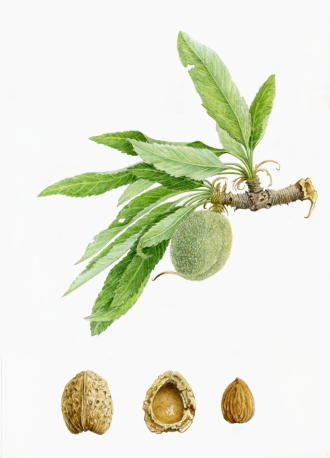
Prunus dulcis, Almond, watercolor by Margaret Best, © 2016, all rights reserved.
BAGSC members Margaret Best, Akiko Enokido, Asuka Hishiki, Mitsuko Schultz, and Deborah Shaw have been accepted into the 19th Annual International American Society of Botanical Artists (ASBA) and The Horticultural Society of New York.
Jurors Susan Fraser (Director, Mertz Library,The New York Botanical Garden), David Horak (Curator of the Aquatic House, Brooklyn Botanic Garden), and Catherine Watters (Botanical Artist) chose 48 artworks from 258 submissions. Works in the exhibition include artists from the United States, Australia, Brazil, Canada, Japan, the Netherlands, and the United Kingdom.
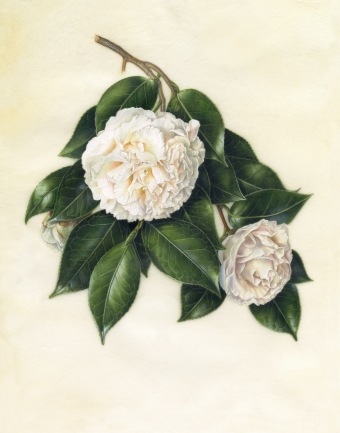
Camellia japonica ‘Hakuho’, Heirloom Camellia ‘Hakuho’ ‘White Phoenix’, watercolor on vellum by Akiko Enokido, © 2015, all rights reserved.
This year’s exhibition is in a new venue: it will be hosted by the New York Design Center and installed in their bright, airy, contemporary gallery space, 1stDibs, on the tenth floor. The Horticultural Society of New York, New York Design Center, and ASBA are designing special outreach events and programs, to be announced in September.
The opening reception will take place on Thursday evening, November 3, 2016 and will be on display through December 30, 2016. The catalog of artwork images will be posted on ASBA’s website the day of the opening. A full-color catalog will be published and available on ASBA’s website, as well as at the 1stDibs Gallery and at The Horticultural Society of New York. For further information please contact ASBA’s Exhibitions Director.
1stDibs is located on the 10th Floor of The New York Design Center, 200 Lexington Avenue, New York, New York, 10018. Gallery Hours are 9:30 – 5:30 Monday – Friday.
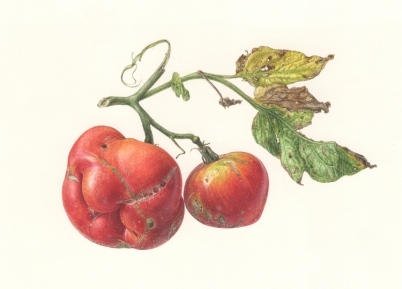
Solanum lycopersicm, Dancing Duo 34-A, Portrait of an Heirloom Tomato, watercolor by Asuka Hishiki, © 2016, all rights reserved.
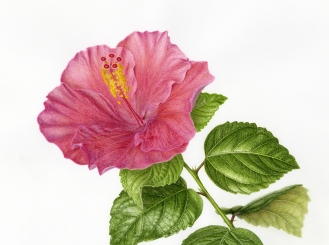
Hibiscus rosa-sinensis, Hibiscus, watercolor by Mitsuko Schultz, © 2016, all rights reserved.
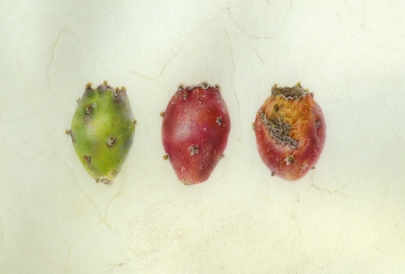
Opuntia spp. Fruit, Tunas or Prickly Pear Cactus Fruit, watercolor on vellum by Deborah Shaw, © 2016, all rights reserved.

California Poppy, 50″x28″, © JW Fike, 2015. Photographed in Miramonte, CA.
by Deb Shaw
There are a wealth of exhibitions this summer in Southern California that are botanically instructive and inspirational.
One is in South Orange County. Soka University in Aliso Viejo is currently showing JW (Jimmy) Fike’s solo exhibition, Photographic Survey of the Wild Edible Botanicals of California, now through August 26, 2016.
Even though his medium is photography, rather than traditional painting or drawing, the intent behind Fike’s large, stark, beautiful photographs is similar to any botanical artist or illustrator:
“Within my system the plant is excavated, arranged in the studio, photographed, then illustrated digitally in such a way as to render the edible parts in color while the remaining parts, less emphatically, read as contact prints.” [Quote from Soka University website.]
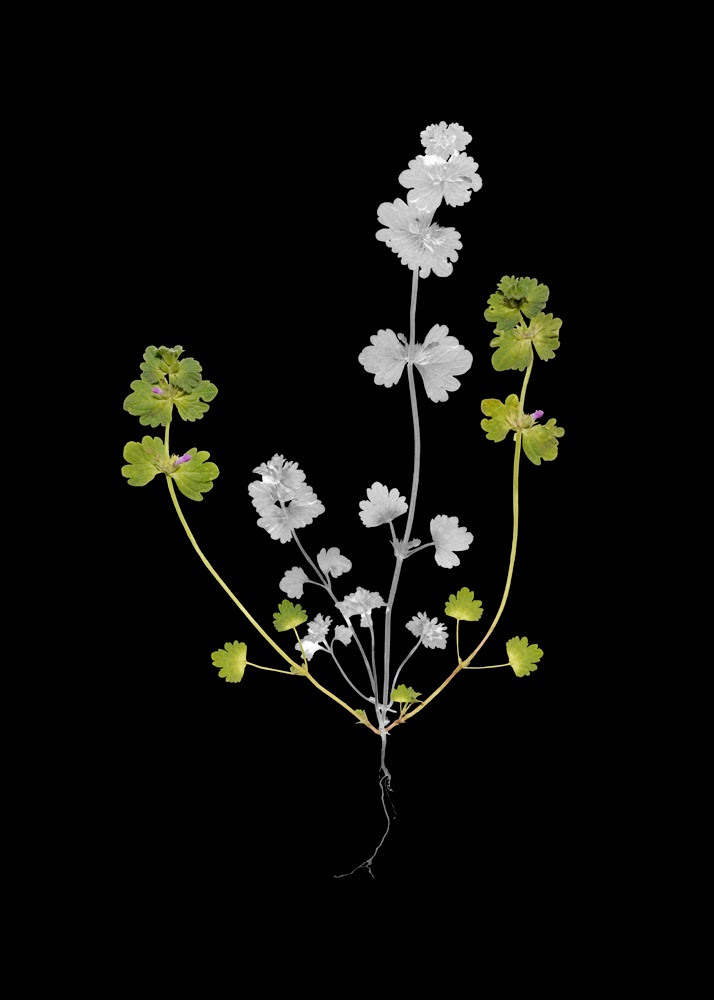
Henbit, 28″x20″, © JW Fike, 2014. Photographed in Miramonte, CA.
After Fike meticulously composes and arranges his specimen to emphasize key plant characteristics, he photographs it and then begins illustrating in Photoshop. Each piece may take up to three or four months to illustrate. (Sound familiar?) Each photograph references scientific illustration, contact prints, and photograms:
“I’m referencing the history of contact prints and photograms from the dawn of photography,” said Fike, noting 19th century English botanist Anna Atkins and pioneering photographer Henry Fox Talbot. “Some of the very first photographs were plant specimens on sensitized paper.” [Quote from LA Times article, Haunting flowers: The eerily beautiful California botanical art of J.W. Fike.]
Fike exhibits a symbiotic collection of edible plants from a geographic area. He has photographed more than ninety plants in “seven different states and plan to continue the survey until I’ve created a collection that spans the continental United States.” [Quote from Soka University website.]

Soap plant, 110″ x 64″, © JW Fike, 2015. Photographed in Miramonte, CA.
Fike’s exhibition has been covered in the LA Times, and on Botanical Art & Artists by Katherine Tyrrell. His photographs and other articles can be found on his blog.
Soka University’s Founders Hall Art Gallery is located at 1 University Drive, Aliso Viejo, CA 92656, 949-480-4000, info@soka.edu
Exhibition now through August 26, 2016
Free Admission
Monday thru Friday, 9:00 a.m. to 5:00 p.m.
Map and directions
by Bonnie Born Ash, photos by Janice Sharp, posted by Deb Shaw
On Saturday afternoon, July 16, 2016, a festive opening reception for “Capturing the Arboretum: the Art of Botanical Illustration” was held in the newly renovated Arboretum Library. Participating BAGSC artists were Cristina Baltayian, Bonnie Born Ash, Diane Nelson Daly, Estelle DeRidder, Nancy Grubb, Cynthia Jackson, Arillyn Moran-Lawrence, Marilyn Parrino, Mitsuko Schultz, Janice Sharp, Deborah Shaw, and Beth Stone.
Artists and guests enjoyed viewing twenty-three fine works of art depicting plants of the Arboretum. Individual works were enhanced by comments from Jurors James Henrich, Arboretum’s Curator of Living Collections; Arboretum Librarian Susan Eubank; and Olga Eysymontt, Botanical Art Teacher. In addition, artwork signage gives the specific location in the reference library to find additional information on each plant illustrated.
Throughout the reception, Estelle DeRidder and Mitsuko Schultz demonstrated botanical art techniques. Additional artist demonstrations are planned in the Library on two Saturdays, August 27 and September 24. The exhibition continues through December 29. Many thanks to our jurors, volunteers, and congratulations to all participating artists!
Library Location
The Arboretum Library is located within The Arboretum. Go straight through the double doors on the left (east) of the entrance rotunda.
Library Hours
Tuesday-Friday 8:30 am to 5:30 pm
Saturday 8:30 am to 5:00 pm
Sunday 12:00 pm to 4:00 pm
Susan Eubank, Librarian
Phone: (626)821-3213
Fax: (626)445-1217
The Los Angeles County Arboretum and Botanic Garden is located at 301 North Baldwin Ave, Arcadia, CA 91007.
Click on an image below to enlarge and view through a slide show format.

Photo by Janice Sharp, © 2016.

Photo by Janice Sharp, © 2016.

Photo by Janice Sharp, © 2016.

Photo by Janice Sharp, © 2016.

Photo by Janice Sharp, © 2016.

Photo by Janice Sharp, © 2016.

This notice of the Art Show appeared in the latest issue of the Arboretum Newsletter. Artwork by Diane Daly, © 2016, all rights reserved.
by Janice Sharp, posted by Deb Shaw
The Botanical Artists Guild of Southern California will present an exhibit of their work depicting Arboretum trees and flowers from July 16 to December 29 in the Arboretum Library at the Los Angeles County Arboretum and Botanic Garden. Meet the artists featured in Capturing the Arboretum: The Art of Botanical Illustration at a reception:
Saturday, July 16, 2016
1 pm – 3 pm in the Arboretum Library
Members of the local chapter of the American Society of Botanical Artists will demonstrate botanical art techniques including graphite, colored pencil and watercolor in the Library on two Saturdays, August 27 and September 24. Prints and cards will be sold during demonstrations, with a portion of the proceeds to benefit the Los Angeles Arboretum.
The Guild promotes public awareness of this artistic tradition.
BAGSC artists participating in The Art of Botanical Illustration include: Bonnie Born Ash, Cristina Baltayian, Diane Nelson Daly, Estelle DeRidder, Nancy Grubb, Cynthia Jackson, Arillyn Moran-Lawrence, Marilyn Parrino, Mitsuko Schultz, Janice Sharp, Deborah Shaw, and Beth Stone. Congrats to all!
The Los Angeles County Arboretum and Botanic Garden is located at: 301 North Baldwin Ave, Arcadia, CA 91007, 626.821.3222.
The Arboretum Library is located within The Arboretum. Go straight through the double doors on the left (east) of the entrance rotunda.
Library Hours are from:
Tuesday-Friday 8:30 am to 5:30 pm
Saturday 8:30 am to 5:00 pm
Sunday 12:00 pm to 4:00 pm
by Deb Shaw
 The deadline for submission to The California Islands Symposium Art Exhibition has been extended to July 19, 2106!
The California Islands Symposium Art Exhibition will be held October 3 – 7, 2016 in Ventura, California during the Symposium and then moved to the Santa Barbara Botanical Garden in Santa Barbara, California, where it will be on display for one month, from October 9 – November 6, 2016.
Artists are invited to enter original artwork in any two-dimensional medium that reflects the beauty and uniqueness of the California Islands. One source of the flora found on the islands is: https://www.nps.gov/chis/learn/nature/plants.htm. Submissions are not limited to the plant life, but can include marine life, shells, birds and fauna. The only qualifier for content is that the subject matter must be connected to the California Channel Islands. Many of the plants that grow on the Channel Islands also grow on the mainland. Check the lists; if you’ve painted any California natives, you may already have a painting in the drawer that qualifies for submission.
Entries are accepted through http://www.onlinejuriedshows.com and the deadline is July 19th. The symposium website can be found at: http://www.californiaislands.net/island-art-exhibition/. There will be prize money for the top three artists.
“We believe that including the arts in the international island symposium is a critical component in cultivating a greater appreciation of the unique California islands. The juried Art Exhibition is a special event associated with the scientific symposium.”
Questions? Contact the 9th California Islands Symposium Planning Committee at: californiaislands@gmail.com
 BAGSC News