You are currently browsing dbshaw’s articles.
by Beth Stone

© 2016, Descanso Gardens Guild, Inc. Image information: Matilija Poppies, © Descanso Gardens.
Descanso Gardens has announced a call for entries for its second juried exhibition, entitled “Portraits of the Garden II — BLOOM!” Following its popular 2014 exhibition “Portraits of the Garden,” Descanso hopes to cover the walls of the Sturt Haaga Gallery with artwork of flowers.
Any artwork depicting flowers, floral forms, and the flower’s role in the life-cycle of plants in any artwork style and medium will be considered.
Entries may be submitted at callforentry.org. Descanso Gardens members receive a 75 percent discount off the $60 entry fee; members should use promo code Flower17 to receive the discount.
The deadline for submissions is January 11, 2017. “BLOOM!” will be on display at the Sturt Haaga Gallery from March 7 to May 28, 2017. Read detailed Exhibition and Artwork Requirements here.
Descanso Gardens is located at: 1418 Descanso Drive, La Cañada Flintridge 91011.
by Clara Josephs, Beth Stone and Deb Shaw
BAGSC held an information-stuffed quarterly meeting on Sunday, September 11. Workshops were announced, the new BAGSC website was revealed (more about the website in a future article coming soon) and BAGSC member Kathy Morgan demonstrated carbon dust techniques on clayboard.
Kathy was first introduced to carbon dust in a class with Olga Eysymontt and was immediately hooked. Kathy has mastered this unique method of painting known for rich, dark values and flawless transitions.

A few of Kathy’s favorite materials: a pad of Dura-lar, Wolff’s carbon pencils in four grades of hardness and a stencil cutting kit. Photo by Beth Stone, © 2016.
Instead of using an X-acto blade to cut a stencil, Kathy prefers to use a heated stencil cutter on a sheet of Dura-lar, over a piece of tempered glass. She first places her tissue drawing under the glass, then uses a pen to carefully trace the outline(s) on the Duralar. Moving slowly, she then carefully cuts along all the outlines with the heated stencil cutter. She saves both the positive and negative parts of the stencil to use in different stages of her drawing.
Kathy usually adds some temporary registration marks to her drawing surface and her stencil, to make it easier to align the stencil again at a later stage.
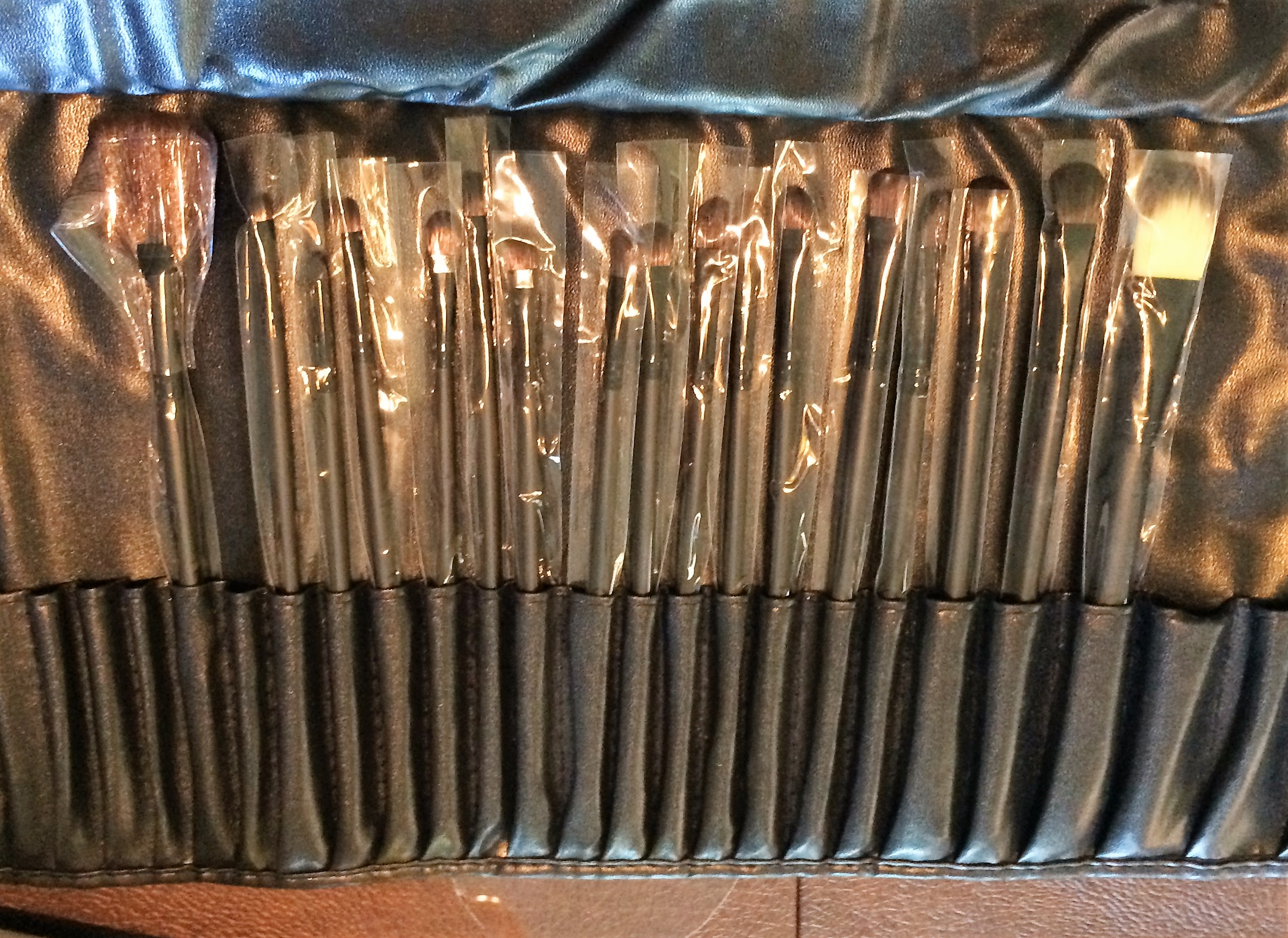
Kathy Morgan prefers to use soft cosmetic brushes of various sizes for her carbon dust work. Photo by Beth Stone, © 2016.
She uses four different hardnesses of Wolff’s carbon pencils to get different tonal values, starting with the lightest tone and getting darker as the drawing progresses. She prefers to use cosmetic brushes, always working from the outside edges in. (If you work from the inside towards the outside, you run the risk of creating a hard, dark edge where the stencil begins.)
Kathy uses a metal emery file to create the carbon dust, adding each hardness of dust to its own empty plastic medicine vial. (Yet another use for those empty medicine containers!)
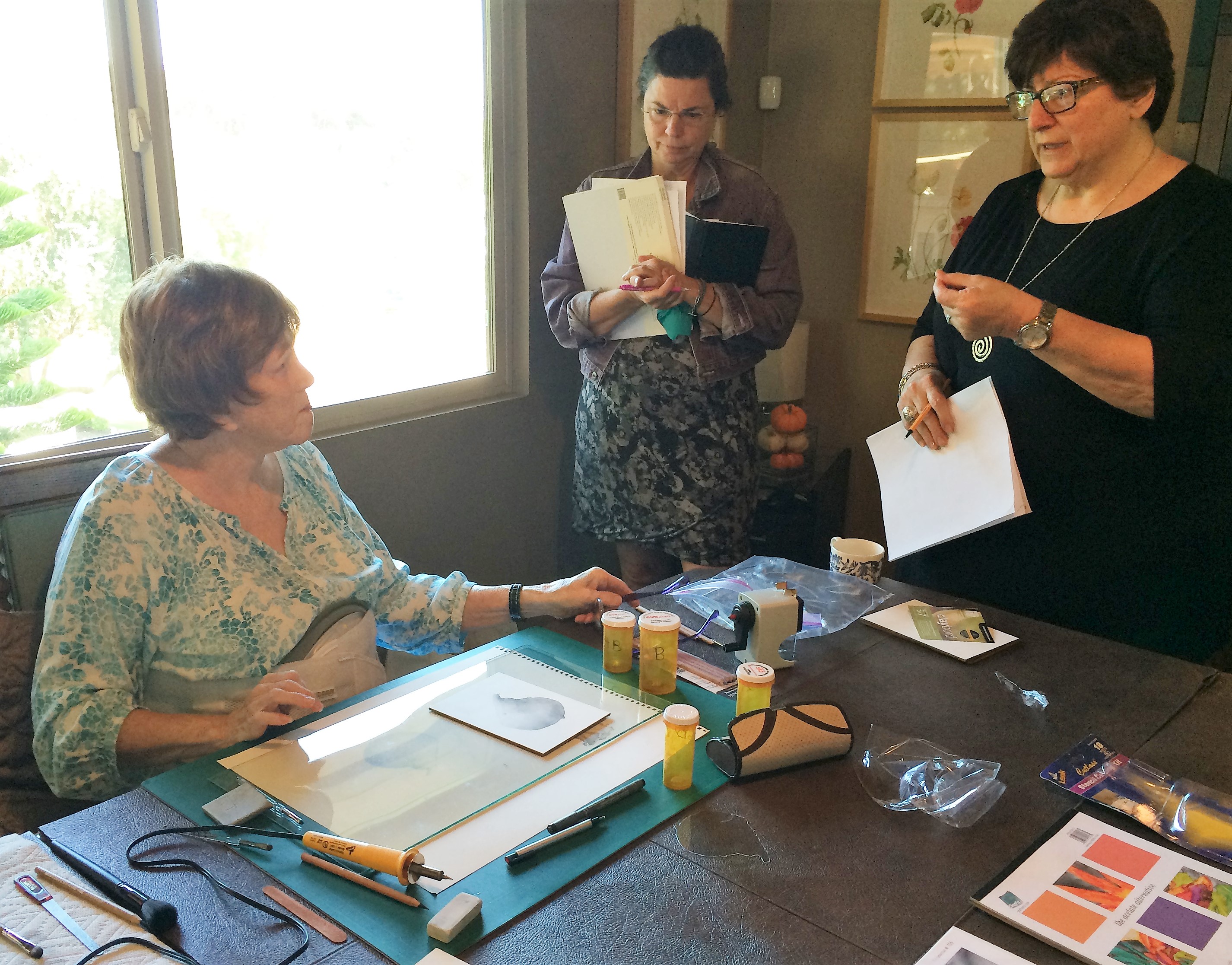
Kathy Morgan answers questions from BAGSC members Carmen Lindsay and Cristina Baltayian. Photo by Beth Stone, © 2016.
Details are added with a very sharp carbon pencil in the tonal value she needs. She sprays finished works with a workable fixative.
BAGSC members who could stay after the potluck lunch experimented with the technique with the assortment of fruits and vegetables that Kathy brought as subject matter. Thank you Kathy for a fun and informative presentation.
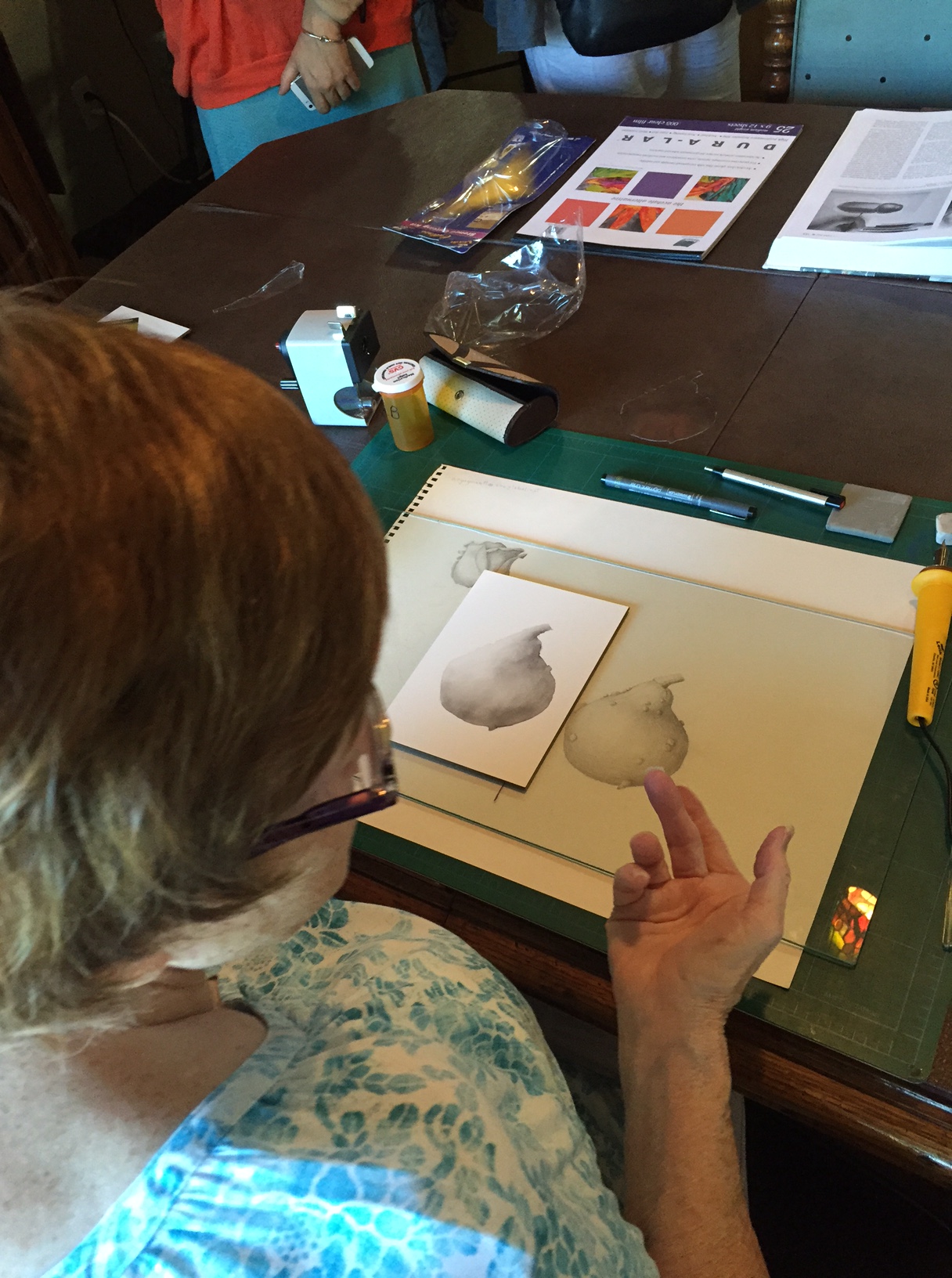
Kathy Morgan demonstrating drawing a pear. Photo by Clara Josephs, © 2016.

BAGSC members Carmen Lindsay and Bonnie Born Ash experiment with carbon dust. Photo by Clara Josephs, © 2016.
by Deb Shaw

Open Parrot Tulip, oil on paper, © 2016, Ingrid Finnan.
In San Francisco? Arader Galleries is currently exhibiting Outside In: Contemporary Natural History Artworks, from September 9 – October 12, 2016. Original artworks are on display by seven ASBA artists, including Francesca Anderson, Jean Emmons, Monika de Vries Gohlke, Ingrid Finnan, Asuka Hishiki, Catherine Watters and Carol Woodin.
An article by ArtPlantae has information about each artist, with links to their websites.
In addition to the exhibition, Outside In, Arader Galleries will also feature the Highgrove Florilegium at the same time. Both volumes of the Florilegium will be on display, capturing HRH The Prince of Wales’ celebrated garden at Highgrove in 124 paintings by contemporary botanical artists from around the world.
by TAG Gallery and Sally Jacobs, posted by Deb Shaw

Savoy Cabbage, graphite, by Sally Jacobs, © 2016.
BAGSC member Sally Jacobs has an upcoming exhibition of watercolor paintings and graphite drawings entitled “Larger Than Life.” The exhibition at the TAG Gallery in the Bergamot Station Art Center runs from September 27 – October 22, 2016
Opening Reception: Saturday, October 1, 2016 from 5 – 8 pm
Artist Panel: Saturday, October 8, 2016, 3 pm
The following is from the press release, sent out by TAG:
Sally was inspired by the rich arrays of produce and flora found in Los Angeles’ farmers markets. Jacobs zooms in, portraying flowers, vegetables, and fruit with dramatic precision. Jacobs transforms a vegetable we choose for nourishment or a flower for decoration by aiming higher, rendering it’s unique structure eye-catching and explicit, causing the viewer to catch their breath in wonder.
Jacobs uses watercolor or pencil in a unique, graduated way, masterfully capturing the minutest details of her subjects’ anatomy while staying true to the whole. She delves deep into a plant’s structure to reveal striking patterns and colors that seize one’s attention and imagination.
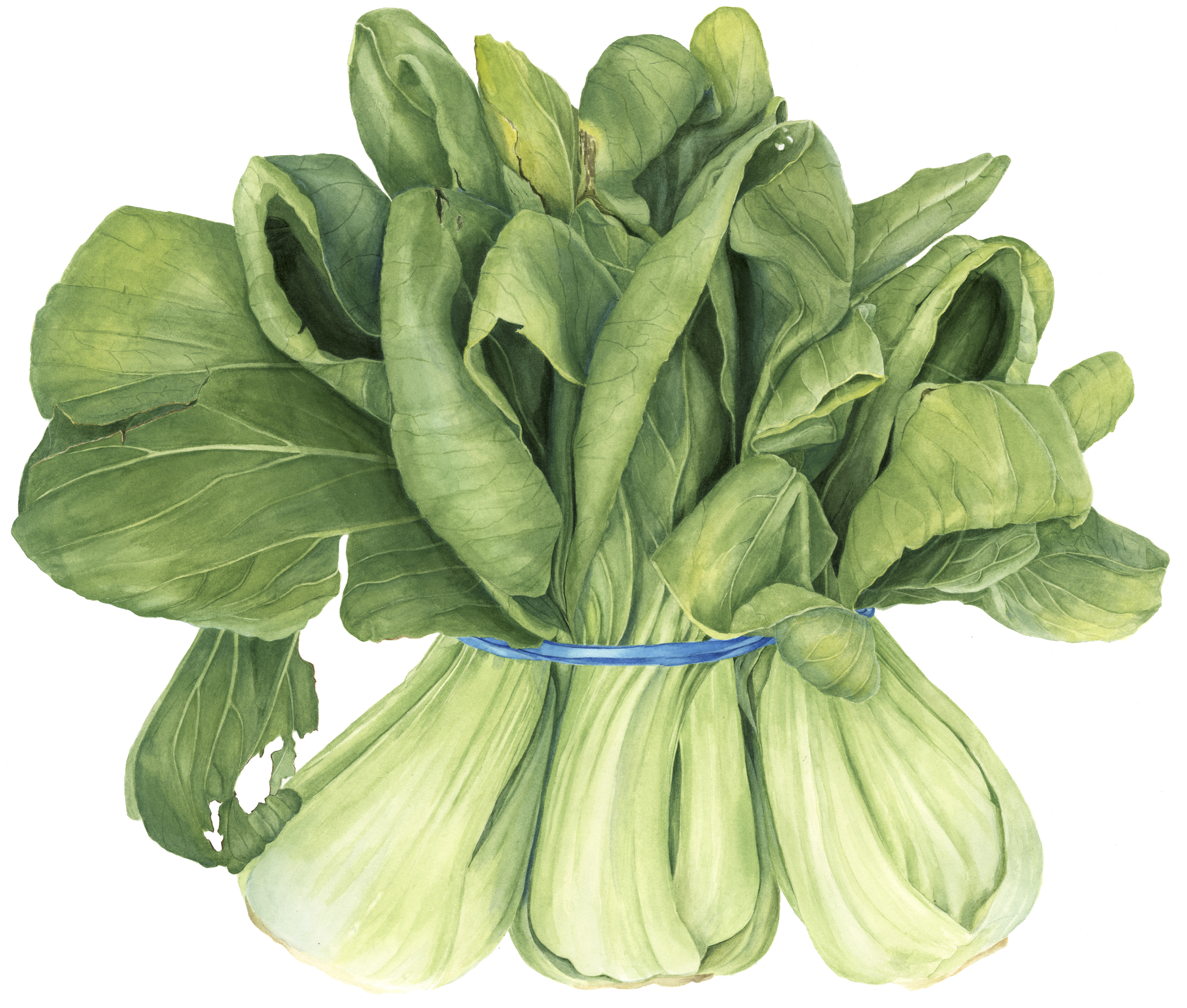
Bok choy, watercolor, by Sally Jacobs, © 2016.
Jacobs is a contemporary botanical artist who has exhibited in numerous juried shows in New York and San Francisco, and at museums in New York, Minneapolis and Phoenix. She was an award winner at the Brand 37 Works on Paper exhibit and is one of the artists included in “Todays Botanical Artists,” a publication of well-regarded nature artists.
About TAG Gallery
Established in 1993 as a not-for-profit corporation, TAG Gallery is a member-owned community of forty artists. Through the physical gallery in Santa Monica’s landmark Bergamot Station as well as lectures from exhibiting and visiting artists, TAG Gallery has become a valuable resource for launching the careers of both emerging and mid-career artists based in the greater Los Angeles area. For more information about TAG Gallery, please visit http://www.taggallery.net. Questions about the exhibition? Please contact Rakeem Cunningham, (310) 829-9556, gallery@taggallery.net
TAG is located at 2525 Michigan Ave., D3, in the Bergamot Station Art Center, Santa Monica, CA 90404, 310. 829.9556.
by Leslie Walker with Deb Shaw

Chocolate shake from St Francis Fountain, San Francisco California. By Ann Larie Valentine, Wikimedia Commons, https://commons.wikimedia.org/wiki/File%3AChocolate_shake_from _St_Francis_Fountain.jpg
Leslie Walker alerted me today that every September 12th is National Chocolate Milkshake Day! Apparently, the holiday dates from 1885, although a quick internet search did not reveal anything about the origins.
Chocolate Milkshakes were created as an alcoholic drink served in bars. In addition to the chocolate, the recipe called for whisky, eggs and cream. By 1900, the whisky had been replaced, and the drink could move out of the bar and into the general population.
If you need a break from painting, Wikipedia has a list of all the designated “food days” from around the world, listed by country (of course!). There are some that are pretty crazy. If you are avoiding dairy but love chocolate, you could have a coconut milk chocolate shake, or, you could wait until tomorrow, September 13, which is International Chocolate Day.
Happy painting!
by Estelle De Ridder, posted by Deb Shaw
The California Islands Symposia have been held more or less, every five years since 1965, to share up-to-date information about the management, scientific research, work in all disciplines of natural and cultural science and general well-being of the California islands.
The 9th California Island Symposium for 2016 is being held at the Marriott Hotel, Ventura, California. One of the less scientific and more entertaining presentations of this symposium will be the Art Exhibit that has been advertised for more than six months. The three jurors worked hard and with diligence to put together a coherent show that will present the Channel Islands to the public in an inviting and interesting manner. After the symposium, the exhibit will be moved to the Santa Barbara Botanic Gardens, where it will be on display for another three weeks.
The Channel Islands of California comprise eight islands located in the Pacific Ocean off the Southern California coast. Five of the islands and the surrounding waters are part of Channel Islands National Park and the Channel Islands National Marine Sanctuary.
The Park is supported by many partners who share the protection of the history and prehistory, the cultural and biological diversity as well as protecting vital habitat for marine, terrestrial plant and animal species.
Public appreciation through education, interpretation and research is widely promoted.
Isolation over many thousands of years has developed unique animals, plants and archeological resources found ONLY on these islands and makes is possible for visitors to experience the western coast of the North America as it used to be.
Visitation has increased dramatically over the years, and with contracted concessionaires, the numbers show how the interest in the islands have grown:
1963 = 1,200
2014 = 342,000

Malva assurgentiflora, the Island Mallow, Mission Mallow, Royal Mallow, Island Tree Mallow. © 2016, Estelle De Ridder, all rights reserved. Watercolor and colored pencil on drafting film and paper.
Flora on the Channel Islands include a unique subspecies of pine, oak and island tree mallow.
Santa Rosa Island holds two groves of the endemic to the island, Torrey pine subspecies Pinus torreyana var. insularis. Torrey pines are the United States’ rarest pine species. The islands also house many rare and endangered species of plants, including the island barberry, the island rush rose, and the Santa Cruz Island lace pod. Giant kelp forests surround the islands and act as a source of nutrition and protection for other animals.
BAGSC members Estelle De Ridder, Mitsuko Schultz and Ellie Tu are participating in the exhibition.
Estelle has illustrated two species: Malva assurgentiflora and Heteromeles abtutifolia.
Malva assurgentiflora, the Island Mallow, Mission Mallow, Royal Mallow, Island Tree Mallow, Malva Rosa is a species of flowering plant in the mallow family. It grows into a strikingly architectural shrub/small tree with beautiful white bark.
It is endemic to California, where it is native only to the Channel Islands. It can also be found growing as an escapee from cultivation in coastal mainland California.
Estelle’s painting of Heteromeles abtutifolia was done on paper with watercolor and colored pencil. Heteromeles abtutifolia, Toyon berry, grows on the north-facing coastal bluffs of Santa Cruz Island. It grows on all the other islands, except Santa Barbara island, and was planted on San Nicolas.

Plantanus racemosa, California Sycamore, Watercolor by Mitsuko Schultz, © 2016, all rights reserved.
Mitsuko Schultz had her Platanus racemosa, California Sycamore accepted to the exhibition.
Ellie Tu has three pieces in the exhibition: Dudleya greenei, Coreopsis, and Leptosyne gigantea Kellogg.
Leptosyne gigantea Kellogg (formerly Coreopsis gigantea), Giant Coreopsis is a strikingly strange plant. It grows on dunes, rocky cliffs and exposed slopes, and has a fleshy trunk and branches. It can reach heights of eight feet with a five inch trunk. It is deciduous and dormant in the dry season, taking on an other worldly appearance when visitors hike through a large stand of them. In spring, however, masses of bright yellow blooms put on quite a show.
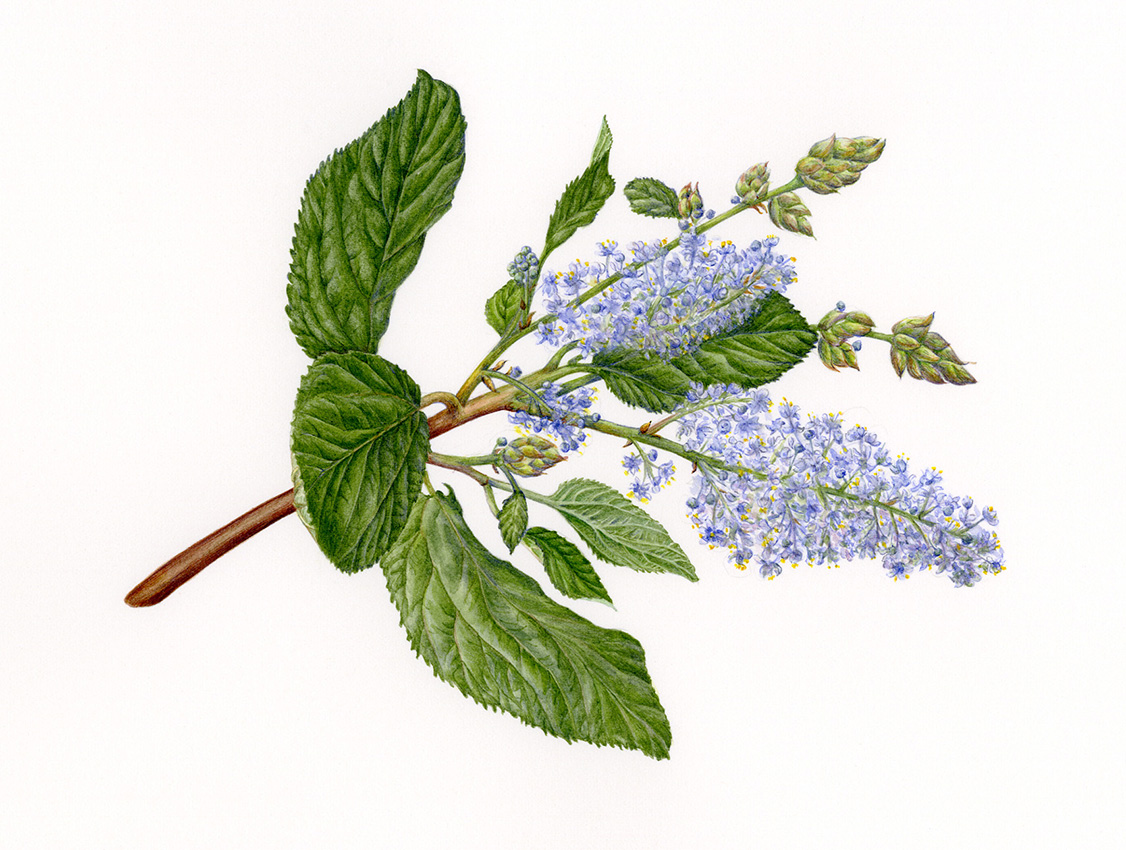
Ceanothus arboreus, Feltleaf Ceanothus, or Island Ceanothus. Watercolor, © 2016, Ellie Tu, all rights reserved.

Leptosyne gigantea Kellogg, (formerly Coreopsis gigantea), Giant Coreopsis, Ellie Tu, colored pencil, © 2016, all rights reserved.
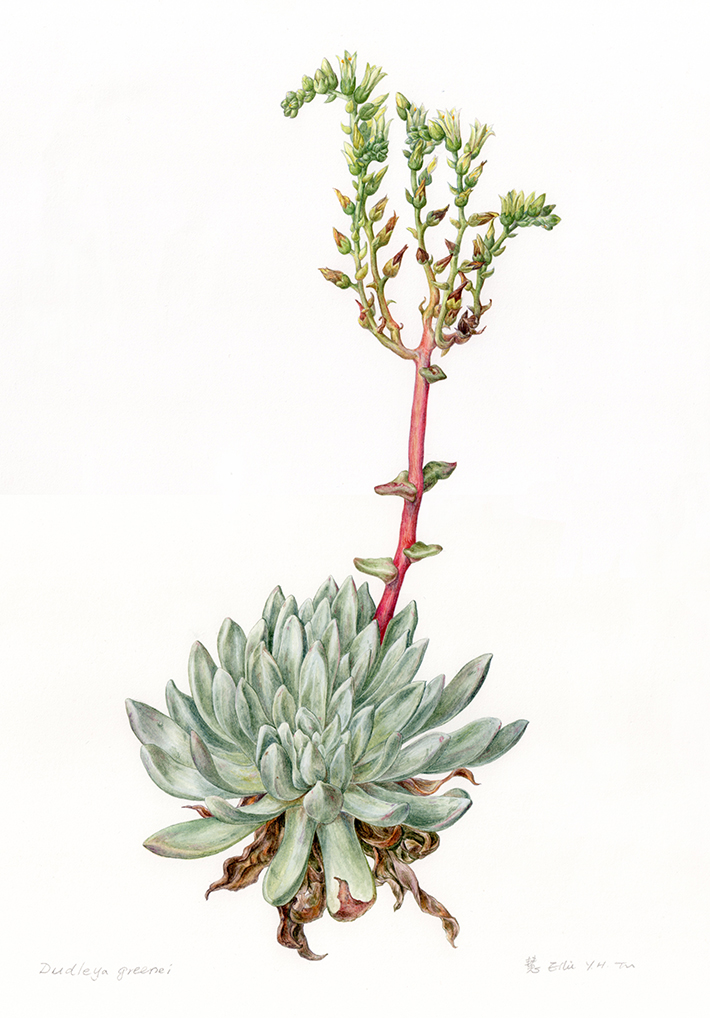
Dudleya greenei, watercolor by Ellie Tu, © 2016, all rights reserved. This plant grows in the Channel Islands National Park.

Anne-Marie Evans.
The Virginia Robinson Gardens will have Anne-Marie Evans in November, 2016:
November 7th – 11th
November 14th – 18th
Anne-Marie added to her lengthy list of credentials when she was awarded an MBE (Member of the British Empire) for her services to Botanical Art and Education in the New Year Honours List in December, 2015.
Anne- Marie is in a large way responsible for the renaissance of botanical art in the twentieth and twenty-first centuries. Her classes cover the five-step method she developed for producing a botanically correct and beautiful portrait of a floral subject in watercolor.
Anne-Marie welcomes beginners and experienced artists.
Please save the dates for this very special opportunity to be taught by one of the best!
Tuition: $595 members/$625 non-members each week
$100 non-refundable deposit due upon registration, with balance due one week prior to scheduled class.
On-line registration: Make checks payable to Friends of Robinson Gardens – memo: Botanical
Classes begin at 9:30 AM and end at 3:30 PM. Please bring your lunch.
Details and supply list will be emailed to all registrants prior to the class.
For additional information please call Friends of Robinson Gardens at 310.550.2068
The Virginia Robinson Gardens is located at: 1008 Elden Way, Beverly Hills, CA 90210.
by Clara Josephs, posted by Deb Shaw
Be sure it’s on your calendar: BAGSC’s general quarterly meeting is coming up in two weeks, on Sunday, September 11. As usual, BAGSC members will receive this meeting notification in an email blast with directions to the location, at the home of BAGSC’s President.
Join us to see the unveiling of BAGSC’s new website, hear plans for workshops and upcoming exhibitions, and see a demonstration of carbon dust. Coffee will be served at 9:30 a.m. and the business meeting will begin promptly at 10. Bring a lunch item to share. The carbon dust demonstration will follow our potluck lunch.
Carpooling is recommended. In addition to your lunch contribution, bring any painting you are working to show or to receive help from our members. Questions? Contact Pat Mark or Clara Josephs.
Looking forward to seeing you on September 11, at 9:30 a.m!
by John Pastoriza-Piñol, Jude Wiesenfeld and Deb Shaw
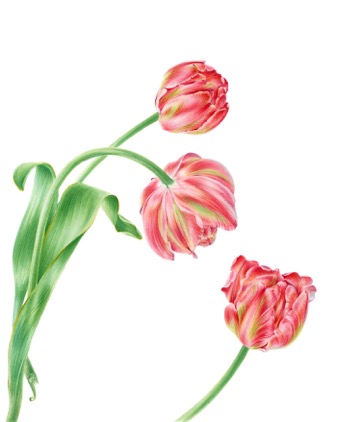
Tulipa x hybrida, watercolor by John Pastoriza-Piñol, © 2016.
BAGSC will be offering a Masterclass with Australian botanical artist John Pastoriza-Piñol in November, 2016. Students will learn the intricacies of achieving fine detail with watercolour masking fluid and NEEF ¼ Comb, invaluable tools for contemporary botanical artists. As a result, your paintings will be brought to a new level of realism and detail. Students should have skills in drawing and watercolor. Over three days, John will assist you with painting the chosen class subject. John will show how masking fluid can be used to achieve very fine detail and will instruct students how to use the NEEF ¼ Comb.
November 8, 9 and 10, 2016
9:30 am – 4:00pm each day
The Huntington Library, Art Collections, and Botanical Gardens
Cost: BAGSC Members: $300; Non-Members: $330
Maximum Registration: 16 students
To register:
Send a check for your $50 non-refundable deposit fee (or payment in full), made out to BAGSC, to BAGSC Education Chair, Jude Wiesenfeld. Please write “JohnPP” on the memo line of the check. Payment in full is due by Monday, October 25, 2016.
Bring your lunch, or purchase lunch at The Huntington Cafes, at The Huntington.
Questions about the Workshop? Contact the BAGSC Education Chair.

Fragaria x ananassa, Strawberry, watercolor by John Pastoriza-Piñol, © 2016.
Learning Objectives:
Students who enroll in this workshop would have completed some level of introduction to Botanical Art and be at an intermediate to advanced level. The structure of the class involves a three-day painting project and the demonstrator assists each student with composition, painting techniques, colour theory which will be offered in class and assigned for homework.
Download a PDF of the materials list: John Pastoriza Pinol Materials list 2016
About the Instructor:
Rich luminous hues and gorgeously exotic and rare botanical specimens epitomize John’s work, however his are much more than mere flower paintings:closer inspection reveals a certain ambiguity of form and intent directing us towards a complex narrative.
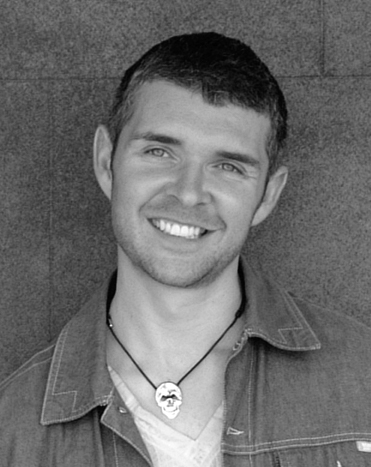
John Pastoriza-Piñol, © 2016.
A master of his medium, his perfectly executed watercolours remain true to the accuracy that is vital to botanical illustration yet they have a fluidity and sensuality that stirs the viewer to experience more than a mere marveling of technique.
The artist suggestively urges us to look beyond the aesthetic and move into slightly more uneasy territory as his work inhabits a territory somewhere between scientific analysis and symbolic realism, prompting a reading that goes beyond the purely representational and literal. The artist intends for literal and subversive elements to coexist uneasily on the same plane, while the aesthetics will remain true to the fundamental principle of objective observation of the natural world.
Location:
The workshop will be held at The Huntington Library, Art Collections, and Botanical Gardens, in the Botanical Education Center. The Huntington is located at: 1151 Oxford Road, San Marino, CA 91108.
by Jude Wiesenfeld and Deb Shaw
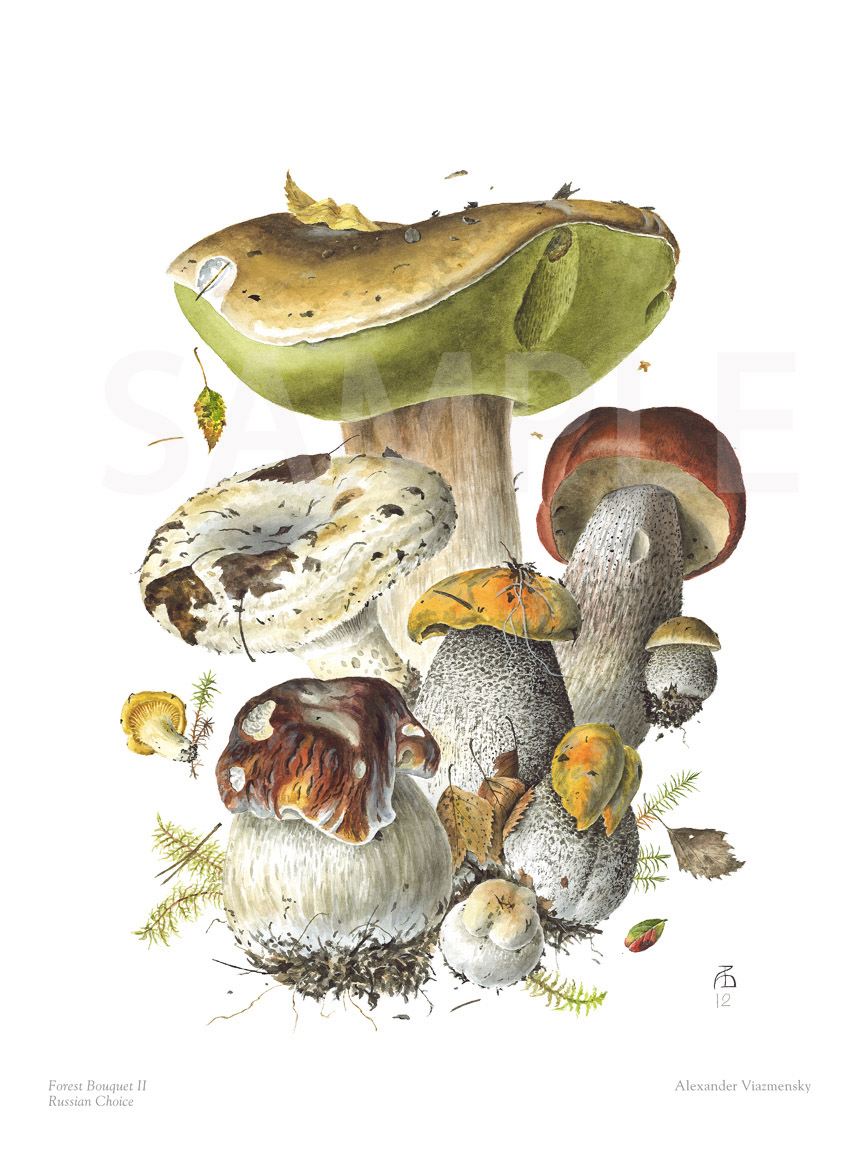
“Forest Bouquet, Russian Choice,” watercolor by Alexander Viazmensky, © 2016, all rights reserved.
Alexander (Sasha) Viazmensky will be returning to Southern California from St. Petersburg, Russia to teach a three-day, BAGSC-sponsored workshop, Mushroom Portraits in Watercolor.
Wednesday, October 19 – Friday, October 21, 2016
9:30 am – 4:00 pm each day
Los Angeles County Arboretum, Oak Room
$300 for BAGSC members; $330 for non-members
Class limit: 16 students
Workshop Description:
Mushroom hunting is a passionate, national pastime in Russia, and Sasha’s paintings capture the spirit of the fungi and the forest. Painted life sized, he calls his paintings “Portraits of Mushrooms.” The class will consist of the following steps:
- Composition.
- How to properly place your subject: lights, shadows, reflections.
- Creating the shape from light to dark.
- Creating various textures with dry brush.
- Using white gouache.
- Final details.
Download the materials list: sashaMaterialsList
To Register:
Send a check for your $50 non-refundable deposit fee (or payment in full), made out to BAGSC, to BAGSC Education Chair Jude Wiesenfeld. Please write “Sasha” on the memo line of the check. Payment in full is due by Monday, October 3, 2016.
Bring your lunch, or purchase lunch at the Peacock Café, on the Arboretum grounds.
The Los Angeles County Arboretum and Botanic Garden is located at: 301 North Baldwin Ave, Arcadia, CA 91007.

Alexander Viazmensky in the woods. © 2016.
About the Instructor:
Sasha Viazmensky was born and lives in St. Petersburg, Russia, and specializes in painting fungi. Although he has a Master’s Degree in Electrical Engineering, he has devoted his life to painting, studying, and picking mushrooms. His work is included in the collections of the Hunt Institute for Botanical Documentation in Pittsburgh, the Minneapolis Institute of Arts, the Shirley Sherwood Collection and the Komarov Botanical Institute in St. Petersburg, among others, and in private collections all over the world. You can read an article Sasha wrote about picking mushrooms in Russia, published in MUSHROOM, The Journal of Wild Mushrooming, here.
by Deb Shaw
A New Blue

Blue pigment discovered at Professor Subramanian’s lab at Oregon Stste University. Photo from Oregon State University.
Professor Mas Subramanian is a professor of materials science at Oregon State University, researching new materials that could be used in electronics. In 2009, one of his grad students, Andrew E. Smith took a mixture out of the furnace that had been heated to more than 2,000 Fahrenheit and found it had turned a brilliant, clear blue color. They had accidentally, serendipitously discovered a new blue pigment; the first new blue in more than 200 years. The last “new inorganic blue” to be manufactured was Cobalt Blue in the early 1800’s. Cobalt, however, was not lightfast and was toxic to boot.
Considered a “complex inorganic pigment,” the new blue is currently called YInMn blue, named for its chemical makeup of yttrium, indium and manganese oxides.
Subramanian, Smith and Oregon State University chemistry professor Arthur Sleight patented the YInMn material; Shepherd Color, an industrial pigment distributor is testing out the pigment’s application. Once the Environmental Protection Agency approves the color for commercial manufacturing, Shepherd is licensed to sell the pigment. So far, YInMn has proven to reflect heat more than Cobalt Blue and has proven to be remarkably stable; holding up against oil, water and sunlight better than other available blues. In addition to being light safe, none of the ingredients are toxic.
Once large manufacturers are using a pigment, the material trickles down to our art supplies. Keep your eyes open in the next few years for a brand new blue, which will most likely receive a sexier name for marketing purposes. And the team of “new blue” researchers are already working to create new colors by altering the mixture. They have created a purple by adding titanium and zinc and are expecting additional bright, vivid colors to follow.
National Public Radio (NPR) has an article online with interesting links about the new blue from July 16, 2016. Oregon State University has an in depth article about it as well.
Late Summer “Reads”: Links to Books and Online Articles and Podcasts about Color
Now that we’re hitting the dog days of summer, here are some interesting books, links and podcasts about color:
NPR has a series of free podcasts about color, called Color Decoded: Stories that Span the Spectrum. Read the articles, or listen or download them all from the link, or individually from any of the links below. Many of the following (in reverse order) are only a few minutes long, so queue them all up. Some of them have been featured on our BAGSC News blog previously. They’re fun listening while painting or drawing:
- For One Artist, Colorblindness Opened Up A World Of Black And White
- The Color Of Politics: How Did Red And Blue States Come To Be?
- How Kodak’s Shirley Cards Set Photography’s Skin-Tone Standard
- Sacred, Sad And Salacious: With Many Meanings, What Is True Blue?
- How Animals Hacked The Rainbow And Got Stumped On Blue
- These X’s Are The Same Shade, So What Does That Say About Color?
- Is It Time To Reappropriate Pink?
- Whether Green With Envy Or Tickled Pink, We Live In A Color-Coded World
- #ColorFacts: A Weird Little Lesson, In Rainbow Order
- Girls Are Taught To ‘Think Pink,’ But That Wasn’t Always So
- The Golden Gate Bridge’s Accidental Color
- Celebrating Green: As Color, As Concept, As Cause
- The Color Red: A History in Textiles
Each of the individual articles have links to other resources and stories about color: TED Talks, podcasts and news articles. It’s easy to journey deep into online color discoveries.
For those who prefer spending the end of summer curled up with a good book, here are a very few great reads about colors:
- A Perfect Red: Empire, Espionage, and the Quest for the Color of Desire, Amy Butler Greenfield, ISBN-10: 0060522763
- A Red Like No Other: How Cochineal Colored the World, Carmella Padilla and Barbara Anderson, ISBN-10: 0847846431
- Mauve: How One Man Invented a Color That Changed the World, Simon Garfield, ISBN-10: 0393323137
- Color: A Natural History of the Palette, Victoria Finlay, ISBN-10: 0812971426
- The Brilliant History of Color in Art, Victoria Finlay, ISBN-10: 1606064290
- Rarest Blue: The Remarkable Story of an Ancient Color Lost to History and Rediscovered, Baruch Sterman, ISBN-10: 0762782226
Have a favorite book about the history of a color? Let us know in the “Comments” section.
Enjoy!
by Deb Shaw
Not too long after Jim Folsom, published his free ebook, “A Botanical Reader for the Curious Gardener,” in February 2016, it mysteriously disappeared from iBooks, much to the disappointment of those who hadn’t yet had a chance to download it. The problem turned out to be some technical glitches.
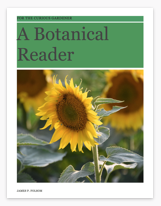
Cover, “A Botanical Reader for the Curious Gardener”, James P. Folsom, © 2016, all rights reserved.
Jim used the opportunity to issue version 1.2 of “A Botanical Reader” as they got the ebook back online. The new version includes edits, expansion of the Botanical Calendar, and an enlarged Plant Trivia TimeLine.
BAGSC News covered the initial launch of “A Botanical Reader” [read the full article at: https://bagscblog.com/2016/03/04/a-botanical-reader-by-jim-folsom-now-available-in-ibooks/]
The ebook is downloadable for free through iTunes/iBooks, at https://itun.es/us/XDT5ab.l It’s listed in the category of Life Sciences, and is a
About the Author
James P. (Jim) Folsom, PhD., rides the demographic peak of baby boomers, having been born in southeastern Alabama in 1950. His lifelong love of plants is reflected in a BS in Botany from Auburn University, an MA in Biology from Vanderbilt University, and a PhD in research botany from The University of Texas at Austin. Though his research has centered on the orchid family, with much of the research time spent in Tropical America (including a year in Colombia on a Fulbright Pre-Doctoral Fellowship), Jim’s botanical interests are wide-ranging. As Curator of the Botanical Gardens at The Huntington in San Marino, CA, he dedicates much of his effort to educational programs that increase public interest and understanding of the science, culture, and history of plants and gardens. He lives at The Huntington with his wife, Debra (also a botanist) and children Molly and Jimmy. Jim was recognized as a Friend of the Cactus and Succulent Society of America in 1996, a Member-at-Large of the Garden Club of America in 1998, and presented a Professional Citation by the American Association of Botanical Gardens and Arboreta in 1999. The Garden Club of America awarded him their Medal of Honor in 2007.
by Susan Jackson, posted by Deb Shaw
A new exhibit has just opened at the San Diego Natural History Museum in Balboa Park that botanical artists would find quite interesting. It is located in the Eleanor and Jerome Navarra Special Collections Gallery on the third floor of the museum. It is a permanent exhibition called Extraordinary Ideas from Ordinary People: A History of Citizen Science which features rare books, art, photographs, maps and historical documents that pay homage to the past, present, and future of citizen science.
The upper mezzanine features an exhibit that a botanical artist will not want to miss. On display are nine “Plant Portraits” by the early twentieth century painter, A. R. Valentien. He was commissioned by the philanthropist Ellen Browning Scripps to paint California wildflowers. Over a period of ten years, Valentien traveled around California creating exquisite watercolor and gouache scientific illustrations. Part of the collection of 1,094 paintings, all done on 13x 20 paper, will be rotated in this gallery. A book which includes photographs of all the paintings can be found in the gift shop, however, it is no substitute for seeing the real thing. Bring your magnifying glass.
The gallery also has original catalogs from Pierre-Joseph Redoute, William Curtis, Auguste Johann Rosel von Rosenhoff, and John James Audubon. These are huge volumes printed in black ink and then hand colored. They are a reminder of a time before photography when beautiful books were only available to the very wealthy. Although we frequently see prints that originated from these catalogs, there is something very special in actually seeing the originals.
More information about the exhibit and the San Diego Natural History Museum may be found on their website. There is also a short video about the Valentien Collection, which can be seen by clicking on the arrow located on the close up view of the Mariposa Lily. If you decide to visit, plan on spending several hours, because there are lots of other things to see as well.
The San Diego Museum of Natural History is located at 1788 El Prado, Balboa Park, San Diego, CA 92101. The Museum is open daily 10 AM to 5 PM, and until 8 PM on most Fridays this summer. Visit the website for ticket prices and specific daily hours; the Museum may close early on some days.
by Deb Shaw
We were working on the house, with KPCC (89.3) on the radio in the background. The Dinner Party Download (American Public Media) came on. They were re-playing an old episode (Episode 341) from March 25, 2016.
Graphic novelist Daniel Clowes was a featured guest. In answer to the statement “Tell us something we don’t know about you,” he told how he searched for years for the perfect pen — the pen that the comic artists he most admired must have used to create those beautiful lines. Much to his surprise, he found out it wasn’t a pen at all, but a watercolor brush, specifically, a Kolinsky Sable brush. It was a struggle for him to learn to be proficient with the brush. Once mastered, he couldn’t conceive of using anything else. Then he spoke about how we couldn’t get them here in the US for a period of time, and all about the Russian Siberian Weasel (including the scientific name).
A reference right there on the radio, about an obscure subject that consumed our artists’ community!
by Deb Shaw, with permission from David Reynolds
Melbourne-based botanical artist and filmmaker David Reynolds has created a one-hour documentary about six of Australia’s botanical and natural history artists. Titled Studio Sessions: Seen through the eyes of the artist, the documentary features interviews with Celia Rosser, Jenny Phillips, Dianne Emery, Terry Napier, Mali Moir, and John Pastoriza-Piñol.
Written and directed by Reynolds, the documentary offers insight into the artists’ approach. Each interview is filmed in the artist’s studio, giving the viewer an intimate look at the setting in which the artists create their detailed, accurate works.

Studio Sessions: Seen through the eyes of the artist. Written and directed by David Reynolds. © 2016, all rights reserved.
The DVD is available for pre-order through Reynolds’ website: http://www.davidreynoldsart.com.au/ Cost is $30 AUD (there is a convenient currency converter on the site) with an additional $10 AUD for postage and handling outside Australia. The DVD will be available world-wide in both PAL and NTSC format and will be Region Free. (Here in the US, NTSC is the most common format.)
Shipping is planned to begin in early September, 2016. Once the DVD is released, pre-order customers will be contacted to arrange payment and delivery. After release, the DVD will be able to be ordered through an online store on the website.
 BAGSC News