You are currently browsing dbshaw’s articles.
by Deb Shaw

Dichelostemma volubile and Madia elegans. Watercolor © Joan Keesey, all rights reserved.
A quick reminder to my original blog post: the California Native Plant Society (CPNS) is holding a botanical art exhibit in conjunction with their Conservation Conference, January 15-17 in San Jose. The entry deadline for submission of artwork is November 1, 2014. They would love to see our artwork there.
Artists are invited to enter original artwork in any two-dimensional medium that reflects the beauty and uniqueness of California flora and adheres to high standards of botanical accuracy. All entries must depict plants indigenous to California.
More information is at the CNPS web site. You may also download the PDF form 2015 Prospectus CNPS Botanical Art Exhibition, or contact Bernard Halliwell.
The Northern California Society of Botanical Artists (NCalSBA) will be helping with the exhibit and coordinating techniques demonstrations at the Conference. Lesley Randall will be coordinating BAGSC members who would like to help our NCalSBA counterparts. More to come on demonstration opportunities later!
by Deb Shaw
BAGSC member Lisa Pompelli will be teaching a botanical art class about carnivorous plants at The Huntington during the month of November:

Nepenthe, watercolor by Lisa Pompelli, © 2014, all rights reserved.
Botanical Watercolors: Carnivorous Plants
Saturdays, November 1 – November 15, 2014
9 a.m. – 3 p.m.
Members: $245. Non-Members: $275.
Explore the unusual world of sarracenias, nepenthes, sundews, and other carnivorous plants while honing your botanical watercolor skills. Prior drawing experience recommended. Register online with Brown Paper Tickets, or call 800-838-3006. A supply list will be sent upon registration.
The Huntington Library, Art Collections, and Botanical Gardens is located at:
1151 Oxford Road
San Marino, CA 91108
by Gayle Uyehara, posted by Deb Shaw

Carol Govan delivered a fast-paced, exciting lecture about botany. Photo by Gayle Uyehara.
Carol Govan’s Thursday “Wow, Botany Is Exciting” workshop really was that, WOW!
Carol contacted the class participants a few weeks earlier and sent us a very informative email and handout with all the technical terms we would learn so we wouldn’t have to stop and look them up during class. She also told us to relax but hang on tight because the workshop was structured from her 8-week course at Wellesley College Botanic Gardens. In three hours we learned the parts of a plant and their function in a humorous, informative manner that only Carol can deliver.
After we learned the names of the plant parts, we quickly sketched the specimen before us and labeled them. “Quick” being the emphasis and it was amazing how many things we had captured in our short observation. What a treat this class was!

Learning the plant parts. Photo by Gayle Uyehara.
Carol’s botany workshop built on this newbie’s vocabulary in a manner that will allow me to pick up a book and know what to look for in the field. She pointed out several older reference books because of their descriptive words of the plant rather than their non-visual clues like DNA and chemical properties.
Toward the end of class, Carol demonstrated how she uses sketch paper, hard pencil and grid frame to capture a quick but accurate gesture composition of a plant; keeping in mind the negative spaces she creates. The grid was only a few marks on paper and frame but gave her a visual clue about placement on the paper. From there she does a quick contour drawing which she will work with the rest of the time—while making any corrections to her gesture drawing. The color she adds as part of her sketch is made from a three-color palette made up of the primaries. She mixes up her watercolor swatch on a white plate to include the shadow and highlights.
Carol finished up this delightful workshop by telling us how she uses her sketches to create a composition and showed us examples of her finished pieces.
Let me mention again what a treat this class was!
I am sure that I will think of her many times as I continue on my botanical art journey. Thank you Carol!
by Beth Stone, posted by Deb Shaw

Laurence Pierson demonstrating her beautiful egg tempera technique. The camera/light in the foreground is the one mentioned in the article. Photo by Beth Stone.
At the Denver Botanic Gardens, Laurence Pierson demonstrated egg tempera on gesso panel. She mixes dry pigment with water using a colour shaper, adds a bit of alcohol if the particular pigment requires it to dissolve, and mixes in a bit of egg yolk.
Laurence’s background is in painting icons, typically on wood panel prepared with gesso and often including gold leaf. She applies her skill with tempera to botanical subjects with beautiful results!
The camera used in this photo seemed particularly effective for teaching, see the Ladibug DC192 on http://www.lumens.com.tw/product_1.php?big_id=1

Ladibug lamp detail. Photo by Beth Stone.
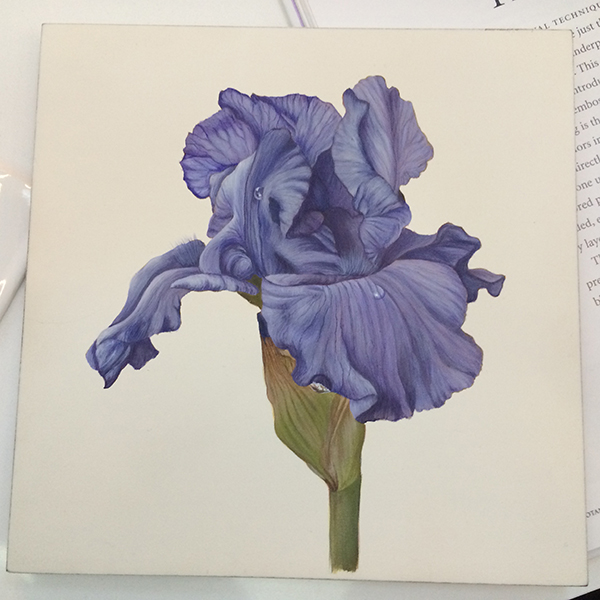
Iris painting in egg tempera by Laurence Peirson. Photo by Beth Stone.

Laurence Pierson’s palette looks like a jewel box. Photo by Beth Stone.
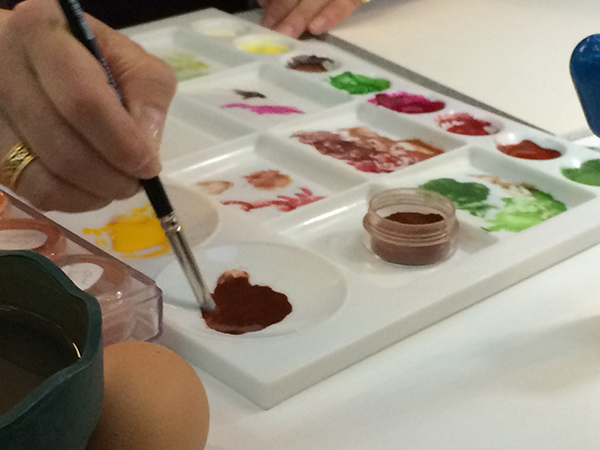
Laurence Peirson mixing egg tempera. Photo by Beth Stone.
by Deb Shaw
Some of our BAGSC members are lucky to stay for the post-conference workshops, but many of the rest of us have gotten home. We had a great response to our “Live from the Conference” postings; many sent emails letting us know how much they enjoyed the posts. I’m sorry I was struggling with a technology meltdown and couldn’t get all of them up sooner. I believe I now have the technology (mostly) behaving, and will get things posted as quickly as possible.
![[Brush holder] The Rocky Mountain Chapter made (yes, HANDMADE) pine brush holders for each of the conference attendees. Photo is of my new brush holder, happily ensconced in its new home on my work table. Photo by Deb Shaw.](https://bagscblog.com/wp-content/uploads/2014/10/brushholderfront.jpg)
[Brush holder] The Rocky Mountain Chapter made (yes, HANDMADE) pine brush holders for each of the conference attendees. Photo is of my new brush holder, happily ensconced in its new home on my work table. Photo by Deb Shaw.
Thank you to the Rocky Mountain Society of Botanical Artists and ASBA for all your hard work. And thank you to the roving BAGSC reporters who sent in stories and photos. If you have any more, keep ’em coming and I’ll get them posted. For readers; lots more to come.
See you next year at the Weird, Wild & Wonderful Symposium at the Huntington in the Summer, and at the ASBA Annual Meeting and Conference in Miami in October.
Happy painting!
![[Brush holder back] Susan Fisher explained that the wood came from pine trees harvested after being killed by Mountain Pine Beetles (Dendroctonus ponderosae), native to the forests of western North America. The blue color of the wood is the result of staining from the beetle infestation. Libby Kyer designed the logo on the back, which was also on the water bottles donated by Libby and her husband. Photo by Deb Shaw.](https://bagscblog.com/wp-content/uploads/2014/10/brushholderback.jpg)
[Brush holder back] Susan Fisher explained that the wood came from pine trees harvested after being killed by Mountain Pine Beetles (Dendroctonus ponderosae), native to the forests of western North America. The blue color of the wood is the result of staining from the beetle infestation. Libby Kyer designed the logo on the back, which was also on the water bottles donated by Libby and her husband. Photo by Deb Shaw.
by Deb Shaw

Tania Marien’s James White Award
The ASBA announced their annual awards last night at the closing banquet. Tania Marien was presented with the James White Service Award for her dedication to botanical art, in recognition of her distinguished support of botanical art.

Lesley Randall’s ASBA Award for Scientific Botanical Illustration
Lesley Randall was presented with the ASBA Scientific Illustrator Award for Excellence in Scientific Botanical Art, in recognition of her outstanding achievements as a scientific illustrator.
George Olsen was presented with the ASBA Diane Bouchier Artist Award for Excellence in Botanical Art, in recognition of his outstanding acheivements as a botanical artist.
Unfortunately, the three award winners were not present to receive their awards in person. When Tania and Lesley’s names were announced, however, the BAGSC table cheered loud enought to hear back in Southern California. Congratulations to the award winners for richly deserved recognition!!
by Beth Stone, posted by Deb Shaw
The Techniques Showcase featured three artists covering a very broad range of approaches: Hillary Parker, Ann Swan, Kelly Leahy Radding.
Hillary Parker shared her artistic problem-solving approach to very large format botanical watercolors which most of us would surely consider impossible! First was a driftwood commission on 40 x 60 inch, 300 lb cold press paper. The second was a 9 foot long (!) watercolor of a stone wall with a foreground of woodland plant silhouettes worked in masking fluid. Can you imagine fitting such a massive work in your studio? Then consider how you would maneuver yourself and your paints around to work on it!
Ann Swan completed a kiwi botanical in front of our eyes as just a portion of her wonderful segment of the Techniques Showcase. The seemingly magical techniques Ann demonstrated included: colored pencil layering strategies; exploiting colors that resist adhesion of subsequent layers (for example, creating veination); use of alcohol-based solvent or baby oil (actually not oil, but dilute paraffin) to blend and spread color; and embossing to create fine hairs for kiwi and pussy willows.
I’m told Ann’s blog is one to watch. She posted photos of the Chihuly glass sculpture exhibit currently at the Denver Botanic Gardens. http://annswan.wordpress.com
Finally Kelly Leahy Radding demonstrated the technique she used to paint the beautiful water lily she entered in the show’s Small Works exhibit. The water lily is painted with gouache on a dramatic black background. Kelley demonstrated her painting process with gourds. She shared a tip regarding both zinc white and the warmer titanium white. Both dry with a slight blue cast which can be counteracted by mixing in just a touch of yellow.
As a special additional treat to complete the Showcase, John Cogley, founder, President and CEO of Daniel Smith, spoke on the manufacture of pigment. The process involves fracturing/cleaving the crystalline materials rather than grinding them. It was great to see the actual mineral samples John brought including a beautiful, huge, piece of Lapis. John graciously answered audience questions: explaining that his company bought out all the Quinacridone close-out stock, so we will always be able to buy a consistent Quinacridone Gold; that we shouldn’t be concerned if Gum Arabic binder oozes from a newly opened tube, it’s just excess that rose to the top; and we should use distilled water in our painting work rather than introduce tap water impurities. Deb Shaw went to John’s lecture, and will include pictures in the next posting.
by Beth Stone, posted by Deb Shaw
Jesse Meyer, founder of Pergamena, the parchment production extension of his family’s centuries-old tanning and leather business, gave a fascinating talk on the Story of Vellum. Check out their web site at pergamena.net for history, process and product information. TV’s Mike Rowe brought his Dirty Jobs crew to Pergamena for not one but 2 episodes, see YouTube.
What a treat conference goers had today with the opportunity to leaf through and select vellum sheets for purchase…and with show discount prices!
posted by Deb Shaw
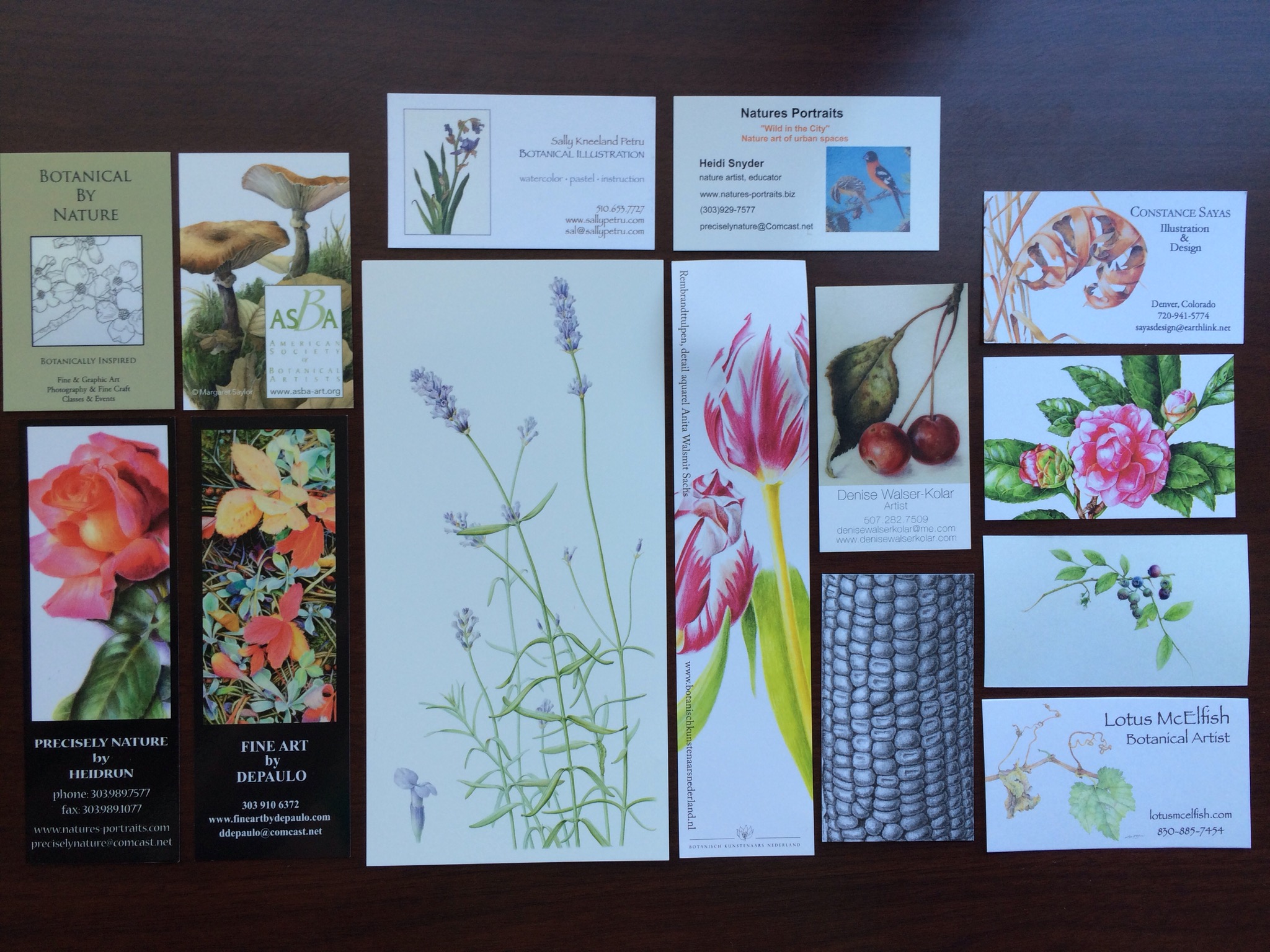
There were some amazing portfolios on view; always fun to get right up close and personal to the work, and to be able to talk with the artists. (Photo by Beth Stone of a few cards and handouts.)
On the 20th anniversary of the ASBA, founding member Diane Bouchier gave an inspirational speech during the annual meeting luncheon about the importance of what we do: to ourselves, and to the world around us. (Photo by Gayle Uyehara.)

Posted by Deb Shaw
BAGSC members at the conference are: Beth Stone, Cristina Baltayian, Deborah Friedman, Deborah Shaw, Gayle Uyehara, Lori Vreeke, Melanie Campbell-Carter, Nina Antze, Sally Jacobs, and Terri Munroe. We are going to try to post some photos and updates as we can. I’ll confess, the blog postings aren’t behaving well from my iPad, but we’ll do what we can.
Wednesday evening was the kick-off opening reception for the Small Works exhibition. Gayle Uyehara took a panoramic view of the reception.

Photo by Gayle Uyehara.
The Small Works is one of my favorite exhibitions. It’s wonderful to see the range of art and creativity. This year is no exception. As always, it’s hard to get close to the art at an opening, so I’m glad to get to go back today for a more careful look.
The hotel is within walking distance of the 16th Street Mall, with lots of shops and restaurants, and easy access to the Denver Art Museum. A free shuttle runs the length of the mall. Gayle, Sally, Anita Walsmit Sachs and more friends from the Netherlands, Esmee Winkel and Marianne van der Stee-Kuiper went to dinner at the Tilted Kilt, and reported the people-watching was excellent.

Left to right: Gayle Uyehara, Esmee Winkel, Marianne van der Stee-Kuiper, Sally Jacobs and Anita Walsmit Sachs-Jansen.
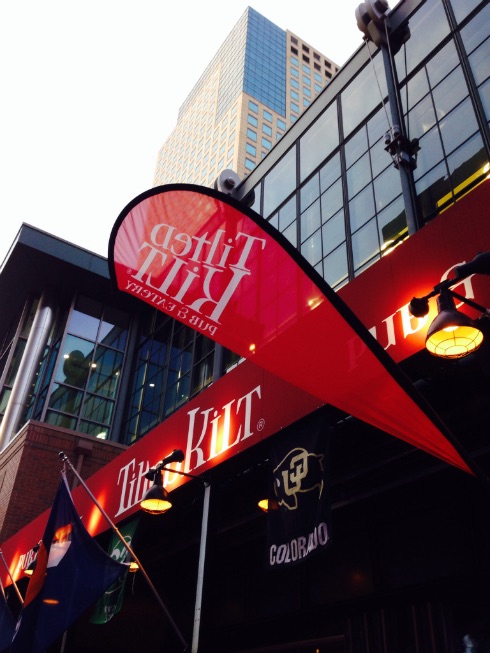
Sign for the Tilted Kilt. Photo by Gayle Uyehara.
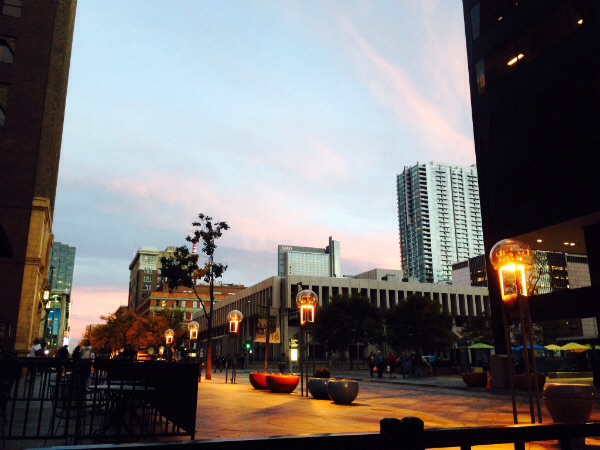
The 16th Street Mall in Denver at Sunset, photo by Gayle Uyehara, © 2014.
by Deb Shaw
The American Society of Botanical Artists (ASBA), The Botanical Artists Guild of Southern California (BAGSC) and The Huntington Botanical Gardens present:
A Weird, Wild & Wonderful Symposium
July 23 (Thursday) – 26 (Sunday), 2015
in conjunction with
Weird, Wild & Wonderful
The Second New York Botanical Garden Triennial Exhibition of 46 captivating paintings and illustrations of exotic specimens by invited members of the American Society of Botanical Artists at
The Huntington Library, Art Collections and Botanical Garden
San Marino, California

Solanum lycopersicum, Heirloom Tomato, Watercolor on paper, © Asuka Hishiki
Information about the Symposium is available on the ASBA website, and registration opens in May, 2015. Save the dates and watch this blog for exciting learning and volunteering opportunities.
About Weird, Wild & Wonderful:
Botanical art has traditionally depicted conventionally beautiful plants, such as sunflowers, irises, and roses. Weird, Wild, & Wonderful features plants not always thought of as beautiful but rather strange, eccentric, intriguing, and mysterious. Join us in Southern California as we explore the plants and their depictions during a special Weird, Wild & Wonderful Symposium on July 23 – 26, 2015, with additional classes, workshops, displays and lectures throughout the summer.
Only 46 works were selected from nearly 240 entries, hailing from the United States, Australia, Canada, India, Japan, and the United Kingdom. The selection jury consisted of Lugene Bruno, Curator of Art at the Hunt Institute for Botanical Documentation; Jean Emmons, award-winning botanical artist; and Marc Hachadourian, Manager of the Nolen Greenhouses for Living Collections at The NewYork Botanical Garden.
About The Huntington Library, Art Collections and Botanical Garden:
The Huntington Library, Art Collections, and Botanical Gardens is a collections-based research and educational institution established in 1919 by Henry E. and Arabella Huntington. Henry Huntington was a man of vision—with a special interest in books, art, and gardens. During his lifetime, he amassed the core of one of the finest research libraries in the world, established a splendid art collection, and created an array of botanical gardens with plants from a geographic range spanning the globe.These three distinct facets ofThe Huntington are linked by a devotion to research, education, and beauty. For more information, visit: http://www.huntington.org
About American Society of Botanical Artists (ASBA):
ASBA is a nonprofit organization dedicated to promoting public awareness of contemporary botanical art, to honoring its traditions and to furthering its development. In its 20th year, ASBA has 1,300 members from more than 20 countries around the world. For more information, visit: ASBA-art.org.
About The Botanical Artists Guild of Southern California (BAGSC):
A chapter of the American Society of Botanical Artists, BAGSC members actively promote development and awareness of this artistic tradition. Guild members are committed to improving their artistry and technical abilities.The Guild supports and sponsors workshops with local experts and visiting lecturers in areas such as drawing and painting botanical subjects, botany, resources, and botanical art history. For more information, visit: bagscblog.com.
by Kathlyn Powell, posted by Deb Shaw

I wanted to let everyone know about a terrific 25 podcast series on BBC Radio 4 called “Plants: From Roots to Riches” that might be of interest. Each podcast is approximately 15 minutes, and is free. All of the podcasts can be downloaded at the same time.
“Plants: From Roots to Riches” is a brief history of botanical science and our changing relationship with plants over the last 250 years—from tools, to objects of beauty, to an essential resource we have to conserve. Presented by Professor Kathy Willis, Director of Science at the Royal Botanic Gardens, Kew, the series draws upon the archives, collections and scientific research at the Royal Botanical Gardens Kew. Additional information is available from the series main website, including clips, galleries and additional podcasts.
I found out about it from an article in my favorite magazine, New Scientist. Enjoy!
by Deb Shaw

Eight crayons; photo from DataPointed: http://www.datapointed.net/2010/01/crayola-crayon-color-chart/
Many of us began our first forays into art and color with a box of crayons at a young age. Crayola Crayons, according to their website, began in 1885, when two cousins, Edwin Binney and C. Harold Smith took over Edwin’s father’s pigment business. At the time, they used pigments such as red oxide (used as barn paint), and carbon black (used in car tires). In 1903, Crayola produced the first box of eight wax-based crayons, at 5 cents each box. Those original colors included: red, orange, yellow, green, blue, violet, brown, and black. The original limited palette.
Flash forward to 2010 (when the graphics in this post were created) and you’ll find 120 colors in the Crayola color box! New colors come with new and interesting names, such as: “Cerise” (a dark, cool, violet-red), “Outer Space,” “Inchworm,” and “Atomic Tangerine.” We can be completely sympathetic; as botanical artists, we, too, face the marketing of an expanding universe of new professional colors with new names each year.
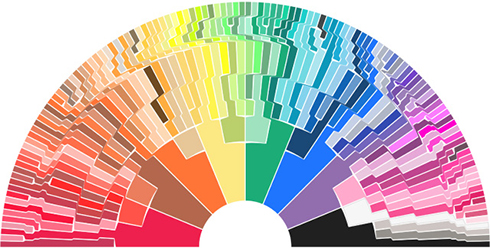
Stephen Von Worley’s graphic showing the expansion of Crayola colors from the original eight crayons. To view an interactive graphic, where rolling your mouse over a color displays the color’s name, go to: http://www.datapointed.net/visualizations/color/crayola-crayon-chart-bow/
On his website, Data Pointed, artist, scientist and data visualization researcher Stephen Von Worley gives credit to a pseudonymous friend with whom he works, called “Velociraptor.” Together, they created a series of data graphics showing a visual crayon chronology in two articles: “Color Me A Dinosaur: The History Of Crayola Crayons, Charted” and “Somewhere Over The Crayon-Bow: A Cheerier Crayola Color Chronology.”
Data Pointed explores the best methodologies for conveying information and data visually. Interesting to me was the evolution of his crayon color graphic. The original article “Color Me A Dinosaur” displayed the crayon chronology in a square format. The story was picked up quickly over the web, and has recently seen renewed interest. Stephen was interested in the audience reaction to the square, and, in his second article on the subject, “Somewhere Over the Crayon-Bow,” he re-visits his graphic, working on portraying the same information in different visual formats to see the effects.
by Deb Shaw
Tired of spending endless time and paint trying to find the right color? Learn to mix colors through color theory. This fun, no-stress overview workshop is for beginners through advanced participants and goes beyond what is typically taught in botanical color mixing classes. Although this watercolor workshop will focus on botanical subjects, the theory and exercises apply to all art forms and media, including: plein air, still life, and portraits; whether they’re created in watercolor, oil, acrylic, colored pencil, or pastel. Learn about:
- The hidden values in color, and color mixing basics.
- Where colors fall on the color wheel, and how that affects mixing.
- Transparency, lightfastness, granulation.
- Basic color theories and changing color through the ages (how did Van Gogh get those sad violets?).
- Color mixing and painting methods.
- How to avoid mixing mud, AND how to (purposefully) mix the appropriate mud, shadows and other nasty colors.
- Mixing beyond the basics, including a handout containing the ultimate color mixing exercise.
Monday, October 27, 2014, and Tuesday, October 28, 2104, 9:30 am – 3:30 pm
Cost: $225 for Virginia Robinson Gardens members and Botanical Artists Guild of Southern California (BAGSC) members; $275 for non-members.
$50 deposit is non-refundable.
Tea, coffee and water provided. Bring your own lunch. A materials list will be supplied. Paint samples will be supplied.
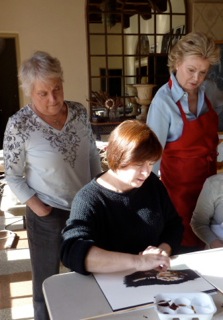
Suz Landay and Kerstin Royce look over Deb Shaw’s shoulder during a demonstration.
Classes will be held in the Pool Pavilion, Virginia Robinson Gardens, 1008 Elden Way, Beverly Hills. To make reservations, visit Virginia Robinson Gardens; call (310) 550-2068; or mail a check, made payable to: FRIENDS OF ROBINSON GARDENS.
Instructor biography:
Deborah Shaw has a degree in fine art from Pomona College, The Claremont Colleges, where she also studied botany and native California flora. Ms. Shaw is an active member of the American Society of Botanical Artists, the Botanical Artists Guild of Southern California, and the Guild of Natural Science Illustrators. She has taught art and botanical art at numerous venues, including The Getty; The Huntington Library, Art Collections, and Botanical Gardens; Virginia Robinson Gardens; and Bowers Museum. She taught illustration, digital design and information design at the University of California, Irvine, Extension where she was the recipient of the “Distinguished Instructor” award.
Deborah’s work has been displayed in juried and non-juried exhibitions, and is in private collections. Her work is in the permanent collection at the Hunt Institute for Botanical Documentation at Carnegie Mellon University. She has received numerous awards for art, illustration, design, product design and advertising. Her preferred media include graphite, watercolor, colored pencil, scratchboard, Illustrator and Photoshop.
by Deb Shaw
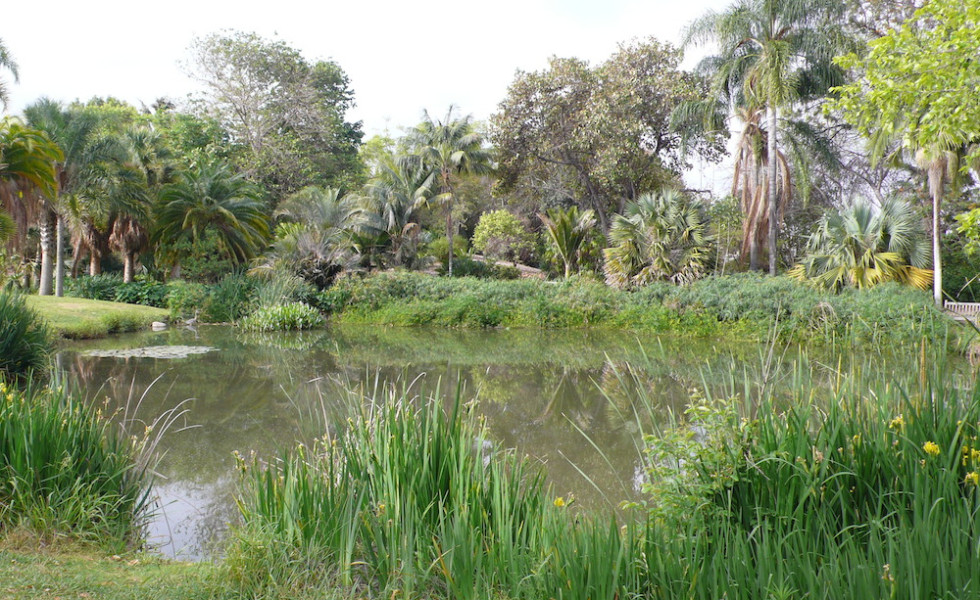
Fullerton Arboretum, CSU Fullerton, © CSU Fullerton, all rights reserved.
Tania Marien, ArtPlantae, has scheduled a series of workshops at the Fullerton Arboretum, called “InterpretPlants.” These workshops are scheduled for October 2014 through May 2015, and highlight the Arboretum’s 26-acre oasis and vast plant collections and community programs on the sprawling campus of California State University, Fullerton.
The first two workshops will be a Farmer’s Market Guide to Plants, at the
Fullerton Arboretum at CSU Fullerton, Wednesday, October 29, 2014 (1-4 pm) and Saturday, November 1, 2014 (10 am – 1 pm)
$28 members, $35 non-members (fee includes most of the required art supplies)
Limit: 12
Participants will create their own, personalized farmer’s market guide to locally grown food. Sketch the harvest, create printed images reminiscent of woodcut images in old herbals and learn about the botany of food while documenting the Fall harvest at the Arboretum’s Farm Stand. Create your own artwork to use on recipe cards, notecards, food labels or wherever you like!
Future workshops include:
- Pollination Ecology for Young Naturalists
- History of Botanical Illustration
- Discover the Arboretum Potting Shed
- A Vistor’s Guide to the Cactus Garden
- Farmer’s Market Guide to Plants
- A Visitor’s Guide to the Palm Garden
Online registration can be accessed by clicking the “InterpretPlants” link above, or on the Fullerton Arboretum site.
The Fullerton Arboretum is located at 1900 Associated Road, Fullerton, CA. Information about BAGSC member Tania Marien’s background can be found on her “About” page at ArtPlantae.
 BAGSC News