You are currently browsing dbshaw’s articles.
by Deb Shaw
 Margaret Best will be teaching a 10-day botanical art workshop in the Cotswolds, England in September, 2014. This Quench tour combines must-see botanical art destinations with a week of botanical art at the Cotswolds estate, Colesbourne Park. The Cotswolds are home turf for Margaret, and the Fall offers delightful specimens to paint from the English countryside.
Destinations include: Kew Gardens, with guided tours of the library and archives through the renowned Shirley Sherwood Gallery and the beautifully restored Marianne North Gallery, as well as an excursion to The Prince of Wales’ country estate Highgrove, home to his gardens and the Florilegium. Colesbourne Park, the estate of Lady Carolyn and Sir Henry Elwes, will provide an inspiring setting of gardens and woods The estate boasts 900 acres of private arboretum with some historical trees.
Highlights of the itinerary, from September 17 – 26, 2014 include:
- September 17: Arrive at London Heathrow airport and transfer to Kew. Settle into your hotel. Join Margaret, Kiloran, and your fellow travellers for a welcome dinner.
- September 18: Full day visit of The Royal Botanical Gardens that includes a talk and viewing of the archives/historical collection, followed by a tour, led by Margaret, in Shirley Sherwood Gallery and Marianne North Gallery. Evening at leisure.
- September 19: Late morning transfer to The Cotswolds. Stop at the charming village of Bibury for High Tea. Continue on to Colesbourne, where you can settle into the inn. Welcome drinks at Colesbourne Park with your hosts. Evening at leisure.
- September 20: Full day in studio. Lunch in studio or in village. Evening at leisure.
- September 21: Full day in studio. Lunch in studio or in village. Evening at leisure.
- September 22: Full day in studio. Lunch in studio or in village. Evening at leisure.
- September 23: Mid-morning excursion to Highgrove for garden tour and lunch. Afternoon at leisure in nearby village of Tetbury. Return to Colesbourne. Evening at leisure.
- September 24: Morning and early afternoon in studio. Lunch in studio or in village. Late afternoon excursion to Cheltenham, which includes time in the Montpellier Parade shopping district. Dinner in Cheltenham.
- September 25: Full day in studio. Lunch in studio or in village. Farewell dinner.
- September 26: Return home.
 The cost is for the trip is $4,775 (Canadian dollars). Non-participant discount is $925 per person. Maximum group size is 14 people.
 Margaret is an internationally recognized botanical artist and teacher offering classes and workshops in graphite, colour pencil and watercolour. She has taught workshops to all levels of experience from beginners to advanced in Canada, the UK, Italy, the US, Morocco, and Bermuda. Workshop venues have included the Huntington Library, Art Collection and Botanical Gardens in San Marino, California; Santa Barbara Botanical Gardens; San Diego Natural History Museum; Filoli Gardens; Dow Learning Center in Zoo Conservatory, Calgary, Canada; and the Bermuda Art Center, Hamilton, Bermuda. Margaret’s watercolours have been widely exhibited in New York; Weisman Museum, Minneapolis; Hunt Institute of Botanical Documentation, Carnegie Mellon University, Pittsburgh; Los Angeles; Denver; Bermuda; Toronto; San Francisco; and her work is found in numerous private and corporate collections around the globe. Margaret has designed four coins with botanical themes for the Royal Canadian Mint. For the past six years Margaret has painted regularly with her mentor, Pandora Sellars who is widely regarded by experts as the leading contemporary botanical artist of our time. A professionally qualified art teacher, Margaret is known for her nurturing style and her ability to readily identify student skill level in order to steer advancement.
For more information, download the PDF: Quench_Itinerary_England, call 416 366 2777, or email tripdesign@quenchtravel.com.
by Jill Berry, posted by Deb Shaw
Now that 2014 is here, the Los Angeles Arboretum & Botanic Garden classes are all beginning again! Below is the schedule for botanical art through June, 2014 of botanical art and illustration classes with Cristina Baltayian, Instructor:
All of the classes listed below meet on Tuesdays, from 10 am – 2 pm.
January 7, 14, 21, 28: Basics of color theory and color mixing
February 4, 11, 18, 25: Spring Bulbs (on February 11, this class will meet in the Bamboo Room)
March 4, 11, 18, 25: Wisteria (on March 11, this class will meet in the Bamboo Room)
April 1, 8, 15, 22: Arboretum Florilegium, subject to be decided (on April 11, this class will meet in the Bamboo Room)
May 6, 13, 20, 27: Basics of Composition
June 3, 10, 17, 24: Fruits, subject to be decided
Fee: $255 per month for Arboretum members; $275 per month for non-members
Fees includes Arboretum admission. Class participation is limited to a minimum of 5 students and a maximum of 12.
Pre-registration is required; please call the Class Registration line at 626.821.4623.
A supply list will be provided upon registration. You may bring your lunch or purchase it at the Peacock Café.
These classes will be exploring color pencil, graphite, pen and ink, and watercolor on various papers, vellum and other surfaces. The emphasis will be on plant observation, drawing, composition, color theory and matching, and medium techniques.
In addition, this year, in conjunction with the Botanical Artists Guild of Southern California, students will be studying and portraying many of the Arboretum plant introductions from the last 50 years. The goal is to build a collection of paintings that will celebrate and document the invaluable contribution of the Los Angeles Arboretum to the state of California.
Cristina Baltayian has a background in drawing (graphite, charcoal, pen and ink), two-dimensional design, watercolor, and colored pencils. Her work has been shown at Filoli, the Los Angeles County Arboretum, and Chapman University. She is a member of the American Society of Botanical Artists, and The Botanical Guild of Southern California.
The Los Angeles County Arboretum & Botanic Garden is located at 301 North Baldwin Avenue, Arcadia, CA 91007-2697, Phone: 626.821.4624, Fax: 626.821.4642
by Leslie Walker and Deb Shaw
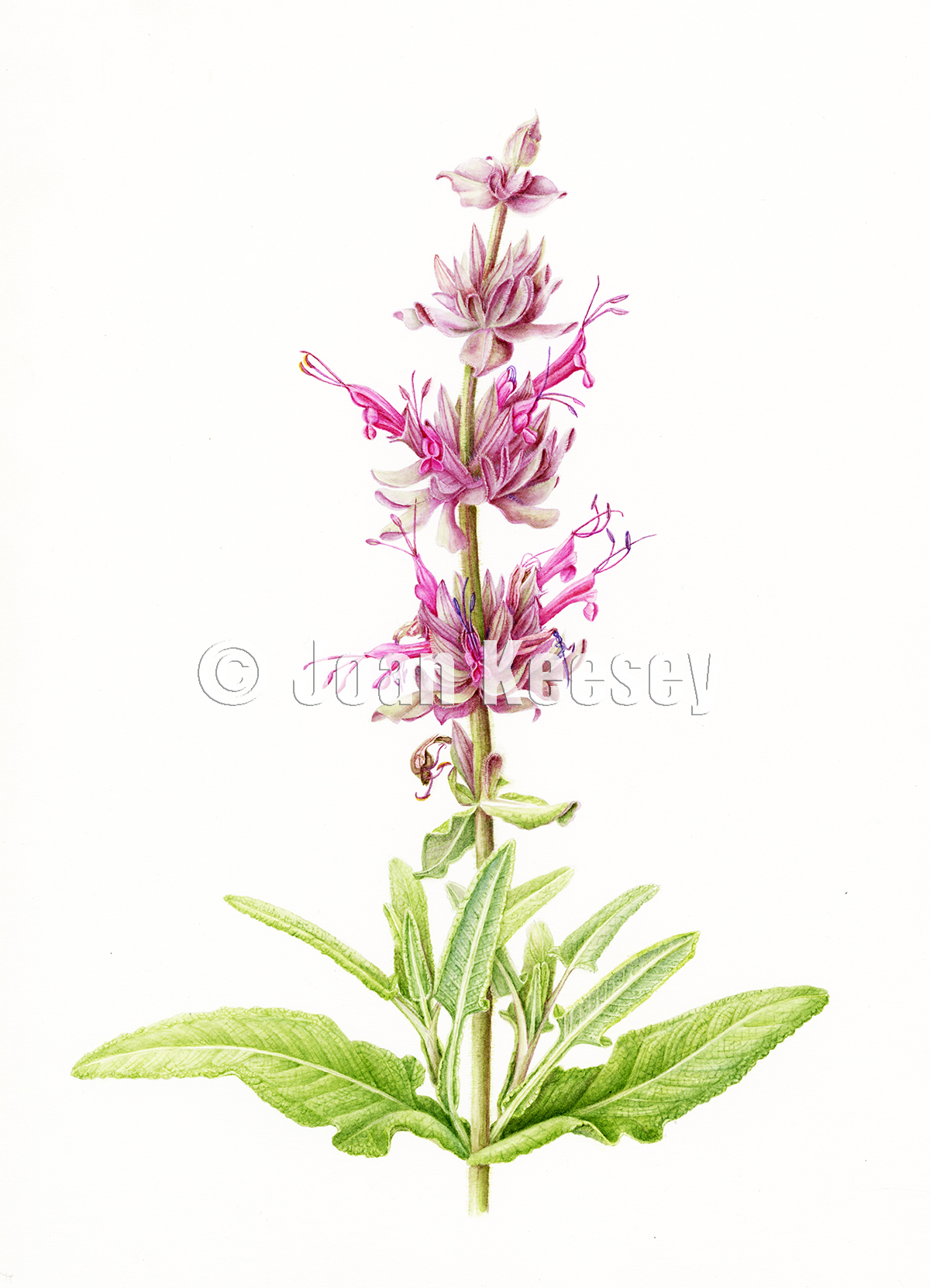
Salvia spathacea, Hummingbird Sage, watercolor by Joan Keesey, © 2013, all rights reserved.
The Theodore Payne Foundation will be hosting an opening reception for the exhibition “The Botanical Artists Guild of Southern California, The Art and Science of Native Plants” on
January 11, 2014
2:00 pm – 4:30 pm
The exhibition is open for viewing from January 11 – March 15.
This juried exhibition was created by the Theodore Payne Foundation (TPF) in recognition of the Botanical Artists Guild of Southern California (BAGSC) and the continuing importance of botanical art in the service of both science and art, knowledge and beauty. Jurors were: Olga Eysymott: Artist and teacher; founder of BAGSC; Bart O’Brien: Director Special Projects, Rancho Santa Ana Botanic Garden; Co-author of “California Native Plants for the Garden”; and John Wickham: Past president of the board, Theodore Payne Foundation; native plant gardener.
The exhibition consists of 23 artworks by 14 BAGSC artists, including: Nina Antze, Diane Daly, Estelle DeRidder, Clara Josephs, Joan Keesey, Patricia A. Mark, Arillyn Moran-Lawrence, Lesley Randall, Mitsuko Schultz, Gilly Shaeffer, Janice Sharp, Deborah Shaw, Gayle Uyehara, and Jude Wiesenfeld.
The show encompasses a range of styles and media: from scientific illustration to plant portraits. Works effectively use pen and ink, watercolor on paper and vellum, colored pencil on paper and film, and mixed media to depict California native plants — many with their pollinators.
The Theodore Payne Foundation for Wild Flowers & Native Plants is located at 10459 Tuxford Street, Sun Vally, CA 91352. Hours are Tuesday – Saturday. 8:30 – 4:30. The Theodore Payne Foundation is closed Sundays and Mondays. For information, call (818) 768-1802 during business hours.
by Deb Shaw
Be sure to watch the short and delightful “The Nondenominational Holiday Botanical Celebration” from The Brain Scoop with Emily Graslie. It’s all about the plants we use to celebrate the holidays:
Happy Holidays to you and yours and wishes for wonderful art in the coming year.
by Patricia Van Osterhoudt

(left to right) Lori Fields, Arillyn Moran-Lawrence, Cristina Baltayian, and Gayle Uyehara gather around Lee McCaffree (seated) while she demonstrates a masking fluid technique. Photo by Clara Josephs, © 2013.
Hairs, dots, indentations! It’s enough to make the hairs on your neck stand up and salute! Who can count the hairs on a lime green Icelandic Poppy stem or the odd shaped rectangles on a peanut shell, and more importantly, why would one want to? This is the question all botanical artists wrestle with in the process of drawing and painting from nature, and it is one Lee McCaffree skillfully guided fourteen artists through in a two-day workshop on November 9 – 10, 2013 at the Environmental Nature Center (ENC) in Newport Beach. The classroom is in a LEED Platinum building at the ENC; the space is light and airy, perfect for botanical painting.
Through Lee’s expertise as an artist and teacher, we were encouraged to experiment with several specimens including peanuts, dry grasses, pussy willows, and various types of bumpy leaves. We began with careful observations and then did tracings for form, shape, and texture. From these we did graphite drawings as a reference point to come back to often during the actual painting. Lee continually stressed the importance of an accurate drawing for a successful painting. In the painting process we mixed color and did washes staying within the lines of the pencil lead, which all built up to texture. Many of the artists used color pencils as well. Most importantly, Lee encouraged everyone to move along rather than dally over any one particular part so we could “get the feel” for various types of texture. That nudge kept us all going!
Throughout the workshop, Lee consistently demonstrated the techniques she wished us to attempt. During the demos, she made comments such as the “importance of letting each layer of paint dry so that after several layers the light from other colors could shine through.” Later as we painted and drew, she consistently came around to each student giving constructive and creative comments that helped us move to a new and improved place. As she circled back to see our progress, she made very encouraging comments such as, “Great, see how much better that shading looks now!” As we worked side-by-side with our attention focused completely on the subject at hand (peanuts in the shell), Cristina Baltayian looked up and quietly stated, “We are the Peanut Gallery!”
In our final critique, as each artist laid her many paintings and drawings on the end of each table, Lee asked, “What did you like and not like about creating your art?” Overall, we had a general feeling that we were encouraged to try new and more challenging subjects having learned the techniques for how to get there. I always think of the botanical workshops as “a booster shot,” and I certainly got that from Lee!
A special thank you goes out to Leslie Walker, Deb Shaw, Clara Josephs, and Diane Daly for organizing this fantastic workshop!!
by Deb Shaw
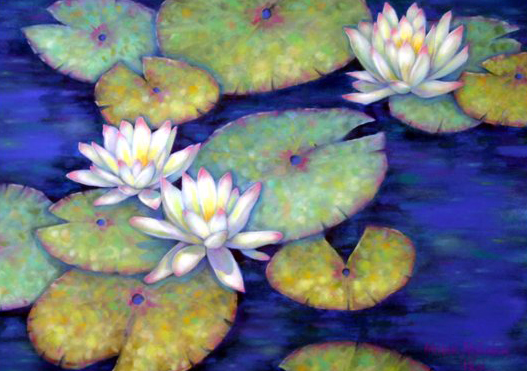
“Waterlily Garden,” pastel by Morgan Alexandra Kari, © 2013.
BAGSC member Morgan Alexandra Kari is exhibiting in Step Up for Pastels 2013 on the mezzanine of Gallery 113, November 4 – 30, 3013. All participating artists are members of The Pastel Society of the Gold Coast. The closing reception will be held November 30, 2013 from 3:00 pm to 5:00 pm.
Gallery 113 is located in the La Arcada Courtyard, 1114 State Street, Santa Barbara, California 93101, 805.965.6611. Gallery hours are Monday – Saturday, 11:00 am – 5:00 pm, and Sunday, 1:00 pm – 5:00 pm.
Congratulations Morgan!
by Deb Shaw
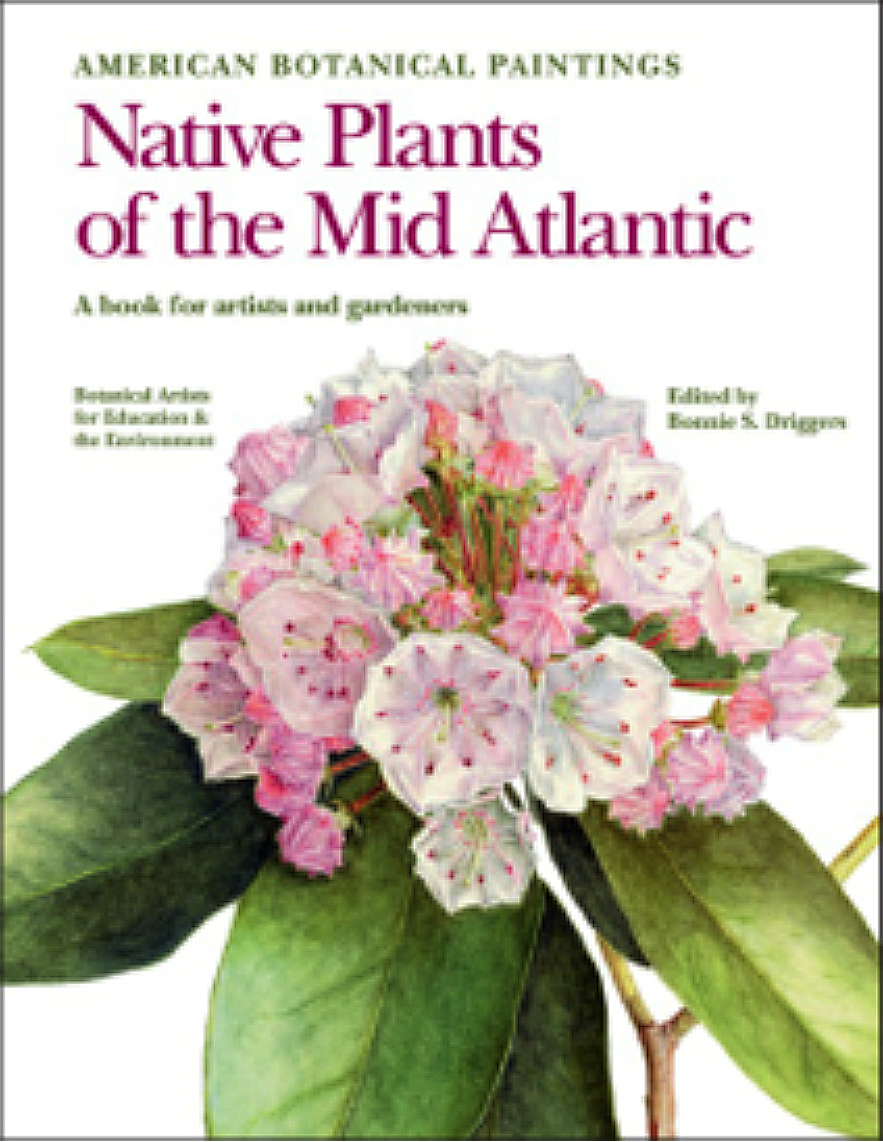
Cover art: American Botanical Paintings: Native Plants of the Mid Atlantic.
The Botanical Artists for Education and the Environment (BAEE) is pleased to announce that their book, American Botanical Paintings: Native Plants of the Mid Atlantic is now available to pre-order.
The book, which was more than three years in the making, contains 60 reproductions of original paintings and drawings of plants and 40 original paintings of butterflies, moths, and other pollinators. Each plant is briefly described with its habitat, and includes relevant information about the plant family and ways in which Native Americans or early settlers used the plants. For plants unsuitable for home gardens, their environmental importance is mentioned, such as food and habitat for birds and animals.
Proceeds from the sale of the book will be used to support native plant education, conservation, and horticulture. Publication costs are covered by donations, including a grant from the American Society of Botanical Artists (ASBA), for which BAEE is most grateful. For additional information about BAEE, please visit the website at www.baeecorp.org.
Pre-Sale Special Offer – Free Shipping. Scheduled for release February 2014. A limited number will be published, selling for only $39.95 plus shipping. Shipping is free on orders received by December 31, 2013 (US only). ORDER your copy today at www.starbooks.biz
An exhibition of the artwork will be held at the U.S. Botanic Garden in Washington, D.C., February 15 through June 15, 2014. Learn more from the USBG website: www.usbg.gov. See the BAEE website for complete details about the project at www.baeecorp.org
Geared toward a broad audience, the book has been well received, and is endorsed by respected authorities in the fields of both art and science, including the following:
This is a delightfully illustrated book, beautifully designed and with lots of variety in the choice of plant subjects. I admired the standard of painting and the fresh, appealing studies that will be attractive to both naturalists and gardeners.
— Dr. Shirley Sherwood, OBE, Botanical art collector
The U.S. Botanic Garden was thrilled to be a part of this book as it embodies what we know to be vital—our world is better and richer with fine botanical art, and the plants in our backyards, in our woods, and along the roadsides are amazing!
— Holly H. Shimizu, Executive Director, U.S. Botanic Garden
Like the exquisitely illustrated floras from past centuries, this volume carries on a rich tradition of detailed and deftly created botanical artistry. Each painting portrays the abundance and diverse beauty of the natural world around us, from early spring ephemerals to the towering monarchs of our deciduous forests.
— Peggy Cornett, Curator of Plants at Monticello
Botanical Artists for Education and the Environment (BAEE) is an incorporated 501(c)(3) Federal tax-exempt nonprofit in Virginia. The book is funded solely through donations. Any profits generated by the sale of the book will benefit nonprofit organizations that support native plant education and conservation.
If you have questions, please contact Judy Rodgers.
by Deb Shaw
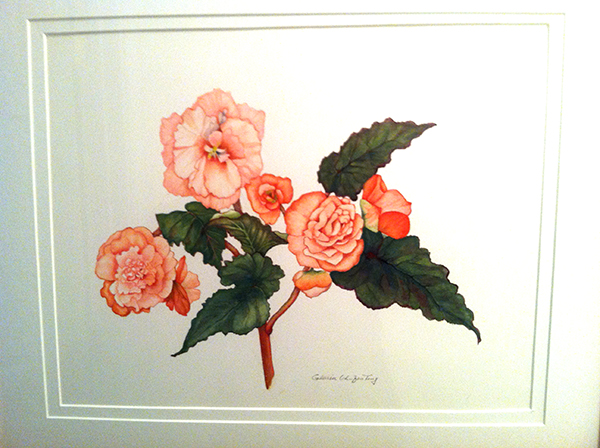
Begonia, snapshot of watercolor by Gloria Whea-Fun Teng, © 2013
BAGSC member Gloria Whea-Fun Teng has an exhibition at the Long Beach Main Library from November 1, 2013 through December 22, 2013.
Gloria has started painting in oils, and has still life paintings and landscape watercolors on display in addition to her botanical art and Chinese brush paintings.
The Long Beach Main Library is located at 101 Pacific Avenue, Long Beach, California 90822. Hours are Tuesday, 12:00 noon – 8:00 pm; Wednesday, 12:00 noon – 6:00 pm; Thursday, 12:00 noon – 7:00 pm; and Friday and Saturday, 10:00 am – 5:00 pm. The Library is closed Sunday and Monday.
Congratulations Gloria!
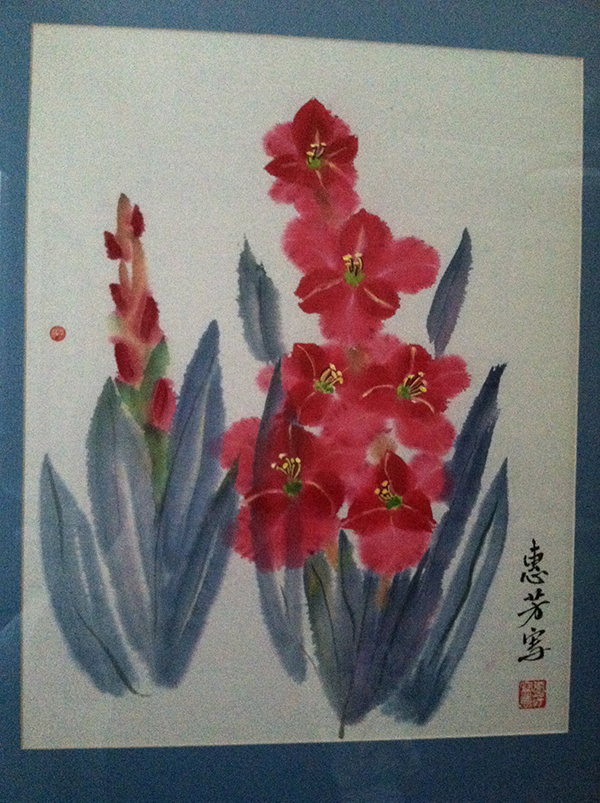
Snapshot of Chinese Brush Painting by Gloria Whea-Fun Teng, © 2013
by Deb Shaw and Leslie Walker

“One Truth, Many Lies: A New View of Art and Natural History Collections,” Artist Residency Program, California Academy of Sciences.
One Truth, Many Lies: A New View of Art & Natural History Collections [click on the title to view web page application information] is a new Artist Residency Program being offered to West Coast visual artists by The California Academy of Sciences in Golden Gate Park, San Francisco.
The deadline is coming up soon: proposals are due December 13, 2013, by email by 5:00 pm.
The Academy will select a total of four Artists for the program, to take place during the Spring/Summer of 2014. Artists will receive an honorarium and compensation for travel, lodging, meals and incidentals for three days and two nights in San Francisco, California.
Selected artists will be require to present two programs during their residency, at least one of which will be a public educational program consisting of a lecture or demonstration for the general public. A “hands-on” workshop or other class taught by the Artists in Residence will be offered free of charge to the public.
Artists will have at least one day to work with researchers at the Academy and with the collections housed in the Academy’s Institute for Biodiversity Science and Sustainability.
Questions? Contact Diane T. Sands, Collection Development Librarian, California Academy of Sciences by email, or phone, (415) 379-5489. Additional application information and information about the Artist Residency Program can be found on the website. This Residency is made possible in part by a generous grant from the Institute for Museum and Library Services.
by Deb Shaw
BAGSC member Tania Norris has generously donated 41 rare books from her personal collection to The Getty Research Institute (GRI).
Tania has been collecting these books individually for the past 13 years from booksellers in the United States, the United Kingdom, Europe and Australia. The collection provides the opportunity to study and compare the contributions of natural science and the visual display of scientific and botanical illustration from the sixteenth through the nineteenth centuries.

“Chrysanth,” Crispijn van de Passe, 1614
From Crispijn van de Passe, Hortus floridus (Arnhem, 1614)
The Getty Research Institute, 2898-803
Donated by Tania Norris
Two important works include Crispin Van de Passe’s Hortus Floridus, published in 1614, and Johann Christoph Volkamer’s Nürnbergische Hesperides, published in 1708. The Hortus Floridus is believed to be the first illustrated book to illustrate plants using magnifying lenses. Johann Christoph Volkamer’s Nürnbergische Hesperides is a fascinating documentation of the introduction of Italian citrus to Germany, as well as the revolution in urban planning and the design of parks.
The collection also includes a copy of Maria Sibylla Merian’s Derde en laatste deel der Rupsen Begin (Birth of the Butterfly), published in 1717, the first book to depict insect metamorphosis. The volume is believed to be one of the few surviving copies that was hand-colored by Merian’s daughter. Tania’s donation will have a companion in the GRI vaults: Merian’s stunning Metamorphosis of the Insects of Surinam (1719), the self-published book which documented the her explorations and documentation of the wildlife of the South American jungles. BAGSC members will remember the Metamorphosis fondly, as it was featured prominently in the Getty Museum’s exhibition, Merian and Daughters in 2008, which celebrated the extraordinary contributions of Maria Sibylla Merian and her daughters.
“The Getty Research Institute is deeply honored to receive the donation of the Tania Norris Collection of Rare Botanical Books from one of the founding members of our GRI Council. This gift promises to open novel paths to explore the complex historical intersections between science and art,” said Marcia Reed chief curator at the Getty Research Institute. “Tania’s passionate interests and her collecting instincts have created a very generous gift which has also served to raise the profile of an important subject with strong relevance for researchers who use our special collections.”
David Brafman, curator of rare books at the GRI, said “The Norris Collection offers inestimable rewards for scholars researching global botanical trade and the ensuing stimulus of cultural exchange to the trend of collecting curiosities spawned in Renaissance and Baroque European culture. Other books in the collection document the codependent progress of technologies in the history of medicine, pharmacology, and the color and textile industries from the sixteenth to nineteenth centuries. No less important are the opportunities to study the complex artistic relationship between physiognomy and ‘naturalism’ in visual representation, as well as developments in urban planning and landscape architecture. Ms. Norris’ generous donation enhances significantly GRI’s existing collections in such subjects and promises to transform the way art historians examine the past in the future.”
The Norris Collection will also provide insights in ongoing research in landscape- and still-life painting, as well as recipes and global trade in color and pigments.
Tania was a founding member of the Getty Research Institute Collections Council, and also serves on the J. Paul Getty Museum Disegno Drawing Council and Paintings Conservation Council. “It was one of the proudest moments of my life when the Getty Research Institute accepted my books for their library. I never collected expecting anyone else to think my books of interest, “ she said. “But now at the GRI, anyone can view them; some have been or will soon be in exhibitions and programs. More importantly, they will be preserved for generations to come.” She added, “You don’t need much money, just passion to collect and you just never know what treasures you may have.”
by Deb Shaw
BAGSC member Akiko Enokido is returning in December, 2013, and will teach two, three-day watercolor classes. BAGSC is experimenting with having the same teacher in two different locations for added convenience. Sign up for one or for both!
The first three-day session will be at the Los Angeles Arboretum:
Tuesday, December 10 – Thursday, December 12
9:30 am – 3 pm
Subject: Forced Bulbs
Cost: $200.00 BAGSC members
$225.00 non-members
Start forcing your choice of bulbs in November or sooner to bring to class, or you can even bring sprouting garlic or onions from the pantry; your subject matter is your choice. If you would like to have your drawing already prepared before class, that would be wonderful.
A $50.00 non-refundable deposit can be sent to Leslie, check made out to BAGSC, with “Akiko, Arboretum” in the memo line. Maximum class size is 16 people, first come, first served. The total amount is due by Friday, November 8. You can also send the total amount and skip the deposit step. Your check won’t be deposited until the start of class in December.
Bring your usual supplies for drawing and watercolor painting. If any special art supplies are needed, a supply list will be sent to participants upon registration.
Bring your own lunch, or you may purchase it at the Peacock Café at the Arboretum.

Quercus agrifolia, Coast Live Oak, watercolor by Akiko Enokido, © 2010, all rights reserved.
The second three-day session will be at the Santiago Creek Wildlife & Watershed Center, Santiago Park Nature Reserve, Santa Ana, right across from Main Street Plaza: Monday, December 16 – Wednesday, December 18
9:30 am – 3 pm
Subject: Acorns and Oak Leaves
Cost: $200.00 BAGSC members
$225.00 non-members
California native acorns and oak leaves will be provided; if you have other acorns and oak leaves you’ve collected and would like to paint, please feel free to bring them. If you have lots you want to share, please bring those as well! A $50.00 non-refundable deposit can be sent to Leslie, check made out to BAGSC, with “Akiko, Santiago” in the memo line.
Maximum class size is 16 people, first come, first served. The total amount is due by, Friday, November 8. You can also send the total amount and skip the deposit step. Your check won’t be deposited until the start of class in December.
Bring your usual supplies for drawing and watercolor painting. If any special art supplies are needed, a supply list will be sent to participants upon registration.
Detailed directions will be provided to class registrants. The Santiago Park Nature Reserve is not hard to find, and is easily accessible from the 5 and the 22 Freeways. It is highly recommended you bring your own lunch; There are large shopping centers across the street in two directions, but the lunch places are busy with business people, and it would take quite a bit of time away from class.
See you there!
by Cristina Baltayian, posted by Deb Shaw

Thumbnail of colored pencil artwork by Cristina Baltayian, © 2013, all rights reserved.
Cristina Baltayian will teach a five-day class in colored pencil techniques with botanical art, including colored pencil washes, layering colors, burnishing, blending, the basics of color mixing, and more. Drawing and composition skills will be emphasized, and students will do some quick sketching to capture the characteristics and rhythm of the plant.
The class will be held at the Virginia Robinson Gardens in the Pool Pavilion
1008 Elden Way, Beverly Hills, California 90210
Monday, October 28 – Friday, November 1
10 am – 3 pm
Cost is $400 for Friends of Robinson Gardens members; $475 for non-members. Register online, or by phone, 310.550.2068, or by mail at the address above: Friends of Robinson Gardens, memo “October Botanical.”
Cristina has a background in drawing (graphite, charcoal, pen and ink), two-dimensional design, watercolor and colored pencils. Her work has been exhibited at Filoli, the Los Angeles County Arboretum & Botanic Garden, Chapman University Leatherby Libraries, and the Robinson Gardens Florileguim. She is a member of the American Society of Botanical Artists, the Colored Pencil Society of America and the Botanical Artists Guild of Southern California. Cristina also currently teaches botanical illustration classes at the Los Angeles Arboretum.
by Sue Kuuskmae, posted by Deb Shaw
 BAGSC member Sue Kuuskmae, along with other artists and art organizations from the South Bay area are grouping together to create a Studios/Gallery called Destination: Art. View a three-minute video about the concept by clicking here.
They are in the process of finding a permanent location, but will debut in San Pedro at the Fall Fine Art Fest at CRAFTED at the PORT of LA:
October 18, 19, 20
11:00 am to 6:00 pm each day
Come meet the artists and see the demos. Destination: Art has a website, and a facebook page. They can also be contacted by email.
by Deb Shaw
If you’re a fan of RadioLab, you may have heard the last episode about “Colors.” If you haven’t heard it, you’re in for a treat. You can listen, stream, or download the RadioLab Episode on “Colors” (Episode 13) by clicking here.
The piece jumps into all kinds of subjects about color, including interview snippets with Victoria Finlay, who wrote the book by the name of Color. From Issac Newton and Homer; to how we see (as opposed to dogs, birds, butterflies, and mantis shrimp); to our language about color; to how Gamboge is made — it’s a great show with a fun soundtrack.
If you haven’t listened to RadioLab before, be sure to stick with it. Their station identification pieces are a little longer than most, and I do know people who have thought the program was over, when it was really just getting started.
Enjoy!
by Deb Shaw
Even with budget cuts and sequestering, many of our nation’s National Parks offer Artist-in-Residence programs for all different types of artists, including botanical artists.
Applications are open for one such program: the Artist-in-Residence Program at Acadia National Park, SCHOODIC District, in Winter Harbor, Maine. This program offers artists housing for two-week to four-week periods so they can pursue their art while surrounded by the inspiring landscape of the park. The program is open in the spring and fall. No additional stipend is available.
In return, participating artists are asked to donate a piece of work representative of their style and their stay to the park collection. The park collection artworks are displayed to the public on a rotating schedule. Artists are also asked to participate in one public program per week of their residency, based on their preference for educational outreach. These may include demonstrations, talks, or workshops, and are only for a few hours of your stay.
Applications for the Arcadia artist-in-residence program must be received by October 28, 2013.
There are many such programs across the United States, with different applications and due dates. Most applications will need to include at least a few samples of your artwork. Be sure to read about the accommodations in each park before you apply. Some are quite nice; others extremely rustic, but all are available for a botanical adventure.
 BAGSC News