You are currently browsing the category archive for the ‘Feature Articles’ category.
by Anita Walsmit Sachs and Deb Shaw

Tulip Parade, watercolor by Anita Walsmit Sachs, © 2016, all rights reserved.
Back by popular demand, Anita Walsmit Sachs will be offering a 5-day botanical drawing and painting workshop, “Hortus atelier” in cooperation with The Hortus botanicus, Leiden, in 2016.
The Hortus atelier program
The purpose of a botanical illustration is primarily a scientifically accurate drawing. The artistic input is reflected in the sensitivity in which the subject is displayed and in the composition.
PROGRAM: from April 11 to April 15, 2015, Course number 3 E C.2016.02 E
First day, the class starts at 10, with coffee and presentation, who is who and info, followed by a guided walk through the garden.
Lunch 12.00 – 12.30
Afternoon 12.30 – 15.45 Instruction about the subject to draw. Pencil drawing, including light and dark values.
Second day, instruction about material, paper, paint and colour mixing and composition.
Third day, transferring the drawing to the watercolour paper and painting.
Fourth and fifth days, continuing the process. Every day there will be a discussion about the progress of the drawing. The education is individually focused to gain an optimal result.
Costs
The fee will be € 395,00 including morning coffee, brasserie lunch and afternoon drinks. Information about payment will follow after subscription as well as information about lodging possibilities. A small optional assignment will be given before the course starts. Sign ups for the class are through Anita directly via email.
About the Hortus

The Hortus botanicus Leiden is a green oasis in the center of Leiden.
The Hortus botanicus Leiden is the oldest botanical garden in the Netherlands and one of the oldest in the world. It is located in the historical center of Leiden. Sitting behind the academy building of the Leiden University, the garden is a green oasis with a large collection of plants native to Southeast and East Asia, Southern Europe and South Africa. The Hortus is a haven within the city center, a historical monument and a meeting place full of character.
People go to the Hortus to relax, enjoy the seasons or to learn more about the diversity of the plant kingdom.
In 1590 the Hortus was founded by the University of Leiden. In 1594 Carolus Clusius (1526-1609) turned it into a medicinal herb garden. But Clusius introduced the tulip and many other plants like tobacco and potato to the Hortus. These flowers and plants became known throughout Western Europe.
Many famous international scientists such as Clusius, Boerhaave, Linnaeus and Einstein were connected to the Hortus botanicus in Leiden.

The Hortus botanicus Leiden is the oldest botanical garden in the Netherlands, and one of the oldest in the world.
In the 19th century, the German physician Philipp Franz von Siebold (1796-1866) brought hundreds of plant species with him from Japan to the Netherlands and 15 of these original introductions can still be found in the Hortus today.
About the Artist

Anita Walsmit Sachs in her studio.
Anita initially trained in fashion design at the Royal Academy of fine Arts in The Hague. Fifteen years ago she became a scientific illustator at the National Herbarium of Leiden University, now Museum Naturalis. She has won two RHS Gold medals and a second prize medal at the RBG show in Sydney, Australia. Anita has participated in the Highgrove Florilegium of HRH Prince Charles, the Transylvanian Florilegium of HRH Prince Charles, and the Sydney Florilegium. She is passionate about painting and teaching.
by Ted Tegart and Deb Shaw
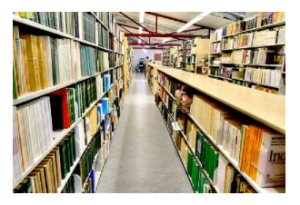
A view down a row of the remodeled Los Angeles Arboretum Library. Photo courtesy of LA Arboretum website, © 2016.
UPDATE TO ORIGINAL POST (by Deb Shaw):
I posted the article below at the beginning of the day (18 February), but then received an email this evening with an invitation to the Library Grand Re-opening on Saturday, February 27, from 1 – 3 pm. Steve Rushingwind will be performing Native American flute music and children can make a toy kaleidoscope. Karen Hochman Brown will be discussing her exhibit, Reflections in the Garden, which is on display in the Library. Free with admission; members free. Please contact Susan Eubank with questions, at 626.821.3213 or susan.eubank@arboretum.org.
The March 3 walk and talk may still be on the schedule; please double check with Susan.
Original Post:
Join Los Angeles Arboretum Librarian Susan Eubank for a walk and talk through and about the Arboretum Library on Thursday, March 3, 2016. After 50 years, the collections have emerged from the dark into a spacious, welcoming reinterpretation of a mid-century modern building, including a new children’s library. The extensive collections date from 1578 to 2016 in all formats and technologies. The Arboretum Library contains a comprehensive collection of resources on gardening, botany, California native plant life, environmental issues, and some agriculture as these subjects relate to the plants native to and planted in Southern California. This includes books, magazines, old seed and plant catalogs, government documents, pamphlets, and audio-visual materials.
The Library is open to everyone, free of charge. Any member of the general public may use library materials on-site. Arboretum Foundation Members may check out books.
NEW to the Arboretum is the capability to access articles online through the new digital archive, covering the development of the gardens, botanical descriptions of plants, background on local history, arboretum staff, exhibitions, lectures, concerts and more! Browse 65 years of Arboretum publications online and view online exhibitions (including botanical art)!
Arboretum Librarian Susan Eubank is a consummate botanical garden librarian who’s passionate about plants, gardens, libraries and helping customers with their quests.
The Arboretum is located at: 301 North Baldwin Ave, Arcadia, CA 91007. For more information about the tour, and for times, call 626.821.3222. The Arboretum Library is located within The Arboretum. To visit the Arboretum Library, go to the entrance rotunda and tell the cashiers you are there to use the library. Go straight through the double doors on the left (east) of the entrance rotunda. Library hours are:
- Tuesday-Friday, 8:30 am to 5:30 pm
- Saturday, 8:30 am to 5:00 pm
- Sunday, 12:00 pm to 4:00 pm
by Diane Daly and Deb Shaw
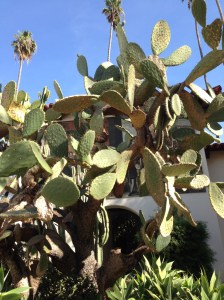
The Opuntia cactus in the courtyard at the entrance to Bowers Museum. Another beautiful Fall day in Southern California. Photo © Deborah Shaw, 2015.
BAGSC members Diane Daly, Deb Shaw, and new BAGSC member Linda Carpenter spent a gorgeous Fall day at the Bowers Museum on November 22, demonstrating botanical art and talking with visitors to the Museum. BAGSC members are demonstrating in conjunction with the Bowers exhibition “The Red that Colored the World,” on display through February 21, 2016.
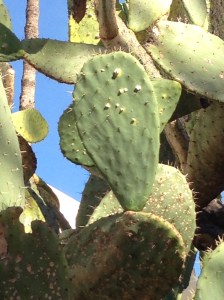
Cochineal (Dactylopius coccus) is a scale insect that lives on Opuntia cacti. The insect produces carminic acid, from which carmine dye is derived. The females and their nymphs secrete a waxy, white web to protect them from the sun and predators. Photo © Deborah Shaw, 2015.
There is a huge Optuntia (Prickly Pear) growing in the courtyard at the entrance to the Bowers, serendipitously covered with Cochineal. We were lucky to have a large pad that had fallen to the ground, and, in addition to botanical art, we were able to show visitors the Cochineal scale insect, the color, and even some Mealybug Ladybird (ladybug) larvae who were feasting on the Cochineal. It was a whole world on one cactus pad. Visitors to the museum were fascinated (as were we!).
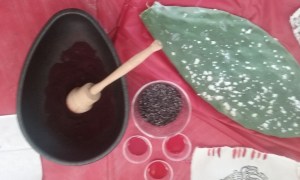
Live Cochineal (under the white on the Opuntia cactus paddle); dried Cochineal; and paint from the crushed insects. Photo by Diane Daly, © 2015, all rights reserved.
Diane Daly teaches at the Bowers Museum Treasures Program, which reaches out to senior centers, community centers, libraries, social service agencies and residential communities, engaging older adults who may be feeling isolated through art. The Thursday program focused on Cochineal as well, complete with demonstrations of crushing the bugs and using them to make paint. The seniors then painted an Aztec design using the paint. They could add lemon juice to some of the paint, which made it a lighter, warmer red.
Deborah Shaw will be teaching a a two-day color mixing class, “What’s Cool (and Warm) about Red” (with paint from the art supply store) on Saturday, December 12 and Sunday, December 13 at Bowers. Registration is through the Bowers website.
Additional BAGSC demonstration days in conjunction with the exhibition will be held in January and February. Come join us and learn about a color that changed the history of the world, that’s still in use today. (You’ll be amazed at how much Cochineal is still used in food, make-up and clothing dyes.) Email Deb to sign up!
by Alyse Ochniak, posted by Deb Shaw
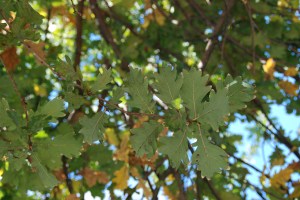
Leaves of the Quercus ruber (English Oak) outside the Botanical Ed Center. Photo credit: © 2015 Alyse Ochniak, all rights reserved.
On October 24, 2015, BAGSC members enjoyed an informative class taught by Dr. Jim Folsom, Telleen/Jorgensen Director of the Botanical Gardens at The Huntington Library, Art Collections and Botanical Gardens.
The class focused on the growth and structure of trees. Students looked at branches from the Quercus ruber (English Oak), from outside the Botanical Ed Center, studying leaves and growth buds. Dissection and compound microscopes were used to bring tiny cell structures of oak leaves and bark into focus.
After studying the different cells and structures students enjoyed a walk with Jim looking at different growth habits, bark, leaves and acorns of different oak trees in the gardens.
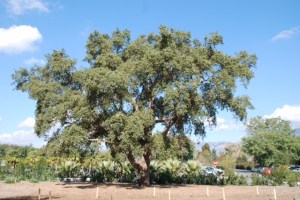
Quercus suber, Cork oak tree, from looking at trees with Jim Folsom. Photo credit: © 2015, Alyse Ochniak, all rights reserved.
The class ended with refreshments and discussion of the next workshop on January 17, 2016.
Hurry space is limited, if you want to sign up for the next workshop! The January 17, 2016 workshop is limited to 20 students, and will be held in the Engemann Applied Tech Lab, from 8:30 am – 12:00 pm. Cost is $10.00, payable at the workshop. Reservations are required, however; please RSVP to Alyse Ochniak. Reservations are first come, first served.
For more information about the New York Botanical Garden Triennial “Out of the Woods, Celebrating Trees in Public Places” visit the ASBA website.

Quercus suber, Cork oak tree, close up of bark. Photo credit: © 2015, Alyse Ochniak, all rights reserved.
The Huntington is located at: 1151 Oxford Road, San Marino, California, 91108.
About the instructor:
Jim Folsom, PhD., rides the demographic peak of baby boomers, having been born in southeastern Alabama in 1950. His lifelong love of plants is reflected in a BS in Botany from Auburn University, an MA in Biology from Vanderbilt University, and a PhD in research botany from The University of Texas at Austin. Though his research has centered on the orchid family, with much of the research time spent in Tropical America (including a year in Colombia on a Fulbright Pre-Doctoral Fellowship), Jim’s botanical interests are wide-ranging. As Curator of the Botanical Gardens at The Huntington in San Marino, CA, he dedicates much of his effort to educational programs that increase public interest and understanding of the science, culture, and history of plants and gardens. He lives at The Huntington with his wife, Debra (also a botanist) and children Molly and Jimmy. Jim was recognized as a Friend of the Cactus and Succulent Society of America in 1996, a Member-at-Large of the Garden Club of America in 1998, and presented a Professional Citation by the American Association of Botanical Gardens and Arboreta in 1999. The Garden Club of America awarded him their Medal of Honor in 2007.
by Gilly Shaeffer, posted by Deb Shaw

Heteromeles arbutifolia, Toyon by Gilly Shaeffer, © 2015, all rights reserved.
BAGSC members are invited to this Art Show and Sale at Gilly Shaeffer’s home, studio and garden this Sunday, November 22nd.
It will go from 9:30 to 5:00 p.m. Gilly’s show is part of the Arroyo Arts Collective Tour which takes place around northeast Los Angeles area every year. Gilly will have many years of her botanical painting work on display. Robert Layport-landscape oil painter, Cecile Decigaran-jewelry designer, Carol Yin and Kylie Ruan- potters will also be showing their work at Gilly’s during this event.
If you would like to buy a ticket to attend other art sites on this tour, you can do so online at http://arroyoartscollective.org. You do not need a ticket to come to Gilly’s—all BAGSC members are welcome!
The show is located at Gilly’s: 825 Elyria Dr., Los Angeles, California 90065
by Maureen Horn, Librarian, Massachusetts Horticulture Society, via email from Danielle Rudeen, The Huntington, posted by Deb Shaw
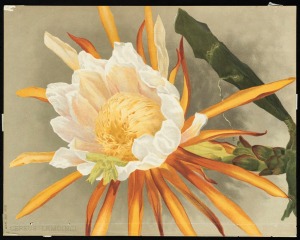
“Cereus lemoinei,” by Mrs. William Duffield, 1892. Massachusetts Horticultural Society Library, Box 9, Repros (shelf locator). Gift of Mrs. Fiske Warren, March, 1943. Permalink: http://ark.digitalcommonwealth.org/ark:/50959/0p097c160 This work is licensed for use under a Creative Commons Attribution Non-Commercial No Derivatives License (CC BY-NC-ND).
The Massachusetts Horticulture Society has announced that its botanical print collection has been digitized at the Boston Public Library and is ready to be viewed online.
The digitizing and posting of the collection is the culmination of three months of collaboration between the Massachusetts Horticultural Society, the Boston Public Library, and Digital Commonwealth. More than 1,000 rare images from the oldest horticultural library in the nation are now available for viewing and use by members, scholars, historians, artists and the general public.
Mass Hort’s Botanical Print Collection contains more than three centuries of botanical illustration, dating from 1620 to 1969, offering an invaluable resource. Artists and the public can explore images that until now have been seen only by experts.
Tom Blake, Digital Projects Manager, Boston Public Library, commented that “Digital Commonwealth enables Massachusetts cultural institutions to develop a virtual presence, enhancing education and research by creating a community of support, offering professional advice, and facilitating collaboration. The Digital Commonwealth portal facilitates worldwide access to the cultural heritage of Massachusetts. Our repository provides an affordable option to organizations that are unable to host one locally.”
The Horticultural Library at Massachusetts Horticultural Society was the first in the United States. It was established soon after the Society was founded in 1829 to share horticulture knowledge and beauty through its prints, books, extensive collection of seed catalogs, and other rare materials.
Noticing an interest in botanical prints, the Society mounted its first major exhibit in 1968. It continued with another exhibition in 1969, when a group of lily prints was shown to the North American Lily Society at its annual meeting.
Today, digitization and online access to special collections is an important strategy for any cultural heritage organization. With the help of Digital Commonwealth, Mass Hort’s Library will meet the 21st Century digital needs of students, researchers, authors and the public.
Massachusetts Horticultural Society’s botanical prints are available online at the Digital Commonwealth repository at https://www.digitalcommonwealth.org/collections/commonwealth:k930hm897 . These images are available for the purposes of viewing and studying and not for commercial use.
Massachusetts Horticultural Society’s Library collection includes more than 20,000 volumes at their library in the Education Center of the Elm Bank horticulture center and gardens. Additionally, the Society maintains 5,000 rare books, manuscripts, prints, seed catalogs, glass slides, and early transactions of horticultural institutions at a separate archival storage facility.
Many of the books transferred to the Chicago Botanical Garden’s Lenhardt Library Rare Book Collection in the early 2000’s by Mass Hort are now available online through the Illinois Digital Archives at http://www.idaillinois.org/cdm/landingpage/collection/ncbglib01; search on “Massachusetts Horticultural Society.”
Arillyn Moran-Lawrence, posted by Deb Shaw

“Elegant Syrah,” © 2015, Arillyn Moran-Lawrence. Pen and ink, 13-1/2″ x 19″. All rights reserved.
“Elegant Syrah” is a pen and ink drawing of grapes from a Temecula vineyard. I found this interesting group of grapes on the vine at the Callaway Winery. I liked the way the grapes were embraced by the leaves. I sketched and photographed them and made some color swatches as I hadn’t decided which media I would use.
Francesca Anderson’s pen and ink work has always fascinated me so I decided that I would use pen and ink. I began with stippling on the grapes and had to decide to make each grape unique in some very small way so that I could happily reach the end of my work.
I entered “Elegant Syrah” In the 119th Annual Juried Exhibition of the Catharine Lorillard Wolfe Art Club. I worked for 10 years to finally qualify to be a full member of the club and have now been a member of the group for many years.
The Exhibition at the historic landmark National Arts Club in Manhattan”s Gramercy Park is the club’s major event. $8,000.00 in awards are given. A Metropolitan curator also serves on the jury of awards.
A Preview Reception benefits a travel fund for curators from the Metropolitan to research collections across the country.
Catharine Lorillard Wolfe was a philanthropist and art collector who was the only woman in the group of men who founded the Metropolitan Museum of Art. Catharine Lorillard Wolfe was the first woman to be on the board of of the Metropolitan Museum of Art. The Art Club with her name was established in 1896, to aid women and to counsel and help them exhibit their art. Now the club reflects the members’ professional standing and interests. For more information on the Catharine Lorillard Wolfe Art Club, please see their website.
The National Arts Club is an historic private club in Gramercy Park, Manhattan. It is a National Historic Landmark.
Reposted in its entirety by Deb Shaw from an article from the Illustrators Partnership. The Illustrators Partnership has posted a request with the following article to “Please post or forward this artist alert to any interested party.”
From the Illustrators Partnership: Google Prevails in Copyright Lawsuit
Next Stop: Supreme Court
How will outcome affect artists?
October 16, 2015
Four years ago the Google Book Search Settlement was thrown out of court on the grounds that neither party to the agreement had legal standing to carve up the exclusive rights of the world’s authors. In his ruling, Judge Denny Chin wrote that it was for Congress, not the courts, to decide on the future of copyright law.
Since then, however, the courts have been chipping away at copyright, expanding the scope of what’s called “fair use,” that is, how much someone can use of your work without your permission.
Today an appeals court ruled in Google’s favor, according to an online article in Fortune.
“It’s finally over. An appeals court confirmed that Google’s scanning of more than 20 million books counts as fair use.
“It’s been ten years since authors first sued Google over the decision to scan millions of books, but now an appeals court appears to have confirmed once and for all the scanning did not violate copyright law.”
To be clear, this does NOT directly affect the new orphan works legislation currently being considered by Congress. But it’s a safe bet that corporation lobbyists will use it to argue that the decision paves the way for it:
“Friday’s appeals court ruling is significant because it clears the legal uncertainty that has been hanging over Google for a decade, and also because it provides more guidance on what qualifies as fair use in a digital age.
“In particular, the court states on several occasions how copyright law represents a balance between authors and the public, and points out how many forms of fair use are partly commercial.”
[Emphasis added.]
The Authors Guild has announced that it plans to appeal to the Supreme Court:
“We are disheartened that the court was unable to comprehend the grave impact that this decision, if left standing, could have on copyright incentives and, ultimately, our literary heritage. We trust that the Supreme Court will see fit to correct the Second Circuit’s reductive understanding of fair use, and to recognize Google’s seizure of property as a serious threat to writers and their livelihoods, one which will affect the depth, resilience and vitality of our intellectual culture.”
Thanks to all of you who wrote the Copyright Office this summer, and let’s all buckle our seat belts. We could be in for a bumpy ride.
Letters submitted by Illustrators Partnership and ASIP can be read on our Orphan Works Blog:
by Deb Shaw

Pincushion Protea, watercolor and colored pencil on paper, © 2015 Estelle DeRidder, all rights reserved.
The American Society of Botanical Artists and The Horticultural Society of New York announce the opening of the 18th Annual International at a new venue: the New York Design Center at a new venue. The ASBA’s longest-running collaboration, this prestigious exhibition will be held for the first time in mid-town Manhattan.
The opening reception will be on Wednesday, November 4, 2105 from 6 pm – 8 pm. Awards will be announced at 7 pm.
The evening’s events will begin with a book talk by author Amy Goldman at 5 pm. Limited seating is available. To attend Amy Goldman’s talk, an RSVP is required: scourtade@thehort.org. No RSVP is required to attend the opening reception.
As always, the catalog of the exhibition is available through ArtPlantae, starting November 4th.
BAGSC artists accepted into the exhibition include: Margaret Best, Melanie Campbell-Carter, Estelle DeRidder, Akiko Enokido, Asuka Hishiki, Joan Keesey, and Lesley Randall. Jurors for the exhibition were: Susan Fraser, Director, Mertz Library, The New York Botanical Garden; David Horak, Curator of Orchids and Aquatic House, Brooklyn Botanic Garden; Catherine Watters; Botanical Artist and ASBA Board Member.
The New York Design Center is located at: 200 Lexington Ave. New York 10016, (212) 679-9500.
by Lori Vreeke, Melanie Campbell-Carter, Diane Daly, posted by Deb Shaw
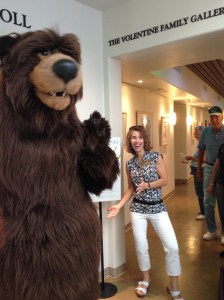
Lori Vreeke at the “Zoo in Bloom” opening. Photo by Melanie Campbell-Carter, 2015. As Melanie stated, “She’s the little one :-)”
On Saturday, October 3, 2015, the BAGSC “Zoo in Bloom” exhibition opened at the Santa Barbara Zoo. It was a wonderful day and the exhibit received great reviews!
The Zoo reported there were approximately 600 visitors at the beginning of the day for the “Members Morning” and a total of 1,962 Zoo guests for the entire day!
More than 100 visitors voted for the Peoples’ Choice award at the BAGSC exhibition of nine artists, showing 22 artworks in a variety of media. Awards are as follows:
1st Choice: Asclepias fascicularis, Narrowleaf milkweed with
Danaus plexippus by Estelle DeRidder
2nd Choice: Strelitzia reginae, Bird of Paradise by Lori Vreeke
3rd Choice: Heteromeles arbutifolia, Toyon by Gilly Shaeffer
Artists helping throughout the day included: Lori Vreeke, Jan Clouse, Melanie Campbell-Carter, Gilly Shaffer, Barbara Janelle, and Diane Daly.
The show will hang in the Volentine Gallery in the Zoo’s Discovery Pavilion October 3, 2015 — January 3, 2016.
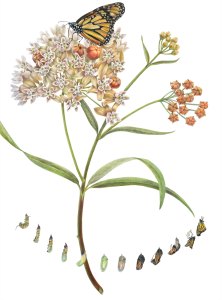
First place Peoples’ Choice award: Asclepias fascicularis, Narrowleaf milkweed with Danaus plexippus by Estelle DeRidder, © 2015, all rights reserved.

Second place Peoples’ Choice award, Strelitzia reginae, Bird of Paradise by Lori Vreeke, © 2015, all rights reserved.
Third place Peoples’ Choice award: Heteromeles arbutifolia, Toyon by Gilly Shaeffer, © 2015, all rights reserved.
Click on any of the circle images to see them large, with captions, in a slide show:

Gilly Shaeffer assisting exhibition visitors who are trying their hand at botanical art in watercolor. Photo by Lori Vreeke, © 2015.

BAGSC member Melanie Campbell-Carter assists an exhibition visitor with a leaf rubbing. Photo by Lori Vreeke, © 2015.

Diane Daly demonstrating botanical art with a fall squash. Photo by Lori Vreeke, © 2015.

The Zoo bear sniffed each painting in the exhibition. Photo by Lori Vreeke, © 2015.

BAGSC “Zoo in Bloom” exhibition in the Discovery Pavilion at the Santa Barbara Zoo. Photo by Lori Vreeke, © 2015.

BAGSC “Zoo in Bloom” exhibition in the Discovery Pavilion at the Santa Barbara Zoo. Photo by Lori Vreeke, © 2015.

BAGSC “Zoo in Bloom” exhibition in the Discovery Pavilion at the Santa Barbara Zoo. Photo by Lori Vreeke, © 2015.

BAGSC “Zoo in Bloom” exhibition in the Discovery Pavilion at the Santa Barbara Zoo. Photo by Lori Vreeke, © 2015.

BAGSC “Zoo in Bloom” exhibition in the Discovery Pavilion at the Santa Barbara Zoo. Photo by Lori Vreeke, © 2015.

BAGSC “Zoo in Bloom” exhibition in the Discovery Pavilion at the Santa Barbara Zoo. Photo by Lori Vreeke, © 2015.

BAGSC “Zoo in Bloom” exhibition in the Discovery Pavilion at the Santa Barbara Zoo. Photo by Lori Vreeke, © 2015.
by Lori Vreeke, posted by Deb Shaw
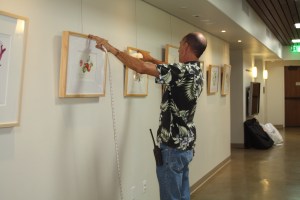
Hanging the “Zoo in Bloom” BAGSC exhibition at the Santa Barbara Zoo. Photo by Lori Vreeke, © 2015, all rights reserved.
I just wanted to share a few pictures from the Santa Barabara Zoo. The artwork was hung yesterday, and everything looks wonderful!
Please join us on Saturday, October 3 for the opening reception for the exhibition from 10 am – 2 pm. See the posting on the Zoo’s website. The Zoo has offered free entry to our members and families; please wear your BAGSC name badge if you have one, and contact Lori Vreeke for information about free entry.

Hanging the “Zoo in Bloom” BAGSC exhibition at the Santa Barbara Zoo. Photo by Lori Vreeke, © 2015, all rights reserved.
The Zoo is anticipating 600 – 800 members in the morning on Saturday. BAGSC artists will be demonstrating throughout the day, and there will be BAGSC-led activities for kids and families. BAGSC volunteers and demonstrators are welcome!! There are still a few volunteer slots available, and the more volunteers available for BAGSC public activities the merrier. Please contact Lori Vreeke to let her if you would like to volunteer for an hour or so, and please bring any extra paper, colored pencils and pencils to share.

Hanging the “Zoo in Bloom” BAGSC exhibition at the Santa Barbara Zoo. Photo by Lori Vreeke, © 2015, all rights reserved.
Bring a lunch, or enjoy the café right outside the exhibition hall for a beautiful day in a beautiful setting.
The show will hang in the Volentine Gallery in the Zoo’s Discovery Pavilion October 3—January 3. The Santa Barbara Zoo is located at: 500 Ninos Drive, Santa Barbara, CA 93103.
(805) 962-5339 main; (805) 962-6310 info line
Looking forward to the exhibit, and hope to see you there!

Hanging the “Zoo in Bloom” BAGSC exhibition at the Santa Barbara Zoo. Photo by Lori Vreeke, © 2015, all rights reserved.
by Nancy Grubb/Deb Shaw
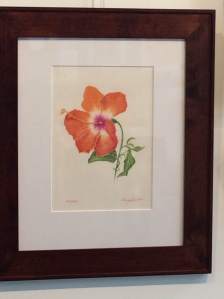
Hibiscus, colored pencil on paper by Nancy Grubb, © 2015, all rights reserved.
BAGSC member Nancy Grubb was juried into the Creative Arts Group in Sierra Madre, CA last week. She has been invited to exhibit approximately 12 paintings in their Spring Show, which hangs from early March to mid May, 2016. She is excited and honored to show her work in their prestigious gallery.
Details about the Spring Show and artists’ reception will be posted to the blog as soon as they are announced. Information will also be posted on the Creative Arts Group website as soon as it is available.
The Creative Arts Group is located at:
108 N. Baldwin Avenue, Sierra Madre, CA 91024
(626) 355-8350
info@creativeartsgroup.org
Congrats Nancy!
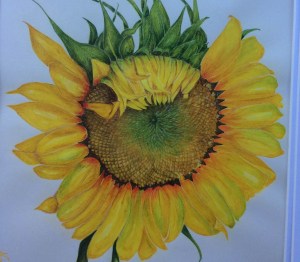
Sunflower, colored pencil and watercolor, Nancy Grubb, © 2015, all rights reserved.
by Deb Shaw
There is an imminent deadline this week, Thursday, October 1, 2015, for artists (and the public) to make “reply comments” to the Copyright Office regarding the return of Orphan Works legislation.
If you are concerned your ability as an artist to make a living and retain copyright ownership of your art, it is important to understand the proposed changes to copyright law. More than 2600 letters were written and filed during the initial comment period for the proposed changes—the majority by artists concerned about or against the proposed changes to copyright. These are the final two days to add your voice.
The following is from the Illustrators’ Partnership: read some of the letters written or write a first letter for yourself (in case you missed the initial opportunity), or comment on points made by others. It is important to become informed and participate.
_______
From the Illustrators Partnership:
Brad Holland and Cynthia Turner for the Board of the Illustrators’ Partnership
We want to thank all of you who wrote to the Copyright Office several weeks ago regarding the return of Orphan Works legislation. The Copyright Office received nearly 2,600 letters, an unprecedented response.
Nearly all are from artists protesting the draft legislation proposed to Congress in June.
To put our response in context, orphan works legislation has been based on fewer than 215 letters sent to the Copyright Office in 2005. That means our initial response trumped those total comments by a factor of 10.
The letters have been posted here: http://copyright.gov/policy/visualworks/comments/
You may find accessing the full set of comments in this PDF a bit of a challenge. See these instructions if you have problems.
Now the next step will be to write “reply comments.” We hope everyone will take the opportunity to write again.
A “reply comment” can take any form you’d like. We’d suggest 1 of 2 ways:
1. Take one or more comments you agree with and say that you agree.
2. Take one or more comments you disagree with and explain why you disagree.
We invite you to consider endorsing the letter submitted by the Illustrators Partnership. It’s key sentence reads:
“Because Article 1, Section 8 of the Constitution grants authors the exclusive rights to their work, it is our understanding that those rights cannot be abridged without a constitutional amendment.”
The full letter can be found in Document #1: Direct Initial Comments. It’s listed alphabetically under Illustrators Partnership.
Reply Comments are due October 1, 2015. American and foreign artists can both submit their letters online here: http://copyright.gov/policy/visualworks/comment-form/
Comments must be submitted using the comment submission form or they will not be considered part of the public record.
Please be advised:
“The Office intends to post the written comments and documentary evidence on its website in the form in which they are received. Parties should keep in mind that any private, confidential, or personally identifiable information appearing in their comment will be accessible to the public.”
Special note to foreign artists: If you are submitting from outside the US, under “State,” please scroll down to the bottom and select “Non U.S.A. Location.”
For those who didn’t write the first time, please don’t miss the opportunity to do so now. Please post or forward this artist alert to any interested party.
by Deb Shaw

Damselfly, Carnation, Firebug, Caterpillar, Carnelian Cherry, and Centipede; Joris Hoefnagel (Flemish / Hungarian, 1542 – 1600), and Georg Bocskay (Hungarian, died 1575); Vienna, Austria; 1561 – 1562; illumination added 1591 – 1596; Watercolors, gold and silver paint, and ink on parchment; Leaf: 16.6 x 12.4 cm (6 9/16 x 4 7/8 in.); Ms. 20, fol. 68. Digital image courtesy of the Getty’s Open Content Program.
The Getty has a treasure in its collections, prized by botanical artists all over the world: the Mira Calligraphiae Monumenta by Georg Bocskay and Joris Hoefnagel. Commissioned in 1560 by the Holy Roman Emperor Ferdinand I, Georg Bocskay, court scribe, displayed his astonishing calligraphy skills in this small book. Thirty years after he completed the volume, Joris Hoefnagel, the court illuminator to Ferdinand’s successor, the Holy Roman Emperor Rudolf II, painted incredible portraits of flowers, insects, snails, seeds, frogs, snakes and more in the spaces on each page.
ASBA member Denise Walser-Kolar was inspired by Hoefnagel’s work after seeing the modern reproduction, Nature Illuminated: Flora and Fauna from the Court of Emperor Rudolf II in a bookstore. She is working on a 25-painting series, Hoefnagel-Inspired. To see more of her work, visit the article in the Getty Iris, the online magazine by the Getty. To order your own copy of Nature Illuminated, visit the Getty Store.

Hoefnagel-Inspired #4 2014, Denise Walser-Kolar. Watercolor and gouache on calfskin vellum, 4 x 6 in. Courtesy of and © Denise Walser-Kolar.
by Gilly Shaeffer, posted by Deb Shaw
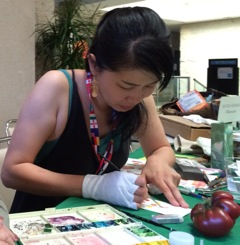
Asuka Hishiki demonstrating during the “Weird, Wild & Wonderful” Symposium at The Huntington, July 2015. Photo by Gilly Shaeffer, © 2015.
During the recent “Weird, Wild & Wonderful” Symposium at The Huntington, I watched Asuka Hishiki as she demonstrated how she would paint a segment of an heirloom tomato skin. Here are my impressions of the way she went about developing this small sample of the tomato skin with paint.
- Asuka says every time she approaches her subject it is new for her.
- Asuka starts sketches on tracing paper.
- She uses a wood pencil in a pencil holder which she sharpens with a box cutter.
- She goes over her pencil lines with a lighter color paint or yellow ochre. So she will have thin lines in watercolor for her drawing.
- At this point she erases any pencil lines.
- She covers the entire form with a Chinese white wash. (The Chinese white that she likes is the Holbein brand.) She says one should stay very light when applying the first layer of this white paint. This Chinese white wash acts as a protection for the paper. Much of it gets taken off during the removal of the masking fluid (to be mentioned later).
- Asuka will add more Chinese white paint on the places where she wants the paint to bleed to create soft color transitions. She also mentions the importance of keeping harmony in the colors used as the form develops.

Asuka Hishiki masking fluid technique. Photo by Gilly Shaeffer, © 2015.
- She mixes three colors together in a small amount to be used to develop the form using the dry brush technique. She uses Interlon brand brush #3/0 for her dry brush work.
- In preparing to use masking fluid to prevent certain areas of the paper from getting painted, she would prime the brush to be used with liquid soap. The soap helps to keep the masking fluid brush in good shape for future use. This brush is used exclusively for masking fluid.
- She will use the masking fluid to hold the places that she does not want to get painted—in this case the place where a leaf would be (which looks like a skinny wiggly line in the photos), where the highlights would be and where imperfections would be found on the tomato skin.

Asuka Hishiki masking fluid technique. Photo by Gilly Shaeffer, © 2015.
- Asuka stipples on the masking fluid with a very skinny brush on the section that she has begun to paint.
- She uses tissue to blot any extra paint from her paper.
- Then she adds a second layer of masking fluid. So, this layer of masking fluid dots will have more tone than the first layer of dots that she applied that prevent any paint from getting through to the paper.
- She always makes sure that the paint and the masking fluid that she has applied are absolutely dry before proceeding.
- She says that you can lift paint more easily when you have first applied a Chinese white wash to the paper.
- She applies a layer of Yellow Ochre wash.
- She continues to develop the form through her dry brush technique. At this point the masking fluid remains on the painted area.

Asuka Hishiki masking fluid technique. Photo by Gilly Shaeffer, © 2015.
- Asuka uses Winsor Newton Series 7 brushes, #5 and #3 for the colored washes.
- She adds a third layer of masking fluid dots.
- With WN Series 7 #5 brush, she puts a colored wash on the section that she had previously dry brushed. This makes any lines from dry brushing disappear.
- Now she lifts the masking fluid dots. When she does this she is also lifting the Chinese white paint that was applied to the paper at the very start. The white of the paper now shows through in the places that had masking fluid on them.
- She decides that she wants to apply another layer (this would be the fourth layer) of masking fluid dots. This will make the dots appear lighter and less visible than the layers applied earlier.
- Next more dry brushing with a deeper color paint. Some stippling is used. Then some more wet strokes (colored washes) to further the development of the form.
- When she removes the fourth layer of masking fluid, it is easy to see the section of the heirloom tomato skin developing on the paper with its highlights, its shiny smooth skin, its roundness, its imperfections and its rich colors of orange, red, and purple.
 BAGSC News