You are currently browsing the category archive for the ‘Member News’ category.
by the BAGSC Board
In the beginning of April, Pat Mark, President of BAGSC since 2014, announced she was stepping down as president, citing personal reasons. At a Special Board meeting on April 2, 2017, Janice Sharp was appointed by the Board to fill the position of President, Beth Stone was appointed Treasurer, to replace Janice Sharp, and Ellie Tu was appointed Membership Chairperson to replace Melanie Campbell-Carter, who has moved to Tucson. Normally scheduled elections for the positions of President, Treasurer and Membership Chairperson are to be held in December.
In addition to these changes the following Board position are open:
Exhibition Chair: Responsibilities are primarily to coordinate exhibition events and post them on BAGSC.org along with Calls for Entries. Lessons of posting information to the web site will be provided. Each of the venues where BAGSC exhibits has a primary person who is the contact person for the venue. These people are Janice Sharp (Arboretum), Beth Stone (Descanso), Lesley Randall (San Diego Botanic Gardens), Diane Daly (Chapman), Tania Norris (Huntington), Gilly Schaeffer and Janice Sharp (20th Anniversary). Bonnie Born-Ash and Leslie Walker are also members of the Exhibition Committee and assist at all the venues.
Please contact Janice Sharp if you are interested in filling this position.
Blog Writer(s) at Large: We are always looking for BAGSC members who would like to be trained to write and post on the blog. Lessons will be provided.
Please contact Deborah Shaw if you are interested in filling this/these position(s).
by Jennifer Muto; and Rose Marie James, ASBA On-Line Manager; posted by Deb Shaw
As you know, ASBA continues to be a wonderful resource for all information about what is happening in the world of botanical art. It brings us together in the way of conferences, a terrific quarterly magazine and as a means of showing our work to the world through exhibitions, our website gallery and our annual on-line auction.
The ASBA online auction offers us the most exposure because it provides a broad opportunity for friends and associates, and their friends and acquaintances, to see and purchase our work through social media. It benefits everyone – you the artist, the buyers and ASBA.
ASBA needs the help of our members to participate in this very important fundraiser. Submit an original piece or a gicleé print you have in your library of work. If it’s an original you get half the sale price back. This is about the same as any gallery but the balance goes to our wonderful organization.
Please help support the ASBA so that we can continue to provide those enriching resources we have all come to enjoy. The ASBA On-Line Auction is approaching its submission deadline in eight days, on Monday, March 13th. Here is the link to the ASBA website where you can register to participate in the online aution. Just send a digital copy of your art and the PDF application form and you are good to go. It will make us happy.
You may have seen the copy below in the recent ASBA highlights newsletter. We would love to get more submissions from ASBA members and was hoping you’d be willing to submit something and/or reach out to your ASBA friends to help us rally submissions. No submission is too small!
Tick tock, tick tock. Time is getting short. The ASBA Online Auction needs you! You need the Online Auction! It’s a Win-Win! It’s a chance to show your botanical artwork to a world-wide audience. Plus, if you make a sale of an original work, 50 percent comes back to you, and you help ASBA at the same time. It really is easy to send a digital image of your art (sized to 72 dpi, 8 inches high) with a brief description of the art work or item, plus its value. You may submit one or more original pieces, or giclée prints (five per artist maximum), art materials or equipment, and classes. Here – is the link for further details and submission – just click it – it is easy! We’ll take care of the rest. Deadline to submit: March 13th, 2016.
Thanks and looking forward to seeing you in October at Filoli for the ASBA Conference & Annual Meeting!
by Jude Wiesenfeld and Lee McCaffree, posted by Deb Shaw
BAGSC will be sponsoring a one-day Leaf Detail workshop with Lee McCaffree, on:
Saturday, May 6, 2017
9:30 am – 4:00 pm
The Huntington Library, Art Collections and Botanical Gardens, Botanical Education Center
Cost, BAGSC Members: $100
Non-Members: $120
Maximum Registration: 16 students

Roger’s Red Grape, watercolor by Lee McCaffree, © 2017.
Leaves form the background for most botanical paintings. It is important to spend the time to make them accurate. We will work to make the veins and margins realistic in their finishing touches while following the form and texture of several leaves. This workshop will cover leaf-painting techniques using dry brush work, masking fluid, lifting and leaving the white paper.
For more information about the workshop, sign-up, and the materials list, please see the BAGSC website “Classes” and “Class Details” page.
About the Instructor
Lee McCaffree is a botanical illustrator in watercolor. She shares the coordination and implementation of the Filoli Botanical Art Certificate Program and is a primary instructor. She served on the Board of Directors of The American Society of Botanical Artists. She gives regular private classes in the Bay area and instructed at the ASBA Annual meetings and the UC Berkeley Botanical Garden. She supports botanical artists by participating in coordinating teams for art exhibits and jurying.
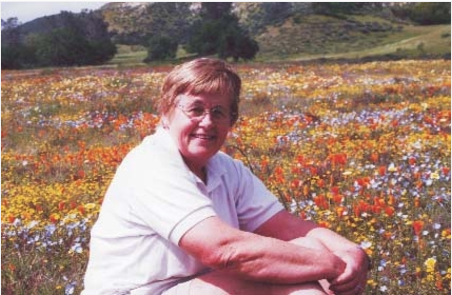
Lee McCaffree
She began her career in London, England studying under Christabel King of Kew Gardens. She received Medals for showing her “Pinus” series and “Plants in Peril” series at the Royal Horticultural Society exhibitions in London. Her works are in the permanent collections of the Royal Botanic Gardens at Kew Collection, London, the Filoli Florilegium and Hunt Institute of Botanical Documentation; Lee won Best of Show at the Northwest ASBA Exhibition in Portland, OR. Her showings include juried exhibitions at Contemporary Art Center, MOMA-New York; Longwood Gardens; Hunt Institute, Pittsburgh; Seattle Science Center; Flinn Gallery Greenwich, CT; Horticultural Society of New York; Missouri, Chicago, Denver and UC Berkeley Botanical Gardens; Strybing Arboretum, CA; Arizona Desert Museum, New York State Museum; Johnson & Johnson Headquarters; Oakland Museum; Loveland Museum (Colorado); Filoli exhibits and Florilegium; Northern California Society of Botanical Artist’s Alcatraz Florilegium and other venues. She created the poster for the California Native Plant Sale for the East Bay for ten years. Her work is published in Curtis’s Botanical Magazine, England and Today’s Botanical Artist. Her work was included in “Losing Paradise”, an exhibit of endangered species illustrations which traveled throughout the U.S and to the Shirley Sherwood Gallery at Kew Gardens, London. Currently, she is exhibiting in the Weird, Wild and Wonderful Traveling Exhibit from the New York Botanical Gardens.
Lee’s work concentrates on native plants which she hopes will increase their visibility and use in public and private landscaping. Her skill as a botanical artist allows her to focus her creativity on the finest details of each plant she paints. Her enthusiasm inspires her students to develop their own skills and enjoy the creative process.
by Deb Shaw
The Los Angeles County Arboretum and Botanic Garden has announced the schedule for Cristina Baltayian’s Botanical Art and Illustration classes.
Each session meets four (4) Tuesdays per month, from 10 am – 2 pm (includes lunch break) in the Oak Room:
January 10, 17, 24, 31
February 7, 14, 21, 28
March 7, 14, 21, 28
April 4, 11, 18, 25
May 2, 9, 16, 23
June 6, 13, 20, 27
Cost: $275 Arboretum members per month; $295 non-members per month (includes Arboretum Admission)
To Register please call the Education Department at 626.821.4623 or pay at the class.
These classes explore color pencil, graphite, pen and ink, and watercolor on various papers, vellum and other surfaces. The emphasis is on plant observation, drawing, composition, color theory and matching, and medium techniques. In conjunction with the Botanical Artists Guild of Southern California, students will be studying and portraying many of the Arboretum plant introductions from the last 50 years. The goal is to build a collection of paintings that will celebrate and document the invaluable contribution of the Los Angeles Arboretum to the state of California.
The Los Angeles County Arboretum and Botanic Garden is located at 301 North Baldwin Ave, Arcadia, CA 91007, 626.821.3222.
by Arillyn Moran-Lawrence, posted by Deb Shaw

Website for “Ko; An Ethnobotanical Guide to Hawaiian Sugarcane Varieties,” by Noa Kekuewa Lincoln, PhD., © 2016, University of Hawai’i, Manoa, all rights reserved.
Arillyn Moran-Lawrence, will have a pen and ink drawing of Hawaiian Sugar Cane in the forthcoming book Ko; An Ethnobotanical Guide to Hawaiian Sugarcane Varieties. The book will be published by University of Hawaii Press, a nonprofit scholarly publisher.
The author is Noa Kekuewa Lincoln, PhD, Assistant Professor at the University of Hawai’i, Manoa.
About the author of “Ko; An Ethnobotanical Guide to Hawaiian Sugarcane Varieties”
Dr. Noa Kekuewa Lincoln is of native Hawaiian, German, and Japanese decent, born in Kealakekua on Hawai‘i Island. He received his BS in Environmental Engineering from Yale University, and his PhD in Environment and Resources from Stanford University, where his work focused on traditional agricultural development pathways and management strategies. His postdoctoral work examined traditional values and practices of ecosystems for food in Aotearoa. Noa has worked in marine and terrestrial ecosystem restoration and conservation around the Pacific, and has coupled these efforts with cultural and environmental education and community engagement. He has worked on traditional Hawaiian ethnobotany and agriculture and has implemented projects facilitated through a variety of partnerships with community organizations. He is recognized as an emerging expert in Hawaiian crops and cropping systems. His primary interests are in combining traditional and modern knowledge of land management to evaluate social utility, rather than economic, contributions. He is currently a research fellow with Ngai Tahu Research Centre at the University of Canterbury and an Assistant Professor at the University of Hawai‘i at Mānoa with a focus on Indigenous Crops and Cropping Systems.
by Joan Keesey and Deb Shaw

Eschscholzia californica, California Poppies, watercolor, © Joan Keesey, 2016, all rights reserved.
Joan Keesey will be exhibiting her botanical watercolors at the Theodore Payne Foundation for Wild Flowers and Native Plants from Saturday, January 21, through Saturday, April 22, 2017.
The exhibition will focus on California native plants blooming in and around the Theodore Payne Foundation and in the Santa Monica Mountains.
Everyone is invited to the opening reception for the exhibition, on Saturday, January 21, 2017, from 1 – 3 pm.
The Theodore Payne Foundation is located at 10459 Tuxford Street, Sun Valley, California 91352, 818.768.1802. Hours are Tuesday – Saturday, 8:30 am – 4:30 pm. Theodore Payne is closed Sunday and Monday each week. On-leash dogs are welcome. There is no admission fee.
 Theodore Payne will be hosting their annual native Winter Plant Sale Thursday – Saturday, January 26 – 28, from 8:30 am – 4:30 pm all three days. Everyone will receive discounts for all three days, plus receive expert advice from Theodore Payne staff and volunteers. Members receive 15 percent off plants, seed and Theodore Payne wear all day. Non-members receive 10 percent off plants, seed and Theodore Payne wear after 11:00 am. Not yet a member? Join at the door! Shop early for best selection.
Bring your own boxes and wagons, see the art exhibition and purchase native California plants.
by Estelle DeRidder and Deb Shaw
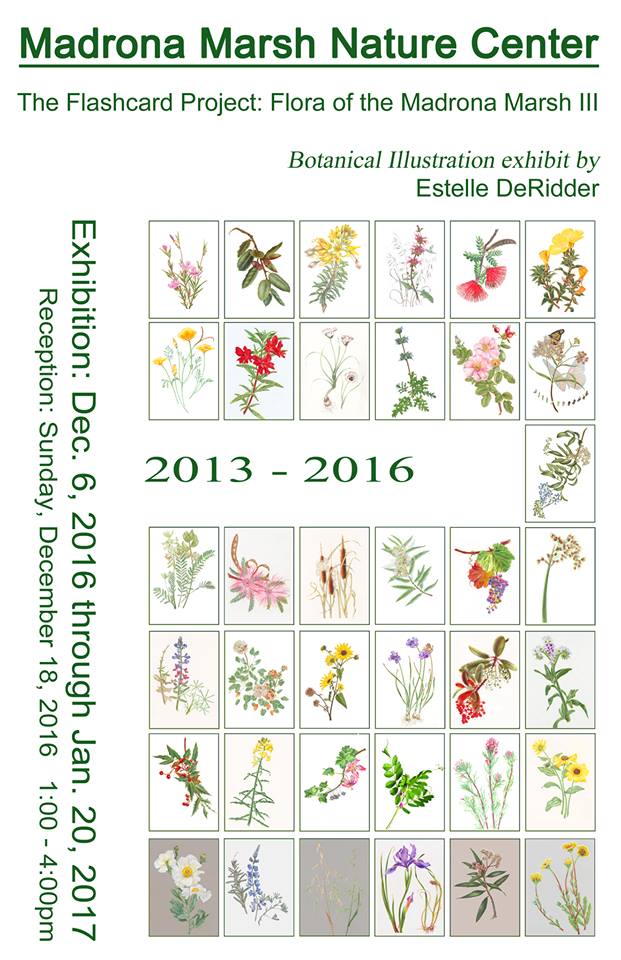
Invitation for Estelle DeRidder’s Madrona Marsh Nature Center Exhibition, © 2016, Estelle DeRidder.
In 2012, BAGSC member Estelle DeRidder was awarded an education grant from the American Society of Botanical Artists (ASBA) to use in creating reusable plant identification cards featuring California native plant illustrations from the Madrona Marsh Preserve in Torrence, California.
Information about Estelle’s project was presented at the ASBA Annual Meeting and Conference in Denver, Colorado during the ASBA Grant Presentations, October 17, 2014.
Estelle is now exhibiting the complete project at the Madrona Marsh Nature Center. Titled The Flashcard Project: Flora of the Madrona Marsh III, the exhibition runs from December 6, 2016 through January 20, 2017. There will be an opening reception Sunday, December 18, 2016
1:00 – 4:00 pm.
The public is invited and welcome.
The Nature Center at the Madrona Marsh Preserve is located at: 3201 Plaza del Amo, Torrance, CA 90505. Phone: (310) 32-MARSH. The Madrona March is open Tuesday – Sunday, 10 am – 5 pm.
If you are interested in applying for an ASBA grant, please apply by August 1, 2017 (open to ASBA members only). Information and the application can be found on the ASBA’s Grant page on their website.
by Diane Daly and Deb Shaw
BAGSC member Steve Hampson loves Sweet Peas and Daffodils. Diane Daly found a YouTube video of Steve from Roger’s Gardens. Enjoy!
by Sally Jacobs, posted by Deb Shaw

Sally Jacobs’ 2017 Gift Calendar, © 2016 Sally Jacobs, All rights reserved.
BAGSC member Sally Jacobs has issued a 2017 calendar featuring her original watercolors and graphite, keyed to the month and season.
A perfect 12-month, compact calendar for desk or counter, each month is printed on a separate 4″ x 5″ sheet, which fits into a compact, clear acrylic 4.5″ x 7.5″ plastic shell. The shell provides a stand for the calendar, or folds flat. As a holiday special, buy three (3) or more and receive an extra calendar free! [Note: the free additional calendar won’t show on the Etsy site, but don’t worry, it will be in your shipment.]
Calendars are shipped in 1 – 3 days in well-protected, eco-friendly, stay-flat mailers.
Order your calendars. Questions? Contact Sally Jacobs.
by Melanie Campbell-Carter, posted by Deb Shaw
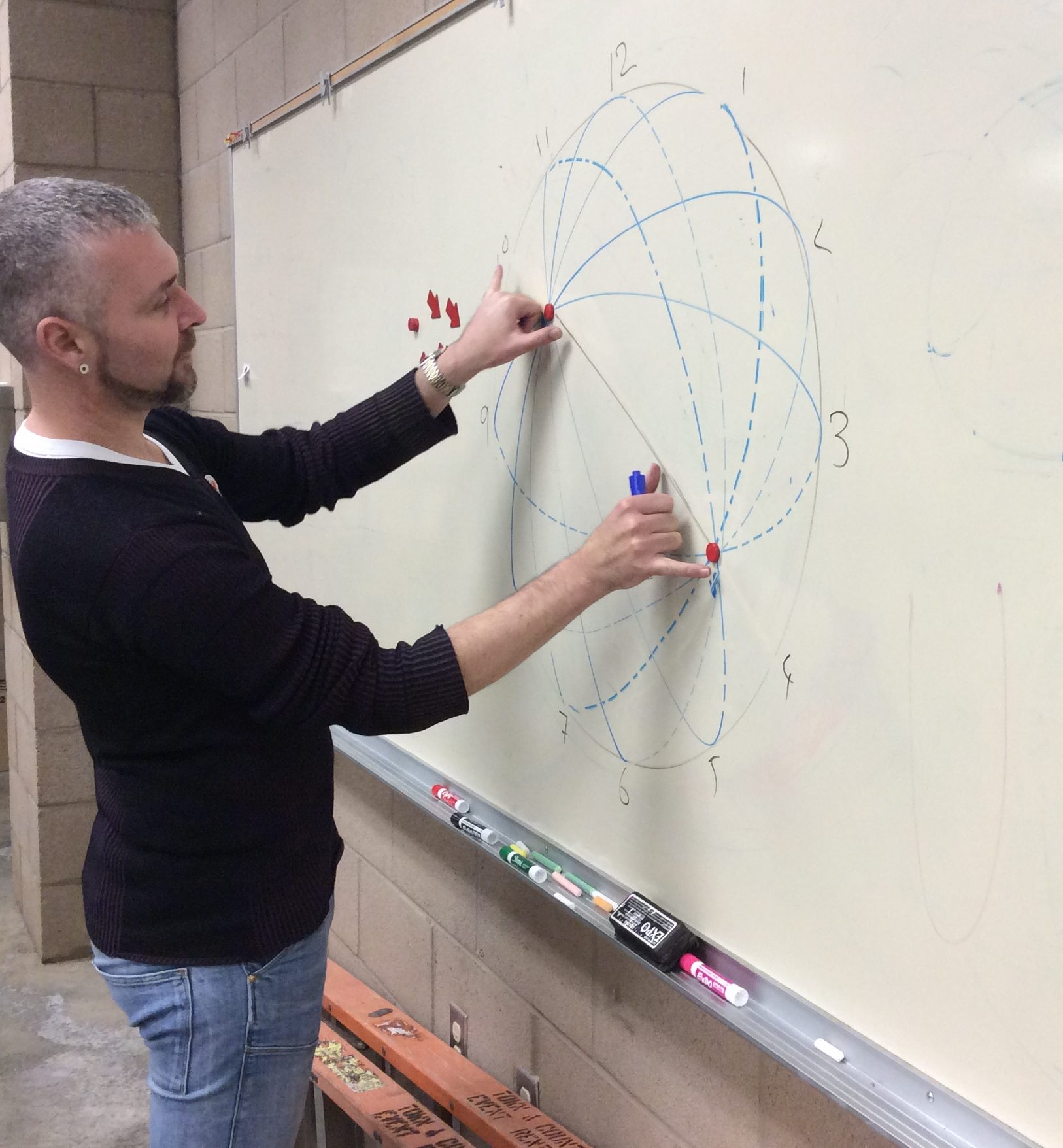
John Pastoriza-Piñol demonstrating ellipses. Photo by Melanie Campbell-Carter, © 2016.
The renowned Huntington Library, Art Collections and Botanical Gardens provided fourteen BAGSC members with a three-day Master Class with John Pastoriza-Pinol on November 8 – 10, 2016. The Huntington offered us exquisite Paphiopedilum specimens from the Conservatory and greenhouses for our subjects. Kudos to Melanie Thorpe of The Huntington, and BAGSC Education Chair Jude Wiesenfeld, for flawless organization on this long-anticipated workshop.
Quoting participant Arillyn Moran-Lawrence, “We learned so many new techniques:
- Using ellipses to find the proper placement of a plant on the paper.
- Using abundant masking fluid to keep the areas between washes pristine.
- Using many layers of pale colors to build to unique darker colors.
- Using brushes like blenders, spotters and a Neef comb to complete the painting.”
Reactions to the experience by participating artists included,
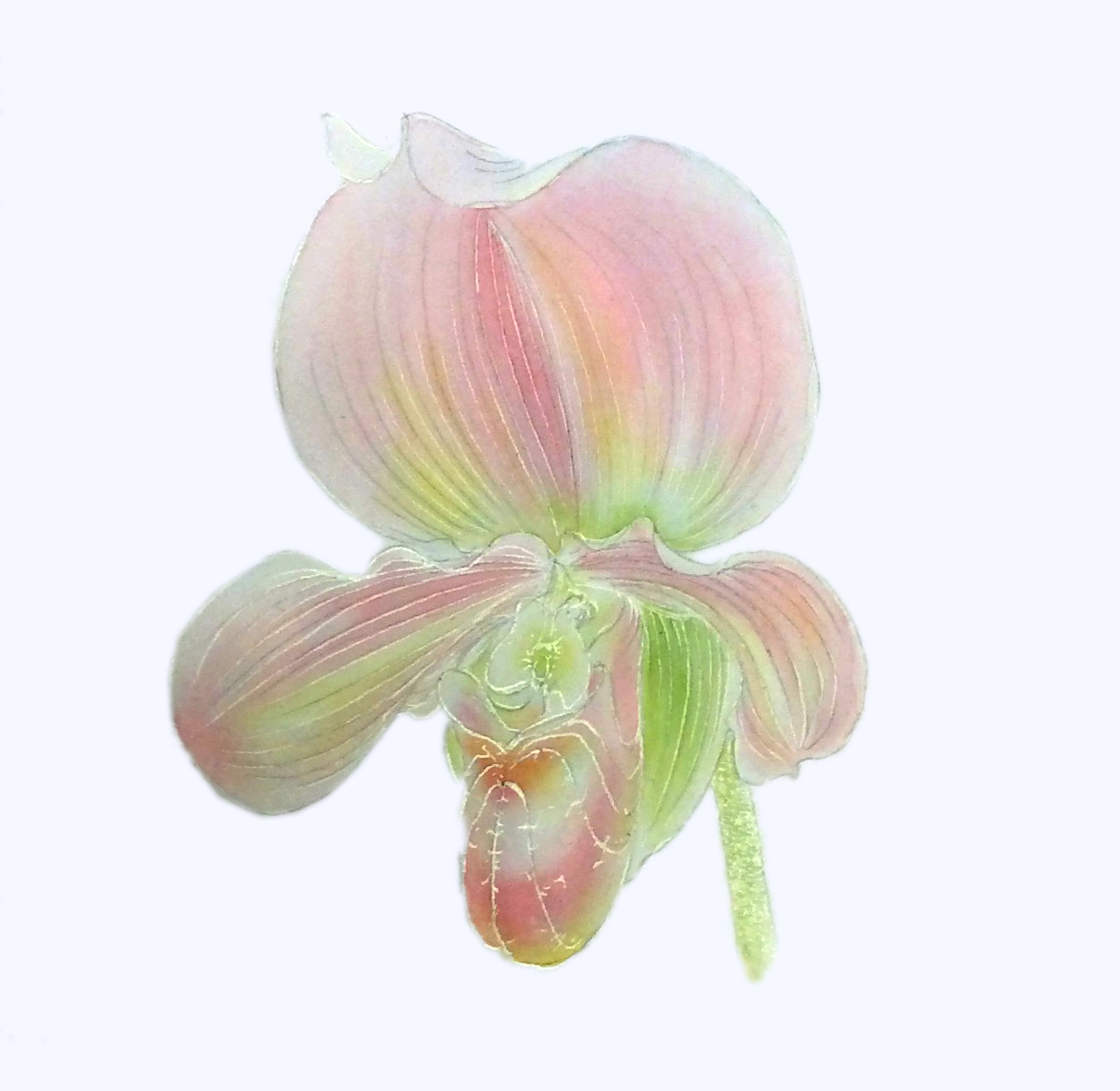
Using abundant masking fluid. Photo by Melanie Campbell-Carter, © 2016.
“Combing is my new favorite thing!” Cynthia Jackson
“Watching John develop the orchid painting was truly an inspiration.” Gilly Shaeffer
“(John) will rewet six or seven times before he starts dry brush work and a total of maybe 30 layers to the final work. I am so happy to have learned about his methods.” Leslie Walker
“I never named my orchid but after all those pastel washes I named my painting…my pretty pony!” Beth Stone
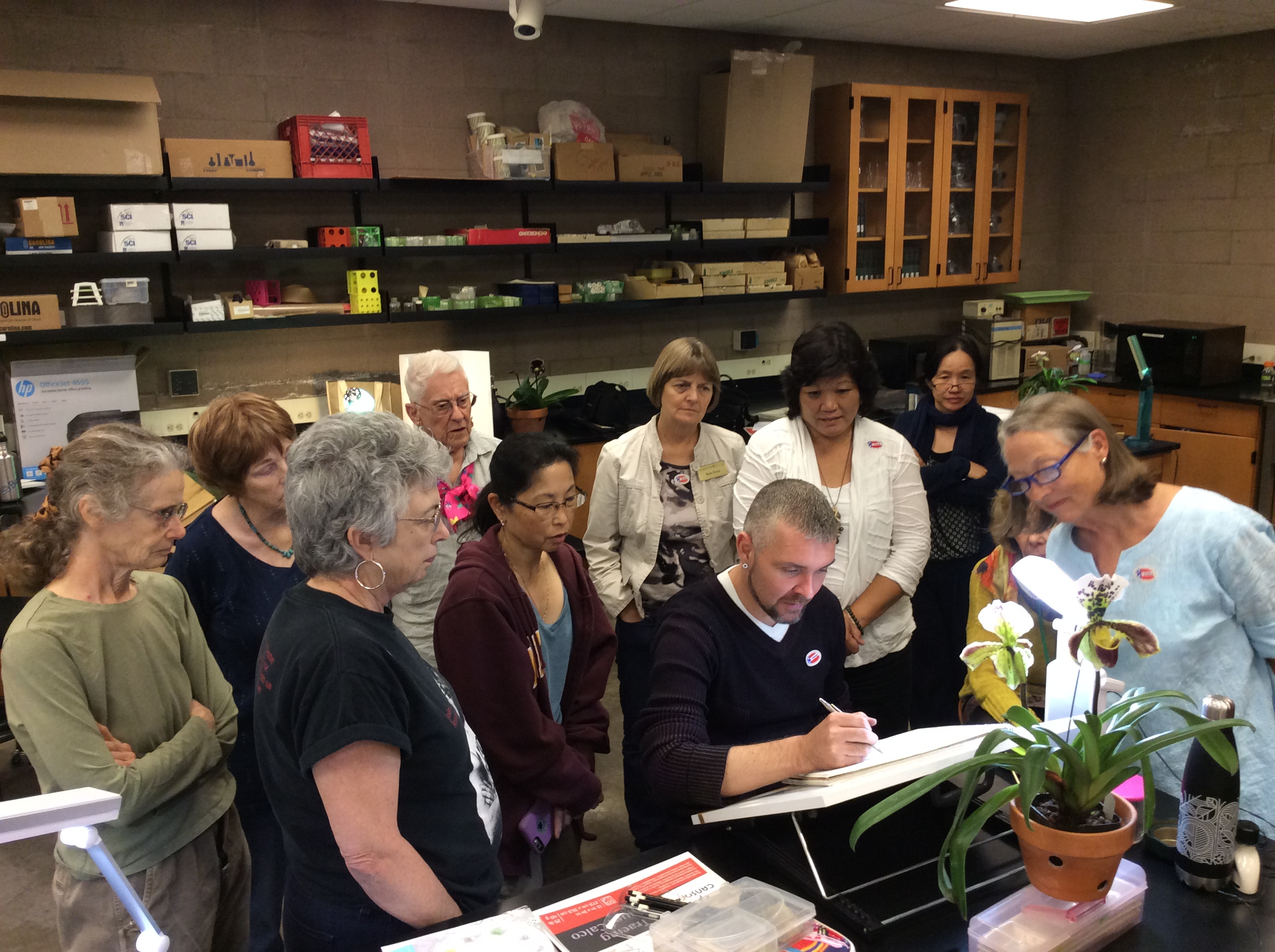
John Pastoriza-Piñol demonstrating to class participants. Photo by Melanie Campbell-Carter, © 2016.
The students coordinated a “paint share” for John’s materials list, courtesy of BAGSC member/artist Beth Stone. As an unexpected bonus, Robert Hori of The Huntington graciously shared several prints from the Estate of Rory McEwen with the class. BAGSC member/artist Mitsuko Schultz shared several books, including the new publication, Flora Japonica, from the current exhibition at the Shirley Sherwood Gallery at the Kew Gardens, which she attended two months ago.
John is currently enjoying an extended stay in the US on a grant from the Australian Arts Council, and will be in New York City through the end of the year in an association with the Horticultural Society of New York. Seeing the American national election process through his eyes was an interesting experience! We are gratified that he so enjoyed his time at The Huntington that he expressed a heartfelt wish to return soon.

A few of the participants in John’s class. (L to R:) Teri Kuwahara, Gilly Shaeffer, Jude Wiesenfeld, John Pastoriza-Piñol, Gayle Uyehara, Sydney Tanner, Cynthia Jackson, Leslie Walker, and Kat Powell. Photo by Melanie Campbell-Carter, © 2016.
by Jude Wiesenfeld and Deb Shaw

Kathie Miranda, Strelitzia spp., Bird of Paradise, colored pencil on film. © 2016.
Kathie Miranda had been slated to give a workshop at the Weird, Wild & Wonderful Symposium at The Huntington, but unfortunately couldn’t make it due to a sudden family emergency. BAGSC is pleased to announce that Kathie will be coming to Southern California to teach Colored Pencil on Film at the Los Angeles County Arboretum and Botanic Garden in January, 2017:
Tuesday, January 24 – Thursday, January 26, 2017
9:30 am – 3:30 pm each day
Los Angeles County Arboretum and Botanic Garden, Bamboo Room and Oak Room
Maximum Registration: 16 students
Cost, BAGSC Members: $300
Non-Members: $330
BAGSC Special Discount: receive 10% off
BAGSC is offering a special discount for Kathie’s workshop:
- New BAGSC members receive a 10% discount for a total cost of $270
- Current BAGSC members registering for the workshop BEFORE December 12, 2016 receive a 10% discount for a total cost of $270
Mylar is a wonderful media for colored pencil, and allows the artist to work on both sides of the film. Visit the new BAGSC website to view the full workshop description, costs, directions, and information, and to download a PDF materials list: http://bagsc.org/index.php/classes/kathie-miranda
Kathie’s Weird, Wild & Wonderful Symposium workshop filled immediately, so don’t delay on this opportunity to learn Kathie’s techniques and to receive a substantial discount!
About the Instructor
Kathie Miranda is an award-winning artist, juror and educator of botanical art. She teaches at The Art Students League, NYC and the New York Botanical Garden. She is an active member of the Connecticut Watercolor Society and the Colored Pencil Society of America.
by Cordelia Donnelly, posted by Deb Shaw
On June 4, 2016, BAGSC members had the wonderful opportunity to tour Cordelia’s garden, home and view her artwork. It was an enlightening meeting, and one that has generated a lot of discussion about our connections to place and garden, water conservation, design and aesthetics. Pacific Horticulture magazine published an article by Cordelia in their fall, 2016 issue, entitled, “My Horticultural Odyssey: An interdisciplinary approach to designing my garden“. This link goes to the full article, with images of the garden (a few of which are reproduced below).
Cordelia wrote the following for BAGSC News publication. Thank you for your work and inspiration! —Deb Shaw

Standing stones in the completed front garden are reclaimed Kansas fence posts, pieces of ancient ocean limestone bed, used to mark farm boundaries in a prairie ecosystem lacking trees. Photo © 2016, Cordelia Donnelly.
Water scarcity is shifting the paradigm of how to live and garden in Southern California. I completed my first garden renovation in San Marino in 2011 in order to close the building permit for a 1926 Spanish house renovation on a plot of land measuring 57 by 119 feet. A childhood of extensive blue water sailing across the South Pacific with my family prepared me well for these land-based adventures in engineering, science, law, code compliance, community design review, culture, horticulture, garden aesthetics, craftsmanship, and storytelling. Water was finite onboard our boat, and this set the stage for my interest in water conservation, reclamation and recycling. My garden teaches continuously and its story is still unfolding to my wonderment, to 1,200 visitors and counting.
I was educated in liberal arts in the true sense: fine art, applied design, education, ecology, land and water management, and writing. Work in these fields helped me recognize the potential significance of this interdisciplinary garden voyage. It is said that writing is thinking. Now I have learned very well that gardening is thinking. My garden design involved ideas about craftsmanship, where form follows function. I prioritized this garden design around water use, including capturing and redirecting water, and gradually practicing deep and infrequent watering as plants’ root systems get established. A site condition, such as the pronounced slope in the front yard, lends itself very well to growing Proteas and Banksias.
The chemistry of water enables life. Life in its diversity has adapted on Earth to different states and forms of water. Yet, we live in a remarkable age of science when it is theorized with high probability that the most common form of precipitation in our universe does not exist as water, but as diamonds, raining down on planets such as Saturn and Jupiter. While concepts of valence, polarity, surface tension, and cohesion describe atomic and molecular attributes of water, they also describe the human condition. We are One—with Water!
Plants, cyanobacteria, and algae, too, have special relationships with not only water, but also with light and darkness, in oxygenic processes to manufacture chemical energy. Science has discerned how these organisms have customized their methods of photosynthesis, for example, to explain why Agaves using CAM (Crassulacean Acid Metabolism) reactions are so well adapted to desert climates. To give an idea of the atmospheric scale significance of oxygenic processes, it is estimated that if such oxygen-giving processes by these life forms were to halt, the oxygen in Earth’s atmosphere might run out in a few thousand years. Discoveries are unfolding about significant anoxygenic processes found in various bacteria, which rely on chemical conversions in water, without sunlight but with other kinds of radiation, since the visible spectrum is only one type of light. The diversity and virtuosity of these mechanisms suggest that other planets in our universe may indeed contain very strong forms of Life.
Recently, Dr. Dianne Newman at Caltech has discovered, in the new field of molecular geomicrobiology she created, that bacteria in ocean sediments photosynthesize using iron instead of water. It is appropriate to be awed by intricacies of today’s science, which are uncovering some of the most ancient survival mechanisms on Earth, and spurring innovations in medicine by attending to how natural systems work. Furthermore, she has applied geoscience to solving a problem of chronic medical infections in humans. Dr. Newman has found that in a chronic infection such as cystic fibrosis, Pseudomonas aeruginosa (a long studied bacterium) produces pherazines which promote biofilm development in the lungs, inhibiting pathways for antibiotics to clear such infections. Logically understanding that the growth of P. aeruginosa is controlled in nature by a natural mechanism, she then searched for and found both P. aeruginosa and a coevolved bacterium, just in the soil outside her lab! This coevolved bacterium produces an enzyme which is able to degrade pherazines produced by P. aeruginosa, thereby rendering a chronic infection by P. aeruginosa more treatable by antibiotics. Human therapies for chronic infections based on her research will be available in a decade! It is time to bring our awe back to our gardens and to think of native plants as forms of technology—which are already adapted for our current climate conditions.
This garden project required extensive research. Attending a course taught by Lili Singer at Theodore Payne convinced me to rip out the conventional grass lawn as a first step. Ruth Shellhorn’s climate appropriate landscape design in 1982 for my parents’ home had also influenced my thinking about the potential for this garden project. My mother gave me Thomas Church’s Your Private World. San Marino’s Planning Department supported my renovation ideas, for which I am grateful. Government entities play a primary role in implementing sustainability, and California has made major changes to its Building Codes, which will soon become much stricter. But tensions certainly exist because of the need for change, and certain laws soon may apply sustainability mandates to all homeowners, not just to those renovations and new construction.

Antique wrought iron gates and several cloud form cast metal panels from a disassembled Chinese pavilion in Bel Air were found on Craigslist and repurposed in the finished landscape as gates and wall pieces. Photo © 2016, Cordelia Donnelly.
My project demonstrated to San Marino how garden beauty can be created using concepts of sustainability. I did not pour cement in the front yard garden because cemented hardscape is viewed as unsustainable—and thus also avoided design review. Concrete for my house renovation was poured only where required by Building Codes. As a foundation for steps leading into the garden from the street, green-treated wood beams are skewered into the slope by steel rods, a method used for building steps on hiking trails in US National Parks. The next layers use Stabiligrid tile, clad with copper as the riser material, hardwood planks for treads, finished by quartzite pavers set in sand. A liquid acrylic polymer was used to harden the sand while also providing permeability.
In the spirit of sustainable recycling, I tried where possible to reclaim assorted left-over or salvaged materials from craigslist to use in this project. The antique terra cotta riser tiles in the backyard are from France, by way of a tile setter who had completed a project in Malibu, and advertised his extra tiles on craigslist. Luckily, I also bought a pair of antique wrought iron Chinese gates and several Chinese cloud form cast metal panels, from a contractor who had disassembled a Chinese pavilion in Bel Air and listed these materials on craigslist.
I felt a solidarity with my Chinese neighbors, who supported me from the very beginning. I decided to align my aesthetic values for this project to honor the rich heritage of Chinese gardening. Chinese landscape design’s majestic history brings together Confucian, Daoist, and Buddhist influences. The spiritual depth appeals as much as the aesthetics, and the interdisciplinary wisdom thrills. This path of mastery involves concurrent mastery of poetry, calligraphy, and landscape painting—understanding the influences each of these disciplines has on the others, thus making a garden a living vignette of nature’s lyrical beauty. I fell in love with the idea of views in a Chinese garden unfurling gradually to the viewer, much like the scrolls of a Chinese landscape painting. The viewer takes a journey through such a garden in order to enjoy the different vantage points.
One of my goals in renovating the house was to make the house relate directly to the garden, and this new relationship can be enjoyed through a series of large windows, including the very large arched window in the living room, and three different sets of glass sliding doors looking out onto different garden views. As the sun travels throughout the day, the house itself becomes the garden sundial. I intuitively planned my garden design for the passage of light across the various spaces, influenced by my years of landscape painting. I sought consciously to unify the values of the green colors of plants in order to allow texture and temperature to operate to the eye—this is a strategic lesson from painting applied to gardening.
Another major influence on my thinking was the Mediterranean Garden Society/Pacific Horticulture 2010 Symposium at the Los Angeles Arboretum. This Symposium’s speakers, the local garden tours, the gorgeous Australian plants grown by Jo O’Connell, and conversations with people about gardens changed my life, within the already transformative context of researching Chinese gardens. These experiences convinced me to install drip irrigation for the entire garden. “Woolly Pockets” I saw at the Symposium helped me create vertical gardens on walls and balconies, and further online searches led me to “Smart Pots,” made of recycled plastic bottles, to use as larger containers. I decided to use Australian native plants for my garden upon seeing their poetic textures, remembering them from my childhood, recognizing their symbolic otherness, and their significance to plant evolution and the geologic history of our planet. These plants evoke ideas held in the Dreamtime: origin stories of creation, ancestral voices, relationships between humans and nature, and spiritual quests toward Oneness.
A dry stream bed, using native granite rocks rescued from the basement excavation, invokes the memory of water in this native landscape. Inspired by Jeffrey Bale’s colored pebbles, I used polished coral pebbles in the bottom of the stream bed as a color contrast to the pea gravel on the garden paths. When it rains, the dry stream becomes very colorful. I planned the stream bed to cross the front garden approach, in an informal X, as in X marks the spot on a treasure map. Here, too, is the satisfying idea that one must cross over the stream on the journey to the front door. This spring I was very pleased to take my mom on a driving tour to see eight neighboring gardens installed since I completed this one, in which the homeowners chose a similar theme of dry stream bed crossing the front path approach in an informal X. As an artist and designer, I think asymmetry plays a very important role in leading one’s eye through a composition, whether in a painting or in a garden. The front garden was made more mountainous by adding soil to match the slope of the neighbor’s garden, as allowed by the Grading and Drainage Permit. The aim was to create a relationship between mountain and water, and to honor the spiritual significance of this relationship as articulated by Confucius. Another practical goal was to raise the soil level because hedge height can be measured from the higher soil level, and furthermore, because specimen plants can be grown here without a height limit to cushion the front yard garden from the busy street.
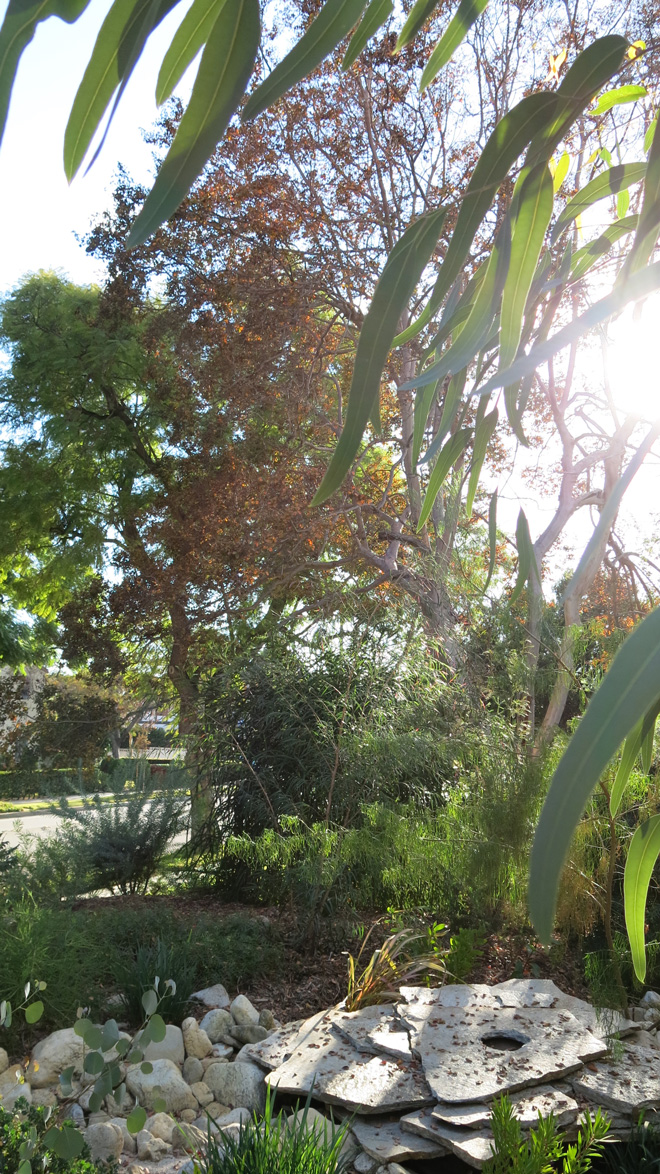
A sound sculpture in the front garden activates with rain. Water is harvested from gutters on the house and garage and pumped into the sculpture before draining through a perforated drainage grid. Photo © 2016, Cordelia Donnelly.
An integrated drainage system, the first of its kind to be permitted in my city, orders this garden universe. My sister gave me Brad Lancaster’s Rainwater Harvesting for Drylands and Beyond, which I used to do the engineering to secure a Grading and Drainage Permit. This plot of land is blessed with incredibly advantageous riverine geology, once part of extensive orange groves, and a slope of 4-1/2 feet from the backyard to the front yard. She encouraged me to add a unique water feature to the drainage system, and reaching beyond exhaustion, I resolved to think carefully about this. So, I designed a “sound sculpture” in the dry stream bed. Rainwater flows passively from house and garage gutters, collects in an underground basin and is pumped up into the sound sculpture. Sufficient rain creates the sound of rushing water in the sound sculpture. Then this water drains passively underneath the entire front garden through a perforated drainage grid. A key feature of the sound sculpture is that it only works when it is raining. Another aspect of its design was to stack a series of quartzite flagstones on top of the sound sculpture basin, to create a Goldsworthy-like nest form in order to hide the brownish rain gutter water from view.

Permeable gravel surfaces finished with StabiliGrid tiles hold gravel in place and provide ADA-compliant wheelchair accessibility for the driveway and garden. Photo © 2016, Cordelia Donnelly.
The permeable gravel driveway was finished with Stabiligrid tiles to hold the gravel in place. The Stabiligrid tiles filled with gravel also give the driveway and garden ADA-compliant wheelchair accessibility. Indeed, less concrete used in my whole garden renovation allows greater permeability: there is no runoff from the property. An outdoor soaking tub stands dry and covered, relies on zero chemicals, and is tied into the drainage system. A backyard pond is designed with an herbaceous border and contains chemically treated water. This pond drains itself separately from the drainage system, and is designed to drain passively into a deep french drain. Integrated drainage systems have been built since ancient times across diverse civilizations, and at different levels of complexity and cost. Even if we are not building drainage for an extensive palace, such as that found at Knossos on Crete, and at Machu Picchu in Peru, we need to do whatever we can to save water. These ideas are ancient, but feel new to our suburban gardening culture.
Recently, I installed an Australian-designed, gravity-fed, gray water drip system. I specified an Aqua2Use gravity filter with IrriGray drip components, which is distributed by WaterRenu.com in the USA. My system satisfies CA Building Codes and involves no modification of existing plumbing. It allows upstairs bathtubs to drain into the garden, via manual siphon into heat-proof Pex pipe going through the exterior wall. This drainage into my garden is encouraged provided that only low-sodium, pH neutral, bio-degradable soap is used (Dr. Bronner’s). To avoiding over-watering with supplementary water, this system sends water to general front garden beds, instead of to specific plants, and serves the major purpose of allowing this water to infiltrate back into the land.
Reflecting upon this garden odyssey, these journeys within journeys, I realize I have honored not only great cultural and aesthetic traditions, but also those of my ancestors. My great grandfather and grandfather developed diverse industrial uses of diatomaceous earth, an ingredient in the cactus mix I use for planting. I also have honored my parents: my mother, a teacher, and my father, a builder-developer in Pasadena, California. This garden honors a growing global awareness about the need for sustainable water use and climate appropriate plants in every garden.
It is a miracle to witness how beauty transforms awareness, invites conversation, and inspires!
NOTE: BAGSC News previously published a plant list from Cordelia’s beautiful garden. Click on the words “plant list” in the previous sentence to view it, along with some pictures from the tour.
by Asuka Hishiki, posted by Deb Shaw
Flora Japonica opened mid-September, 2016 at the Royal Botanic Gardens, Kew, in London. Before the opening, I personally felt very overwhelmed and was worried about how we would be received. It turned out GREAT! The people at the Kew were so nice and friendly. When Dr. Shirley Sherwood congratulated us at the opening speech, I felt so honored to be a part of the celebrated show.
There is so much to tell about the exhibition. There are, however, so many good writings about the show already available. Instead of summarizing those good reads, I thought I would make a list of the links for you to visit. Meanwhile, I would love to share my thoughts on several specific artworks. This are just my opinions and maybe rather boring ones at that, but I hope you enjoy walking with me through the show.
I have mentioned that these are just my opinions. Keep in mind, my bold statement is this: I think that most Japanese endemic plants are rather unflattering. Meaning that they are not obviously gorgeous like roses, tulips or tropical plants. Maybe this is the case not only with Japanese native plants; perhaps many endemic plants appear very humble looking. Well, really? It could be because these plants are not looked at properly.
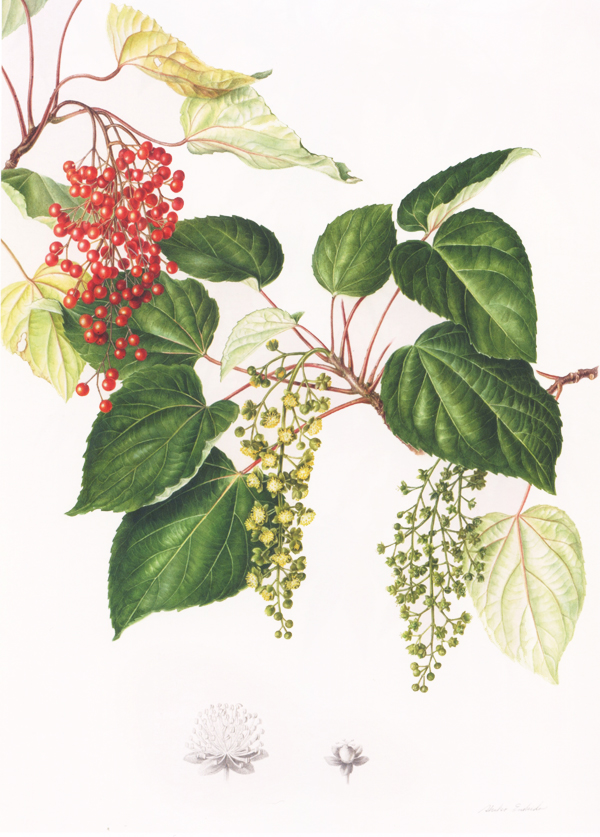
Idesia polycarpa, watercolor on paper, © 2016, Akiko Enokido.
Take a look at the watercolor Idesia polycarpa by Akiko Enokido. I think the actual plant (not her painting!) is very modest looking. Its male and female flowers are especially small and plain. However, if you look at it up-close as Akiko did, it is obvious that the flower clusters are very gorgeous! Akiko successfully converted the modest look of the plant into a dynamic figure using her vivid and strong color. The beauty is sometimes there in front of us, but it doesn’t reveal itself until we open our eyes properly. I think as artists we have the wonderful power to help open the secret door, clearing the smoke that hides nature’s beauty.
Speaking of color, I thought many of the artists’ subjects held a very clean but pastel color. I wondered how they achieved their shades. On first look, I thought perhaps the artwork was done in color pencil, but no, it was watercolor. In some parts, I saw tiny, tiny brush strokes. Instead of washing those stitches out, the artists kept them, floating them onto white paper, like a Georges Seurat painting. I couldn’t get an answer about this technique from my fellow artists, so I will tell you when I find out.
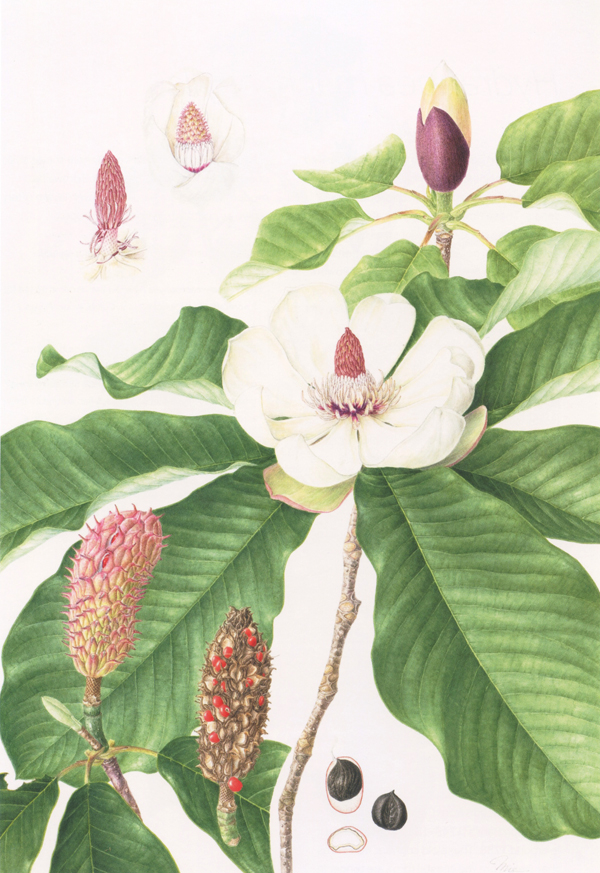
Magnolia obovata, watercolor on paper, © 2016, Mieko Konishi.
You may have the same question I have: how to portray something huge like a whole tree, or a plant like Magnolia obovata, which has leaves that grow up to 45 cm long and 25 cm wide? Two fantastic artists had the answers for me in this show.
The way Mieko Konishi portrayed Magnolia obovata was awesome! She positioned a main flower right up the center, and from it huge leaves spread in all directions. The leaves are cropped off in the middle. Only the two front leaves show almost the complete leaf shape, but even these leaves are cropped off at the tips. This is a huge painting already, but Mieko uses cropping and composition to indicate that the plant is too big to fit the paper. Her image reminded me the surprise I had when I picked up a Magnolia obovata leaf from the ground. I knew it was big, but seeing the actual leaf and holding it gave me additional amazement.
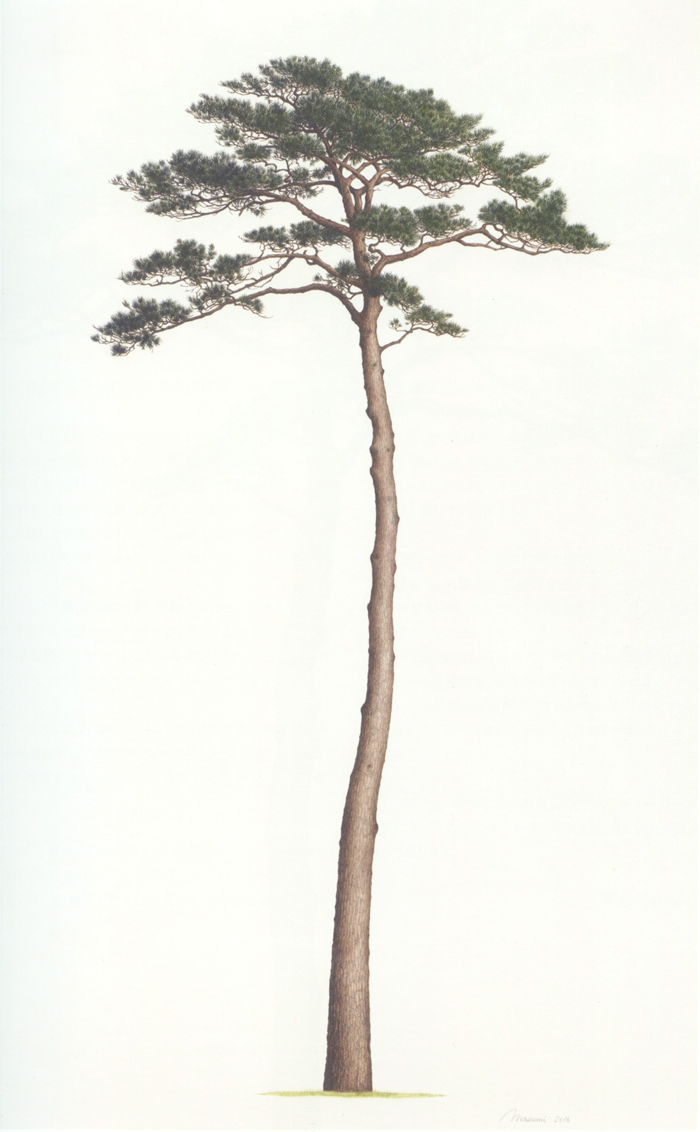
Pinus x densithunbergii, watercolor on paper, © 2016, Masumi Yamanaka.
The other example is done by Masumi Yamanaka. Unfortunately, I couldn’t see her Pinus x densithunbergii in person. It was planed to be exhibited at the Japanese embassy in London a few weeks after I visited. This tree is known as the “Miracle Pine”, which survived the devastating tsunami that accompanied the Great East Japan Earthquake in March 2011 and somehow remained standing, even though the entire 70,000-tree pine forest along the beach was uprooted.
I had a privilege, however, to visit her studio in Kew Garden where she works with other official botanical illustrators of Kew. I could go on and on about the visit, but I would like to go back to her tree painting. I wondered how she created the tree painting without the actual tree in front of her. I watched her short documentary about the painting. Yes, she had many many references of the tree. Yes, she visited the actual tree and made the color samples at the site. But if she had had only those references, the tree would not be portrayed as accurately as it is in her artwork. What her painting contains is her experience and knowledge as a botanical illustrator. She has studied hundreds and thousands of plants with her keen observation and has painted them. This wisdom is laid on underneath the image.
I think the time we spend on a painting is not only spent on that specific artwork, but the knowledge we gain remains and accumulates in us as wisdom.
When I walked in the Kew garden and bumped into one of the trees Yamanaka had portrayed, I had a warm sensation as if I had just run into someone I knew.
Lastly, I couldn’t pass up telling you about what I do not know how to explain. Confusing, yes.
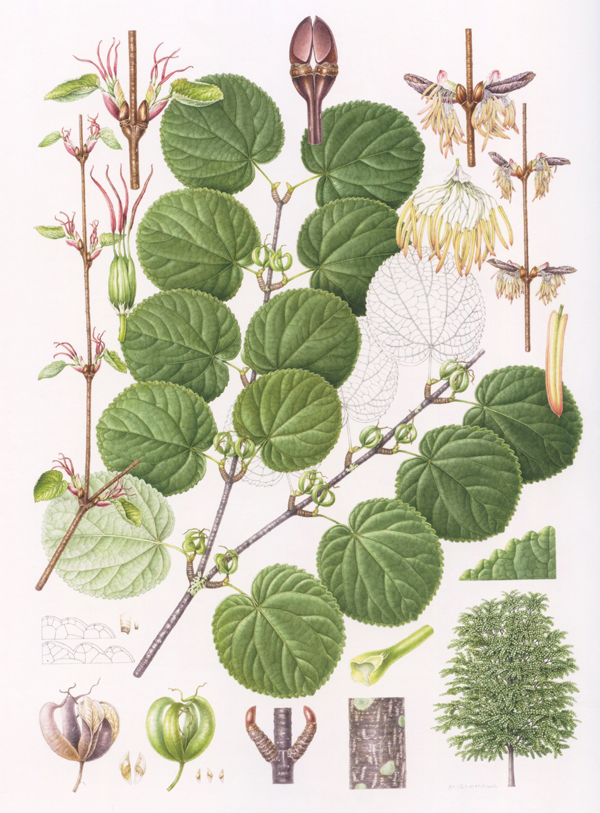
Cercidiphyllum magnificum, watercolor on paper, © 2016, Mieko Ishikawa.
I just had a “wow” when I saw Mieko Ishikawa’s Cercidiphyllum magnificum. The plant itself is again, very humble looking at first glance. Yet it grabbed my attention immediately. What captured me the most is the perfection of the drawing, The leaves look soft and slightly rounded, and the male and female flowers are delicate, yet lively. It is extremely realistic, yet informative. Even though she includes many details in various sizes and different angles, everything fits fantastically into one frame. In her illustration, I think that Art and Science meets in a precise middle point and keep a golden balance. Well, to be honest with you, I have no background nor knowledge of the science of botany, so I may have no idea what I am talking about. There are just so many things in this one painting to gaze at, to be amazed by, to learn, and questions to pose and think about.
“Good artists copy; great artists steal.” This is a famous quote by Picasso. I simply wish he also told us how to steal it.
The Flora Japonica exhibition is open from 17 September 2016 to 5 March 2017, 10 am to 5:30 pm in the Shirley Sherwood Gallery of Botanical Art at the Royal Botanic Garden, Kew, London, UK. Price is included with entry to the Gardens.
This exhibition includes about one hundred Japanese wild, native, endemic plants, portrayed by 36 of the most eminent contemporary Japanese botanical artists. The exhibition also features historic drawings and paintings by some of Japan’s most revered botanists and artists such as Dr. Tomitaro Makino (1863-1957), Sessai Hattori and Chikusai Kato (Edo period artists 1603-1868).
Additionally, works from Kew’s Illustration and Economic Botany collections also are on display, including an early Japanese botanical illustration, Honzō Zufu by Kanen Iwasaki (1786–1842), an illustrated encyclopaedia of medicinal plants from 1828, and Japanese wood panels by Chikusai Kato (1878), which are made from the wood and framed with the bark of the trees that they depict.
Royal Botanic Gardens, Kew is located at: Kew, Richmond TW9 3AB, United Kingdom, +44 20 8332 5655.
Find information about Flora Japonica on Kew’s website.
Two press releases about the exhibition can be found here, and here.
Purchase the Flora Japonica catalogue.
Read the DAIWA Foundation article about the exhibition.
Read about the Flora Japonica exhibition on Asuka’s website and view Asuka’s artworks and exhibitions.
by Deb Shaw

Aristolochia gigantea, ink on paper, Lesley Randall, © 2013, all rights reserved
The 14th International Exhibition of Botanical Art and Illustration by The Hunt Institute for Botanical Documentation has been traveling around the United States for the past two years. Its final stop is at the Petaluma Arts Center in Petaluma, California, for a botanical art exhibition entitled Floribunda, which will run from October 16, 2016 through December 11, 2016.
Floribunda is a celebration of all things floral, featuring the 36 artists from nine countries in The 14th Hunt exhibition, including BAGSC members Leslie Randall and Deborah Shaw. Additionally, the Petaluma Arts Center will feature the work of Aimee Baldwin, Evan Kolker and Randy Strong—three Bay Area artists who create three-dimensional representations of flowers.
“This exhibition is designed as a source of inspiration and an invitation to see the natural world around us in distinct ways, to illuminate the relationship between art and science,” explained Petaluma Arts Center Exhibitions Manager Kim Chigi. “With Botany as one of the sciences, we are excited about the juxtaposition of traditional botanical illustration with the contemporary three-dimensional creations, working in tandem, to explore the connections between the creativity of both artist and nature.”
The Petaluma Arts Center will host a series of events related to the exhibition, including artists’ talks, studio workshops, and botanical art demonstrations:
- Saturday, November 5: Botanical Art Demonstrations with BAGSC member Nina Antze, and Martha Kemp, Lucy Martin and Vi Strain, 1:00 pm, FREE
- Thursday, November 10: Artists’ Talk with Evan Kolker and Randy Strong, 7:00 pm; doors open at 6:30 pm.
- Sunday, November 12 -13: Watercolor Botanical Workshop with Amber Turner
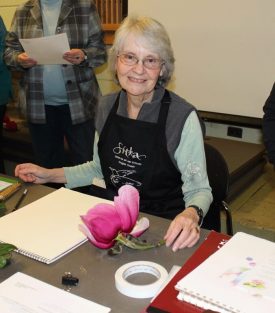
Nina Antze, Martha Kemp, Lucy Martin and Vi Strain, will demonstrate botanical art in a variety of media starting at 1:00 pm on Saturday, November 5, 2016. The demonstrations are free.
Details and ticket information can be found on the Events page on the Petaluma Arts Center’s website. To arrange for group visits or school tours, email or call Kim at (707) 762-5600 x104.
Following the 14th International Exhibition at the Hunt, the travel exhibition went to the Southern Alleghenies Museum of Art—Loretto and was on display from October 18 through December 6, 2014. The exhibition then traveled to the Fellows Riverside Gardens in Youngstown, Ohio where it was on display until January 10, 2016.
The Petaluma Arts Center is located in the historic train depot at 230 Lakeville St, Petaluma, California, 94952. Gallery Hours are: Thursday through Monday, 11 am-5 pm. The gallery is closed Tuesday, Wednesday and holidays.

Prosopis pubescens seed pod (Screwbean Mesquite, or Tornillo), watercolor and graphite on honey vellum, © 2012, Deborah Shaw, all rights reserved.
Admission to the Petaluma Arts Center is $5 for general admission and $4 for seniors. Students, teachers, military, and PAC members are free.
 BAGSC News