You are currently browsing the tag archive for the ‘art exhibition’ tag.
by Margaret Best
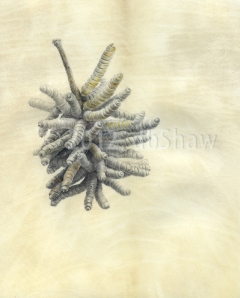
Prosopis pubescens seed pod (Screwbean Mesquite, or Tornillo), watercolor and graphite on honey vellum, © 2012, Deborah Shaw, all rights reserved.
It is with great pleasure that we share the wonderful news that BAGSC member Deborah Shaw has had one of her recent graphite and watercolour works on vellum accepted into the Hunt Institute’s International Exhibition in 2013.
About 11 years ago, shortly after I met Deborah at a class in Arizona, she showed me a graphite study of a white phalaenopsis orchid. Having enjoyed teaching and using graphite myself for a number of years, I recognized that Deborah had exceptional skills in this medium. I was struck by her mastery of perhaps the best continuous tone I had ever seen! The ultimate control required in the smoothest of value changes was evident throughout the piece. The work also displayed a keen awareness of the finest of edges and tiniest of details. Needless to say, I gushed about it and I clearly never forgot it.
Business and family commitments, as well as generosity of heart to fellow artists, have been obstacles to Deborah being able to focus fully on her own art. More recently she has managed to carve out time for her botanical art. She has begun exploration of a surface uniquely suited to her touch and intense awareness of texture – vellum. Vellum has brought it all together for Deborah. What has been so exciting to witness is how she has achieved a marriage of skills in a truly magical way on a surface that challenges even the most experienced artists.
Everybody is very proud of your well-deserved selection in the next Hunt Institute exhibition!
by Diane Daly and Clara Josephs, posted by Deb Shaw
January’s coming up fast, and the Chapman University Leatherby Library Drought Tolerant Plant Exhibition will be upon us (along with all the other exhibition opportunities we have stacked up for the month — but more on those later!).
Students from Jennifer Funk‘s Ecology course currently are writing descriptions of the plants’ drought-tolerant traits now. We are planning to have at least one species that fits into each of the following seven categories:
- Drought-deciduousness (plants that lose their leaves during the dry season, or during periods of dryness)
- Small leaves (better adapted to dry soils and conditions)
- Deep taproot (a tap root that penetrates deep into the ground can access water when it is scarce during a drought or dry conditions, as well as store water in the root)
- Succulent leaves (thick, fleshy leaves and stems can store water)
- Pubescent leaves (pubescent, or furry leaves can slow the air flowing over the leaf to reduce water evaporation, hold water, reflect sunlight, and provide shade for the surface of the leaf)
- Evergreen, sclerophylous leaves (evergreen leaves, of course, stay on the plant year-round; sclerophylous leaves have a hard surface and are frequently spaced close together
- Annual life habit (one way to avoid dry periods is to quickly grow, bloom and develop seeds during the wet season, skipping the dry season altogether!)
Important Deadlines:
- Artist entry deadline: January 11 (BAGSC needs the list for handouts, Chapman University needs the list for labels and insurance)
- Set up show in Henley reading room: January 25
- Reception: February 7 , 7-9 pm
- Take down the show: February 25
All BAGSC members will receive an email with the official BAGSC “Call for Entries” packet. If you do not receive this email with the attachment by 30 November, please contact Deb.
Drought Tolerant Plant Choices for the Chapman Exhibition
The following are plants that BAGSC members are planning to submit. Botanical and common names, of course, will need to be reviewed and verified. Don’t worry if you have to change your mind, or if you’re already painting something that someone else is painting on the list below. This is a preliminary list and is not set in cement. Space allowing, species duplicates will be accepted (see the Call for Entries packet).
Arillyn Moran-Lawrence:
Dudleya Farinosa; Salvia Chamaedroyides, Electric blue sage; Desert Marigold, Baileya multiradiata; Echeveria graptoveria or Kalanchoe thyrsiflora
Bonnie Ash:
Agave Utahensis var. nevadensis; Pacific Mist Manzanita, Arctostaphylos uva-ursi
Linda Ericksen:
Prickly pear cactus, Opuntia
Joan Keesey:
California Buckeye Flower, Aesculus californica; Flannel Bush, Fremontodendron; California Poppy Eschscholzia californica; Foothill Penstemon, Penstemon heterophyllus; or Heart Leaf Penstemon, Keckiella cordiforlia; Toyon, Heteromeles arbutifolia; Bush Monkey Flower, Mimulus aurantiacus
Patricia VanOsterhoudt:
Crape Myrtle, Lagerstroemai indica; Columbine Aquilegia; Yucca
Sue Kuuskmae:
Fortnight Lily Dietus vegeta; Rock Rose Kalanchoe; Toyonberry; Matilija poppy, Romneya coulteri
Estelle DeRidder:
Coastal Prickly Pear, Opuntia littoralis; Baja Fairy Duster, Dalliandra eriophylla; California Live Oak, Quercus agrifolia; Chia, Salvia Columbriae
Clara Josephs:
Coffeeberry, Rhamnus californica; Topsy Turvy, Echeveria; Bladderpod, Isomeris arborea
Diane Daly:
Island Alum Root, Heuchera maxima; Seaside Daisy, Erigeron glaucus; Bird of Paradise, Caesalpinia pulcherrima
Carmen Lindsay:
Bladder Sage; Ocotillo; Buckwheat
Veronica Raymond:
Coffeeberry, Rhamnus californica; Bladderpod, Isomeris arborea; Nevins Barberry, Mahonia nevinii; Englemann Oak Quercus engelmannii
Cristina Baltayian:
Lemon, C. limon; Bougainvillea; Fig, Ficus carica L. (Brown turkey); Olives, Olea europaea; Cabernet grape vitis vinfera L.; Pomegranate, Punica granatum
Mitsuko Shultz:
Nevins Barberry, Berberis nevinii; California Sycamore, Platanus racemosa
Patricia Mark:
Manfreda masculosa; Aeonium
Deborah Shaw:
Dudleya pulverulenta, Chalk Dudleya; Dudleya viscida, Sticky Dudleya; Arctostaphylos glauca, Big Berry Manzanita
Add your name and plants to the list: contact Diane.
It’s shaping up to be a great show!!!
by Leslie Walker, posted by Deb Shaw
Here is another show opportunity for BAGSC members. Descanso Gardens has asked us to exhibit paintings of Wild Flowers from January through March — exact dates to come later.
Paintings for the exhibition must be originals, framed and matted, and can have been shown elsewhere.
Contact Leslie with information regarding which wild flowers you would like to exhibit, and how many paintings you might have for this show as soon as possible.
More information will be passed on to you as it is received.
by Diane Daly, posted by Deb Shaw
Finally, we have the dates for our Chapman show on drought tolerant plants. We will have the Leatherby Library Henley Reading Room and the Clarke wall just like we used in the Brush with Nature exhibit.
We will set up and hang the exhibit on January 25, 2013. We will have an evening reception on February 7, and we will take down the paintings on February 25.
The botanist, Jennifer Funk will have her students write descriptions of drought tolerant plant groups with explanations of how the plants retain moisture and survive the heat.
Reminder, all paintings should be framed in the Dick Blick bamboo frame, white mat, and plexiglass. Use the same label on the back as we do for other exhibits. All members can submit up to four paintings. Paintings can be delivered to Diane Daly’s house the week before Jan 25 or brought to Chapman on that date at 10 am to be hung.
More details will be coming. Questions? Contact Diane Daly or Clara Josephs.
A plant selections list follows below. This list is just a “ working list” to let everyone know what other artists are working on. We hope this will inspire other members to paint for this exhibit. Don’t worry if you’re interested in painting something that is already listed below. Duplicates are not automatically excluded. Feel free to add, delete or change, depending on how your paintings are going. Let Diane Daly know. We’ll continue to publish updated lists.
Arillyn Moran-Lawrence
Dudleya Farinosa
Salvia Chamaedroyides, Electric blue sage
Desert Marigold, Baileya multiradiata
Echeveria graptoveria or Kalanchoe thyrsiflora
Bonnie Ash
Agave Utahensis var. nevadensis
Pacific Mist Manzanita Arctostaphylos uva-ursi
Linda Ericksen
Prickly pear cactus, Opuntia
Joan Keesey
California Buckeye Flower, Aesculus californica
Flannel Bush Fremontodendron
California Poppy Eschscholzia californica
Foothill Penstemon Penstemon heterophyllus
Or
Heart Leaf Penstemon Keckiella cordiforlia
Toyon Heteromeles arbutifolia
Bush Monkey Flower Mimulus aurantiacus
Patricia VanOsterhoudt
Crape Myrtle, Lagerstroemai indica
Columbine Aquilegia
Mountain Phlox
Yucca (another view)
Sue Kuuskmae
Fortnight Lily, Dietus vegeta
Rock Rose, Kalanchoe
Toyonberry
Matilija poppy, Romneya coulteri
Estelle DeRidder
Coastal Prickly Pear, Opuntia littoralis
Baja Fairy Duster, Dalliandra eriophylla
California Live Oak, Quercus agrifolia
Chia Salvia, Columbriae
Clara Josephs
Coffeeberry, Rhamnus californica
Diane Daly
Island Alum Root, Heuchera maxima
Seaside Daisy Erigeron glaucus
Carmen Lindsay
Bladder Sage
Ocotillo
Buckwheat
Veronica Raymond
Coffeeberry, Rhamnus californica
Bladderpod, Isomeris arborea
Nevins Barberry, Mahonia nevinii
Englemann Oak Quercus engelmannii
Deborah Shaw
Fuschia Flowered Gooseberry, Ribes speciosum
Blue-eyed Grass, Sisyrinchium bellum
Chalk Dudleya, Dudleya pulverulenta
White sage, Salvia apiana
Mitsuko Schultz
Nevin’s Barberry, Berberis nevinii
California Sycamore, Platanus racemosa
by Akiko Enokido, posted by Deb Shaw

Mieko Ishikawa with her watercolor, “Amorphophallus titanum”. © 2012, all rights reserved.
I was lucky to be able to attend the exhibition of Mieko Ishikawa’s work, 9/1 to 9/9/2012 at Keio Plaza Hotel, Shinjuku, Tokyo. Approximately 60 pieces of her work from the past ten years were exhibited. Included in the exhibits were the cherry blossoms series that received the gold medal at RHS, the plants of Borneo, and Conifers.
On the weekend, Mieko had a special event with lectures and photos from her trip to Borneo. From her fascinating lectures, we learned how she found and sketched the plants in the wild rain forest.
Her most recent work is this huge flowering plant Amorphophallus titanum. This originally grows in the rainforests of western Sumatra, Indonesia. The bloom normally reaches up to 8 to 9 ft tall there.
Mieko drew this particular piece at Koishikawa, Botanical Gardens, Graduate School of Science, the University of Tokyo. Since the one there was only about 6ft tall, she decided to paint it in its actual size. The flower died in two to three days. While she was sketching it, she couldn’t help but notice the terrible smell of the blooming plant. When I visited her studio last March, she was working on 6.5 x 3.2 ft stretched Arches paper. The final work was so beautiful it was hard to imagine that it could give out a terrible odor as she described.

Mieko Ishikawa presentation about painting the plants in the wild rain forest of Borneo.
Mieko has visited Borneo more than ten times. In the rainforest, you can’t take any specimens to confirm the specific plant species. But she became good friends with the guide, and one day he gave her one dead pitcher with a plant. And another time, when the director of the national park gifted her a huge acorn from the herbarium, she trembled with joy as if she was presented with a diamond.
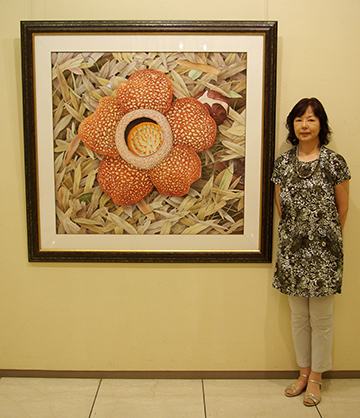
Mieko Ishikawa with painting at Exhibition at Keio Plaza Hotel, Shinjuku, Tokyo.
We generally are not able to go to the rain-forest; we just have knowledge through photos and videos. The plants in Mieko’s works are drawn actual size and look so lively, it makes you feel as if they are going to move right in front of your eyes. She also taught botanical painting to the people who work at the national park, but the papers were so moistened due to wet weather. She said it was extremely difficult to paint. Mieko hopes that botanical art will spread throughout their country. Her works are valuable records of the precious species in Malaysia. Mieko wants to be even more active in drawing Borneo plants, presenting their ecology and fascinating morphology in order to protect the nature in Borneo for many more years to come.
by Deb Shaw
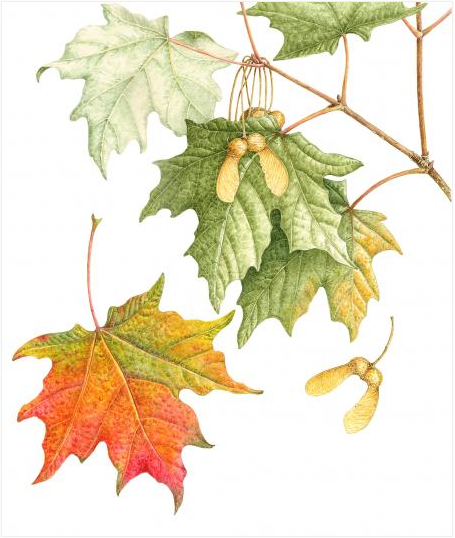
Acer saccharum, Sugar Maple, by Margaret Best, watercolor on paper, © 2012, all rights reserved.
BAGSC members Margaret Best and Akiko Enokido were selected to exhibit in the 15th Annual International exhibition for the American Society of Botanical Artists at The Horticultural Society of New York. The show is comprised of forty-three artworks by thirty-nine different artists from the US, Australia, Brazil, Canada, Japan and the UK.
Jurors Patricia Jonas, Kathie Miranda and Derek Norman had the difficult task of selecting from 192 entries. The artwork in the show can be viewed in the exhibition section on the new ASBA website. Be sure to read interviews with Margaret and Akiko about their work in the show on the website as well.
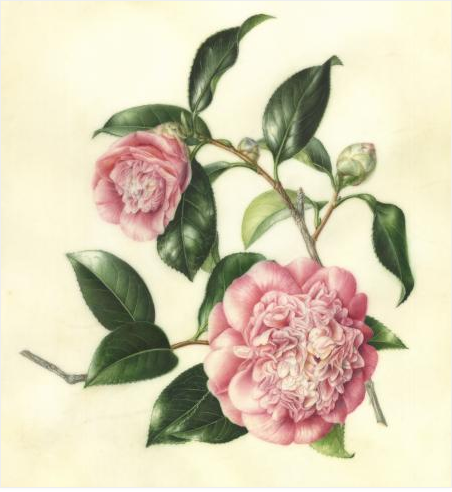
Camellia japonica ‘Chandleri Elegans’, Variegated Camellia, by Akiko Enokido, watercolor on vellum, © 2012, all rights reserved.
Want a catalog of the exhibition? Order from ArtPlantae for $20.
The exhibition will be on display from September 14 – November 21, 2012 at The Horticultural Society of New York, 148 W. 37th Street, 13th Floor, New York, New York, 10018. Gallery hours are Monday – Friday, 10 am to 6 pm.
Congratulations to all!
by Suzanne Kuuskmae, posted by Deb Shaw

Sala Tree Flower, by Suzanne Kuuskmae,

- Iris, by Suzanne Kuuskmae, © 2012 all rights reserved

© 2012 all rights reserved
Two botanical paintings by Suzanne Kuuskmae, Iris, and Sala Tree Flower, were selected for the upcoming Exhibition at the Palos Verdes Art Center at the Peninsula Center, Silver Spur Drive, Palos Verdes. The Gallery is open every day from 9:30 to 4:00 p.m. Selections were made for the Small Treasures Show at the same address and I was thrilled to see that yet another botanical of Hibiscus showing various parts of the flower was selected along with a pastel landscape of Lake Bled, Slovenia. If you get a chance, come on up to see this show that has drawn from a very varied array of art pieces. The reception was held Friday, August 31, from 6 – 8.
by Clara Josephs, posted by Deb Shaw
As we firm up the dates for the Chapman show, now is the time for you to make final decisions about which plants you will portray.
Please email Diane with the names of your selections. As we receive names of plants, the list will be posted monthly on the blog. By checking the blog list, you can make informed decisions as you progress with your paintings for the show.
Several people have asked about duplicate subject matter. We don’t expect a problem with that issue. At the first Chapman show we reserved the right to exclude duplicate subjects if we had too many paintings for the available display space. We had no problem displaying 70 + paintings and probably could have displayed more. This would be our policy again, but this time we would refer to our “Intent” list and give preference to the earliest declarer.
As you know, the exhibit is not only about the plants, but about the artistry in presenting the plant. Certainly, several artists can successful portray the same plant in dramatically different compositions. So don’t let the fact that another artist has declared for a plant stop you from painting a subject you are passionate about. But, do be aware that there is a small chance that if space is tight, some duplicates could be excluded
We hope to announce the exhibit dates very soon. Email Diane as you make your choices. We expect to be able to hang four paintings per member.
by Clara Josephs and Deb Shaw
Many BAGSC members have been asking about where they can find information about drought-tolerant plants. You can find a lot of information about drought tolerant plants on the web. Here is a section from the Wikipedia entry I was directed to after googling “lemonade berry”:
Rhus integrifolia, the Lemonade Berry’s leaves are simple (unusual in a genus where most species are trifoliate), alternating, evergreen and leathery, ranging from two to four centimeters wide on reddish twigs; length of leaves is five to seven centimeters. Leaves are toothed with a waxy appearance above and a paler tone below. The flowers which appear from February to May are small, clustered closely together, and may be either bisexual or pistillate.[1]
These fragrant flowers exhibit radial symmetry with five green sepals, five white to rosy-pink petals, and five stamens. The small flowers are only six millimeters across. The ovary is superior and usually has a single ovule; although in pistillate flowers, the stamens are small and infertile. The mature fruit of Rhus integrifolia is sticky, reddish, covered with hairs, and about seven to ten millimeters in diameter. The elliptical fruit presents tight clusters at the very ends of twigs.
Young plants manifest smooth reddish bark, while more mature individuals have cracked, even scaly, grayish bark with the smooth red bark displayed underneath. Twigs are rather stout and flexible, and reddish bud ends are diminutive and pointed. There is often a multi-furcate branching structure from the base of the plant. A mature plant is large and thicket-like with a sprawling arrangement.
Notice how many painting cues for color and structure are in that entry! It also tells me when it flowers. Very useful and free information! Next, if I hit “images” for lemonade berry – bingo – what a selection!
The following is a list of California Native plants and their drought-tolerant adaptive strategies, compiled for us by Jennifer Funk, Assistant Professor of Biological Sciences, School of Earth and Environmental Sciences, Schmid College of Science and Technology. Please keep in mind that the exhibition is open to any drought-tolerant plants from around the world, not just California natives! This list was handed out at a BAGSC Quarterly meeting earlier this year. Future articles on the blog will list characteristics of drought-tolerant plants.
Let us know your questions, or any future articles you would like to see on the blog about drought-tolerant plants.
A few drought-tolerant species, all native to southern California:
Scientific name, Common name
Drought deciduous (plants that drop their leaves during dry season or periods of dryness)
Achillea millefolium, Common Yarrow
Calliandra eriophylla, Pink Fairy Duster
Encelia californica, California Bush Sunflower
Encelia farinosa, Brittlebush
Keckellia antirhhinum, Yellow Bush Penstemon
Ribes aureum, Golden currant
Small leaves (small leaves have a reduced surface area, and so lose less water)
Adenostoma fasciculatum, Chamise
Arctostaphylos species, Manzanita
Artemisia californica, California sagebush
Ceanothus species, Ceanothus
Cercocarpus minutiflorus, San Diego Mountain Mahogany
Epilobium canum, California Fuchsia
Ericameria cuneata, Wedgeleaf goldenbush
Eriogonum fasciculatum, California buckwheat
Hazardia squarrosa, Saw-toothed Goldenbush
Isocoma menziesii, Coastal Goldenbush
Isomeris arborea, Bladderpod
Lotus scoparius, Deer Weed
Lycium californicum, Coastal Boxthorn
Mimulus aurantiacus, Bush Monkeyflower
Prunus ilicifolia, Hollyleaf Cherry
Deep taproot (taproots find water sources deep below the soil surface, and are often thick and fleshy, so they can store available water)
Pinus species, Pine
Platanus racemosa, California Sycamore
Populus fremontii, Western Cottonwood
Quercus agrifolia, Coast live oak
Succulent leaves (succulent plants store water in their fleshy leaves, stems and roots)
Agave species, Agave
Cylindropuntia prolifera, Coastal Cholla
Dudleya species, Dudleya
Opuntia species, Prickly pear cactus
Yucca schidigera, Mohave Yucca
Yucca whipplei, Chaparral Candle
Pubescent leaves (pubescent leaves are covered with hairs, which may be tiny or long, and which help hold water and reflect the hot rays of the sun)
Asclepias californica, California Milkweed
Encelia farinosa, Brittlebush
Galvezia speciosa, Island Bush Snapdragon
Malacothamnus fasciculatus, Chaparral Mallow, Bush Mallow
Salvia apiana, White sage
Evergreen, sclerophylous leaves (evergreen leaves stay on the plant year-round; sclerophylous leaves have a hard surface and are frequently closely spaced together)
Arbutus menziesii, Madrone
Baccharis pilularis, Coyote brush
Eriodictyon crassifolium, Thick-laved yerba santa
Heteromeles arbutifolia, Toyon
Malosma laurina, Laurel sumac
Rhamnus species, Coffeeberry
Rhus integrifolia, Lemonadeberry
Rhus ovata, Sugar bush
Salvia leucophylla, Purple sage
Salvia mellifera, Black sage
Sambucus Mexicana, Mexican elderberry
Sources
http://www.cnpssd.org/plantlistlinked.html
by Sally Jacobs, posted by Deb Shaw
The TAG gallery in Santa Monica (the coop gallery that I belong to) is having their annual juried show. It’s always a great show, very well hung and attended, with prize money! All BAGSC members who are interested in submitting should do so!! The following is the pertinent information. Please click on the website links to read the details and submit your work online.
About the CALIFORNIA OPEN
The 2012 California Open Exhibition is the seventh annual juried art competition sponsored by TAG Gallery, located at 2525 Michigan Avenue, D3, Santa Monica, CA 90404, Bergamot Station Arts Center, Southern California’s largest art gallery complex and cultural center. The exhibition recognizes excellence in a diverse range of media and offers artists exposure at a world-class destination.
AWARDS
First Place $1000
Second Place $500
Third Place $250
Mendez Memorial Award $250
JUROR
MEG LINTON
Director of Galleries And Exhibitions
Ben Maltz Gallery
Otis College Of Art And Design
CALENDAR 2012
July 1: Submission Deadline
July 20: Notifications emailed
August 7 – 10: Receipt of Shipped Work
August 11 – 12: Receipt of Hand Delivered Work 12 noon to 3:30 pm
August 15: Opening of Show
August 18: Reception 5-8 pm. Awards Presented.
September 1: Pickup of Hand Delivered Work, 12 noon to 3:30 pm
September 4 – 7: Return of Shipped Work
by Clara Josephs, posted by Deb Shaw
After a healthy discussion at our quarterly meeting this past Saturday, we have come to a decision about framing for the show planned at Chapman University on drought tolerant plants.

Dick Blick Bamboo Gallery Frames
The frame we will be using for our Chapman exhibit is the Dick Blick Light Bamboo Gallery frame. Most paintings done on quarter sheets will fit into the 16 x 20 size frame.
If you purchase a pre-cut 16″ x 20″ mat, your matted painting should fit into #18858-7916 bamboo frame. That frame comes with acrylic “glass” and costs $27.50.
The light bamboo frame comes in a range of sizes, from 6″ x 6″ to 30″ x 40″. You may want to decide the final size of your painting when you are planning the composition.
Use the standard wire and D ring hanging system with no saw-tooth or projecting hardware, and a white or off-white mat.
We do not have an exact date set as yet for the show. However, we believe the gallery area will be available to us sometime in early spring, and that we will have room for three to four paintings per member. So, keep working on those paintings! We are hoping to hold several workshops on issues pertinent to portraying drought tolerant plants.
by Lori Vreeke/Deb Shaw
New BAGSC member Lori Vreeke went to the “Grow! A Garden Festival at the LA Arboretum today, met Leslie Walker, Estelle De Ridder and Janice Sharp and took some great pictures. See them on her blog.
Welcome Lori!
by Janice Sharp (from her iPhone), posted by Deb Shaw
More than 1,300 people attended the Friday night opening of “Grow! A Garden Festival” at the LA Arboretum. Food, wine, music and wonderful evening. Lots of plants, and outdoor decor, not to mention beautiful art at the BAGSC booth. Looks like it will be a great weekend. Get out and join us!
Goodnight for now, but see you there this weekend!
by Deb Shaw
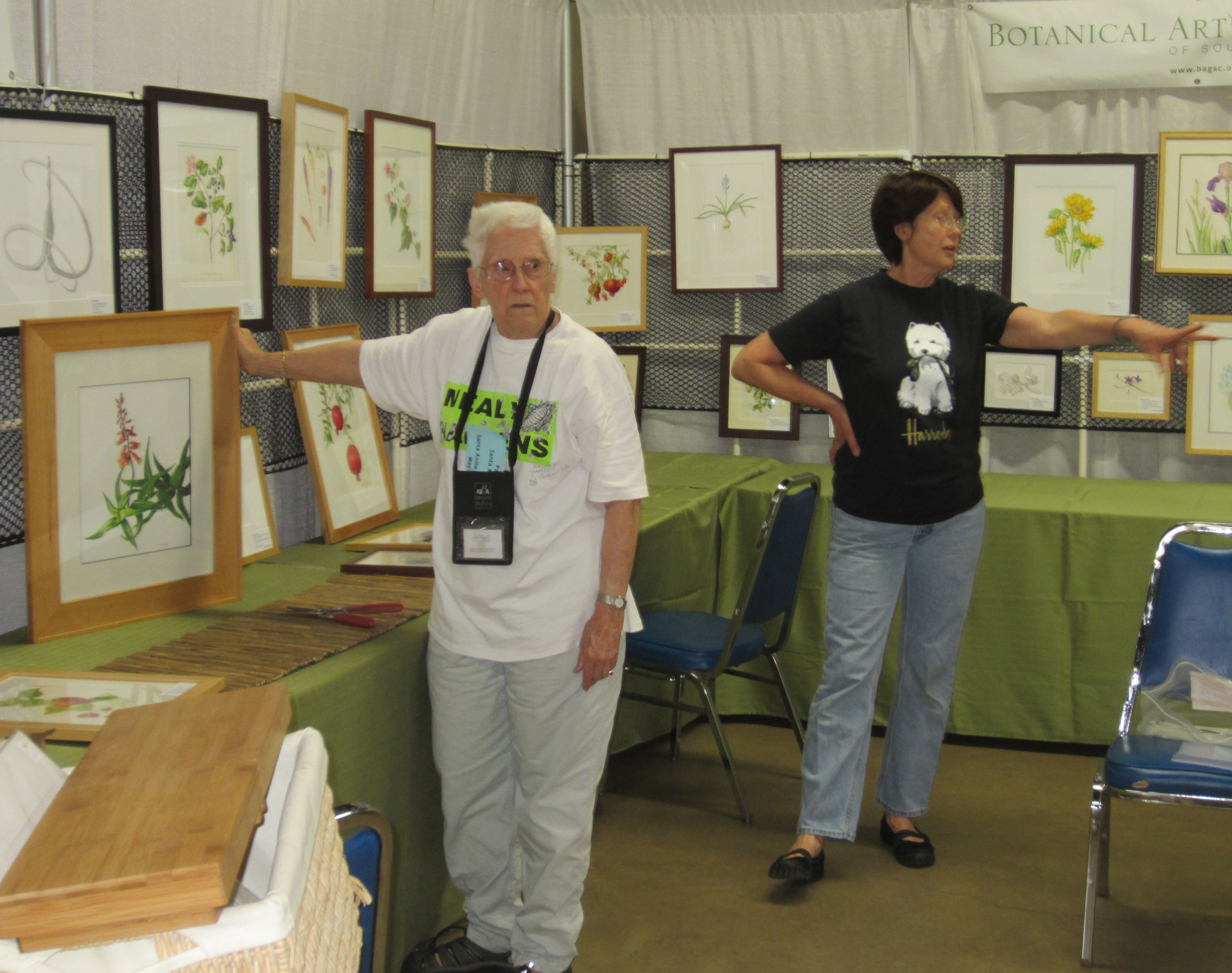
Leslie Walker and Janice Sharp give directions during the show hanging.
BAGSC Members Janice Sharp, Norma Sarkin, Leslie Walker, Kathy Morgan, and Deb Shaw were on hand to set up the BAGSC show in Ayres Hall at the LA Arboretum today. BAGSC has a corner area in a prime location next to the entrance to Ayres Hall, with member Tania Marien, ArtPlantae in the booth right next door. Perfect!
We have a nice showing with 35 works by 14 BAGSC artists. The display encompasses originals in graphite, ink, watercolor, silverpoint, colored pencil and mixed media, as well as prints, cards, etc. for sale.
Festivities start tonight, Friday evening, May 4 – with tequila cocktails by Nobleza Tequila and wine flights offered by Phantom Rivers Winery, accompanied by appetizers from Claud & Company Catering and the Peacock Café. Not to mention a “Beer for Books” booth, where all proceeds will go toward new books for the Arboretum Library.
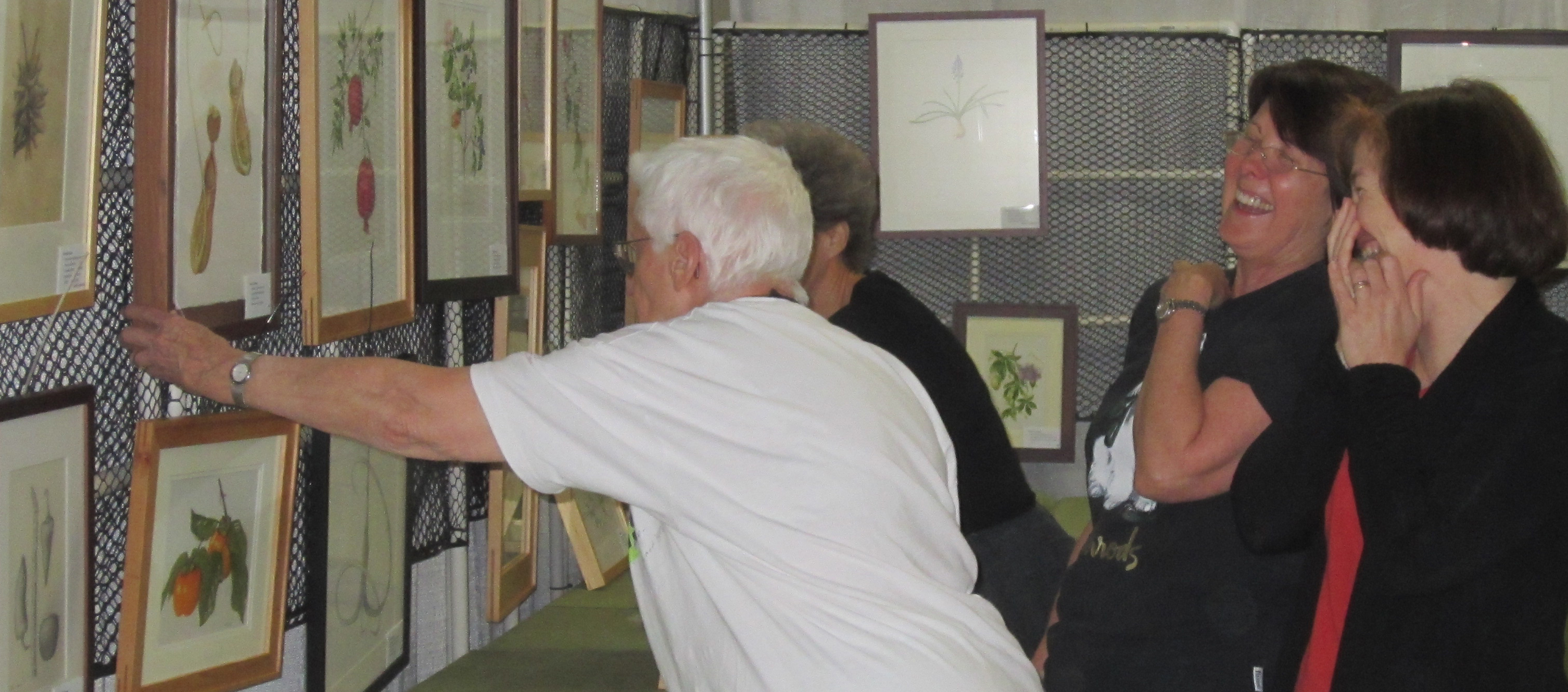
Leslie Walker and Norma Sarkin working, while Janice Sharp and Deb Shaw offer helpful advice.
Also on hand will be live music by the Big Band Theory, a garden sculpture exhibit, “Earth Dreams: Beyond the Sculptural Landscape,” where visitors have an opportunity to meet the eight featured artists.
The show continues on Saturday and Sunday, May 5-6, with plenty of kids’ activities, live entertainment throughout the day, food trucks, guided tours the gardens, and much more!
There is a fantastic lineup of educational Q&A sessions from top garden experts. These forums feature topics on everything from bee-keeping and backyard chickens, maximizing your edible garden production to drought-friendly ornamental landscaping.
And, of course, there are shopping opportunities! The Marketplace has more than 50 vendors with a full array of garden accessories, and over 25 Plant Vendors & Societies offering unique plants and great information. The Arboretum Gift Shop will be offering special discounts on all merchandise as well. I already have a list of things I “must have” from various vendors, and that was just from looking at a few vendors as they were unpacking to set up.
GROW! will also be the first opportunity to see the newly designed Garden for All Seasons – a demonstration garden of cutting-edge water harvesting techniques and urban homesteading principles.
by Deb Shaw
BAGSC members will be exhibiting in a non-juried show at the Los Angeles County Arboretum and Botanic Garden for “GROW! A Garden Festival” on May 4, 5 and 6, 2012. Don’t miss this wonderful opportunity to show and/or sell your work, whether you’re a new member or a founding member!
Call for Entry packets were emailed out to all members in February; a reminder email packet will be emailed along with the posting of this blog reminder. Entry forms and a check for $35.00 per person must be sent to Janice Sharp by April 18th. Artwork must be delivered to a designated BAGSC show committee member before May 4th, or directly to the Arboretum on May 4th. Details will be sent out to participants.
Janice Sharp and Norma Sarkin are co-chairs of the L. A. Arboretum Show, and Pat Mark has agreed to assist. As always, we’ll need lots of volunteers. Watch for more information and finish up your paintings!
 BAGSC News