You are currently browsing dbshaw’s articles.
by Janice Sharp and Bonnie Born Ash, posted by Deb Shaw
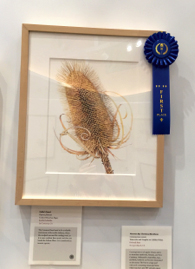
People’s Choice first place award went to Estelle DeRidder’s, Fuller’s Teasel, Dipsacus fullonum, colored pencil on paper, © 2015 Estelle DeRidder, all rights reserved.
During the opening reception for the adjunct exhibition by the Botanical Artists Guild of Southern California (BAGSC), friends, family and the public were able to vote for their personal favorites. The votes are in and the ribbons have been hung for the last three days of the show, Friday, 7 August – Sunday, 9 August.
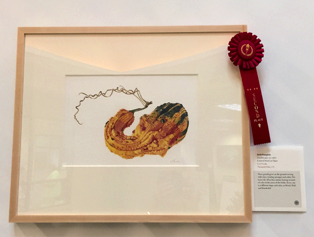
People’s Choice second place award went to Lori Vreeke’s, Field Pumpkin, Cucurbita pepo var. ovifera, colored pencil on paper, © 2015 Lori Vreeke, all rights reserved.
First prize went to Estelle DeRidder’s Fuller’s Teasel with 16 votes. Second prize went to Lori Vreeke’s Field Pumpkin with 12 votes and third prize to Asuka Hishika’s Black Daikon Radish with 11 votes.
There were a surprisingly large number of votes cast (191) and the votes were distributed throughout all the artworks in the show. It is clear that there are many different themes and media that appeal to different viewers, but everyone agrees that the chosen works are fabulous!

People’s Choice third place award went to Asuka Hishiki’s, Black Daikon Radish (Kuromaru Daikon), Raphanus sativus, watercolor on paper, © 2015 Asuka Hishiki, all rights reserved.
by Deb Shaw
Close on the heels of the “Weird, Wild & Wonderful” Symposium at The Huntington Library, Art Collections and Botanical Gardens, the Botanical Artists Guild of Southern California (BAGSC), opened their supplemental exhibition of botanical oddities, in the Brody Botanical Center’s Banta Hall at The Huntington.

The reception for the BAGSC adjunct exhibition was packed with family, friends, colleagues and the public. Weird, Wild & Wonderful Second New York Botanical Garden Triennial Exhibition was also open for viewing and enthusiastically received. Photo © Gayle Uyehara, 2015.
The opening reception on Saturday, 1 August was well-attended and great fun. BAGSC members have been rotating shifts, providing botanical art demonstrations and talking with the public all week, including:
- Bonnie Born Ash
- Cristina Baltayian, colored pencil
- Nancy Beckham, colored pencil
- Melanie Campbell-Carter, colored pencil and watercolor
- Jan Clouse
- Diane Daly, watercolor
- Estelle DeRidder
- Kate Gaman
- Cynthia Jackson
- Susan Jackson
- Clara Josephs, watercolor
- Suzanne Kuuskmae
- Tania Marien
- Patricia Mark
- Terri Munroe, graphite and watercolor
- Kathy Morgan, watercolor
- Marilyn Parrino
- Lesley Randall
- Gilly Shaeffer, watercolor
- Mitsuko Schultz, watercolor
- Janice Sharp, metal point and colored pencil
- Deborah Shaw, graphite on vellum
- Beth Stone
- Leslie Walker
- Jude Wiesenfeld
The BAGSC adjunct exhibition features 72 artworks by 37 members, including: Bonnie Born Ash, Cristina Baltayian, Nancy Beckham, Melanie Campbell-Carter, Jan Clouse, Diane Daly, Estelle DeRidder, Nancy Grubb, Asuka Hishiki, Cynthia Jackson, Susan Jackson, Clara Josephs, Joan Keesey, Suzanne Kuuskmae, Teri Kuwahara, Patricia Mark, Lee McCaffree, Arillyn Moran-Lawrence, Kathy Morgan, Terri Munroe, Alyse Ochniak, Marilyn Parrino, Dolores Pope, Kathlyn Powell, Lesley Randall, Veronica Raymond, Robyn Reilman, Norma Sarkin, Mitsuko Schultz, Gilly Shaeffer, Janice Sharp, Deborah Shaw, Beth Stone, Gayle Uyehara, Lori Vreeke, Leslie Walker, Jude Wiesenfeld.
An exhibition of Botanical Oddities, illustrations by the Botanical Artists Guild of Southern California will continue each day through Sunday, August 9, 2015, 10:30 am – 4:30 pm in The Frances Lasker Brody Botanical Center at The Huntington.
The Weird, Wild & Wonderful: The New York Botanical Garden Second Triennial Exhibition exhibition also will be open each day, Friday – Sunday, August 7 – 9, plus will continue to be open on weekends only until August 23.
Exhibition information and hours posted at huntington.org
Join us before the BAGSC paintings are whisked away!
by Janice Sharp, posted by Deb Shaw
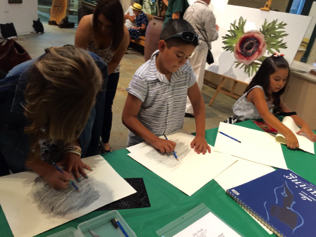
Exploring stencil leaf rubbings in graphite and colored pencil at The Huntington. BAGSC artists are demonstrating for the public August 1 – 9 in conjunction with our group show of botanical oddities by the Botanical Artists Guild of Southern California. “Weird, Wild & Wonderful,” The New York Botanical Garden Second Triennial Exhibition, will be open each day through August 9, and then weekends only through August 23. Photo © Janice Sharp, 2015.
Today was a great family day at The Huntington Library, Art Collections and Botanical Gardens. All afternoon groups of children were attracted to the stencils, pencils and paper we had set out to try their hand at preparing botanical themed rubbings.
Children had fun creating leaf and flower rubbings from stencil templates. They explored the different graphite pencil hardnesses and the effect that could be achieved with light and hard pressure on the pencils. Some ventured into color pencils choosing a favorite color to create shapes or writing their name to claim ownership of their creations. One adventurous artist started with graphite to define outlines then filled in with color.
While most of the budding artists were very young, there were also older “children” who wanted to create a work of art.
I had a fun afternoon giving basic instructions on how to do a rubbing, although most of my time seemed to be spent handing out fresh pieces of paper and sharpening pencils.

Exploring stencil leaf rubbings in graphite and colored pencil at The Huntington. Photo © Janice Sharp, 2015.
A number of parents had to use all their persuasive powers to convince their children that The Huntington offered activities other than rubbings and they should explore them before the close of day.
by Lori Vreeke, posted by Deb Shaw

Flower images photographed by Lori Vreeke at the Santa Barbara Zoo, © 2015, all rights reserved.
BAGSC will be holding a juried exhibition at the Santa Barbara Zoological Gardens, entitled “Zoo in Bloom”.
All current BAGSC members in good standing are eligible to enter up to two (2) original works of art of botanical flowering specimens grown at the zoo (no prints). Artwork must depict plants that grow at the Zoo, but does not have to be drawn there. There is no size limitation, and works may have been shown in previous BAGSC, ASBA, Filoli or other exhibitions.
The exhibition will continue through the end of the 2015 and will be open every day to visitors of the zoo. Due to space constraints, this will be a juried show with approximately 30 pieces of art hung. Jurors will be a zoo representative, a local Southern California juror and a juror from the UK. All original artwork must be for sale, prints not allowed.
Submission Deadline is September 5, 2015. Questions? Contact Lori Vreeke.

Flower images photographed by Lori Vreeke at the Santa Barbara Zoo, © 2015, all rights reserved.
A plant list and the Call for Entries packet will be emailed to BAGSC members.
The opening reception for this wonderful opportunity will be in conjunction with the gala celebrating Santa Barbara Zoo Members Day, running from 9:00am – 5:00pm on Saturday, October 3, 2015. BAGSC artists will be demonstrating throughout the day in the gardens and an information table will be set up to answer any questions about our exhibit and BAGSC. Sign-up requests to follow.
The Santa Barbara zoo is home to over 600 animals on 30 acres of lush gardens overlooking the Pacific Ocean. The property was originally home to a private residence and was gifted to the city as a park. In 1963, the zoo opened to the public featuring formal gardens and lawns, native plants and trees, cacti and succulents, ornamentals and exotic species throughout the park to recreate natural habitat.

Flower images photographed by Lori Vreeke at the Santa Barbara Zoo, © 2015, all rights reserved.
by Leslie Walker and Carol Woodin, posted by Deb Shaw
 The 9th Annual California Islands Symposium is holding a juried show in conjunction with the National Park Service Centennial Celebration.
Exhibition dates:
October 3-7, 2016, Ventura Beach Marriott, Ventura, California
With special showing
October 9 – November 6, 2016, Santa Barbara Botanic Garden, Santa Barbara, California
Accepting Submissions: April 1, 2016 – July 1, 2016
Details for submission can be found at http://www.californiaislands.net/island-art-exhibition/
Artists are invited to enter original artwork in any two-dimensional medium that reflects the beauty and uniqueness of the California islands. All entries must depict the flora, fauna, or landscapes of the California islands. The show will be hung for the duration of the conference. A special showing at the Santa Barbara Botanic Garden will follow. Cash prize awards.
The California Islands Symposium and National Park Service believe that including the arts in the international symposium is a critical component in cultivating a greater appreciation of the unique California islands.
Prizes
First Place $500
Second Place $300
Third Place $200
All winning entries and the Conference Choice entry will be published on the California Islands, Channel Islands National Park, and Santa Barbara Botanical Garden websites.
2016 Exhibition Calendar
- April 1, 2016: Accepting entry forms and digital images
- July 6: Deadline for receipt of images
- August 3: Selection results mailed
- September 26: Deadline for shipped artwork to be received
- September 28: Deadline for hand-carried artwork
- October 3: Exhibition opens to California Islands Symposium attendees and the public
- October 7: Exhibition closes at 1:00 pm
- October 9: Exhibition opens at Santa Barbara Botanical Garden
- November 6: Exhibition closes at 3:00 pm. Pick-up until 5:00 pm
- November 8: Artwork shipped back to artists
Eligibility
Open to all artists. Artists are invited to enter original artwork in any two-dimensional medium that reflects the beauty and uniqueness of the flora, fauna, and landscapes of the California Islands.
Digital Image Procedure
Entries may include up to three digital images. Artists will pay one entry fee for three images. All work must be .jpg file at least 300 dpi. It is crucial that all images be on the highest quality so our judges can fully appreciate and scrutinize your entry.
Entry Fees
$35 for each entry.
Jury Procedure
All artwork will be juried by digital image. Criteria for acceptance will include artistic presentation and technical use of medium, represented by a high-quality digital image. Artists whose work has been accepted will be notified by email by July 30, 2016. Winners will be selected by judges; final choices will be confirmed in person at the conference. The Conference Choice winner will be chosen by attendee votes at the conference.
Further Information
For further information, please check the California Islands Symposium website, http://www.californiaislands.net/symposium or contact Paula Power, (805)658-5784.
Judges:
Bruce Everett, Professor Emeritus, California State University Northridge, is a renowned landscape painter with over 50 years of experience teaching at the college level as Professor of Painting, Drawing and Design. His work is represented in museum and corporate collections, public commissions, and has been shown in numerous solo and group exhibitions. Everett’s work appears in many publications including L.A.Rising: SoCal Artists Before 1980.
Hank Pitcher, painter of California culture and the coastal landscape, is a Senior Lecturer SOE of the College of Creative Studies at the University of California, Santa Barbara, where he has been part of the core faculty since 1971. A cross-disciplinarian active in conservation, Pitcher is a member of the Advisory Committee of the University of California Natural Reserve System, the Oak Group, and supporter of numerous local and national conservation organizations. He is represented by Sullivan Goss, An American Gallery, Santa Barbara.
Karen Kitchel is intrigued by concepts of native vs. invasive, and landscapes that contain stories of human exploration, occupation, and change. The resulting paintings combine meticulous craftsmanship with a conceptual point of view and aggressive, minimalist presentation.
Kitchel’s oil paintings have been featured in exhibitions throughout the U.S., and are in numerous private and public collections worldwide, including the Denver Art Museum, the Palm Springs Art Museum, and the U.S. State Department, among others.
Karen Kitchel was born in Battle Creek, Michigan and graduated from Kalamazoo College and Claremont Graduate University. She has exhibited professionally for over thirty years, and is represented by Robischon Gallery of Denver, CO, and Gerald Peters Gallery of Santa Fe, NM and New York, NY.
alert sent by GNSI member Miste Caulder, posted by Deb Shaw
Orange County Creatives in Laguna Beach, CA has a call for entries out for their 2015 exhibition, “Flora and Fauna.” Entry deadline is August 15, 2015; the entry fee for one – five artworks is $35.00, with a media fee to place the image on the website (per sample over minimum) of $5.00.
The exhibition is juried, and celebrates all the plants and animals of all regions and times, from artists around the world. Information about the exhibition and the link to the exhibition application can be found on the website.
Orange County Creatives is located at:
761 S Coast Highway, Laguna Beach, CA 92651
978-473-9658
Hours: M-W 1 to 5 F 1 to 5, Sat and Sun 11 to 5
First Thursday of the month 6 to 9
by Clara Josephs, posted by Deb Shaw
Here is some helpful information regarding the cost of Olga’s Sunday class at the LA Arboretum. The base cost of the class (through Otis) for noncredit is $435 plus the required amount of $39 for insurance and registration fees. You may deduct up to two $50 ($100 total!) discounts as they apply to you.
Choose from any two of the following:
- Senior, 60 and over: subtract $50
- KCRW member with valid card in your name: subtract $50
- Early bird registration until August 23: subtract $50
- Alumni discount: subtract $50
Take two discounts and the cost of the class is $374 for 8 full days of instruction!
For convenience, here is the basic information posted in a previous BAGSC Blog post:
Graphite for Botanical Illustration. Classes will held for 8 Sundays, from September 13 through November 1, 9:30–4:30 and is appropriate for all skill levels. Register through Otis College 310 665 6950 class # XILU3556. This class is not yet up on the website, but will fill quickly. If you are interested, register soon by phone.
by Clara Josephs, posted by Deb Shaw
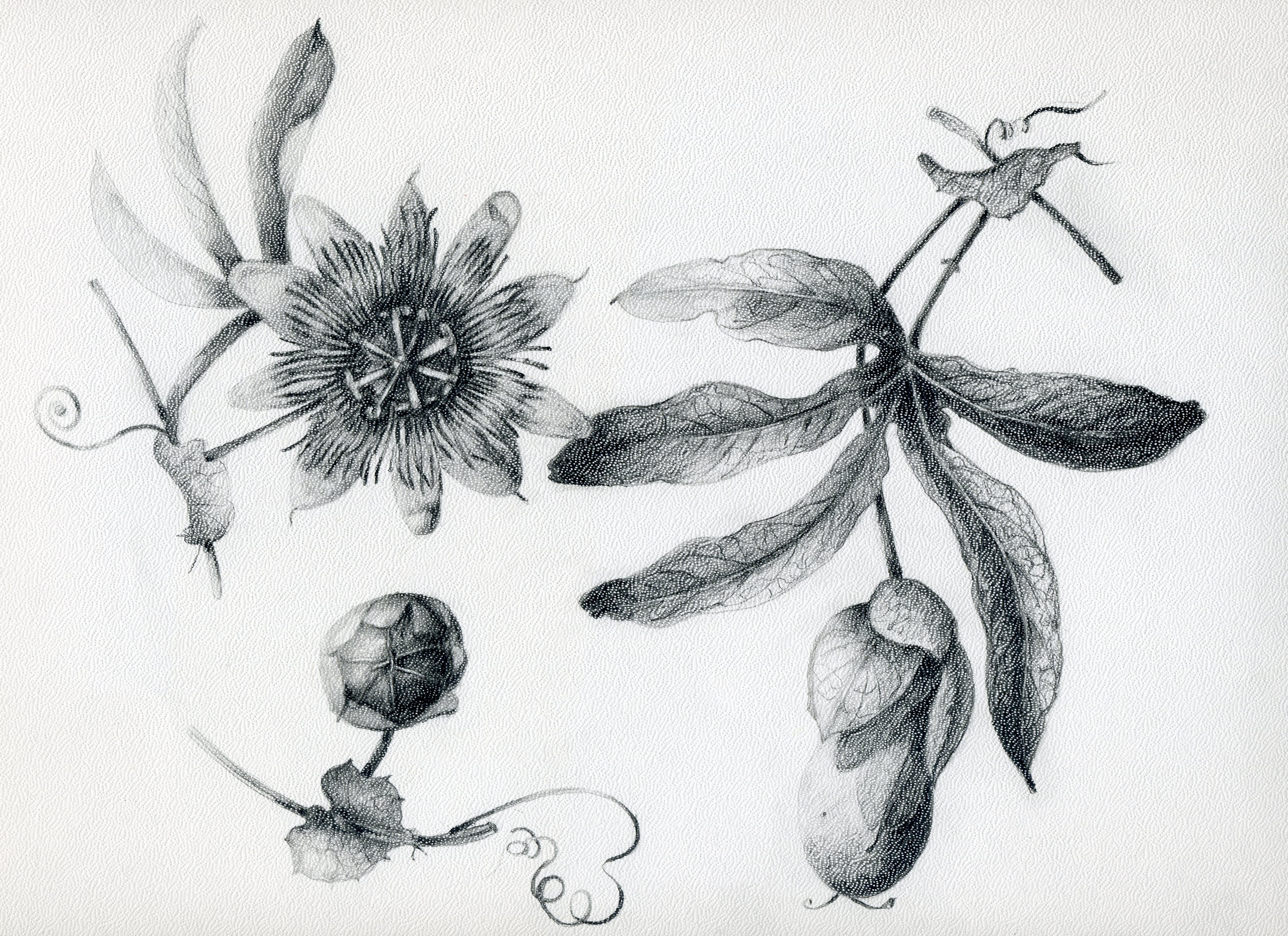
Passion Flower study, Olga Eysymontt, © 2008, all rights reserved.
Olga Eysymontt, one of the founding members of BAGSC and the first botanical art teacher to many of us, is returning to the Los Angeles Arboretum to teach her iconic class, Graphite for Botanical Illustration. If you have not had the opportunity to study with Olga, now is your chance. Classes will held for 8 Sundays, from September 13 through November 1, 9:30–4:30 and is appropriate for all skill levels. Register through Otis College 310 665 6950 class # XILU3556. This class is not yet up on the website, but will fill quickly. If you are interested, register soon by phone.
This hands-on drawing course enables teaches students to observe and draw plants with accuracy, develop perceptual acuity, analyze the role of light on form, and use tonal value skills that are essential in drawing any subject. Classes will be held at the LA Arboretum. This course is suitable not only for beginners but also for those students with extensive drawing experience. Course includes demonstration, class discussion, and critique.
First class materials: 14″ x 17” Strathmore Drawing Pad Series 400, Medium (no sketch or recycled paper; you can use another brand), 14” x 17” Medium Weight Tracing Paper (any brand), 3 Drafting Pencil Holders and 1 Sharpener, Leads: 2H, HB and 2B leads (at least 2 each), Eraser Stick, Erasing Shield, Drafting Brush, Mars Drafting Dots (masking tape), Portable Task Light (Ott-Lite). Vis a Vis wet erase fine point marker, Clip, 8″ x 10″ Plexi and 8″ x 10″ format supplied by teacher for $10.00.
by Deb Shaw

Invitation to BAGSC adjunct exhibition.
In conjunction with “Weird, Wild, and Wonderful” The New York Botanical Garden Second Triennial Exhibition, the Botanical Artists Guild of Southern California (BAGSC) will present a supplemental exhibition from August 1–9, in the Brody Botanical Center’s Banta Hall at The Huntington, featuring free public demonstrations, lectures about botanical art, and specimens of botanical curiosities. The BAGSC adjunct exhibition features 72 artworks by 37 members.
An exhibition of Botanical Oddities…
illustrations by the
Botanical Artists Guild of Southern California
in The Frances Lasker Brody Botanical Center
At The Huntington Library, Art Collections and Botanical Gardens
August 1–9, 2015 (closed Tuesday)
10:30 am – 4:30 pm
We will have a reception for BAGSC members, our guests, and Huntington VIPs and staff at:
10:00 am this Saturday, August 1, 2015
before The Huntington opens to the public.
The “Weird, Wild & Wonderful” New York Triennial exhibition also will be open the entire time the BAGSC exhibition is up, August 1 – 9, except on Tuesday, when The Huntington is closed.
Weird, Wild & Wonderful exhibition dates:
June 13 – August 23
Exhibition open to the public weekends only and each day August 1–9
Additional exhibition information: asba-art.org/exhibitions/weird-wild-wonderful
Exhibition information and hours posted at huntington.org
Artists in the BAGSC exhibition include:
Bonnie Born Ash, Cristina Baltayian, Nancy Beckham, Melanie Campbell-Carter, Jan Clouse, Diane Daly, Estelle DeRidder, Nancy Grubb, Asuka Hishiki, Cynthia Jackson, Susan Jackson, Clara Josephs, Joan Keesey, Suzanne Kuuskmae, Teri Kuwahara, Patricia Mark, Lee McCaffree, Arillyn Moran-Lawrence, Kathy Morgan, Terri Munroe, Alyse Ochniak, Marilyn Parrino, Dolores Pope, Kathlyn Powell, Lesley Randall, Veronica Raymond, Robyn Reilman, Norma Sarkin, Mitsuko Schultz, Gilly Shaeffer, Janice Sharp, Deborah Shaw, Beth Stone, Gayle Uyehara, Lori Vreeke, Leslie Walker, Jude Wiesenfeld.
Download the full invitation here: bagscExhibitionInviteF
by Beth Stone
The LA Times dubbed the weather WEIRD, while plant lovers call it WONDERFUL!!
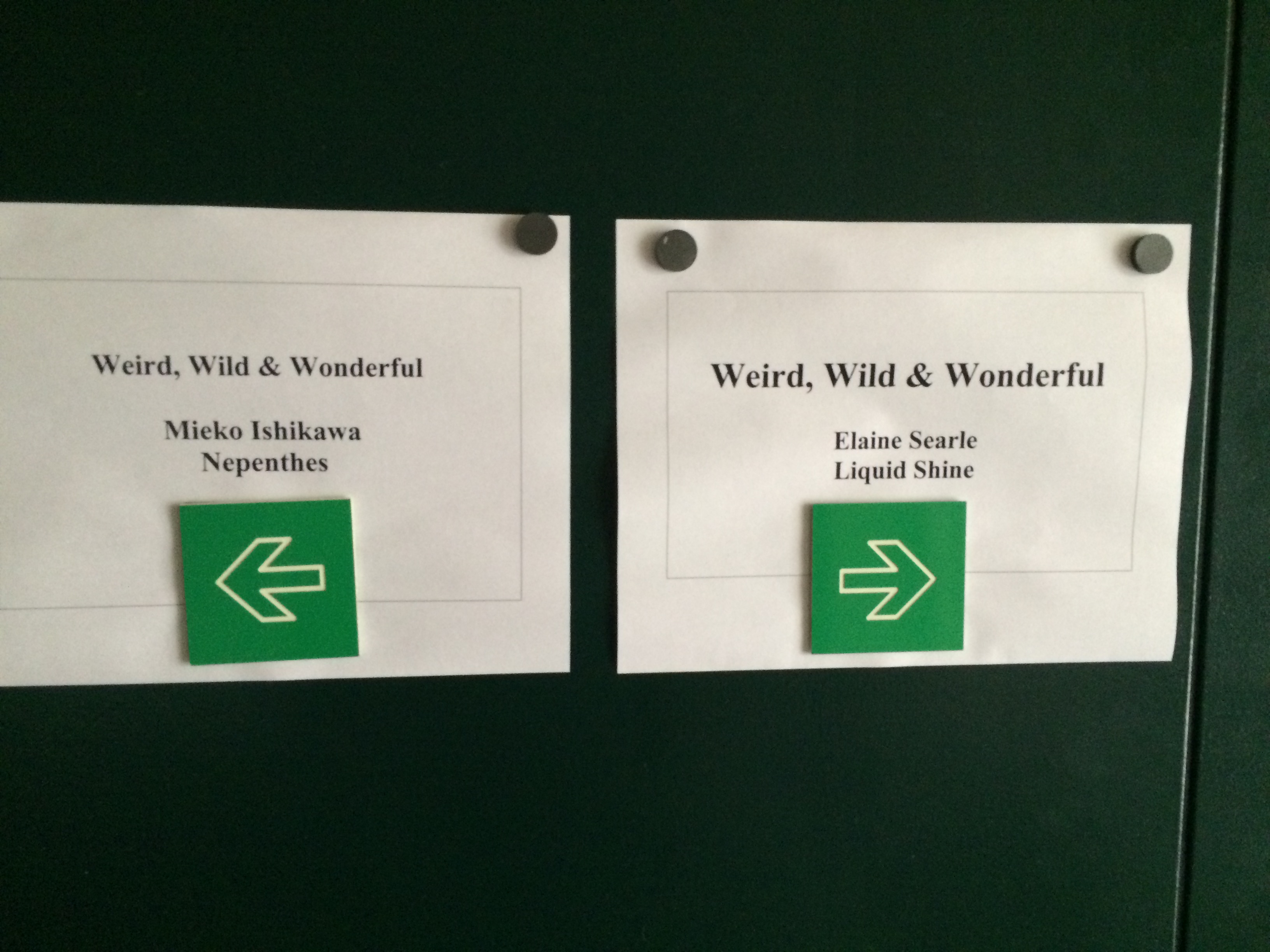
Symposium week is finally here! There are two great workshops underway — Mieko Ishikawa and Elaine Searle, and attendees are getting a preview as the Banta Hall displays are being assembled.



By Akiko Enokido and Deb Shaw
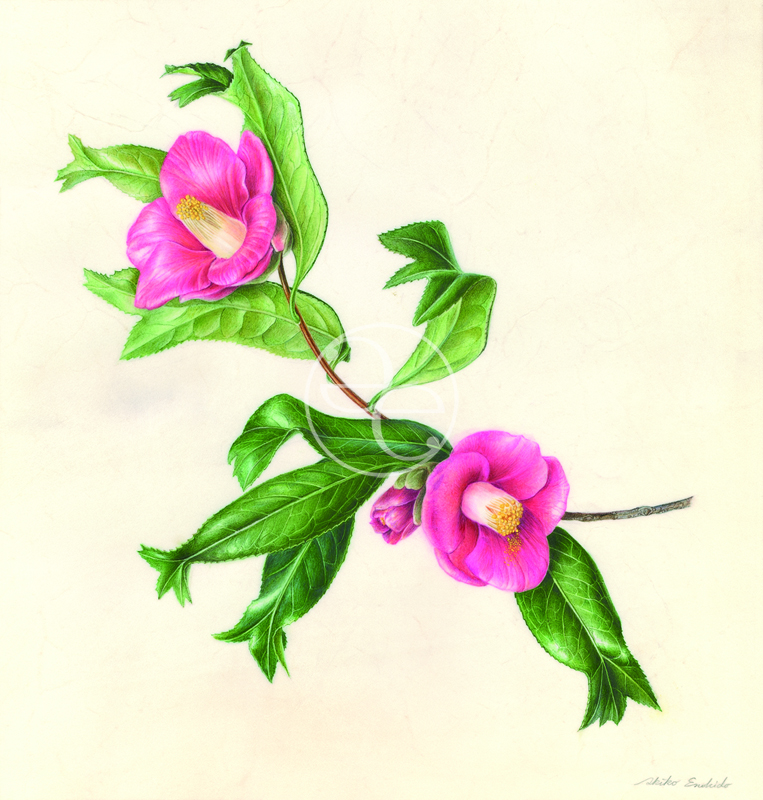
Akiko Enokido, Camellia japonica ‘Kingyoba tsubaki’, common name, Goldfish Camellia. Watercolor on vellum, © 2014, all rights reserved.
In addition to previous postings about BAGSC members’ acceptances, BAGSC member Akiko Enokido was also accepted into the 18th Annual International Show of the American Society of Botanical Artists (ASBA) at The Horticultural Society of New York.
Akiko sent this information about her painting:
The camellia cultivation started in 17th century in Japan. Goldfish Camellia is one of the old species. Most of the flowers are single layer, pink or white. But the foliage is appropriate to its name, and you can see the tip of the foliage split into three to five segments, which looks like a fishtail.
The leaves are unusually shaped and each leaf is different, showing different expressions and movement. These are really odd but lovely, even when they’re not in bloom. I picked one of the enchanting branch with leaves that looked like many fishes swimming and jumping.
Congratulations to Akiko and to all BAGSC members in the exhibition!
by Gilly Shaeffer, posted by Deb Shaw

Gilly Shaeffer, “Camellia,” watercolor on paper, 2015, all rights reserved.
Gilly Shaeffer, long time member of BAGSC, will be holding four Thursday morning classes in July at her home studio entitled “Drawing Basics.” This is a great opportunity for beginners and intermediates to perfect their drawing skills and also a preparation for doing botanical watercolor painting. It is perfect for those who like a small group experience with a lot of individualized attention. It will consist of a cumulative series of exercises to improve observational and drawing skills, as well as, preparing students to create three dimensional form through light to dark shading. Those who complete the drawing exercises with Gilly will move on to the study of botanical watercolor painting. The understanding and skills gained through these classes can be applied when doing all types of drawing and painting.
Visit Gilly Shaeffer’s website to see samples of her work and read her “Bio” to learn about her educational background, teaching experiences and accomplishments in botanical art.
Four Thursdays in July: July 2; July 9; July 16; July 23
Fee:$160
Locations: Gilly’s Home Studio
For address, directions, and answers to any questions, please Gilly’s email address.
by Suzanne Kuuskmae, posted by Deb Shaw
Cristina Baltayian will be teaching a day-long (10 am – 4:00 pm) botanical colored pencil techniques class on July 11, 2015 at Destination: Art in Old Torrance. The cost will be $90 for the day; you can bring your lunch or we will order out.
Contact Suzanne Kuuskmae to sign up or get further information. Come enjoy our comfortable, co-op studio/gallery for the day.
We will have a second session on August 8!
Destination: Art is located at:
1815 West 213th Street, Suite 135
Torrance, California 90501
(310) 742-3192
Destination: Art Map and Directions
by Jan Clouse, posted by Deb Shaw
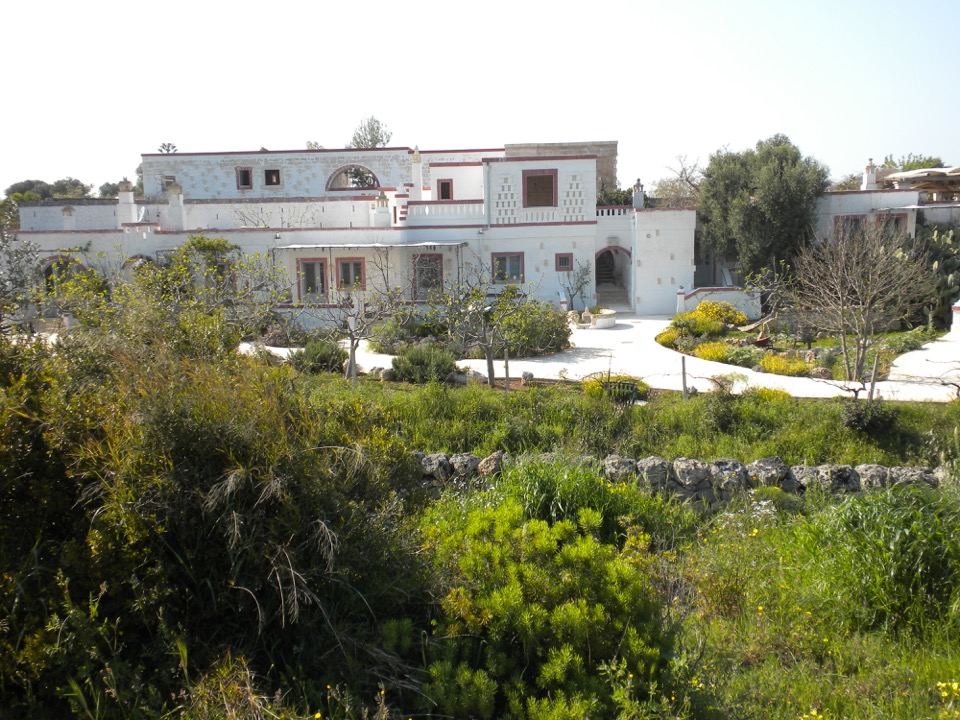
View of Masseria Montenapoleone, photo by Charles Clouse, © 2015, all rights reserved.
By tourist industry standards, Puglia is undiscovered territory. Situated down at the heel of Italy’s geographical boot, facing east to the Adriatic Sea, it is generally ignored in favor of the High Renaissance attractions of Rome, Florence, or Siena, the style consciousness of Milan and Venice or the casual flair of Naples.
Nevertheless, with its own earthy appeal and cultural heritage of pre-historic, medieval and Byzantine sights, Puglia can be irresistible for visitors ready to hike, bike, or drive through its bountiful landscape. It supplies the largest portion of Italy’s olive oil from its ancient trees, and its typical cucina povera depends heavily on delicious seafood, fresh, seasonal vegetables and the famous Pugliese hearth bread.
The olive groves and almond orchards, the rugged coastline and lush meadows filled with wild flora are a painter’s paradise. And this, in particular, was the attraction for Margaret Best’s latest botanical painting workshop/travel excursion. Five botanic artists (Ana Brito, Jan Clouse, Jane Maycock, Carole Schumacher and Leslie Walker) along with one husband/guitarist (Charles Clouse) and a guide (Kiloran McRae) joined Margaret for an 8-day immersion in art, food and visits to this land that time forgot.
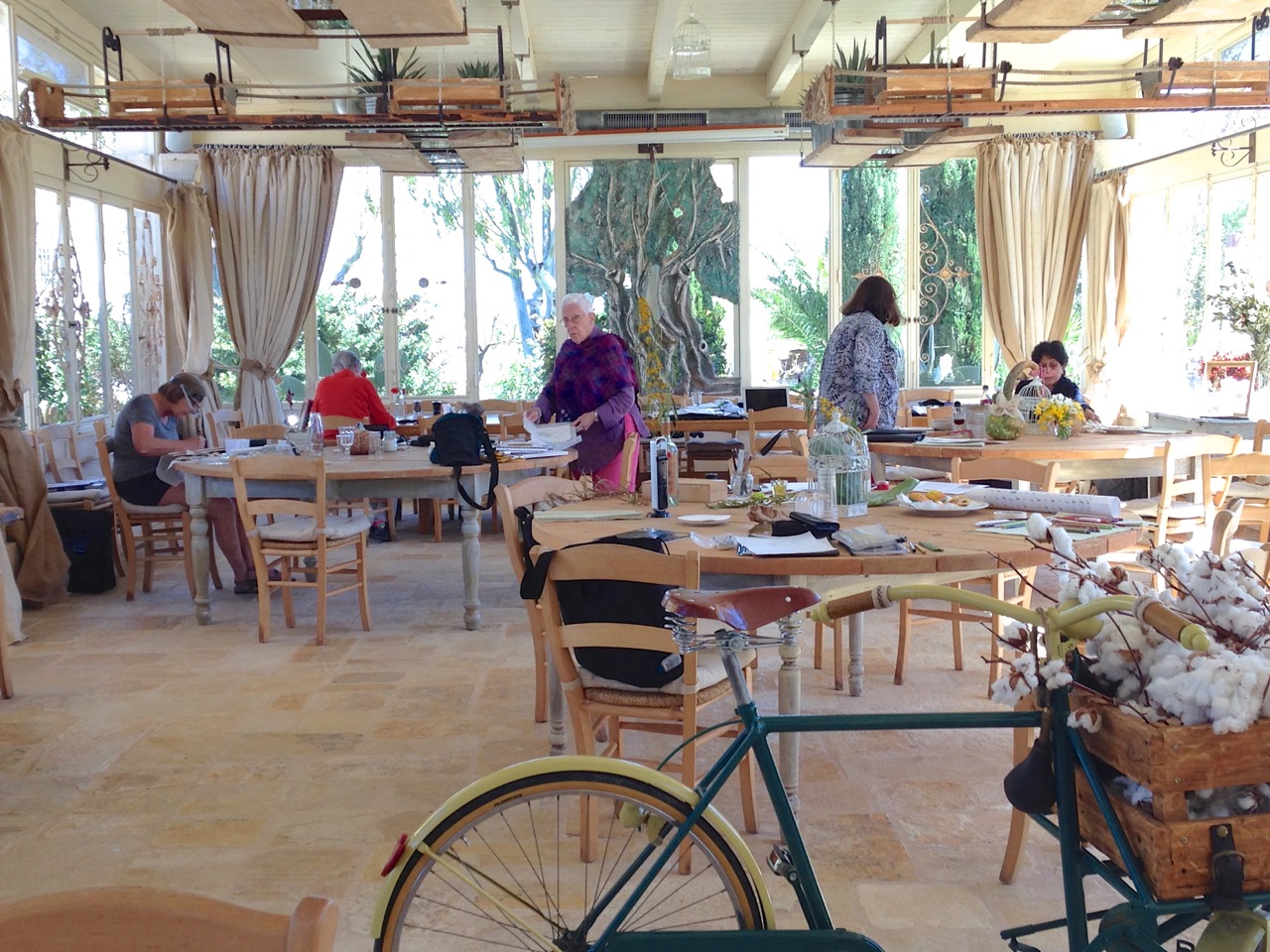
Artists’ studio at Masseria Montenapoleone, (featuring from L to R) Jane Maycock, Carole Schumaker, and BAGSC members Leslie Walker, Margaret Best and Ana Brito, photo by Jan Clouse, © 2015, all rights reserved.
The workshop was based at the rustically elegant agriturismo farm, Masseria Montenapoleone, which besides most comfortable accommodations, provided us with a large airy studio, well lit by walls of windows. At the opposite end of the room from the studio space was a huge fireplace right behind the table where we gathered for fabulous lunches and dinners.
We were introduced to the Masseria by our host, Guiliano Monteneve, who gave us a leisurely tour of the property with the assumption that along the way each of us could find an appealing botanical specimen to paint. Across the path from the main cluster of buildings was an almond orchard interspersed with fava bean rows, further on were olive trees, some many hundreds of years old, a meadow of wildflowers, a path leading to a pre-historic grotto, and everywhere unique indigenous blooms.
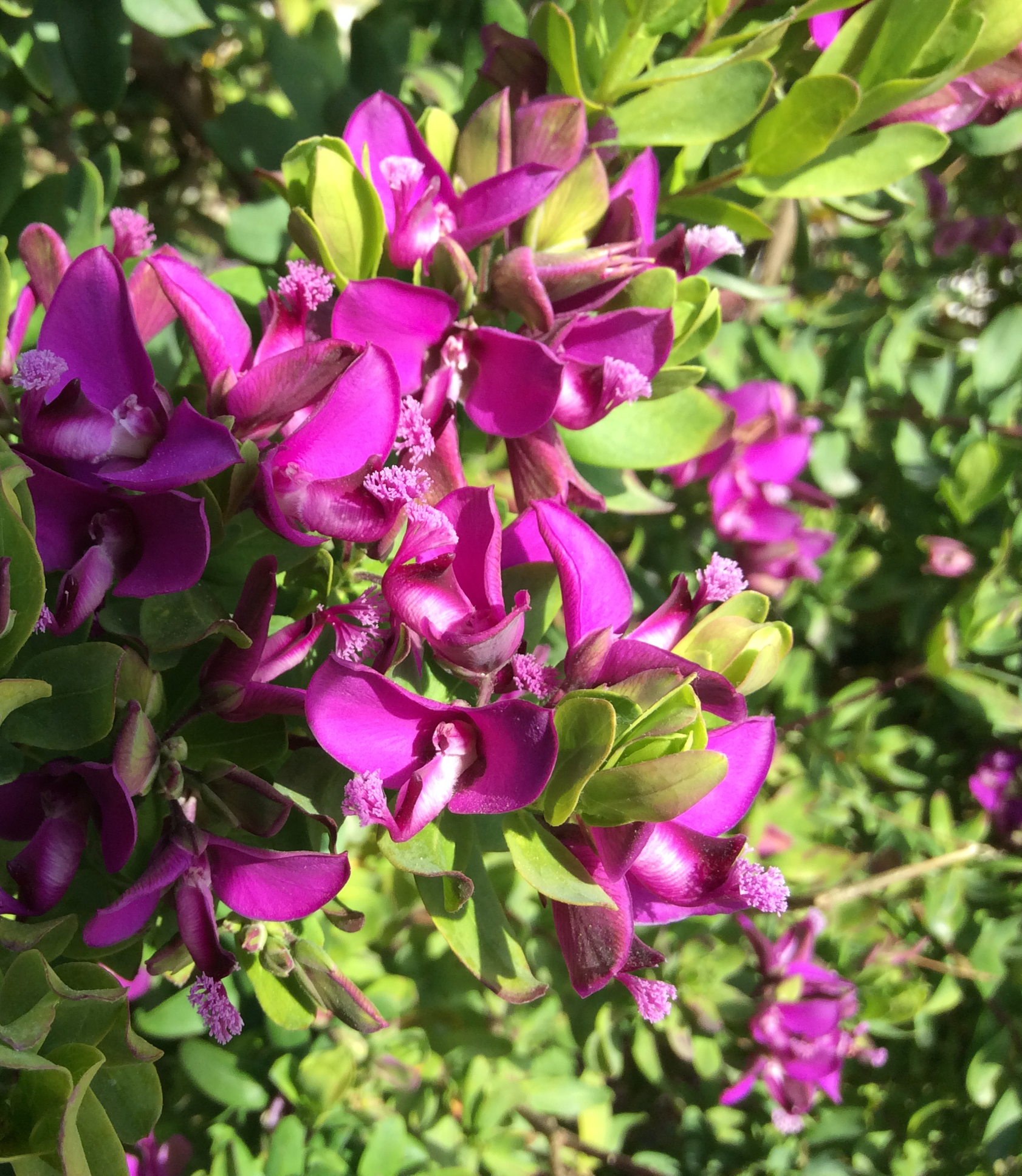
Leslie Walker found a beautiful Polygala myrtifolia to paint. Photo credit: Leslie Walker, 2015, all rights reserved.
Besides the ubiquitous red poppies scattered across the springtime fields, there were small pale lavender wild irises, a dark red orchid, a nameless neon blue ground cover, and furry borage everywhere–including on our dinner plates. Most of us spotted several possible specimens on the walkabout, and by the following morning in the studio everyone was ready to draw. As we settled in, each of us had a large table of our own, plenty of space to spread out, and our drawing pencils sharpened.
Margaret got us started on our first day with a meditation to bring us into the time and spirit for art. As always at her workshops, she had a spiral bound syllabus of information and instructions; this one appropriately titled “Postcards from Puglia.” Ahead of time she had emailed us a few instructions, among them was to rule off several “postcard-sized” formats on our favorite paper to help us compose our paintings, and to bring a few finished pieces with us. Personally I found the “ready format” a real help in focusing and cropping the blooming Acacia branch I had chosen, though my “postcard” turned out to be a double-wide affair. I was productive enough, though, to complete two additional postcards of dried acorns gathered on one of our field trips.

A montage of Leslie Walker’s subject: (clockwise from upper left) Polygala myrtifolia, dissection sheet; Leslie’s finished painting; Leslie concentrating on her subject. Photo(s) courtesy of Leslie Walker, 2015, all rights reserved.
We settled in to a comfortable routine. My husband, Charlie, played guitar to start us off on a couple of mornings, and then shifted to the back of the room or outdoors on the patio where Leslie was working, for her own private concert. Our quiet concentration was broken around eleven each morning when Michele, our personal waiter, laid out a couple of plates of sweets and took our coffee, tea and cappuccino orders.
Long, very productive days in the studio were a gift of undistracted time to draw, paint, and ask my mentor for advice, just when I needed it most. One of the real treats of the week was that Margaret could guide each of us in proportion to our skills and needs as both colored pencil and watercolor artists.
Interspersed with art time, were some extraordinary sights and experiences—an evening visit to the seaside town of Polignano a Mare, another to the rampart city of Ostuni with a dramatic view of the Adriatic. One morning we toured the Giardini di Pomona, where Paolo Belloni is dedicated to sustaining traditional fruit tree species, including over 350 varieties of figs. Another day we shopped the weekly farmer’s market in Locorotondo, buying assigned ingredients for a dinner to be prepared by celebrity chef Tiziano Mita, and finished the morning with a tour of the UNESCO World Heritage town of Alberobello, known for its concentration of curious conically shaped stone houses called trulli.

Hanging the Exhibition with Alessandra and Giuliano, photo by Jan Clouse, © 2015, all rights reserved.
The workshop week ended, not with a routine sharing of work within the group, but with an elegantly mounted evening exhibition that our host Guiliano had envisioned even before we arrived. Here we met a large gathering of neighbors, friends, and folks who had shown us the wonders of Puglia during the previous week. Guiliano and his family had ingeniously transformed our studio into an art gallery, with suspended panels that featured each artist’s bio, personal quotes and work, including the pieces we had brought with us. And the masseria’s chef, Antonio, prepared an incredible array of antipasti and desserts for a very social and international group of about 75 guests.

The “Vernissage,” Gallery opening exhibition, photo by Jan Clouse, © 2015, all rights reserved.
Altogether the week was an energizing and inspiring introduction to a botanically rich yet otherwise little-noticed part of Europe. Guidebooks should definitely make note for Puglia: “painters welcome.”
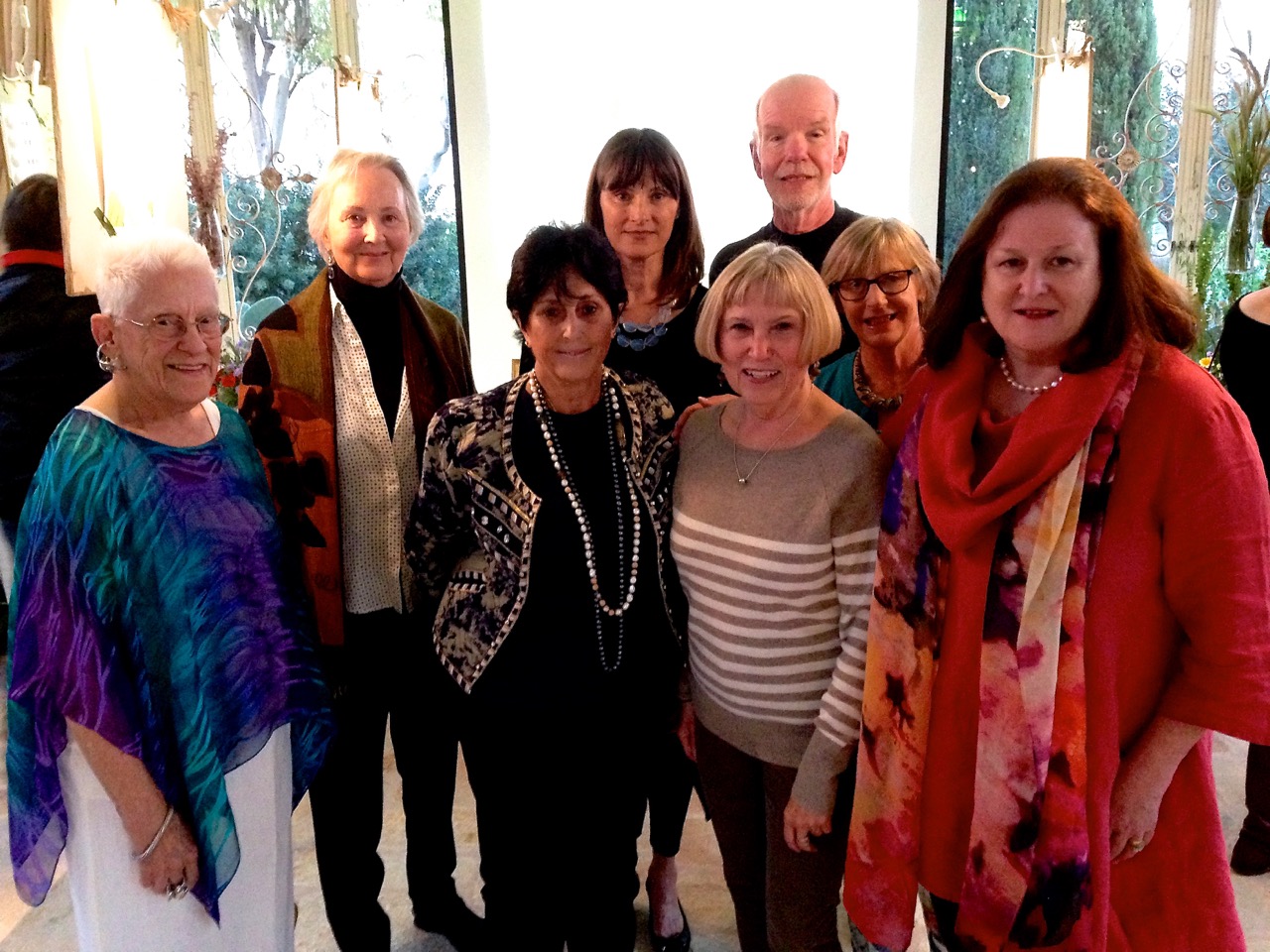
Leslie Walker, Carole Schumaker, Ana Brito, Kiloran McRae, Jan Clouse, Charles Clouse, Jane Maycock, Margaret Best, photo courtesy of Masseria Montenapoleone, © 2015, all rights reserved.
by Jan Clouse, posted by Deb Shaw

Quercus agrifolia, Coast Live Oak. colored pencil by Jan Clouse, © 2105, all rights reserved.
I am perpetually drawn to two particular subjects: eucalyptus and oaks. Two varieties of oaks are native to Santa Barbara. The Coast Live Oak grows everywhere in town, in fact, mighty examples anchor each end of my block. And over the Santa Ynez range of mountains the Valley Oak dominates the landscape. This particular branch came from a tree about 3 blocks from my house with summer acorns, green and fresh. For me, part of its charm was the sprinkling of empty brown caps from the year before.
Congrats, Jan!
The Botanical Art Exhibition at Filoli is open Tuesday, March 24 through Sunday, June 7, 2015. Visit their website for hours.
 BAGSC News