You are currently browsing dbshaw’s articles.
by Deb Shaw

Color test chart by X-Rite
The X-Rite site has a new, nifty Hue Test they’ve developed. They report that 1 out of 255 women and 1 out of 12 men have some form of color vision deficiency. Their online color challenge, based on the official FM100 Hue Test is a fun way to see how well you see hue and value across the spectrum. Rearrange the squares in order of hue and then click on the “score test” button to see how well you do! Zero is a perfect score.
by Deb Shaw
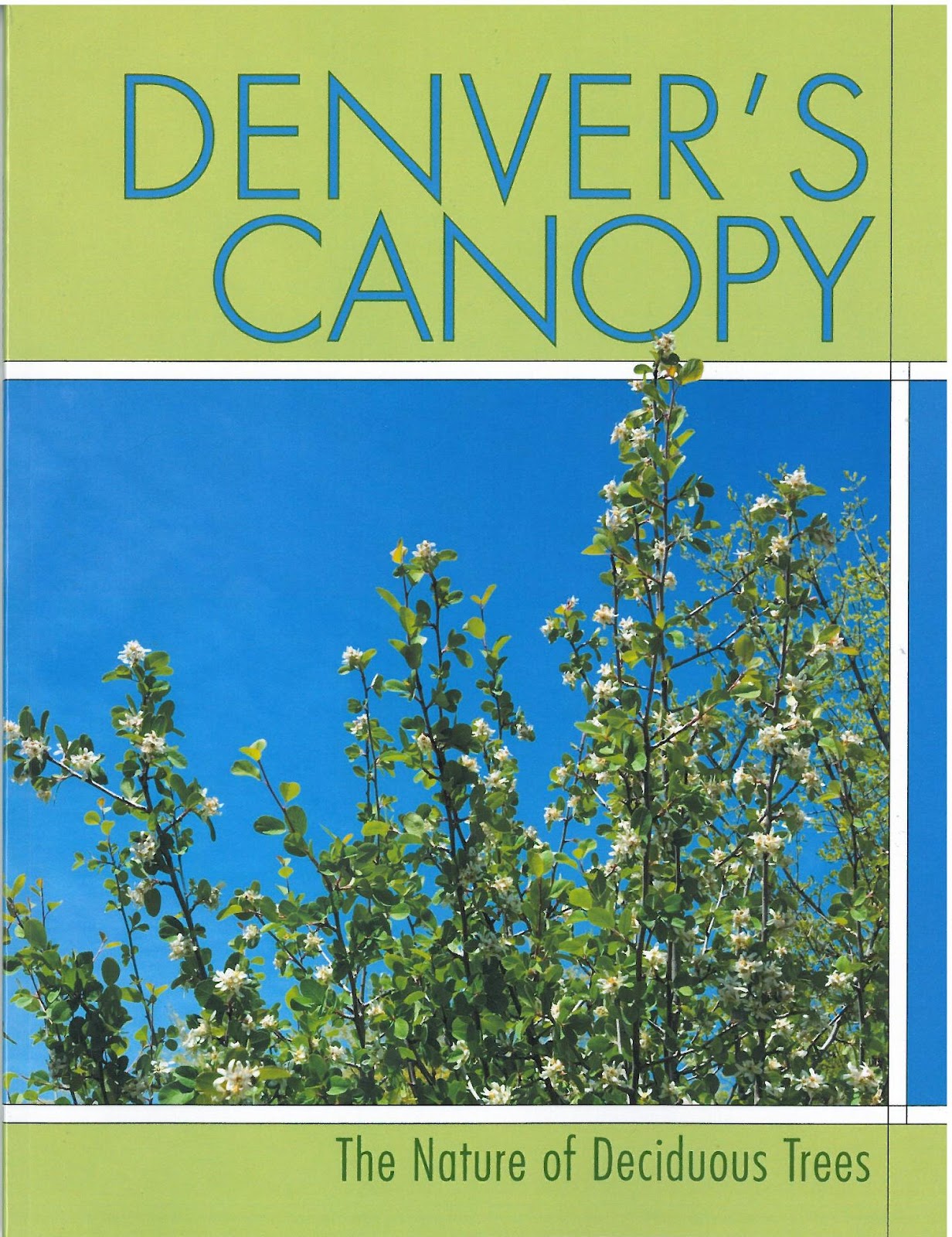 BAGSC Member Estelle DeRidder participated in the illustration of “Denver’s Canopy – The Nature of Deciduous Trees.” Released by the Denver Botanic Gardens, the publication is a tribute to Dr. Moras Shubert, in celebration of his 100th birthday and his service to the Denver Botanic Gardens and the Denver community. The deciduous trees of the Denver area have been a life-long passion of Dr. Shubert, who had the vision for this lavishly visual, limited edition book (225 copies).
The call for entries went out during the first week of February 2012 with a submission deadline of February 29, 2012. Artists had less than 4 weeks to create their illustrations!
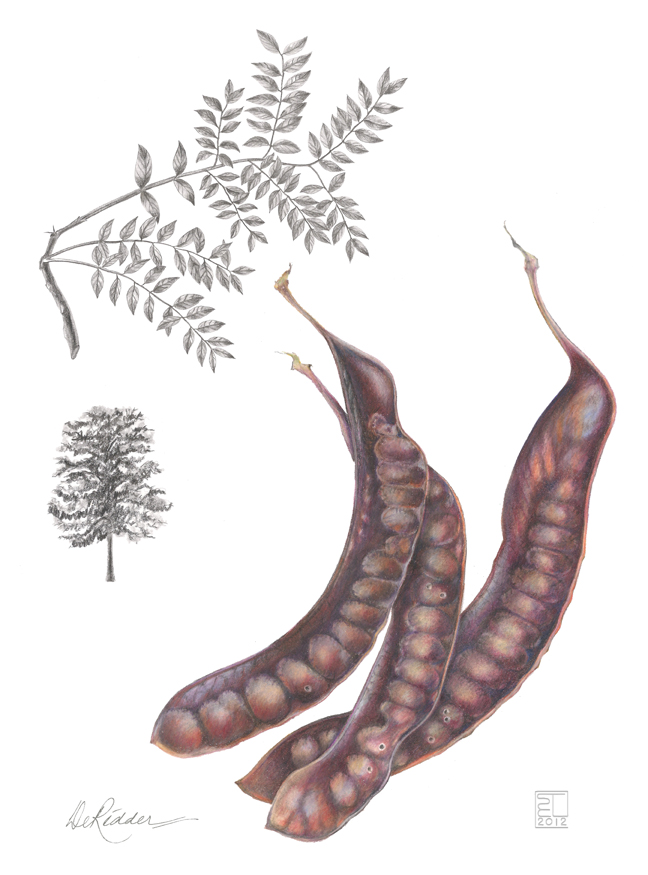
Honey Locust, by Estelle DeRidder, colored pencil, © 2012, all rights reserved
Estelle submitted two illustrations: a Liquid Amber, and a Honey Locust.
The senior author of “Denver’s Canopy” is Sonia John; contributing authors are Panayoti Kelaidis and Martin F. Quigley. The 86 pages feature photographs and more than 30 botanical illustrations by Estelle DeRidder, Jan Boyd Haring, Marjorie Leggitt, Katherine McCrery, Randy Raak, Heidi Snyder and Amy Weinstein. Illustrations were done in a wide variety of media, including graphite, colored pencil, watercolor and pen and ink.
Congratulations to the Denver Botanic Gardens and illustrators for a wonderful project! And a very Happy Birthday to Dr. Shubert!
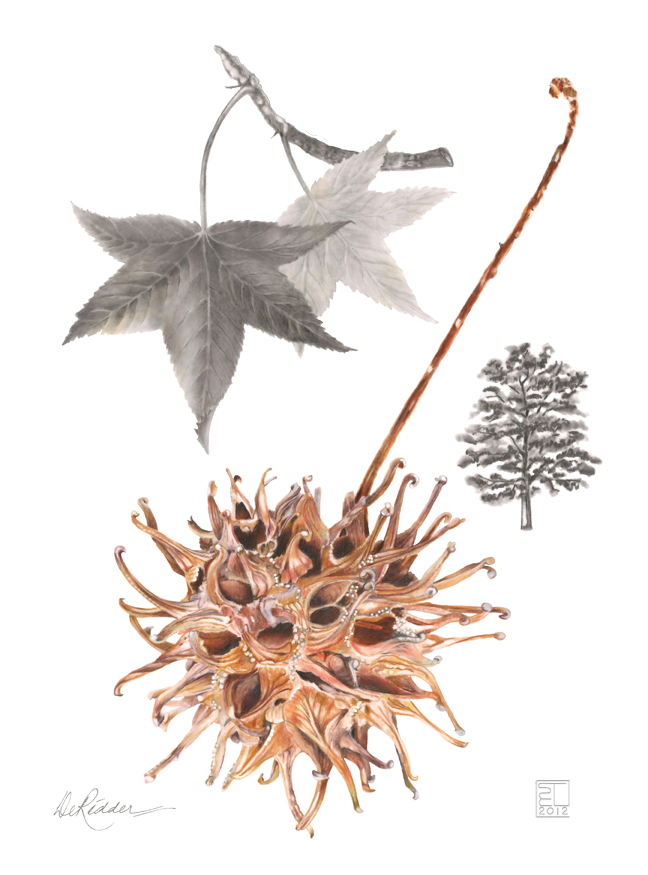
Liquid Amber, by Estelle DeRidder, colored pencil, © 2012, all rights reserved
By Leslie Walker, posted by Deb Shaw
If you’re thinking about taking Margaret Best’s 3-day workshop at the Huntington Gardens on July 26, 27, 28, now is the time to reserve your space, and send in your deposit and/or your full class fee.
Participants will bring their own specimens (your choice!) and Margaret will focus on meaningful compositional choices for your personal art, or for creating potential entries into the BAGSC Drought Tolerant Plant Exhibition at Chapman University Library next year (intent to submit to the Exhibition is not a requirement of this class). All mediums are welcome in this workshop. This open medium instruction will be a first for BAGSC. Margaret suggests you bring your usual supplies, that includes your own preferred paper and paints/colored pencils, but she is happy to provide her own color palette choices for both mediums upon request. She can be reached via her website with any questions in regards to supplies.
There are still a few spaces available, and you can read more about this class on the prior post for the BAGSC blog.
So, if you had been contemplating attending, now’s the time to both register and find your subject. The cost for this class will be $300. Hold your space with a $50. non-refundable deposit, check made out to BAGSC and sent to Leslie Walker. Final $250. payment due July 1, 2012. Fabriano 5 paper (only available in Europe) will be available for purchase from the BAGSC inventory at class, three half-sheets for $7.00.
Participants should be selecting plants (for drought-tolerant help call Deborah Shaw or Leslie Walker), and starting sketches, color matching, and composition ideas. The more preparation you do ahead of the class the more you will get out of the class.
by Clara Josephs, posted by Deb Shaw
As we firm up the dates for the Chapman show, now is the time for you to make final decisions about which plants you will portray.
Please email Diane with the names of your selections. As we receive names of plants, the list will be posted monthly on the blog. By checking the blog list, you can make informed decisions as you progress with your paintings for the show.
Several people have asked about duplicate subject matter. We don’t expect a problem with that issue. At the first Chapman show we reserved the right to exclude duplicate subjects if we had too many paintings for the available display space. We had no problem displaying 70 + paintings and probably could have displayed more. This would be our policy again, but this time we would refer to our “Intent” list and give preference to the earliest declarer.
As you know, the exhibit is not only about the plants, but about the artistry in presenting the plant. Certainly, several artists can successful portray the same plant in dramatically different compositions. So don’t let the fact that another artist has declared for a plant stop you from painting a subject you are passionate about. But, do be aware that there is a small chance that if space is tight, some duplicates could be excluded
We hope to announce the exhibit dates very soon. Email Diane as you make your choices. We expect to be able to hang four paintings per member.
By Leslie Walker, posted by Deb Shaw
Preparing for an exhibition submission can be an exciting project yet sometimes, also a little daunting. What subject should I pick? Where do I find it? How do I create that particular texture? What type of composition will show the specimen off to its best advantage both in terms of its unique characteristics as well as offer an aesthetically appealing result? You will be able to get help with all of these elements by signing up for Margaret Best’s 3-day workshop at the Huntington Gardens on July 26, 27, 28.
Margaret will be steering participants towards meaningful compositional choices to kick-start a direction for creating potential entries into the BAGSC Drought Tolerant Plant Exhibition at Chapman University Library next year. Not only has Margaret developed a new format for her workshops, already proven in Bermuda, Canada and recently in Italy, she is also experienced in teaching graphite, watercolor and colored pencil and will be therefore welcoming all mediums in this workshop. This open medium instruction will be a first for BAGSC. Margaret suggests you bring your usual supplies, that include your own preferred paper and paints/colored pencils, but she is happy to provide her own color palette choices for both mediums upon request. She can be reached via her website with any questions in regards to supplies.
What you are required to bring with you is your own specimen. For those of you who love to depict colorful flowers, there are many options in this category too, but you should also be aware that the purpose of the exhibition is to bring a focus on the unique structures of drought tolerant and drought resistant plants as well. And the choice is not restricted to purely Californian natives. Once you have made your selection, it is suggested that you familiarize yourself with the plant by completing preliminary sketches and doing some research into the ways that the plant structures you will be depicting, assist in its toughness to survive in regions that are often subjected to periods of time without water. This pre-workshop preparation time is not a pre-requisite to attend (nor is there a pressure to exhibit if you do not wish to do so) but it will help you progress more efficiently with a compositional direction and give you more time for color application and technical assistance.
So the time to both register and start looking for a subject is right away. Don’t miss this opportunity to be a part of this wonderful exhibition but also to be able to prepare for it with Margaret Best.
The cost for this class will be $300. Hold your space with a $50. non-refundable deposit, check made out to BAGSC and sent to Leslie Walker. Final $250. payment due July 1, 2012. Fabriano 5 paper (only available in Europe) will be available for purchase from the BAGSC inventory at class, three half-sheets for $7.00.
Participants should be selecting plants (for help call Deborah Shaw or Leslie Walker) now, and starting sketches, color matching, & composition ideas. The more preparation you do ahead of the class the more you will get out of the class.
See you there!
by Leslie Walker, posted by Deb Shaw
There’s been a change in the dates for Margaret Best‘s class in July! Mark your calendars: the new dates are
Thursday, July 26
Friday, July 27
Saturday, July 28
The class will still be at the Huntington Library, Art Collections and Botanical Gardens in San Marino. Details to follow soon!
by Clara Josephs and Deb Shaw
Many BAGSC members have been asking about where they can find information about drought-tolerant plants. You can find a lot of information about drought tolerant plants on the web. Here is a section from the Wikipedia entry I was directed to after googling “lemonade berry”:
Rhus integrifolia, the Lemonade Berry’s leaves are simple (unusual in a genus where most species are trifoliate), alternating, evergreen and leathery, ranging from two to four centimeters wide on reddish twigs; length of leaves is five to seven centimeters. Leaves are toothed with a waxy appearance above and a paler tone below. The flowers which appear from February to May are small, clustered closely together, and may be either bisexual or pistillate.[1]
These fragrant flowers exhibit radial symmetry with five green sepals, five white to rosy-pink petals, and five stamens. The small flowers are only six millimeters across. The ovary is superior and usually has a single ovule; although in pistillate flowers, the stamens are small and infertile. The mature fruit of Rhus integrifolia is sticky, reddish, covered with hairs, and about seven to ten millimeters in diameter. The elliptical fruit presents tight clusters at the very ends of twigs.
Young plants manifest smooth reddish bark, while more mature individuals have cracked, even scaly, grayish bark with the smooth red bark displayed underneath. Twigs are rather stout and flexible, and reddish bud ends are diminutive and pointed. There is often a multi-furcate branching structure from the base of the plant. A mature plant is large and thicket-like with a sprawling arrangement.
Notice how many painting cues for color and structure are in that entry! It also tells me when it flowers. Very useful and free information! Next, if I hit “images” for lemonade berry – bingo – what a selection!
The following is a list of California Native plants and their drought-tolerant adaptive strategies, compiled for us by Jennifer Funk, Assistant Professor of Biological Sciences, School of Earth and Environmental Sciences, Schmid College of Science and Technology. Please keep in mind that the exhibition is open to any drought-tolerant plants from around the world, not just California natives! This list was handed out at a BAGSC Quarterly meeting earlier this year. Future articles on the blog will list characteristics of drought-tolerant plants.
Let us know your questions, or any future articles you would like to see on the blog about drought-tolerant plants.
A few drought-tolerant species, all native to southern California:
Scientific name, Common name
Drought deciduous (plants that drop their leaves during dry season or periods of dryness)
Achillea millefolium, Common Yarrow
Calliandra eriophylla, Pink Fairy Duster
Encelia californica, California Bush Sunflower
Encelia farinosa, Brittlebush
Keckellia antirhhinum, Yellow Bush Penstemon
Ribes aureum, Golden currant
Small leaves (small leaves have a reduced surface area, and so lose less water)
Adenostoma fasciculatum, Chamise
Arctostaphylos species, Manzanita
Artemisia californica, California sagebush
Ceanothus species, Ceanothus
Cercocarpus minutiflorus, San Diego Mountain Mahogany
Epilobium canum, California Fuchsia
Ericameria cuneata, Wedgeleaf goldenbush
Eriogonum fasciculatum, California buckwheat
Hazardia squarrosa, Saw-toothed Goldenbush
Isocoma menziesii, Coastal Goldenbush
Isomeris arborea, Bladderpod
Lotus scoparius, Deer Weed
Lycium californicum, Coastal Boxthorn
Mimulus aurantiacus, Bush Monkeyflower
Prunus ilicifolia, Hollyleaf Cherry
Deep taproot (taproots find water sources deep below the soil surface, and are often thick and fleshy, so they can store available water)
Pinus species, Pine
Platanus racemosa, California Sycamore
Populus fremontii, Western Cottonwood
Quercus agrifolia, Coast live oak
Succulent leaves (succulent plants store water in their fleshy leaves, stems and roots)
Agave species, Agave
Cylindropuntia prolifera, Coastal Cholla
Dudleya species, Dudleya
Opuntia species, Prickly pear cactus
Yucca schidigera, Mohave Yucca
Yucca whipplei, Chaparral Candle
Pubescent leaves (pubescent leaves are covered with hairs, which may be tiny or long, and which help hold water and reflect the hot rays of the sun)
Asclepias californica, California Milkweed
Encelia farinosa, Brittlebush
Galvezia speciosa, Island Bush Snapdragon
Malacothamnus fasciculatus, Chaparral Mallow, Bush Mallow
Salvia apiana, White sage
Evergreen, sclerophylous leaves (evergreen leaves stay on the plant year-round; sclerophylous leaves have a hard surface and are frequently closely spaced together)
Arbutus menziesii, Madrone
Baccharis pilularis, Coyote brush
Eriodictyon crassifolium, Thick-laved yerba santa
Heteromeles arbutifolia, Toyon
Malosma laurina, Laurel sumac
Rhamnus species, Coffeeberry
Rhus integrifolia, Lemonadeberry
Rhus ovata, Sugar bush
Salvia leucophylla, Purple sage
Salvia mellifera, Black sage
Sambucus Mexicana, Mexican elderberry
Sources
http://www.cnpssd.org/plantlistlinked.html
by Sally Jacobs, posted by Deb Shaw
The TAG gallery in Santa Monica (the coop gallery that I belong to) is having their annual juried show. It’s always a great show, very well hung and attended, with prize money! All BAGSC members who are interested in submitting should do so!! The following is the pertinent information. Please click on the website links to read the details and submit your work online.
About the CALIFORNIA OPEN
The 2012 California Open Exhibition is the seventh annual juried art competition sponsored by TAG Gallery, located at 2525 Michigan Avenue, D3, Santa Monica, CA 90404, Bergamot Station Arts Center, Southern California’s largest art gallery complex and cultural center. The exhibition recognizes excellence in a diverse range of media and offers artists exposure at a world-class destination.
AWARDS
First Place $1000
Second Place $500
Third Place $250
Mendez Memorial Award $250
JUROR
MEG LINTON
Director of Galleries And Exhibitions
Ben Maltz Gallery
Otis College Of Art And Design
CALENDAR 2012
July 1: Submission Deadline
July 20: Notifications emailed
August 7 – 10: Receipt of Shipped Work
August 11 – 12: Receipt of Hand Delivered Work 12 noon to 3:30 pm
August 15: Opening of Show
August 18: Reception 5-8 pm. Awards Presented.
September 1: Pickup of Hand Delivered Work, 12 noon to 3:30 pm
September 4 – 7: Return of Shipped Work
by Jill Berry, posted by Deb Shaw
Cristina Baltayian’s popular Colored Pencil classes are now also being held on Saturday, so do plan on coming to the Arboretum and enjoying a beautiful day!
USING COLORED PENCILS In Botanical Art
Cristina Baltayian, Instructor
At the Arboretum, 301 North Baldwin Ave., Arcadia, CA 91007
Saturdays, 2012 from 10am – 4pm (includes lunch break)
June 9
July 14
August 18
September 15
October 13
(No class in Nov.)
December 15
This class will explore flowers, fruits, vegetables and more, using colored pencils techniques to get beautiful, painterly results.
$ 95 Arboretum members per Saturday
$115 Non-members per Saturday
Pre-registration required; please call 626.821.4623 or email Jill Berry. A supply list will be provided upon registration. Class participants may bring lunch or purchase it at the Peacock Café.

Magnolia, © Cristina Baltayian, all rights reserved.
Cristina Baltayian has a background in drawing (graphite, charcoal, pen and ink), two-dimensional design, watercolor, and colored pencils. Her work has been shown at Filoli, the Los Angeles County Arboretum, and Chapman University. She is a member of the American Society of Botanical Artists, and The Botanical Artists Guild of Southern California.
by Clara Josephs, posted by Deb Shaw
After a healthy discussion at our quarterly meeting this past Saturday, we have come to a decision about framing for the show planned at Chapman University on drought tolerant plants.
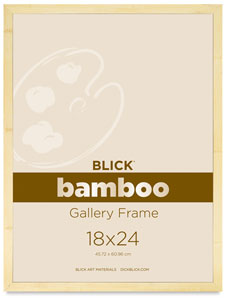
Dick Blick Bamboo Gallery Frames
The frame we will be using for our Chapman exhibit is the Dick Blick Light Bamboo Gallery frame. Most paintings done on quarter sheets will fit into the 16 x 20 size frame.
If you purchase a pre-cut 16″ x 20″ mat, your matted painting should fit into #18858-7916 bamboo frame. That frame comes with acrylic “glass” and costs $27.50.
The light bamboo frame comes in a range of sizes, from 6″ x 6″ to 30″ x 40″. You may want to decide the final size of your painting when you are planning the composition.
Use the standard wire and D ring hanging system with no saw-tooth or projecting hardware, and a white or off-white mat.
We do not have an exact date set as yet for the show. However, we believe the gallery area will be available to us sometime in early spring, and that we will have room for three to four paintings per member. So, keep working on those paintings! We are hoping to hold several workshops on issues pertinent to portraying drought tolerant plants.
by Jill Berry, posted by Deb Shaw
There’s a wonderful plant sale going on at the Arboretum Garden & Gift Shop. All plants are 50 percent off, while supplies last. Take this opportunity to add some terrific plants to your garden. Excludes arrangements by Creative Plant Design. No member discounts apply. All sales are final. Varieties are subject to availability.
Take this opportunity to add some terrific plants to your garden. For BAGSC members looking for subjects for the drought-tolerant exhibition, this might be a great find for subjects to paint. The Arboretum Garden & Gift shop is open daily from 9am to 4:30pm.
by Lori Vreeke/Deb Shaw
New BAGSC member Lori Vreeke went to the “Grow! A Garden Festival at the LA Arboretum today, met Leslie Walker, Estelle De Ridder and Janice Sharp and took some great pictures. See them on her blog.
Welcome Lori!
by Janice Sharp (from her iPhone), posted by Deb Shaw
More than 1,300 people attended the Friday night opening of “Grow! A Garden Festival” at the LA Arboretum. Food, wine, music and wonderful evening. Lots of plants, and outdoor decor, not to mention beautiful art at the BAGSC booth. Looks like it will be a great weekend. Get out and join us!
Goodnight for now, but see you there this weekend!
by Jill Berry and Cristina Baltayian, posted by Deb Shaw

Cristina Baltayian, © 2011, all rights reserved
BAGSC member Cristina Baltayian will be teaching colored pencil classes at the LA Arboretum through December 2012 on both Tuesdays AND now on Saturdays as well!
USING COLORED PENCILS In Botanical Art
At the Arboretum, 301 North Baldwin Avenue, Arcadia, CA 91007, phone: 626.821.4623
These classes will focus on techniques, composition and color mixing. All levels of experience are welcome.
Cristina Baltayian, Instructor
10am-2pm (includes one hour lunch break) – 3 hours of class
$255 Arboretum members per month
$275 non-members per month
Pre-registration required; please call 626.821.4623
Cristina Baltayian has a background in drawing (graphite, charcoal, pen and ink), two-dimensional design, watercolor, and colored pencils.
Her work has been shown at Filoli, the Los Angeles County Arboretum, and Chapman University. She is a member of the American Society of Botanical Artists, and The Botanical Guild of Southern California. A supply list will be provided upon registration. You may bring your lunch or purchase it at the Peacock Café.
Tuesdays, 2012:
May 1, 8, 15, 22
June 5, 12, 19, 26
July 10, 17, 24, 31
August (No Classes)
September 4, 11, 18, 25
October 2, 9, 16, 23
November (No Classes)
December 4, 11, 18 ((December classes go from 10am – 3:15pm)
Saturdays, 2012
Each individual class will explore flowers, fruits, vegetables and more, using colored pencil techniques to get beautiful, painterly results. You may register for one class at a time if you wish.
A supply list will be provided upon registration; you can also bring your lunch or purchase it at the Peacock Café.
10am – 4pm (includes one hour lunch break) – 5 hours of class
$ 95 Arboretum members per Saturday
$115 Non-members per Saturday
Pre-registration required; please call 626.821.4623
May 12
June 9
July 14
August 18
September 15
October 13
(No class in November)
December 15
by Bonnie Born Ash and Leslie Walker, posted by Deb Shaw
Join us for the BAGSC General Quarterly Meeting,
Saturday, May 19, 2012
10:00 a.m., at Cristina’s home
Agenda
Coffee at 9:30
I. President’s Report – Leslie Walker
II. Secretary’s Report – Bonnie Born Ash
III. Treasurer’s Report – Janice Sharp
IV. Membership Report – Joan Keesey
V. Old Business
- Field Trip to Lotusland, April 28
- L. A. Arboretum “GROW! A Garden Festival” May 4-6
VI. New Business
- Classes for 2012
- Chapman University Exhibition – Drought Tolerant Plants
VII. Program
- Estelle DeRidder – British Society of Botanical Artists Diploma Course
- Lori Vreeke – Ann Swan colored pencil class in Dedham, England
- Bring your work to show
Potluck Lunch
An email blast will be sent out with directions. Please RSVP to Cristina. See you there!!
 BAGSC News