You are currently browsing the category archive for the ‘News Updates’ category.
by Deb Shaw
The presentations from ASBA Grant Recipients is always one of my favorite sessions at the ASBA conference. It’s inspiring to hear the many different ways members reach out into the community using botanical art as a vehicle.

Jan Boyd Haring presents Estelle De Ridders project during the Grants presentation at the ASBA conference. Photo by Deb Shaw.
This year was no different. Moderator Jan Boyd Haring presented for our own BAGSC member Estelle De Ridder. As we know here in Southern California, Estelle’s project is to assist with the creation of reusable plant identification cards featuring illustrations of plant life cycle phases for the top 35 native plant species of the Madrona Marsh Preserve in Torrance, California. [See our previous blog posting about Estelle’s exhibition and opening in December of this year.]
Jody Williams presented her project: extending the reach of ASBA’s “Following in the Bartrams’ Footsteps” exhibition to the St. Francois Mountains of Southeastern Missouri. Jody documented and illustrated the plants listed by the Bartrams in the diverse habitats of the St. Francois Mountains by finding, drawing, painting and lecturing about the plants.
Lisa Coddington went from her home base in New Mexico to teach botanical art workshops to elementary students, K – 6 on the island of Grenada with a support partnership involving the Peak Institute. She overcame teacher wariness and students’ shyness to have a final art exhibition created by enthusiastic students, many of whom hadn’t known about their local plants and fruits, or how they grew.
Marsha Bennett with members of the Southwest Society of Botanical Artists funded a five minute video highlighting their Citizen Scientist project, scientific identification and documentation of the flora of the Phoenix Mountains Preserve, a permanent rotating exhibition of artwork of the flora, and public education outreach.
Thank you all!
by Deb Shaw

Dichelostemma volubile and Madia elegans. Watercolor © Joan Keesey, all rights reserved.
A quick reminder to my original blog post: the California Native Plant Society (CPNS) is holding a botanical art exhibit in conjunction with their Conservation Conference, January 15-17 in San Jose. The entry deadline for submission of artwork is November 1, 2014. They would love to see our artwork there.
Artists are invited to enter original artwork in any two-dimensional medium that reflects the beauty and uniqueness of California flora and adheres to high standards of botanical accuracy. All entries must depict plants indigenous to California.
More information is at the CNPS web site. You may also download the PDF form 2015 Prospectus CNPS Botanical Art Exhibition, or contact Bernard Halliwell.
The Northern California Society of Botanical Artists (NCalSBA) will be helping with the exhibit and coordinating techniques demonstrations at the Conference. Lesley Randall will be coordinating BAGSC members who would like to help our NCalSBA counterparts. More to come on demonstration opportunities later!
by Gayle Uyehara, posted by Deb Shaw

Carol Govan delivered a fast-paced, exciting lecture about botany. Photo by Gayle Uyehara.
Carol Govan’s Thursday “Wow, Botany Is Exciting” workshop really was that, WOW!
Carol contacted the class participants a few weeks earlier and sent us a very informative email and handout with all the technical terms we would learn so we wouldn’t have to stop and look them up during class. She also told us to relax but hang on tight because the workshop was structured from her 8-week course at Wellesley College Botanic Gardens. In three hours we learned the parts of a plant and their function in a humorous, informative manner that only Carol can deliver.
After we learned the names of the plant parts, we quickly sketched the specimen before us and labeled them. “Quick” being the emphasis and it was amazing how many things we had captured in our short observation. What a treat this class was!

Learning the plant parts. Photo by Gayle Uyehara.
Carol’s botany workshop built on this newbie’s vocabulary in a manner that will allow me to pick up a book and know what to look for in the field. She pointed out several older reference books because of their descriptive words of the plant rather than their non-visual clues like DNA and chemical properties.
Toward the end of class, Carol demonstrated how she uses sketch paper, hard pencil and grid frame to capture a quick but accurate gesture composition of a plant; keeping in mind the negative spaces she creates. The grid was only a few marks on paper and frame but gave her a visual clue about placement on the paper. From there she does a quick contour drawing which she will work with the rest of the time—while making any corrections to her gesture drawing. The color she adds as part of her sketch is made from a three-color palette made up of the primaries. She mixes up her watercolor swatch on a white plate to include the shadow and highlights.
Carol finished up this delightful workshop by telling us how she uses her sketches to create a composition and showed us examples of her finished pieces.
Let me mention again what a treat this class was!
I am sure that I will think of her many times as I continue on my botanical art journey. Thank you Carol!
by Beth Stone, posted by Deb Shaw

Laurence Pierson demonstrating her beautiful egg tempera technique. The camera/light in the foreground is the one mentioned in the article. Photo by Beth Stone.
At the Denver Botanic Gardens, Laurence Pierson demonstrated egg tempera on gesso panel. She mixes dry pigment with water using a colour shaper, adds a bit of alcohol if the particular pigment requires it to dissolve, and mixes in a bit of egg yolk.
Laurence’s background is in painting icons, typically on wood panel prepared with gesso and often including gold leaf. She applies her skill with tempera to botanical subjects with beautiful results!
The camera used in this photo seemed particularly effective for teaching, see the Ladibug DC192 on http://www.lumens.com.tw/product_1.php?big_id=1

Ladibug lamp detail. Photo by Beth Stone.
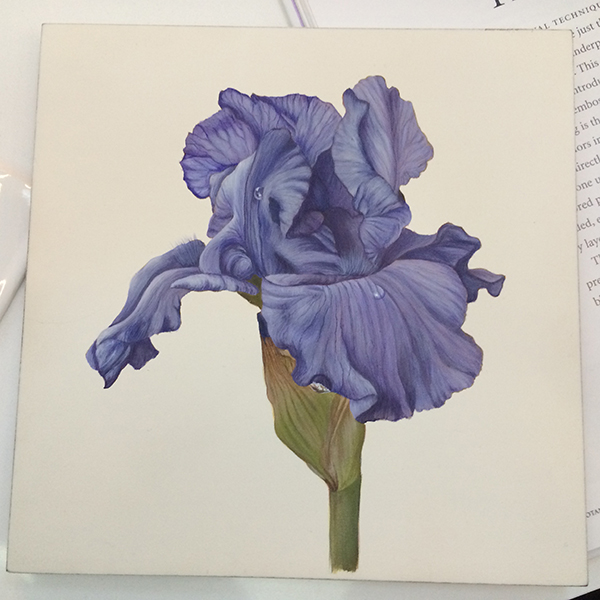
Iris painting in egg tempera by Laurence Peirson. Photo by Beth Stone.

Laurence Pierson’s palette looks like a jewel box. Photo by Beth Stone.
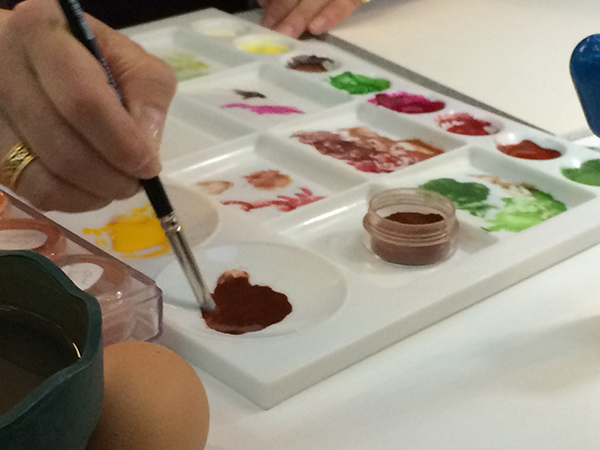
Laurence Peirson mixing egg tempera. Photo by Beth Stone.
by Deb Shaw
Some of our BAGSC members are lucky to stay for the post-conference workshops, but many of the rest of us have gotten home. We had a great response to our “Live from the Conference” postings; many sent emails letting us know how much they enjoyed the posts. I’m sorry I was struggling with a technology meltdown and couldn’t get all of them up sooner. I believe I now have the technology (mostly) behaving, and will get things posted as quickly as possible.
![[Brush holder] The Rocky Mountain Chapter made (yes, HANDMADE) pine brush holders for each of the conference attendees. Photo is of my new brush holder, happily ensconced in its new home on my work table. Photo by Deb Shaw.](https://bagscblog.com/wp-content/uploads/2014/10/brushholderfront.jpg)
[Brush holder] The Rocky Mountain Chapter made (yes, HANDMADE) pine brush holders for each of the conference attendees. Photo is of my new brush holder, happily ensconced in its new home on my work table. Photo by Deb Shaw.
Thank you to the Rocky Mountain Society of Botanical Artists and ASBA for all your hard work. And thank you to the roving BAGSC reporters who sent in stories and photos. If you have any more, keep ’em coming and I’ll get them posted. For readers; lots more to come.
See you next year at the Weird, Wild & Wonderful Symposium at the Huntington in the Summer, and at the ASBA Annual Meeting and Conference in Miami in October.
Happy painting!
![[Brush holder back] Susan Fisher explained that the wood came from pine trees harvested after being killed by Mountain Pine Beetles (Dendroctonus ponderosae), native to the forests of western North America. The blue color of the wood is the result of staining from the beetle infestation. Libby Kyer designed the logo on the back, which was also on the water bottles donated by Libby and her husband. Photo by Deb Shaw.](https://bagscblog.com/wp-content/uploads/2014/10/brushholderback.jpg)
[Brush holder back] Susan Fisher explained that the wood came from pine trees harvested after being killed by Mountain Pine Beetles (Dendroctonus ponderosae), native to the forests of western North America. The blue color of the wood is the result of staining from the beetle infestation. Libby Kyer designed the logo on the back, which was also on the water bottles donated by Libby and her husband. Photo by Deb Shaw.
by Deb Shaw

Tania Marien’s James White Award
The ASBA announced their annual awards last night at the closing banquet. Tania Marien was presented with the James White Service Award for her dedication to botanical art, in recognition of her distinguished support of botanical art.

Lesley Randall’s ASBA Award for Scientific Botanical Illustration
Lesley Randall was presented with the ASBA Scientific Illustrator Award for Excellence in Scientific Botanical Art, in recognition of her outstanding achievements as a scientific illustrator.
George Olsen was presented with the ASBA Diane Bouchier Artist Award for Excellence in Botanical Art, in recognition of his outstanding acheivements as a botanical artist.
Unfortunately, the three award winners were not present to receive their awards in person. When Tania and Lesley’s names were announced, however, the BAGSC table cheered loud enought to hear back in Southern California. Congratulations to the award winners for richly deserved recognition!!
by Beth Stone, posted by Deb Shaw
The Techniques Showcase featured three artists covering a very broad range of approaches: Hillary Parker, Ann Swan, Kelly Leahy Radding.
Hillary Parker shared her artistic problem-solving approach to very large format botanical watercolors which most of us would surely consider impossible! First was a driftwood commission on 40 x 60 inch, 300 lb cold press paper. The second was a 9 foot long (!) watercolor of a stone wall with a foreground of woodland plant silhouettes worked in masking fluid. Can you imagine fitting such a massive work in your studio? Then consider how you would maneuver yourself and your paints around to work on it!
Ann Swan completed a kiwi botanical in front of our eyes as just a portion of her wonderful segment of the Techniques Showcase. The seemingly magical techniques Ann demonstrated included: colored pencil layering strategies; exploiting colors that resist adhesion of subsequent layers (for example, creating veination); use of alcohol-based solvent or baby oil (actually not oil, but dilute paraffin) to blend and spread color; and embossing to create fine hairs for kiwi and pussy willows.
I’m told Ann’s blog is one to watch. She posted photos of the Chihuly glass sculpture exhibit currently at the Denver Botanic Gardens. http://annswan.wordpress.com
Finally Kelly Leahy Radding demonstrated the technique she used to paint the beautiful water lily she entered in the show’s Small Works exhibit. The water lily is painted with gouache on a dramatic black background. Kelley demonstrated her painting process with gourds. She shared a tip regarding both zinc white and the warmer titanium white. Both dry with a slight blue cast which can be counteracted by mixing in just a touch of yellow.
As a special additional treat to complete the Showcase, John Cogley, founder, President and CEO of Daniel Smith, spoke on the manufacture of pigment. The process involves fracturing/cleaving the crystalline materials rather than grinding them. It was great to see the actual mineral samples John brought including a beautiful, huge, piece of Lapis. John graciously answered audience questions: explaining that his company bought out all the Quinacridone close-out stock, so we will always be able to buy a consistent Quinacridone Gold; that we shouldn’t be concerned if Gum Arabic binder oozes from a newly opened tube, it’s just excess that rose to the top; and we should use distilled water in our painting work rather than introduce tap water impurities. Deb Shaw went to John’s lecture, and will include pictures in the next posting.
posted by Deb Shaw
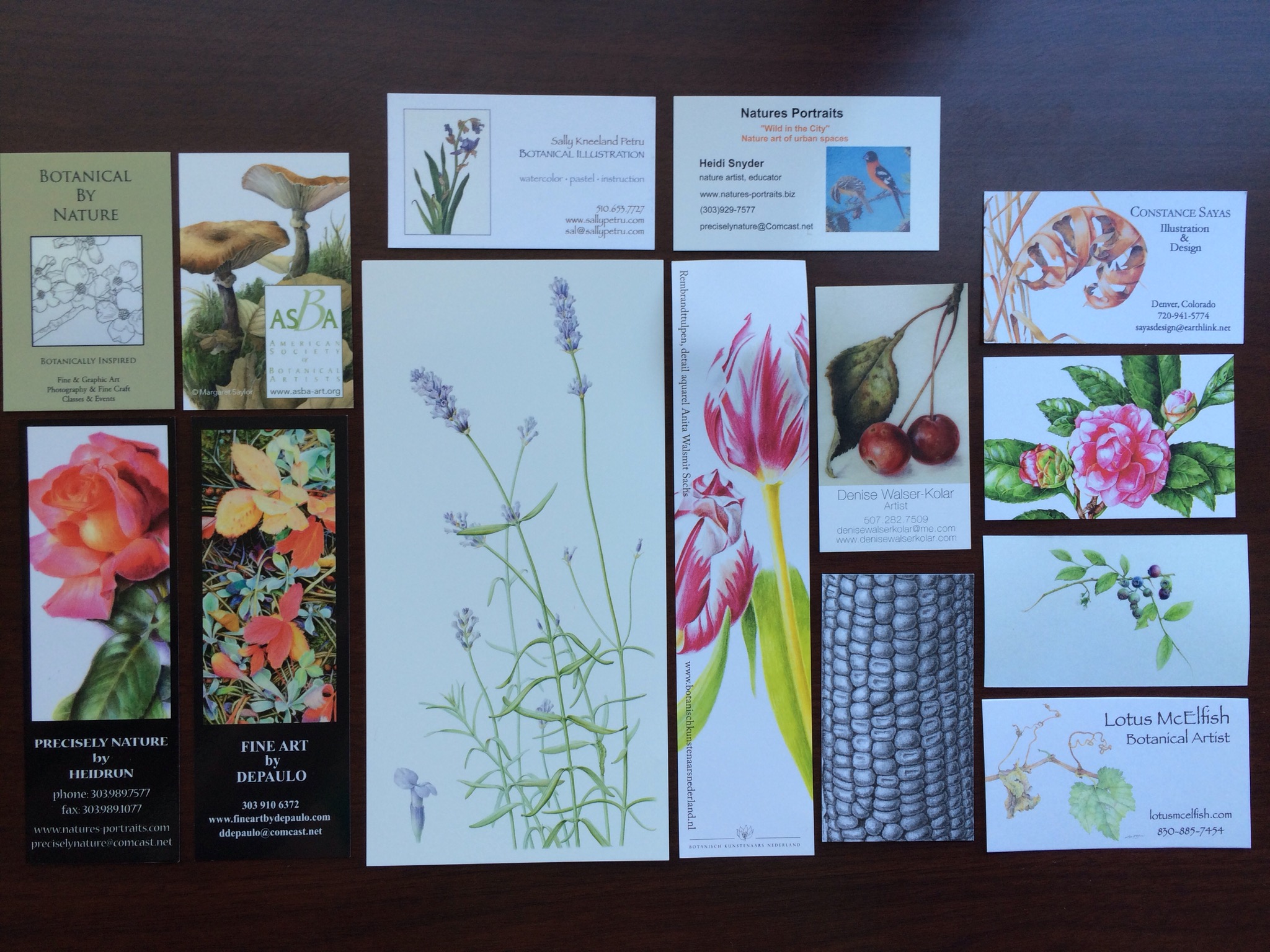
There were some amazing portfolios on view; always fun to get right up close and personal to the work, and to be able to talk with the artists. (Photo by Beth Stone of a few cards and handouts.)
On the 20th anniversary of the ASBA, founding member Diane Bouchier gave an inspirational speech during the annual meeting luncheon about the importance of what we do: to ourselves, and to the world around us. (Photo by Gayle Uyehara.)

Posted by Deb Shaw
BAGSC members at the conference are: Beth Stone, Cristina Baltayian, Deborah Friedman, Deborah Shaw, Gayle Uyehara, Lori Vreeke, Melanie Campbell-Carter, Nina Antze, Sally Jacobs, and Terri Munroe. We are going to try to post some photos and updates as we can. I’ll confess, the blog postings aren’t behaving well from my iPad, but we’ll do what we can.
Wednesday evening was the kick-off opening reception for the Small Works exhibition. Gayle Uyehara took a panoramic view of the reception.

Photo by Gayle Uyehara.
The Small Works is one of my favorite exhibitions. It’s wonderful to see the range of art and creativity. This year is no exception. As always, it’s hard to get close to the art at an opening, so I’m glad to get to go back today for a more careful look.
The hotel is within walking distance of the 16th Street Mall, with lots of shops and restaurants, and easy access to the Denver Art Museum. A free shuttle runs the length of the mall. Gayle, Sally, Anita Walsmit Sachs and more friends from the Netherlands, Esmee Winkel and Marianne van der Stee-Kuiper went to dinner at the Tilted Kilt, and reported the people-watching was excellent.

Left to right: Gayle Uyehara, Esmee Winkel, Marianne van der Stee-Kuiper, Sally Jacobs and Anita Walsmit Sachs-Jansen.
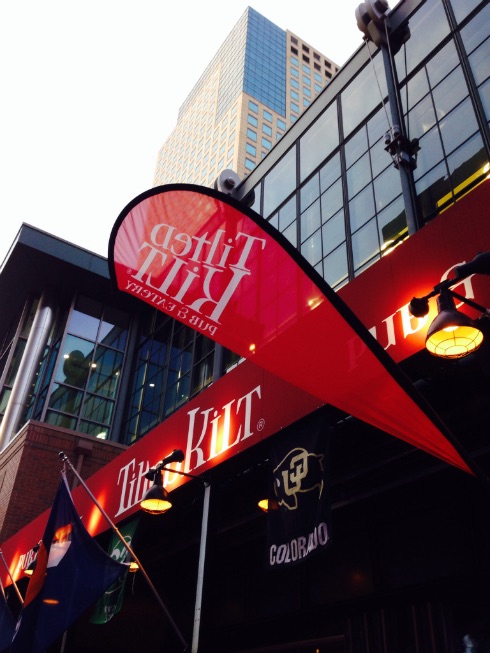
Sign for the Tilted Kilt. Photo by Gayle Uyehara.
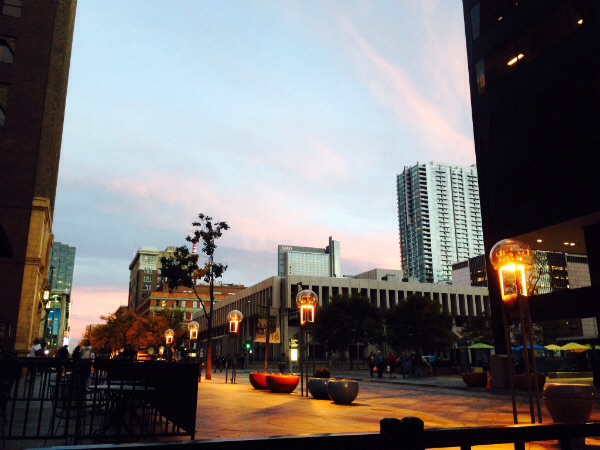
The 16th Street Mall in Denver at Sunset, photo by Gayle Uyehara, © 2014.
by Deb Shaw
The American Society of Botanical Artists (ASBA), The Botanical Artists Guild of Southern California (BAGSC) and The Huntington Botanical Gardens present:
A Weird, Wild & Wonderful Symposium
July 23 (Thursday) – 26 (Sunday), 2015
in conjunction with
Weird, Wild & Wonderful
The Second New York Botanical Garden Triennial Exhibition of 46 captivating paintings and illustrations of exotic specimens by invited members of the American Society of Botanical Artists at
The Huntington Library, Art Collections and Botanical Garden
San Marino, California

Solanum lycopersicum, Heirloom Tomato, Watercolor on paper, © Asuka Hishiki
Information about the Symposium is available on the ASBA website, and registration opens in May, 2015. Save the dates and watch this blog for exciting learning and volunteering opportunities.
About Weird, Wild & Wonderful:
Botanical art has traditionally depicted conventionally beautiful plants, such as sunflowers, irises, and roses. Weird, Wild, & Wonderful features plants not always thought of as beautiful but rather strange, eccentric, intriguing, and mysterious. Join us in Southern California as we explore the plants and their depictions during a special Weird, Wild & Wonderful Symposium on July 23 – 26, 2015, with additional classes, workshops, displays and lectures throughout the summer.
Only 46 works were selected from nearly 240 entries, hailing from the United States, Australia, Canada, India, Japan, and the United Kingdom. The selection jury consisted of Lugene Bruno, Curator of Art at the Hunt Institute for Botanical Documentation; Jean Emmons, award-winning botanical artist; and Marc Hachadourian, Manager of the Nolen Greenhouses for Living Collections at The NewYork Botanical Garden.
About The Huntington Library, Art Collections and Botanical Garden:
The Huntington Library, Art Collections, and Botanical Gardens is a collections-based research and educational institution established in 1919 by Henry E. and Arabella Huntington. Henry Huntington was a man of vision—with a special interest in books, art, and gardens. During his lifetime, he amassed the core of one of the finest research libraries in the world, established a splendid art collection, and created an array of botanical gardens with plants from a geographic range spanning the globe.These three distinct facets ofThe Huntington are linked by a devotion to research, education, and beauty. For more information, visit: http://www.huntington.org
About American Society of Botanical Artists (ASBA):
ASBA is a nonprofit organization dedicated to promoting public awareness of contemporary botanical art, to honoring its traditions and to furthering its development. In its 20th year, ASBA has 1,300 members from more than 20 countries around the world. For more information, visit: ASBA-art.org.
About The Botanical Artists Guild of Southern California (BAGSC):
A chapter of the American Society of Botanical Artists, BAGSC members actively promote development and awareness of this artistic tradition. Guild members are committed to improving their artistry and technical abilities.The Guild supports and sponsors workshops with local experts and visiting lecturers in areas such as drawing and painting botanical subjects, botany, resources, and botanical art history. For more information, visit: bagscblog.com.
by Deb Shaw
A wonderful, talented crew of BAGSC members arrived with hammers in hand to hang the exhibition “Artists’ Favorites” at The San Diego Botanic Garden on Sunday, September 21, 2014. Lesley Randall had prepared labels in advance, with each artist’s statement about why their selected piece was their “favorite.” True to form, members brought healthy (and not so healthy) snacks, music and hammers, and the show went up in no time.
A few comments from BAGSC helpers:
“First and foremost, a great big thank you to Lesley for organizing a wonderful exhibition. And then a big thank you to the huge BAGSC crowd who came to hang the show, the family and friends who came with them and the lovely snacks. A beautiful exhibition and a great group to hang with!” —Deb Shaw
“I want to add my THANKS!!!; first, to everyone for coming down to help set up, but also for sharing your special works and your thoughts about them. It really adds a lot to the exhibit and helps visitors understand what motivates us to do what we do. I am certainly inspired to go out and find more plants to draw. I am so pleased to be able to bring this exhibit to SDBG! Thanks again for all your support and participation. Happy drawing and painting!” —Lesley Randall
“Yesterday was such a great example of what BAGSC is all about…working together to encourage one another and sharing our passion for all things botanical…it definitely is a team effort! Each time we have an opportunity to get together it is always so interesting to get to know one another better, and to learn from one another. A true blessing! Thank you!!” —Kirsten Rindall
“It sure looks fantastic! Great hanging job!” —Sue Kuuskmae
The exhibit will run from:
September 21, 2014 – November 16, 2014
at the San Diego Botanic Garden
in the Ecke Building
The exhibition is open for viewing daily, 9 am – 5 pm
Cost: Free with paid admission or membership
Artists include: Cristina Baltayian, Melanie Campbell-Carter, Diane Daly, Estelle DeRidder, Linda Ericksen, Cynthia Jackson, Susan Jackson, Clara Josephs, Joan Keesey, Suzanne Kuuskmae, Lesley Randall, Kirsten Rindal, Mitsuko Schultz, Gilly Shaeffer, Deb Shaw, Janice Sharp, Gayle Uyehara, and Leslie Walker.
The San Diego Botanic Garden is located at 230 Quail Gardens Drive, Encinitas, California 92024. The phone number is 760.436.3036.
If you have some photos you would like to add to the slideshow gallery below, please email them to Deb Shaw. If we didn’t get images of your work on the wall, our apologies. If we got any of the captions wrong, well, that’s Deb Shaw’s fault — please email her with corrections.
by Deb Shaw with A LOT of contributing authors. Please see the contributors’ list at the end of this article.
I’ll begin with two apologies: the first is for the length of this article. There is a lot of information and misinformation about the disappearance of Kolinsky brushes from art suppliers in the US. It’s a complicated subject, and I’m attempting to gather everything together in one place. The second apology is for the delay in posting this article. Each month I’ve heard rumors that the stockpiles of brushes being held in US Customs were about to be released, and so I’ve erroneously concluded it was a moot point to publish. We’re still waiting, so I’ll dive in.
Background, History, Rumors and Facts
Kolinsky brushes are made with the hair of the Siberian weasel, Mustela sibirica. Some internet information about Kolinsky brushes states that the best brushes are made only with the hairs from the tip of the tales of male weasels, gathered in winter. Some sources claim the hair is gathered from wild populations where the weasels are a pest; some say the hair is a by-product of the fur trade; others state the hair is collected only from humanely and sustainably farmed animals. There is also information that says the animals do not do well in captivity, so it’s impossible to “farm” them. All sources agree that Siberian weasels are not endangered: the International Union for Conservation of Nature (IUCN) classifies these animals as “least concern for extinction.”
![Siberian Weasel (Mustela sibirica), Zoo Dresden, Winter 2002/2003, By Altaipanther (Own work) [Public domain], via Wikimedia Commons.](https://bagscblog.com/wp-content/uploads/2014/10/mustela_sibirica_sm.jpg)
Siberian Weasel (Mustela sibirica), Zoo Dresden, Winter 2002/2003, By Altaipanther (Own work) [Public domain], via Wikimedia Commons.
Weasel hair for brush manufacture typically comes from Russia, China, India and Japan. Mustela sibirica populations also are found in Bhutan, Korea, Nepal, Laos, Burma, Taiwan and Thailand. Once gathered, the hair is then made into brushes either in China or the country of origin, or is sent to Europe or the UK to be made into brushes there.
For us to be able to buy Kolinsky sable brushes in the United States, the appropriate paperwork is required for exporting the hair from the country of origin, and then “re-exporting” the brushes from the country of manufacture. The problems with our supplies of Kolinsky brushes started in 2012, when a US Fish and Wildlife Service inspector was requested to research paperwork and permits from Europe for “re-exporting” Kolinsky hair.
Research and interviews about the disappearance of Kolinsky brushes turned up a multitude of reasons, rumors and innuendos. I emailed the US Fish and Wildlife Service directly, and, much to my surprise, on February 14, 2014, received a reply from Craig Hoover, Chief, Wildlife Trade and Conservation Branch, Division of Management Authority. I’ll confess, I’m still impressed to have even received a response. I’ve edited Mr. Hoover’s reply slightly (for example, taking out my complaints about their website not working), but am posting his answers verbatim below:
Dear Ms. Shaw,
…We appreciate your inquiry and the concerns raised by the industry. We’ve had numerous consultations on this issue and are happy to share additional information with you. Please let me know if you have any additional questions.
Kolinsky hair brushes use hairs derived from the Siberian weasel (Mustela sibirica). This species was added to Appendix III of the Convention on International Trade in Endangered Species of Wild Fauna and Flora (CITES) in 1989 by India. CITES, as you may know, is a treaty to prevent species from becoming endangered or extinct because of international trade. Under this treaty, countries work together to regulate the international trade of animal and plant species and ensure that this trade is not detrimental to the survival of wild populations. Appendix III includes species for which a particular country has sought help to regulate international trade.
Under the terms of the Treaty, and US regulations implementing CITES, any export of an Appendix-III species from a listing country (in this case, India) requires the issuance of a CITES Export Permit after a determination is made that the specimens in question were legally acquired. Exports from a non-listing country (such as China) require the issuance of a CITES Certificate of Origin essentially indicating that the specimens did not come from the listing country.
Under CITES, member countries have an opportunity to take a reservation to a listing, essentially meaning that the country chooses not to implement the listing. With regard to Mustela sibirica, 22 European countries have taken a reservation to the listing. Neither the United States nor China has taken such a reservation.
Much of the Kolinsky brush hairs are produced in and exported from China to Europe where they are then made into brushes. Because the importing countries in Europe have a reservation to the listing, they do not require a CITES document from China. However, because we require a CITES document for import into the United States, European exporters have obtained CITES re-export documents to send shipments to the United States. However, it came to our attention that the shipments going from China to Europe were not accompanied by CITES documents. We have confirmed with Chinese CITES officials that they require a CITES export document and were not approached to issue one. Therefore, because the shipments were exported from China to Europe in violation of CITES requirements, the subsequent re-export to the United States was also in violation of CITES requirements here.
We have explained this to our European CITES counterparts and advised the industry that specimens that are not lawfully exported from China will not be accepted in the United States. It is incumbent upon Chinese exporters to obtain the necessary CITES Certificate of Origin for export to Europe or directly to the United States.
[In answer to my question as to when or if we can expect the brushes to once again be imported into the United States]:
There is no prohibition on imports to the United States either from Europe or directly from China. However, if the brushes are made with Mustela sibirica hair, then the specimens must comply with all CITES requirements.
[In answer to my question as to whether or not it is legal for an individual artist to receive a gift of Kolinsky sable brushes from a fellow artist in Europe]:
If your question relates to whether someone can receive a gift of such brushes in Europe and then import them to the United States, I would refer you to our CITES regulations for personal and household effects, which are found at 50 CFR 23.15 and are found at:
(d) Personal effects. You do not need a CITES document to import, export, or re-export any legally acquired specimen of a CITES species to or from the United States if all of the following conditions are met:
(1) No live wildlife or plant (including eggs or non-exempt seeds) is included.
(2) No specimen from an Appendix-I species is included, except for certain worked African elephant ivory as provided in paragraph (f) of this section.
(3) The specimen and quantity of specimens are reasonably necessary or appropriate for the nature of your trip or stay and, if the type of specimen is one listed in paragraph (c)(3) of this section, the quantity does not exceed the quantity given in the table.
(4) You own and possess the specimen for personal use, including any specimen intended as a personal gift.
(5) You are either wearing the specimen as clothing or an accessory or taking it as part of your personal baggage, which is being carried by you or checked as baggage on the same plane, boat, vehicle, or train as you.
(6) The specimen was not mailed or shipped separately.
[In answer to my request for information about whether these animals are farmed, are caught from the wild, and/or are in danger of extinction]:
The requirements described above apply regardless of the method of production or the status of the animal in the wild. The CITES Parties are obligated to implement the provisions of the Convention unless they have taken a reservation. Just as we would expect India to enforce CITES provisions for a U.S. native species for which we have sought assistance, we will do so. And the CITES document would in fact make clear whether the specimens were produced in captivity or collected from the wild as well as the country of origin. Thus, it would give the industry some level of assurance about the impacts of the trade on the species.
Other Explanations and Updates
Most of our art store suppliers belong to The International Art Materials Association (NAMTA). NAMTA has been working with the US Fish and Wildlife Service, CITES, Global Arts, and European brush companies to resolve the problem. They have been posting updates on their website page “What’s Going On With Kolinsky Brushes?” (although their last post was in February, 2014). Their update postings include links to a copy of NAMTA’s letter to CITES Secretariat-General John Scanlon, and email addresses for people on the NAMTA team who will respond to questions.
Some of our art supply retailers have posted articles and sporadic updates as well, although many have simply labeled their Kolinsky brush stock “indefinite back order.” Dick Blick has a posting on their facebook page from July 26, 2013, titled “Tip of the Week – Why can’t I get my favorite Kolinsky brush?”
Current Status as of Today
For the last few months, art store buyers I have been checking with have been clinging to a rumor that NAMTA had finalized negotiations with US Customs to release the back inventories currently being held. They thought the negotiations, however, only applied to the “back orders” and that there are ongoing negotiations for FUTURE deliveries of Kolinsky sable brushes. The days and months have dribbled by, and as of now there still are no brushes on the shelves. Perhaps we will find our store shelves filled to capacity soon.
So, Where Can I Buy Kolinsky Sable Brushes? (US and Canada)
Unverified rumor has it that Canadian art stores were cut off from Kolinsky brushes that came to Canada through the US, but that Canadian art suppliers could order directly from the UK and Europe and receive those brushes without problems. I don’t know whether or not they can then ship orders to the US. If you reside in the US and have a favorite Canadian art store, check with them before ordering.
There are art stores in England who have informed me and other contributors to this article that they can ship directly to customers in the US, either because they use a single-source hair supplier, and/or they have all the necessary documentation. Three wonderful UK resources are Rosemary and Company, L. Cornelissen & Son, and Ken Bromley Art Supplies. Each of these companies are great to work with, and have said they can export brushes from the UK to the US, no problem. Given how quickly the situation (and inventory) keeps changing, I highly recommend double checking before ordering. See the review of Rosemary and Company brushes below. If you’re ever in London, be sure to stop off at the L. Cornelissen & Son store, for a jaw-dropping treat of an art shop. It’s a wonderful step back in time, with an incredible array of supplies.
A Quick Review of Brush Options
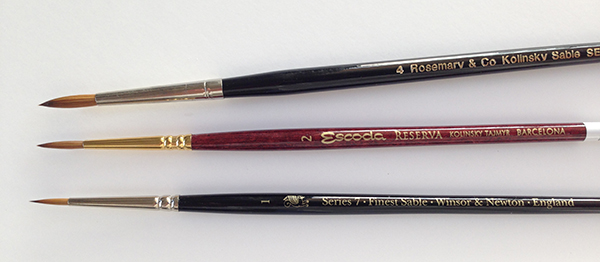
From top to bottom: Rosemary and Company, Series 33 Kolinsky Sable brush, #4; Escoda Reserva Kolinsky Sable Brush, #2; Winsor & Newton, Series 7 Kolinsky Sable Brush, #1. Photo by Deb Shaw.
As artists, we are not alone in our desperate search for Kolinsky brushes or substitutes. Art suppliers have been amazed at the wide variety of industries using sable brushes—industries they never knew they served. These include archeologists, the dental industry, various sciences, curators—the list is long. Some of the brush options described below have been well-loved in other industries. It may be time to look in new areas for supplies.
In the course of online discussions and correspondence, many of the participants discussed their favorite brushes, or new brushes they were trying out as substitutes for favorites that are no longer available. Please double check availability in the US and that the brushes meet international regulations. There are numerous brick-and-mortar art supply shops and online stores. The following is a brief, and by no means comprehensive, synopsis. There are other favorite online suppliers we did not have time to research.
Rosemary and Company: There are many wonderful hand-made brushes from Rosemary and Company, all top-notch quality. Kathleen Garness and Patricia Savage had enthusiastic endorsement of Rosemary brushes on the SciArt ListServ, comparing them to Winsor Newton Series 7. Holly Butlett liked the sable points, water holding capability and the feel. Bruce Bartrug endorsed their brights. (Added advantage for Bruce, “The brushes were also carefully packed in crumpled newspaper, and it was fun reading through the Yorkshire Post.”) Everyone commented on how quickly they shipped. Personally, I find the 33 series is a little long for botanical art (I tend to prefer shorter brushes anyway, especially for working on vellum). Margaret Best extensively tested the Rosemary 33 and 22 series. She thought the 22 series was too long; the 33 series seemed a touch long at first, but by the end of her painting it had become her favorite “go to” brush for botanical watercolors. Margaret also received a Series 323 Spotter she has yet to test. Rosemary and Company makes these for botanical artists, and Margaret reports that it looks like what she would call a miniature.
Pro Arte: I know a lot of folks who adore the Series 1 Pro Arte brushes. These are from the UK. Pro Arte also has a combination synthetic/sable brush called The Connoisseur, a blend of Prolene and Sable. Some artists are testing these out, but I haven’t heard any definitive feedback yet. The Pro Arte Connoisseur brushes are available in the US at Jerry’s Artarama, and other venues.
The Pro Arte brush above is not to be confused with the Connoisseur 007 brush. These are Kolinsky sable brushes, and, from their website, appear to be available in the US. Again, I know some artists who are testing these out, but I haven’t heard any results as of this writing. I also don’t know if they are readily available. Margaret Best will be testing this brush and reporting back. She says, “It is not a normal round brush length and also not a miniature. Somewhat in-between. May be better suited to vellum.”
One of the product buyers at Dick Blick, Nate, (who is also a watercolor artist), has been testing out synthetic brushes for his own work, using synthetics whenever he can to prolong the life of his Kolinsky brushes. He has the following recommendations for us to try: The first is the Escoda Versatil brush, a synthetic brush which is supposed to perform very much like the Escoda Kolinsky Sable brush. Nate also liked the Raphael Kaerell Synthetic—he said he even preferred the point on this brush to those on a real sable. He said that it would not be a great choice for those artists who need a fuller body for large color washes, but it has a good snap and keeps its point for a long time.
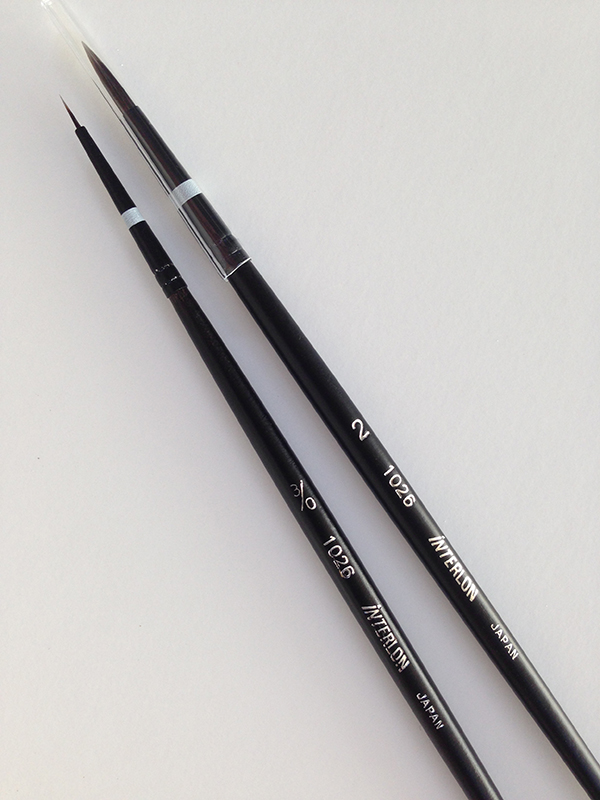
1026 Interlon synthetic brushes from Japan, in sizes #2 and 3/0. Photo by Deb Shaw.
At the ASBA conference in Chicago, 2012, Asuka Hishiki introduced her masking fluid workshop to a lovely synthetic brush, especially in the small sizes: the 1026 Interlon Brush Japan. It turns out that this is the go-to brush for the dental industry in Japan, used for whitening teeth. The brush keeps a sharp point, is great for dry brush work and is inexpensive (approximately $3.50)! Here in the States we were under the impression that the brush was only available in Japan, and we’ve been imposing on our Japanese colleagues to send us brushes. I just found them available at Best from Japan, who ships worldwide.
Several artists have reported decent results using Princetons for dry brushing, but I’m not sure which ones they used.
Cat Hair Brushes: In the September 2014 issue of “The Botanical Artist” (the Journal of the ASBA), Akiko Enokido wrote a techniques article in which she mentioned using a hand-made cat hair brush. She also mentions that these beautiful brushes, used in fine Japanese lacquer painting are not available for import into the US. Customs regulations for the United States bans importation of anything from any part of any cat. I haven’t investigated the reasons behind that ban…
Last, but not least, the beloved Winsor & Newton Series 7: I have heard many reports that the Winsor & Newton Series 7 brushes has been discontinued, and am embarrassed to confess that I had just accepted the news as fact. This too appears to be misinformation; we will have to ask Winsor & Newton directly. It looks like the Series 7 is still available in the rest of the world, and will continue to be manufactured, but Winsor & Newton pulled shipments to the US due to the Kolinsky Sable ban. Just goes to show we need to check everything from the source these days.
What We Can Do
- Make your voice heard. It’s time for us to start voicing our concerns to manufacturers, governments and international agencies. Speak up about safety, quality, availability and sustainability.
- Organize a “BRUSH OFF.” (My name—feel free to use it.) I spoke with our local art supply store about bringing our BAGSC botanical art chapter in to test various paint brushes for a nominal fee. They were enthusiastic, and it is something we will organize in the future. They don’t want to lose us as customers, and it’s expensive for each of us to test new brushes for the qualities we need as individual artists.
- Scour the internet and art supply stores for leftover brushes. Brick-and-mortar art stores have been allowed to sell the Kolinsky brushes they already had in inventory throughout the ban. I’ve found one or two of the last, lonely Kolinsky sable brushes in some out-of-the-way places.
- Let other artists know your finds. Have you discovered some new favorite brushes? Some suppliers for old favorites? Post comments to this article and let us know, or post to other online resources or publications.
The Big Picture: Green Art Supplies, Vegan Art Supplies, and Sustainability
An interesting side discussion has developed while talking about Kolinsky Sable brushes and the Siberian Weasel. Many of us didn’t realize where our brushes came from, or how they were made. Artists who wouldn’t think of wearing a fur coat are taking a second look at their supplies. There are efforts to recognize the impact of our art supplies, and artists are discussing balancing environmental and philosophical concerns against the use of synthetic materials (largely made with products derived from oil and plastic). It is worthwhile to have an ongoing debate about the responsibility, safety and sustainability of our materials. There are lots of resources on these topics—food for thought, and for another article.
Contributors:
There are a LOT of contributors to this article—more than I can possibly thank for sharing resources, opinions and information. It’s been a long process, and my apologies if I’ve forgotten to include your name here:
- Businesses and Agencies: Dick Blick, Ken Bromely Art Supplies, Mr. Craig Hoover, US Fish and Wildlife Service, NAMTA, Rosemary & Company
- ASBA and BAGSC members: Margaret Best, Akiko Enokido, Asuka Hishiki, Clara Josephs
- Facebook, Botanical Artists Group: Laura Dicus, Marilyn Garber, Kathleen Marie Garness, Vicki Lee Johnston, Jessica Rosemary Shepherd, Leslie Schramm
- GNSI SciArt ListServ: Karen Ackoff, Bruce Bartrug, Holly Butlett, Kathleen Marie Garness, Gail Guth, Mary Beth Hinrichs, Barry Kent MacKay, Kathleen McKeehen, Mali Moir, Lore Ruttan, Ph.D., Patricia Savage
by Diane Daly, posted by Deb Shaw

Treasurers’ student working on a beautiful watercolor of a sunflower. Photo courtesy of Bowers Museum/Council on Aging Orange County © 2014.
The James Irvine Foundation generously provides grants to the Bowers Museum Treasures Program. Bowers, in turn, uses the grants to reach out to the senior community. One way to engage older adults who may be feeling isolated is through art. The Treasures program reaches out to senior centers, community centers, libraries, social service agencies and residential communities by offering lectures, films, classes and tours.
The Council on Aging of Orange County is one of those agencies that works with the Bowers Treasures program. Since 1973, their mission has been to promote independence, health and dignity of older adults through compassion, education and advocacy. I have had the most rewarding experience and opportunity to teach a botanical drawing and painting class to the seniors at the Council on Aging. They provide translators since some of the seniors speak minimal English. I went home after the first class and brushed up on my Spanish and learned a greeting in Korean. The language differences seem to disappear when we are all involved in the art process of observing and drawing a fruit or plant. For eight sessions, we had a variety of specimens, starting with an apple and pear, a single tulip, a zinnia, a variety of peppers and chilis, a rose and finishing with a sunflower. It was pure joy to see the delight on their faces as they walked in and saw what the subject would be for the day.
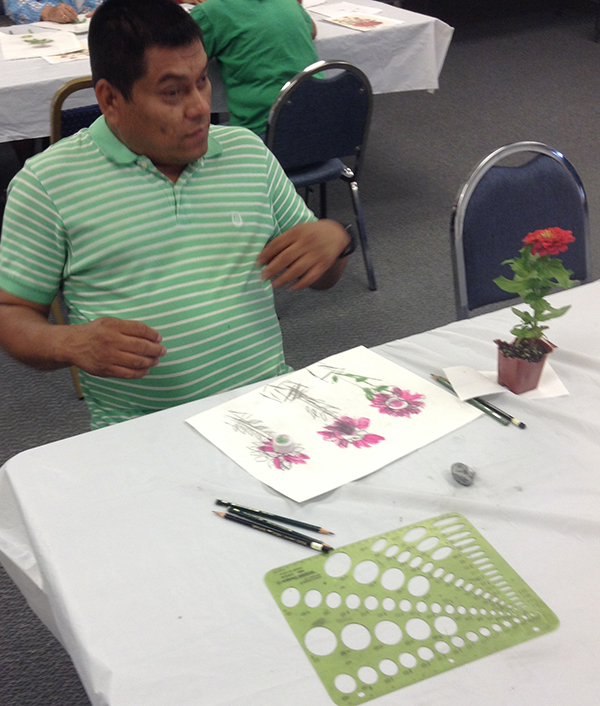
Students who are completely blind (but formerly sighted) were able to produce beautiful drawings. Photo courtesy of Bowers Museum/Council on Aging Orange County © 2014.
At first, when I was briefed on what the class should entail, I was told that there would be a few adults who were totally blind or had some sight impairment. Now, after all these years of trying to get as much detail in a botanical painting, I was truly baffled on how a blind person would be able to draw and how would I be able to teach them anything about drawing a flower. But, I was the one to learn a few things about drawing. They were able to feel the fruit or flower with their hands, emboss the paper with firm pressure on the pencil, use circle templates for guidance, and feel where to fill in the shape with color, with the aid of an assistant. I was amazed at the results. It is not botanical art as we know it, but is art that helps bring people together and give them pleasure and satisfaction. I made simple portfolios for them to take their drawings and paintings home on the last day.
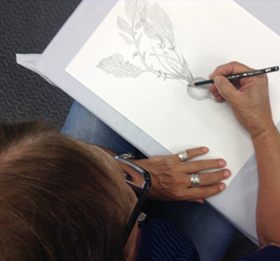
Treasures’ student drawing a radish in graphite. Photo courtesy of Bowers Museum/Council on Aging Orange County © 2014.
I had another opportunity through the Treasures program to teach a class on painting Asian flowers on parasols. Since there were 90 adults coming to this program, we used markers instead of paint. With 90 parasols opened and everyone drawing flowers on them, it was quite a challenge to move around to all the tables. Once again, I was delighted at the results; beautiful, original designs on all the parasols. The parasols were used for a display in the museum that weekend for a cultural event. They were able to take home the parasols, as well as all the other art projects that they created.
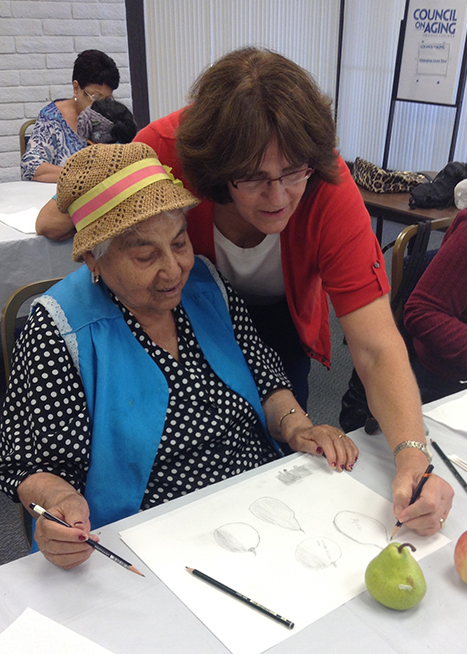
Diane Daly giving feedback to Treasures’ student. Photo courtesy of Bowers Museum/Council on Aging Orange County © 2014.
by Janice Sharp, posted by Deb Shaw
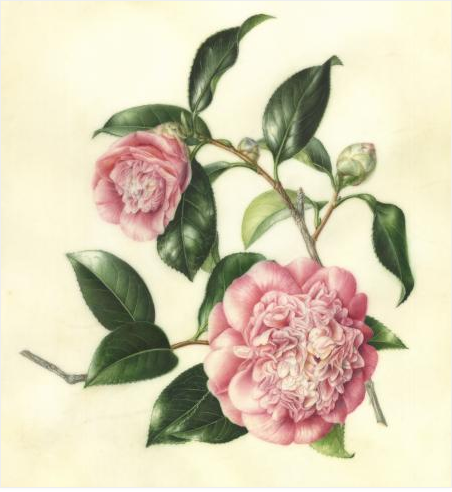
Camellia japonica ‘Chandleri Elegans’, Variegated Camellia, by Akiko Enokido, watercolor on vellum, © 2012, all rights reserved.
BAGSC is planning a Camellia Art Show in conjunction with the Camellia Society Camellia Show at Descanso Gardens in January, 2015. The show would be for two days and it is hoped that it will coincide with Descanso’s Camellia Week. It is possible we may be able to move the show to the Boddy House for a longer period of time.
I would like to get an idea of the number of people who would have paintings they would like to enter into the show. I would suggest that we hang original art in BAGSC’s standard light wood frames. Please email me (by clicking on the word “email”) the number of paintings you think you would like to submit by August 29, 2014. Space is limited in the hall in which the Camellia Show will be held, so we may have to limit the number of entries if we get too many.
If you missed the Spring-blooming Camellias, you’re still in luck—there are many Camellias which bloom in the Fall. The seed pods for Camellias which bloomed during the Spring are just now maturing, in case you want to include them in your work.
Watch the blog and your email for more information about the show as it develops.
by Deb Shaw

Lupinus succulentus, or Foothill Lupine, watercolor by Joan Keesey, © 2013.
The Irvine Fine Arts Center is holding an opening reception for “Paper Farm: Works on Paper” this Saturday, June 14, from 1–3 pm. Admission is free.
The exhibition runs from Saturday, June 14 through July 12, 2014, and features 47 artists’ works in ink, paint, pencil and watercolor of Southern California farm life and regional plants and animals.
BAGSC members Diane Daly, Clara Josephs, Joan Keesey, Terri Munroe, Mitsuko Schultz, Janice Sharp, and Deborah Shaw have artwork in the exhibition. Joan Keesey’s painting of Lupinus succulentus (Foothill Lupine) was used for the promotional materials for the show.
The Irvine Fine Arts Center is located at:
Heritage Park
14321 Yale Avenue
Irvine, CA 92604
Hours are Monday – Thursday, 10 am – 9 pm, Friday from 10 am – 5 pm, and Saturday from 9 am – 5 pm. The Center is closed on Sundays. Admission and parking are free to the public.
For more information, visit the website by clicking on the link above, or call 949-724-6880.
 BAGSC News