by Gilly Shaeffer, posted by Deb Shaw

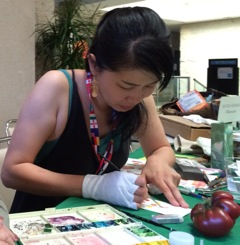
Asuka Hishiki demonstrating during the "Weird, Wild & Wonderful" Symposium at The Huntington, July 2015. Photo by Gilly Shaeffer, © 2015.

Asuka Hishiki demonstrating during the “Weird, Wild & Wonderful” Symposium at The Huntington, July 2015. Photo by Gilly Shaeffer, © 2015.

During the recent “Weird, Wild & Wonderful” Symposium at The Huntington, I watched Asuka Hishiki as she demonstrated how she would paint a segment of an heirloom tomato skin. Here are my impressions of the way she went about developing this small sample of the tomato skin with paint.

  • Asuka says every time she approaches her subject it is new for her.
  • Asuka starts sketches on tracing paper.
  • She uses a wood pencil in a pencil holder which she sharpens with a box cutter.
  • She goes over her pencil lines with a lighter color paint or yellow ochre.  So she will have thin lines in watercolor for her drawing.
  • At this point she erases any pencil lines.
  • She covers the entire form with a Chinese white wash. (The Chinese white that she likes is the Holbein brand.)  She says one should stay very light when applying the first layer of this white paint. This Chinese white wash acts as a protection for the paper. Much of it gets taken off during the removal of the masking fluid (to be mentioned later).
  • Asuka will add more Chinese white paint on the places where she wants the paint to bleed to create  soft color transitions. She also mentions the importance of keeping  harmony in the colors used as the form develops.
Asuka Hishiki masking fluid technique. Photo by Gilly Shaeffer, © 2015.

Asuka Hishiki masking fluid technique. Photo by Gilly Shaeffer, © 2015.

  • She mixes three colors together in a small amount to be used to develop the form using the dry brush technique. She uses Interlon brand brush #3/0 for her dry brush work.
  • In preparing to use masking fluid to prevent certain areas of the paper from getting painted, she would prime the brush to be used with liquid soap. The soap helps to keep the masking fluid brush in good shape for future use. This brush is used exclusively for masking fluid.
  • She will use the masking fluid to hold the places that she does not want to get painted—in this case the place where a leaf would be (which looks like a skinny wiggly line in the photos), where the highlights would be and where imperfections would be found on the tomato skin.
Asuka Hishiki masking fluid technique. Photo by Gilly Shaeffer, © 2015.

Asuka Hishiki masking fluid technique. Photo by Gilly Shaeffer, © 2015.

  • Asuka stipples on the masking fluid with a very skinny brush on the section that she has begun to paint.
  • She uses tissue to blot any extra paint from her paper.
  • Then she adds a second layer of  masking fluid. So, this layer of masking fluid dots will have more tone than the first layer of dots that she applied that prevent any paint from getting through to the paper.
  • She always makes sure that the paint and the masking fluid that she has applied are absolutely dry before proceeding.
  • She says that you can lift paint more easily when you have first applied a Chinese white wash to the paper.
  • She applies a layer of Yellow Ochre wash.
  • She continues to develop the form through her dry brush technique. At this point the masking fluid remains on the painted area.
Asuka Hishiki masking fluid technique. Photo by Gilly Shaeffer, © 2015.

Asuka Hishiki masking fluid technique. Photo by Gilly Shaeffer, © 2015.

  • Asuka uses Winsor Newton Series 7 brushes, #5 and #3 for the colored washes.
  • She adds a third layer of masking fluid dots.
  • With WN Series 7 #5 brush, she puts a colored wash on the section that she had previously dry brushed. This makes any lines from dry brushing disappear.
  • Now she lifts the masking fluid dots. When she does this she is also lifting the Chinese white paint that was applied to the paper at the very start.  The white of the paper now shows through in the places that had masking fluid on them.
  • She decides that she wants to apply another layer (this would be the fourth layer) of masking fluid dots. This will make the dots appear lighter and less visible than the layers applied earlier.
  • Next more dry brushing with a deeper color paint. Some stippling is used. Then some more wet strokes (colored washes) to further the development of the form.
  • When she removes the fourth layer of masking fluid, it is easy to see the section of the heirloom tomato skin developing on the paper with its highlights, its shiny smooth skin, its roundness, its imperfections and its rich colors of orange, red, and purple.

by Clara Josephs, posted by Deb Shaw

Are you looking for a tree to portray for the The Third New York Botanical Garden Triennial, “Out of the Woods”? We have a wonderful opportunity to participate in a guided tour of the unique tree collection of the Los Angeles County Arboretum and Botanic Garden, arranged just for pre-registered BAGSC members.

On the morning of Saturday, October 17, Jim Henrich, LA Arboretum Curator of Living Collections will take 20 pre-registered BAGSC members on a one hour, vigorous walk through the Arboretum to see and learn about some of their very special trees. Jim will explain what makes these trees stand out, their history and uses. After the tour you will be free to sketch and take pictures or just enjoy the Arboretum and Peacock café.

So that everyone can hear the discussion, this tour is limited to 20 members. To reserve a spot, email Clara Josephs. Confirmation and additional details will be sent to you by return email.

For more details about the exhibit “Out of the Woods: Celebrating Trees in Public Gardens”, read the Call for Entries in the Exhibitions section of the ASBA website.

The Los Angeles County Arboretum and Botanic Garden:
626.821.3222
301 North Baldwin Ave, Arcadia, CA 91007

by Deb Shaw

Focus on Nature XIV (FON XIV) has announced they will open in November, 2016 at the Roger Tory Peterson Institute (RTPI) in Jamestown, New York. It is an exciting collaboration between two institutions dedicated to continuing the tradition of natural history illustration. RTPI is a beautiful facility with exceptional exhibition space.

The entry deadline for FON XIV will be March 16, 2016. They will be posting the on-line entry form on the website (and I will hopefully receive an email alert as well, so I can post it to the BAGSC blog). Please check the FON website often as they are in the process of updating.

BAGSC and ASBA members have been well represented through the years in the FON exhibitions. Visit the FON website to view artwork from past exhibitions and award winners.

Stay tuned!

by Lesley Randall, posted by Deb Shaw

Aristolochia gigantea, ink on paper, Lesley Randall, © 2013, all rights reserved

Aristolochia gigantea, ink on paper, Lesley Randall, © 2013, all rights reserved.

Lesley Randall will be teaching a two-day workshop on pen and ink for botanical illustration in northern California. Sponsored by the UC Davis Center for Plant Diversity, this workshop is for students of all levels.

Saturday, October 24 and Sunday, October 25, 2015
9:00 am to 4:00 pm
3075 Sciences Laboratory Building
UC Davis

The cost is $170.00 for Davis Botanical Society and ASBA members; $190.00 for non-members. Make checks payable to Lesley Randall and send to her address. Questions? Contact Lesley via email.

Botanical illustration is an art with a long tradition. Although accuracy is the top priority, pen and ink botanical illustrations are art pieces of elegant beauty. Lesley will cover the basics from sketching to transfer and inking techniques. Types of papers and pens will also be discussed. All levels of experience are welcome! Students are encouraged to bring completed sketches so they can focus on inking techniques.

Lesley has been an illustrator for 27 years. Her published work has appeared in The Flora of Yosemite National Park, The Jepson Manual, Invasive Plants of California’s Wildlands and numerous scientific journals. She has exhibited her work in Australia, the United Kingdom, New York City and California.

by Lori Vreeke, posted by Deb Shaw

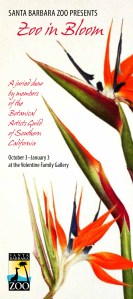
Front of "Zoo in Bloom" invitation postcard, with artwork by Lori Vreeke.

Front of “Zoo in Bloom” invitation postcard, with artwork by Lori Vreeke.

The Santa Barbara Zoo is advertising the opening reception and exhibition for the “Zoo in Bloom” exhibition. The show opening is October 3, 2015, from 10:00am – 5:00pm on Saturday, October 3, 2015, in the Volentine Family Gallery. 

The Volentine Family Gallery is located inside the Discovery Pavilion. Zoo admission rates apply, and drinks and snacks will be available for purchase.

BAGSC members will be demonstrating and answering questions all day. Download the PDF invitation postcard by clicking on this link: ZooArtShowInvitation_2015.

Also happening on October 3rd at the Zoo: Member Morning, from 8 am – 10 am; and ZOOs Line is it Anyway?

The Santa Barbara Zoo is located at:
500 Ninos Drive
Santa Barbara, CA 93103
(805) 962-5339 main
(805) 962-6310 info line
sbzoo.org

by Cynthia Jackson, posted by Deb Shaw

From the New York Times article post: Hardwicke's woolly bat, flying into a pitcher plant, Nepenthes hemsleyana, where it roosts. The plant attracts the bats to feed on their guano. It does not eat the bats. Photo credit: Ch'ien C.

From the New York Times article post: Hardwicke’s woolly bat, flying into a pitcher plant, Nepenthes hemsleyana, where it roosts. The plant attracts the bats to feed on their guano. It does not eat the bats. Photo credit: Ch’ien C.

BAGSC member Cynthia Jackson forwarded a link to a New York Times article, Plants that are Predators, posted online September 14, 2015.

The article highlights numerous carnivorous plants, including the Nepenthe pictured here.

During the “Weird, Wild & Wonderful” Symposium, Mieko Ishikawa gave a workshop on painting Nepenthes, and also discussed them in her lunchtime keynote about painting the plants of Borneo. She showed photographs of one Nepenthe that serves as a toilet for a rodent.

More stories and photos about the “Weird, Wild & Wonderful” Symposium will be posted soon.

Thank you Cynthia for the link!

Mummy Brown* and Other Historical Colors, Arranged by Date (More or Less) from Prehistory to Almost-Present, Veritable Hokum, by Korwin Briggs, http://www.veritablehokum.com/ [Click image for larger view.] Used with permission as stated in terms under "About", © 2015.

Mummy Brown* and Other Historical Colors, Arranged by Date (More or Less) from Prehistory to Almost-Present, Veritable Hokum, by Korwin Briggs, http://www.veritablehokum.com/ [Click image for larger view.] Used with permission as stated in terms under “About”, in the Veritable Hokum blog. © 2015.

by Deb Shaw

Korwin Briggs is an illustrator who publishes the online comic blog Veritable Hokum (click the name to go to the blog). As he writes in his “About” section, “Veritable Hokum is a comic about mostly history, maybe science, and possibly some other stuff too.”

This week’s delightful post is a comic illustration and description about the history of pigments, entitled “Mummy Brown* and Other Historical Colors, Arranged by Date (More or Less) from Prehistory to Almost-Present.” Click on the link above to read the entire article as well as enjoy the graphic description of some of our favorite pigments. The history doesn’t go all the way to the modern Quinacridones, but contains fun facts and history in a quick read format with a great sense of humor.

Enjoy!

posted by Deb Shaw

BAGSC member Rita Hopper has two botanical pieces in the Tustin Art League exhibition at the Tustin Senior Center.

The show is open on weekdays, from 9 am – 4 pm, and will run from September 10 through October 1, 2015. There will be an opening reception on Friday, September 18th from 6 – 8 pm.

The Tustin Senior Center is located at:
200 South “C” Street, Tustin, California 714.573.3340.

The Tustin Art League consists of visual artists and is a program of the Tustin Area Council for Fine Arts (TACFA). The organization’s mission is to provide a venue that contributes to the growth of each member, and to enhance the visual arts within the community to enrich and energize citizens of all ages.

Congrats Rita!

by Deb Shaw

Gilly Shaeffer, Strelitzia nicolai, watercolor on paper © 2015, all rights reserved.

Gilly Shaeffer, Strelitzia nicolai, watercolor on paper © 2015, all rights reserved.

The Santa Barbara Zoo will be hosting an opening reception for the “Zoo in Bloom” exhibition, in conjunction with the gala celebrating Santa Barbara Zoo Members’ Day. The celebration runs from 9:00am – 5:00pm on Saturday, October 3, 2015.

BAGSC artists will be demonstrating throughout the day in the gardens and will staff an information table to answer any questions about our  exhibit and about BAGSC and ASBA.

You do not need to be in the exhibition to volunteer — the more BAGSC members the merrier! Please let Lori Vreeke know when you would like to volunteer and what you would like to do.

Sign up for as many time slots as you would like. Want to carpool to Santa Barbara? Call or email Lori to let her know and to find out who else is coming up from your area.

The Santa Barbara Zoo is located at:
500 Ninos Drive
Santa Barbara, CA 93103
(805) 962-5339 main
(805) 962-6310 info line
zooinfo@sbzoo.org

by Deb Shaw

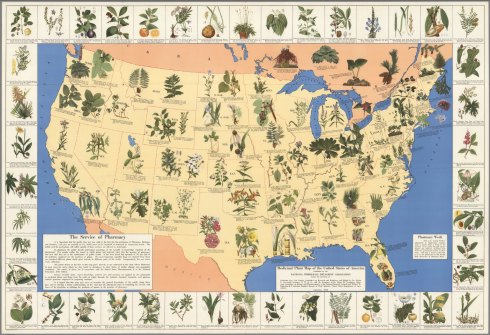
Medicinal plant map of the United States of America, David Rumsey Map Collection, 1932. Author: National Wholesale Druggists' Association, Edwin Newcomb. Publisher: Einson-Freeman Co., Inc., New York.

Medicinal plant map of the United States of America, David Rumsey Map Collection, 1932. Author: National Wholesale Druggists’ Association, Edwin Newcomb. Publisher: Einson-Freeman Co., Inc., New York.

The year 1932 was a year of transition for the pharmacy industry. Historically, medicines had been compounded from plants. Botanical gardens and botanical art had originated with physicians describing diseases and the plants and other natural compounds used to treat and cure them. In the 1930’s however, pharmaceutical companies began to explore new synthetic drugs in the lab with increasing success.

The National Wholesale Druggists’ Association responded by producing a map of medicinal plants and highlighting their knowledge and skills in using them. Botanical illustrations of medicinal plants are shown as a border for the map, as well as in each of the States (minus Alaska and Hawaii) where they grow or are cultivated. Each illustration is accompanied with the Latin name and a description of the plant’s medicinal use.

The text in the lower right corner explains:

“It is important that the public does not lose sight of the fact that the professions of Pharmacy, Medicine, and Dentistry, each give an essential service, which must not be impaired or destroyed by commercial trends. The public and the professions will suffer equally if these services are allowed to deteriorate.

In pharmacy the public should understand something of the breadth of knowledge required of the pharmacist. Few people realize the extent to which plants and minerals enter into the practice of pharmacy, and how vital they are to the maintenance of public health. It has been stated that upwards of 70 per cent of all medicines employed are the products of plants. The more important vegetable drugs are obtained from about two hundred different plants which grow natively in different parts of the world. …”

More information is available in the Slate article by Rebecca Onion, “A Depression-Era Medicinal Plant Map of the United States.” The map is available for download (including in a high-resolution format) and prints are available for sale on the David Rumsey Map Collection site.

Thank you to the GNSI member that posted the link to this map, and my apologies for not being able to find the original post so I could locate your name and give you proper credit!

by Deb Shaw

File photo of the Bomb Squad, reproduced from the "LAObserved Native Intelligence" article, "A visit from the Bomb Squad," by Nancy Boyarsky, published online Septemer 2, 2015, 12:33 am. See link in this article. © 2015 LAObserved.

File photo of the Bomb Squad, reproduced from the “LAObserved Native Intelligence” article, “A visit from the Bomb Squad,” by Nancy Boyarsky, published online Septemer 2, 2015, 12:33 am. See link in this article. © 2015 LAObserved.

BAGSC member Cynthia Jackson, sent an email the other day, asking “is this one of us?” with a link to an article in LAObserved: Native Intelligence, Observations by LA Observed authors and other Angelenos.

Titled, “A visit from the Bomb Squad,” (click on the title to read the article), I didn’t even glance at the byline and started reading right away. When I read the reference to botanical art at the end of the article, (no, I’m not going to give it away — you have to read the article), I scrolled quickly back to the top. Sure enough, it was written by Nancy Boyarsky!

For those of you who are newer BAGSC members, Nancy was one of our founding members, and served on the Board for many years handling Public Relations and Communications for BAGSC with her wonderful writing skills.

Cover of "The Swap," by Nancy Boyarsky, sold on Amazon.com

Cover of “The Swap: A Mystery” by Nancy Boyarsky, sold on Amazon.com

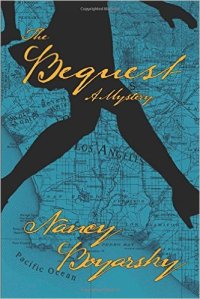
Nancy responded to my email that since leaving BAGSC, she’s written two mystery novels, now available on Amazon: The Swap: A Mystery and The Bequest: A Mystery, and is now working on her third book.

And yes, Nancy sent the article to the unnamed botanical artist responsible, and she and her family thought it was very funny.

Thank you Cynthia, and congrats Nancy!

Cover of "The Bequest: A Mystery" by Nancy Boyarsky, sold on Amazon.com

Cover of “The Bequest: A Mystery” by Nancy Boyarsky, sold on Amazon.com

Plaza de Espana, Seville, © Quench Travel.

Plaza de Espana, Seville, © Quench Travel.

by Michael Best, posted by Deb Shaw

There are only 2 spaces left in Margaret’s April/May 2016 workshop in Spain. Non-artist friends, partners or spouses are also welcome.

The workshop accommodation is a beautifully restored 16th century house located in an aromatic garden surrounded by 3000 acres of olive and orange groves. As for all of Margaret’s previous painting trips, this workshop/tour is capably managed on the ground by Kiloran McRae for the Quench Travel Group of Toronto.

The tiled garden view in Alcazar Palace Gardens, © Quench Travel.

The tiled garden view in Alcazar Palace Gardens, © Quench Travel.

Five glorious days of painting will be spent in a spectacular setting high in Sierra Moreno Mountains, just north of Seville in the heart of Andalucía with options to tour the historic sights of Seville and Barcelona. As always, Quench ‘s remarkable local connections will make for an unforgettable, cultural immersion. Tapas, flamenco dancing, sherry bodegas, historical gardens …

Many of the already registered participants have been on three or more of Margaret’s destination workshops. Their enthusiasm for these unique painting opportunities speaks to the quality of their previous experiences. BAGSC member Jan Clouse and her husband Charles of Santa Barbara have this to say about their previous trips with Margaret and Kiloran:

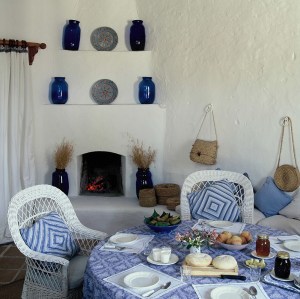
Trasierra interior, © Quench Travel

Trasierra interior, © Quench Travel

Margaret knows how much Jan appreciates her guidance and mentoring, but the sustained exposure to her teaching skills provided by these trips is inestimable. We both admire Kiloran’s skills as well. Where do we start? Guide? Translator? Chaperone? Student of Medieval history? Plant identifier? She does it all at breakneck speed — in two, sometimes three, languages. Can’t praise her too highly either.

The food was as always, rave-worthy … impressive botanical gardens, the welcoming horticulturalists, and historical sights as well… Altogether we had terrific experiences as botanical painter, guitarist, and tourists.

For details about this unique painting opportunity and a chance to explore some remarkable art and sites of historical significance in Spain, see Quench Travel’s website.

Previous Margaret Best/Quench workshop destinations have included:

  • Tuscany, Italy
  • Marrakech, Atlas Mountains, Morocco
  • Newfoundland, Canada
  • Cotswold’s, England
  • Puglia, Italy

by Lori Vreeke, Deb Shaw

A view of the gallery at the Santa Barbara Zoo where the "Zoo in Bloom" exhibition will hang.

A view of the gallery at the Santa Barbara Zoo where the “Zoo in Bloom” exhibition will hang.

While making plans for your Labor Day weekend, don’t forget that the submission deadline is September 5, 2015 for “Zoo in Bloom,” the juried BAGSC exhibition at the Santa Barbara Zoological Gardens. Jurors are: Olga Eysymontt, Ann Swan, and Chris Briggs.

All current BAGSC members in good standing are eligible to enter up to two (2) original works of art of botanical flowering specimens grown at the zoo (no prints).  Artwork must depict plants that grow at the Zoo. There is no size limitation, and works may have been shown in previous BAGSC, ASBA, Filoli or other exhibitions.

The exhibition will continue through the end of the 2015 and will be open every day to visitors of the zoo. Due to space constraints, this will be a juried show with approximately 30 pieces of art hung. All original artwork must be for sale, prints not allowed.

See previous BAGSC Blog posts with submission details. The submission packet will be sent out again in an email blast to members for convenience.

A view of the gallery at the Santa Barbara Zoo where the "Zoo in Bloom" exhibition will hang.

A view of the gallery at the Santa Barbara Zoo where the “Zoo in Bloom” exhibition will hang.

Questions? Contact Lori Vreeke.

by Veronica Raymond and Deb Shaw

Kathy Musial and feathered friend during a botanical trip.

Kathy Musial and feathered friend during a botanical trip.

The Southern California Horticultural Society (SCHS) is honoring Kathy Musial with a “Horticulturist of the Year” award at their 2015 Annual Award Banquet at the Los Angeles Arboretum.

BAGSC members may be most familiar with Kathy’s tireless work as part of The Huntington/BAGSC team for “Weird, Wild & Wonderful: The New York Botanical Garden Second Triennial Exhibition,” Weird, Wild & Wonderful Symposium, and the BAGSC adjunct exhibition.

The Southern California Horticultural Society is recognizing Kathy with the 2015 Horticulturist of the Year award for her work as Curator of Living Collections at the Huntington Library, Art Collections and Botanical Gardens. During her work there during the last 30 years, Kathy has made significant contributions to horticultural and botanical knowledge, both locally and globally.

Kathy has authored numerous publications, ranging from professional papers to excerpts from her travel diary of her tours to Chile, to editing the massive tome, Conifers Around the World, with Zsolt Debreczy and István Rácz. She has led botanical tours to Australia, Chile, New Zealand, South Africa and Madagascar.

Everyone is invited to join SCHS in celebrating Kathy’s remarkable work and dedication in the field of horticulture and in advancing a greater understanding of the flora of our world on:

Thursday, September 10, 2015
Los Angeles County Arboretum and Botanic Garden
301 N Baldwin Ave, Arcadia, CA 91007
Peacock Cafe
6pm, social hour and silent auction. Dinner and presentation begin at 7pm.

Purchase banquet tickets on-line, $45 each, by Thursday, September 3, 2015.
Please call Steven Gerischer, (323) 257-3629 with any questions.


Kathy has been a great resource for many BAGSC members and plant lovers everywhere. Congratulations Kathy!

by Alyse Ochniak and Deb Shaw

Please join us for a brief BAGSC Quarterly meeting and a much deserved Celebration(!!), on Saturday, September 12, 2015 as “Weird, Wild & Wonderful: The New York Botanical Garden Second Triennial Exhibition” goes off across the country to the Frost Museum in Florida to coincide with the 2015 ASBA Annual Meeting and Conference.

The meeting will be at Diane’s home and will include workshop announcements and programs for next year! An email blast will be sent out to all BAGSC members with directions. Coffee and tea is at 9:30 am, and the meeting starts at 10:00 am sharp. Please email Diane to RSVP and let her know what you will bring for potluck.

Please bring any artwork you created (or started) at the Weird, Wild & Wonderful Symposium, along with other drawings and paintings you are working on to share as we celebrate a milestone event.

Calling all “Weird, Wild & Wonderful” Stories and Photos

We want to post stories, reviews of lectures and workshops, and photos (of course) from the Weird, Wild & Wonderful Symposium and the BAGSC adjunct exhibition on the BAGSC Blog. Send your stories and images to Deb Shaw, and a BAGSC Blog committee will edit and post them. Be sure to include caption information for your photos, who took the photo (for copyright) and names of the people or plants in the photo if you know them.

Want to learn how to be a BAGSC Blogger? Contact Deb and have your own byline.

You can see images from the WWW Symposium on ASBA’s site under “RECAP“.

Hope to see you at the BAGSC meeting!

March 2026
M T W T F S S
 1
2345678
9101112131415
16171819202122
23242526272829
3031  

Enter your email address to follow this blog and receive notifications of new posts by email.

Join 161 other subscribers