You are currently browsing the category archive for the ‘Feature Articles’ category.
by Deb Shaw
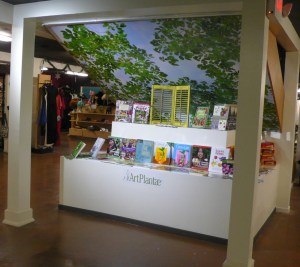
ArtPlantae Display at Aurea Vista in Riverside, California, © 2012 Tania Marien
This weekend ArtPlantae will participate in the First Annual Holiday Party at Aurea Vista, Riverside’s newest shopping destination.
The holidays aren’t the only thing to celebrate this weekend, however.
ArtPlantae is celebrating the launch of a new plant-based education display featuring resources for children, parents and teachers. Dedicated specifically to botany and botanical art education, this section features curriculum by the National Gardening Association, children’s books about plants (in English and Spanish), instructional books about drawing and botanical art, plant identification guides, and the Colorful Edibles coloring book published by the American Society of Botanical Artists.
When visiting ArtPlantae at Aurea Vista, don’t miss the display area upstairs featuring books about contemporary botanical art and botanical art history.
Discover more this Saturday during the holiday party. The festivities begin at 4:00 pm and continue until 9:00 pm. Meet local artists and designers and finish your holiday shopping too. Visit ArtPlantae’s new area about plant-based education and receive a free gift. It is located downstairs across from the children’s boutique.
Stop by on your way to the Festival of Lights and the Artists Collective located just down the street on the Main Street Pedestrian Mall.
Free gifts available while supplies last.
A Little About Aurea Vista
Aurea Vista is located in a building in downtown Riverside, California whose life began in 1927 as a hotel built by architect G. Stanley Wilson. Today the building serves as an exciting new marketplace for local artisans, designers, importers, food sellers and craftspeople.
Visit Aurea Vista and discover many treasures such as delicious olive oils by Beyond the Olive, terrarium designs by Brenda Cook of Botanical Perspective, and yards of inspiration (and classes too!) at Raincross Fiber Arts.
Aurea Vista is located at 3498 University Avenue in Riverside on the corner of Lemon and University. Hours are Monday-Saturday (11-8), Sunday (11-5). Store hours are extended for Riverside’s monthly ArtsWalk and other special events.
Parking: Free customer parking is available across the street in the parking lot with the ballet mural. Aurea Vista customers can park in spaces #1-8 that face University Avenue. Street parking is free after 5 PM Monday-Friday. Street parking also is free on Saturday and Sunday.
by Deb Shaw and others
There are always new tempting art supplies available, but this year there seems to have been a cascade of new art products that make traveling with art supplies a breeze. Below are just a few of our current favorites. Disclaimer: I’ve included some links and prices where it’s easy and I know the resource. I haven’t done extensive research on who carries what, or who has the best prices. If you click on any of the links below, you’ll go to the exact product page for that website, rather than the home page.
Do you have some favorite new products? Write a review and let me know and we’ll put together another column in the future.
Derwent Carry-all
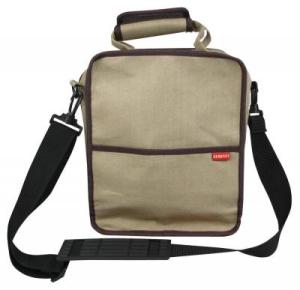
Closed Derwent Carry-all, image courtesy of the Ken Bromley website.
Not yet available in the US, this is the best portable art studio I’ve found! I can fit everything I need for pencil and watercolor artwork, all into one 10″ x 8″ x 4″ canvas satchel. Everything I need now lives permanently in my Carry-all, whether I’m working in the studio, or I’m on the road or in classes.
The Carry-all comes with three “leaves”, held in place by six small notebook-style snap rings. The leaves snap in and out, depending on your travel requirements, and have elastic straps to hold pencils, pens, brushes, etc.

Open Carry-all, image courtesy of the Ken Bromley website.
There’s a zippered mesh pocket on the inside front, and a strap on the inside back to hold an A5 sketchbook and other necessary items.
An external pocket, carry handles and a detachable shoulder strap complete the kit. The Derwent Carry-all is available at Ken Bromley Art Supplies (among other UK art suppliers), on sale now for about $26.00 (£15.99). Deb is putting together a BAGSC group order. Watch your email for an offer to participate!
Invisi Lightweight Display Easel
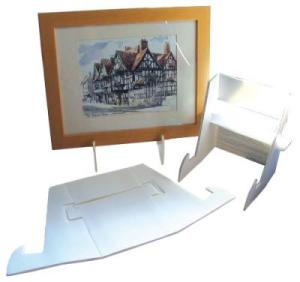
Invisi Lightweight Display Easel, image © Ken Bromley Art Supplies website.
This one is a Ken Bromley exclusive that I’ve tested extensively and will be ordering a lot more (BAGSC members watch for the email to participate).
Originally designed as portable display easel for art exhibitions, the Invisi Easel is made from white corrugated plastic (the same material out of which the Post Office constructs its boxes). Reusable, they lay flat for storage and transport, and snap together in one easy motion to set up.
In addition to using the Invisi Easel to set up an artwork display, I’ve also been using one as an easel in art classes. My neck and back no longer allow me to work hunched over a table, and I work sitting upright at an easel in my studio. The need for lightweight packing for airline travel, however, doesn’t allow me to drag my easel along for art classes.
I’ve been setting up my Invisi Easel, adhering it to the table with a bit of kneaded eraser or tape (so it won’t scoot away as I work). I have my paper (or vellum) on a piece of foam core as I usually do, and I’m ready to draw or paint. No, you can’t put a lot of pressure on the painting as you work, but I haven’t had a problem with painting or drawing. And my back and neck are grateful as well.
The Invisi Easel is about $9.11 each (£5.65), or approximately $40.24 for a 5 pack (£24.95), or approximately $72.50 (£44.95) for a 10 pack. If enough BAGSC members are interested, a pack of 50 is available for about $272.00 (£168.50).
Porcelain Tinting Saucer

Porcelain Tinting Saucer, courtesy of Ken Bromley website
This item comes from BAGSC members Elaine Searle and Pat Mark (who discovered it in Elaine’s class). Again, it’s another one of those things we don’t seem to be able to get here in the US yet. A small (only 3.3″ diameter) white porcelain saucer, it has four divisions for mixing paint and is easy to pack. It’s about $3.60 each from Ken Bromley (£2.25). This too will be on our order list for BAGSC member who want to participate, so watch your email.
Koh-I-Noor Watercolor Wheel Set

Koh-I-Noor Watercolor Wheel Set, image courtesy of the Dick Blick website
Thank you to Tania Marien for discovering this gem at the SCAD bookstore at the GNSI conference in Savannah, Georgia. These are available all over, including Dick Blick and my local art store (where I bought mine). Each wheel measures 3-1/4″ in diameter, and set comes with four wheels (trays) that stack and screw together. Each tray holds six colors (seven if you use the middle space, for a total of 24 – 32 colors. The transparent cover can be used for mixing, if you don’t mind mixing in plastic.
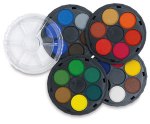
Koh-I-Noor Watercolor Wheel Set, courtesy of Dick Blick website
Be forewarned; it’s not easy to pry, soak and scrape the original colors out of the pans. Once you do, however, your own palette neatly and easily fills the spaces. I created labels with the paint names and information for the underside of each well. Two sets gave me enough space for my entire palette, plus extra spaces for that squirt of color that I didn’t know I needed from a friend in class.
Faber-Castell Clic & Go Water Pot
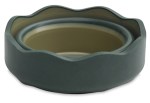
Faber-Castell Clic & Go Water Pot, courtesy of Dick Blick’s website

Expanded water pot, courtesy of Dick Blick’s website
Everyone seemed to discover this one at the same time! Easy to find everywhere (at Dick Blick for $3.86 — 26 percent off list), this ingenious water pot collapses for travel (or for a small amount of water) and then expands to hold at least double the amount. Easy to clean, and nicely designed scallops on the rim are the perfect holders for brushes.
I use two.
Caran d’Ache Pencils
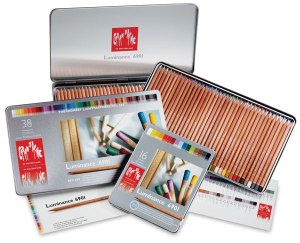
Caran d’Ache Luminance 6901 Colored Pencils, courtesy of Dick Blick’s website
Thank you to Margaret Best for steering me to the Caran d’Ache Luminance Lightfast colored pencils and graphite.
The Colored Pencil Society of America (CPSA) worked with the American Society for Testing and Material to develop the ASTM D-6901 standards for lightfastness in colored pencils. After two years in development, the Swiss company Caran d’Ache released their Luminance 6901 Lightfast Pencil Sets: the only brand to offer 76 colors, 61 of which are in the most lightfast (Lightfastness I) category.
The chromatic range of the soft leads is very similar to the watercolor palettes used by botanical artists, and contains the highest level of pigments of any colored pencil. Additionally, the Luminance 6901 colored pencils have been awarded use of the FSC (Forest Stewardship Council) label, guaranteeing that the logging of the California cedar for the pencils is environmentally-friendly and socially and economically sustainable.
The colored pencils come in sets of 16, 38, and 76 from many sources in the US, including Dick Blick, Cheap Joe’s, Jerry’s Artarama, Rex Art, and more. Jerry’s Artarama is the only site I’ve seen in the US that also sells individual colored pencils, but there may be others.
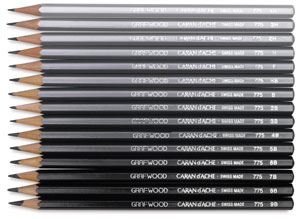
Range of Caran d’Ache Grafwood Pencils, courtesy of Dick Blick’s website
Caran d’Ache also offers a spectacular line of graphite: their Grafwood pencils range from HB through 9B, as well as F, H, 2H, 3H, and 4H. They also carry water-soluble graphite (Caran d’Ache Technolo Water Soluble Graphite Pencils), Grafstone Woodless Graphite Pencils, Charcoal Pencils, and Grafcube Graphite Sticks. The pencils are “color-coded” the entire length of the pencil; the harder the pencil the lighter the silvery-gray color of the barrel.
The only adjectives I can come up with to describe these pencils are the same ones I would use to describe food: luscious, buttery, smooth, creamy, all come to mind. Warning: they’re not cheap. Take a deep breath before looking at the sticker price. As far as I’m concerned, however, they’re absolutely worth it.
by Diane Daly and Clara Josephs, posted by Deb Shaw
January’s coming up fast, and the Chapman University Leatherby Library Drought Tolerant Plant Exhibition will be upon us (along with all the other exhibition opportunities we have stacked up for the month — but more on those later!).
Students from Jennifer Funk‘s Ecology course currently are writing descriptions of the plants’ drought-tolerant traits now. We are planning to have at least one species that fits into each of the following seven categories:
- Drought-deciduousness (plants that lose their leaves during the dry season, or during periods of dryness)
- Small leaves (better adapted to dry soils and conditions)
- Deep taproot (a tap root that penetrates deep into the ground can access water when it is scarce during a drought or dry conditions, as well as store water in the root)
- Succulent leaves (thick, fleshy leaves and stems can store water)
- Pubescent leaves (pubescent, or furry leaves can slow the air flowing over the leaf to reduce water evaporation, hold water, reflect sunlight, and provide shade for the surface of the leaf)
- Evergreen, sclerophylous leaves (evergreen leaves, of course, stay on the plant year-round; sclerophylous leaves have a hard surface and are frequently spaced close together
- Annual life habit (one way to avoid dry periods is to quickly grow, bloom and develop seeds during the wet season, skipping the dry season altogether!)
Important Deadlines:
- Artist entry deadline: January 11 (BAGSC needs the list for handouts, Chapman University needs the list for labels and insurance)
- Set up show in Henley reading room: January 25
- Reception: February 7 , 7-9 pm
- Take down the show: February 25
All BAGSC members will receive an email with the official BAGSC “Call for Entries” packet. If you do not receive this email with the attachment by 30 November, please contact Deb.
Drought Tolerant Plant Choices for the Chapman Exhibition
The following are plants that BAGSC members are planning to submit. Botanical and common names, of course, will need to be reviewed and verified. Don’t worry if you have to change your mind, or if you’re already painting something that someone else is painting on the list below. This is a preliminary list and is not set in cement. Space allowing, species duplicates will be accepted (see the Call for Entries packet).
Arillyn Moran-Lawrence:
Dudleya Farinosa; Salvia Chamaedroyides, Electric blue sage; Desert Marigold, Baileya multiradiata; Echeveria graptoveria or Kalanchoe thyrsiflora
Bonnie Ash:
Agave Utahensis var. nevadensis; Pacific Mist Manzanita, Arctostaphylos uva-ursi
Linda Ericksen:
Prickly pear cactus, Opuntia
Joan Keesey:
California Buckeye Flower, Aesculus californica; Flannel Bush, Fremontodendron; California Poppy Eschscholzia californica; Foothill Penstemon, Penstemon heterophyllus; or Heart Leaf Penstemon, Keckiella cordiforlia; Toyon, Heteromeles arbutifolia; Bush Monkey Flower, Mimulus aurantiacus
Patricia VanOsterhoudt:
Crape Myrtle, Lagerstroemai indica; Columbine Aquilegia; Yucca
Sue Kuuskmae:
Fortnight Lily Dietus vegeta; Rock Rose Kalanchoe; Toyonberry; Matilija poppy, Romneya coulteri
Estelle DeRidder:
Coastal Prickly Pear, Opuntia littoralis; Baja Fairy Duster, Dalliandra eriophylla; California Live Oak, Quercus agrifolia; Chia, Salvia Columbriae
Clara Josephs:
Coffeeberry, Rhamnus californica; Topsy Turvy, Echeveria; Bladderpod, Isomeris arborea
Diane Daly:
Island Alum Root, Heuchera maxima; Seaside Daisy, Erigeron glaucus; Bird of Paradise, Caesalpinia pulcherrima
Carmen Lindsay:
Bladder Sage; Ocotillo; Buckwheat
Veronica Raymond:
Coffeeberry, Rhamnus californica; Bladderpod, Isomeris arborea; Nevins Barberry, Mahonia nevinii; Englemann Oak Quercus engelmannii
Cristina Baltayian:
Lemon, C. limon; Bougainvillea; Fig, Ficus carica L. (Brown turkey); Olives, Olea europaea; Cabernet grape vitis vinfera L.; Pomegranate, Punica granatum
Mitsuko Shultz:
Nevins Barberry, Berberis nevinii; California Sycamore, Platanus racemosa
Patricia Mark:
Manfreda masculosa; Aeonium
Deborah Shaw:
Dudleya pulverulenta, Chalk Dudleya; Dudleya viscida, Sticky Dudleya; Arctostaphylos glauca, Big Berry Manzanita
Add your name and plants to the list: contact Diane.
It’s shaping up to be a great show!!!
by John Keesey, posted by Deb Shaw

Sally’s beautiful studio space was all set up when we arrived, with handouts and gifts from Anita.
For three lovely days in mid-October twelve eager botanical artists enjoyed the warm personality and dazzling expertise of Anita Walsmit Sachs from the Netherlands. They met each morning in the pleasant downstairs classroom of Sally Jacobs’ Studio near LACMA to learn botanical line drawing from Anita, the head of the Art Department of the Nationaal Herbarium Nederland of the University of Leiden in the Netherlands. She brought many examples of the beautifully composed line drawings she creates for scientific articles, complete with ink stippling to suggest shading and shape. She has also contributed exquisite watercolors of Acer and Syinga to the Florilegium of the Prince of Wales’ Estate at Highgrove, and has won two gold medals from the Royal Horticultural Society of England.

Mimulus ‘Dave’, by John Keesey, pen and ink, © 2012
We brought our own plant to draw, first in pencil to show the “habit” or repeating part of the plant, then details of structure often viewed under a dissecting microscope and drawn over graph paper. These pencil drawings were cut out and taped into a suitable composition, which was perhaps the most challenging aspect of the project. This was then transferred via tracing paper and a light box to a paper with a vellum finish suitable for inking, which was done using Rotring or Staedler pens of several sizes to indicate the light source and overlapping. Finally graduated stippling with these pens to indicate shading and shape was discovered to be an excellent form of meditation!

Salvia ‘Hot Salsa’ by Joan Keesey, pen and ink, © 2012
Botanical artists who attended these sessions included Sally Jacobs, Leslie Walker, Deborah Shaw, Tania Norris, Norma Sarkin, Janice Sharp, Bonnie Born Ash, Joan Keesey, Tania Marien, Mitsuko Schultz, Alyse Ochniak and Estelle DeRidder. Also present was Yours Truly, John Keesey.
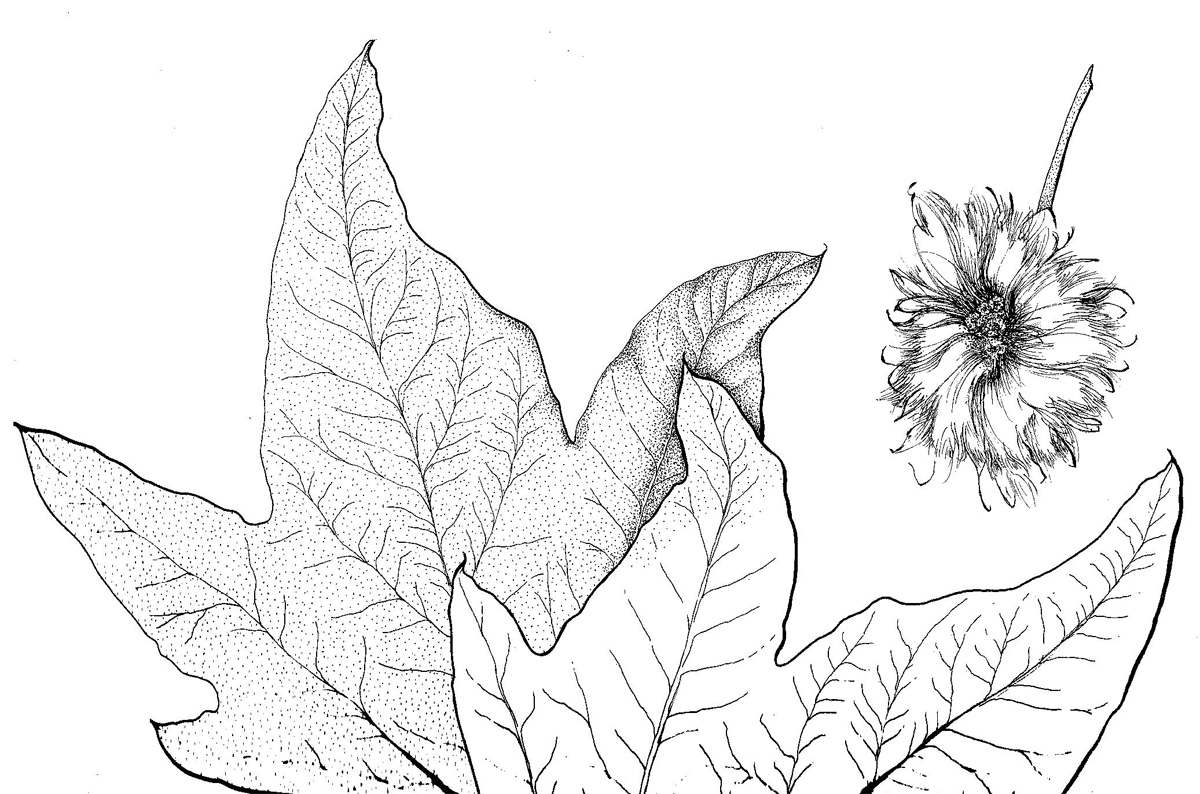
Part of a Western Sycamore by Estelle DeRidder, pen and ink, © 2012
Note to all who attended the class: Please email a photo of your drawing and/or sketches to Deb, so she can post them to the blog.
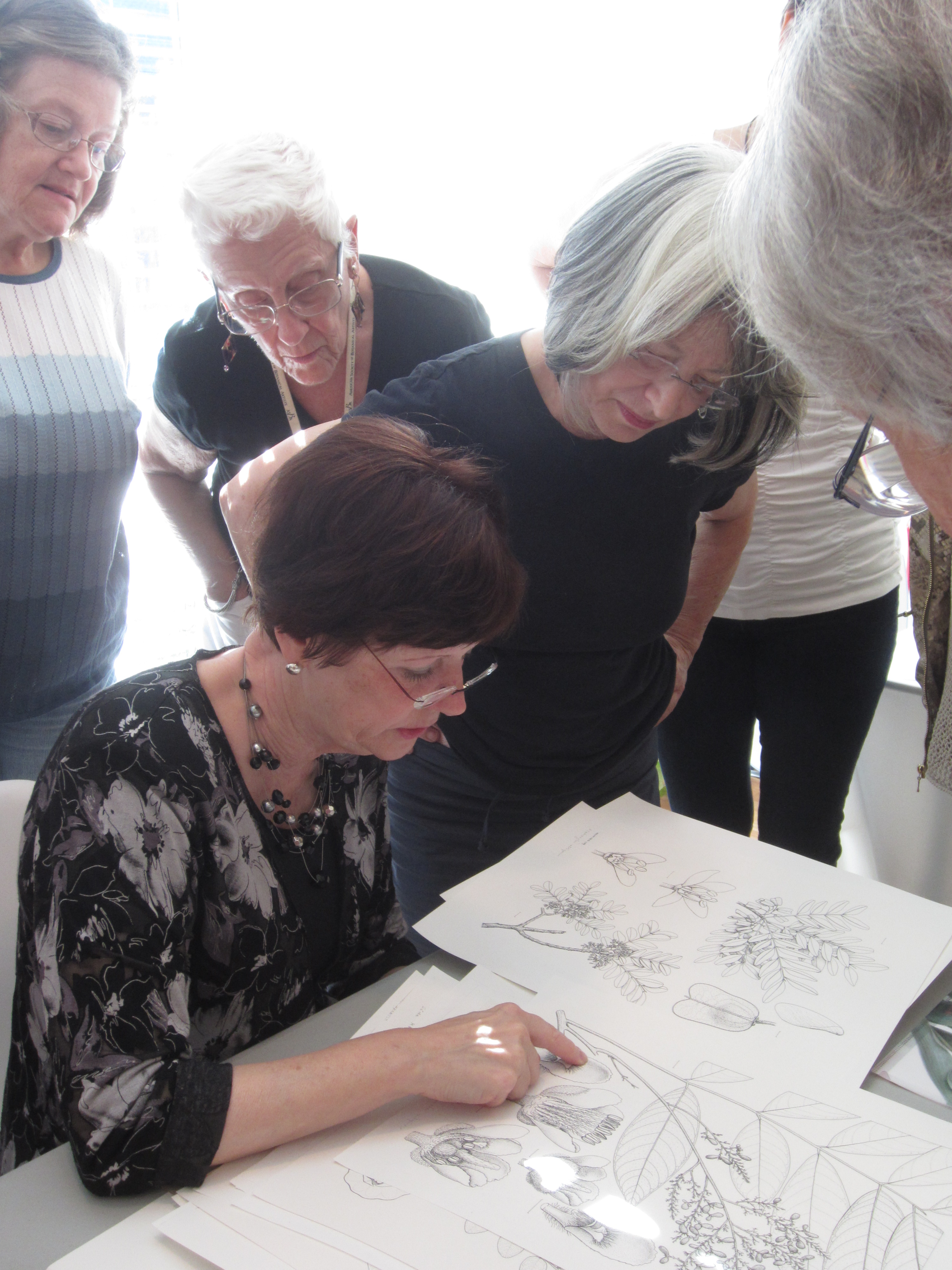
Anita discusses inking techniques with the class.
by Janice Sharp, posted by Deb Shaw
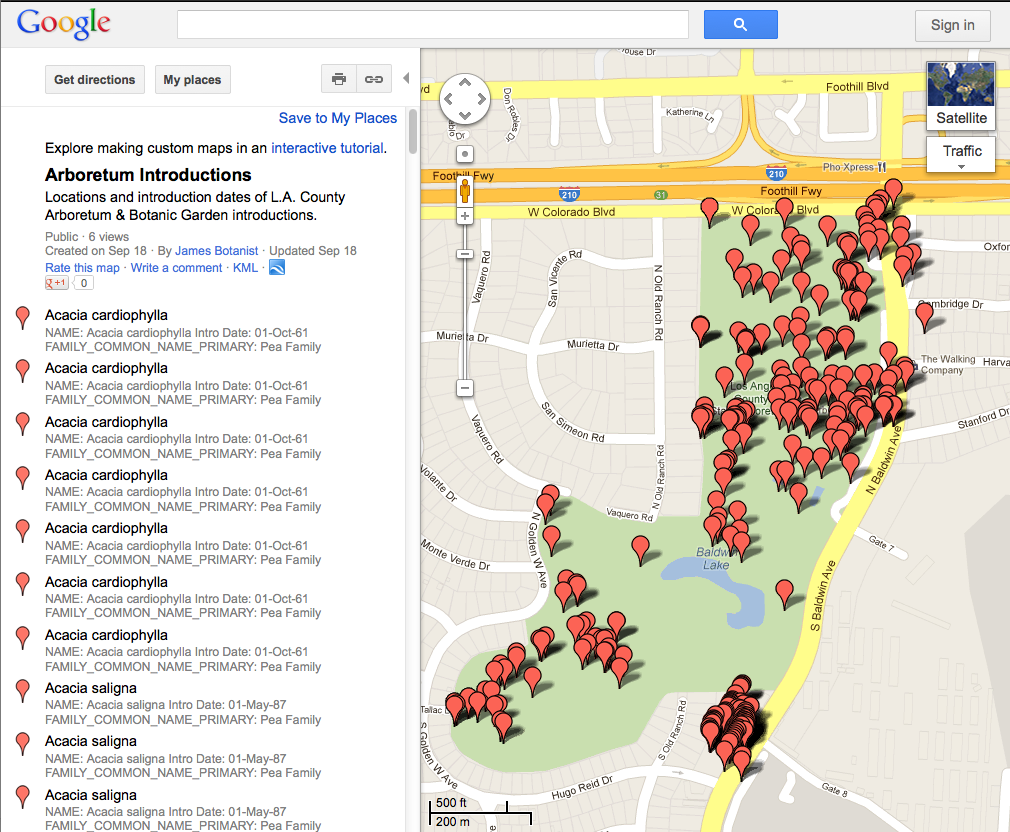
When you first click on the link in the story to the Google map of the locations of Arboretum introductions, this is what you’ll see; a list of all the plants with their locations as dots on the map. Click on “Satellite” view in the upper right corner of the map to see the information displayed over a photographic map.
For all of us who are painting the plants introduced by the Los Angeles Arboretum (or even those of us who want to find those plants from the list), we have a link to a Google map of the locations of Arboretum introductions throughout the grounds (thank you Frank!).
This this data is about five years old, so some plants from our list may be missing from the map, but it’s a great start. When you open the site, click on “satellite” view and zoom in. Then you’ll be able to see the paths and roads in the Arboretum, which will make it easier to find things and find your way around.
Questions? Contact Janice Sharp.
Happy painting!

In the “Satellite” view, zoom in to see the roads, paths and familiar landmarks of the Arboretum grounds.
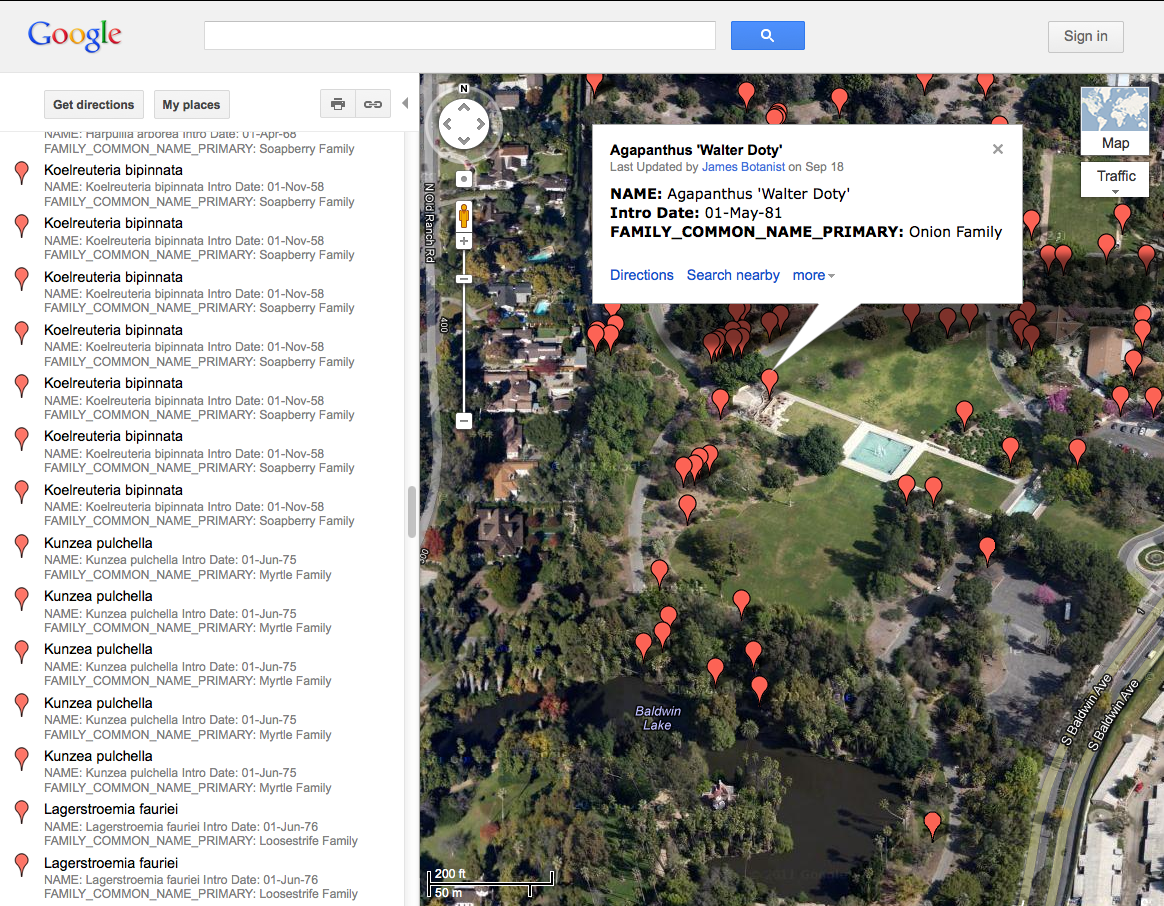
Click on the red pin marker next to a plant name you’re interested in, and the plant information will pop up on the map where the plant is located. Or, click on any red marker pin on the map, and the plant information will pop up there, too.
by Akiko Enokido, posted by Deb Shaw

Mieko Ishikawa with her watercolor, “Amorphophallus titanum”. © 2012, all rights reserved.
I was lucky to be able to attend the exhibition of Mieko Ishikawa’s work, 9/1 to 9/9/2012 at Keio Plaza Hotel, Shinjuku, Tokyo. Approximately 60 pieces of her work from the past ten years were exhibited. Included in the exhibits were the cherry blossoms series that received the gold medal at RHS, the plants of Borneo, and Conifers.
On the weekend, Mieko had a special event with lectures and photos from her trip to Borneo. From her fascinating lectures, we learned how she found and sketched the plants in the wild rain forest.
Her most recent work is this huge flowering plant Amorphophallus titanum. This originally grows in the rainforests of western Sumatra, Indonesia. The bloom normally reaches up to 8 to 9 ft tall there.
Mieko drew this particular piece at Koishikawa, Botanical Gardens, Graduate School of Science, the University of Tokyo. Since the one there was only about 6ft tall, she decided to paint it in its actual size. The flower died in two to three days. While she was sketching it, she couldn’t help but notice the terrible smell of the blooming plant. When I visited her studio last March, she was working on 6.5 x 3.2 ft stretched Arches paper. The final work was so beautiful it was hard to imagine that it could give out a terrible odor as she described.

Mieko Ishikawa presentation about painting the plants in the wild rain forest of Borneo.
Mieko has visited Borneo more than ten times. In the rainforest, you can’t take any specimens to confirm the specific plant species. But she became good friends with the guide, and one day he gave her one dead pitcher with a plant. And another time, when the director of the national park gifted her a huge acorn from the herbarium, she trembled with joy as if she was presented with a diamond.
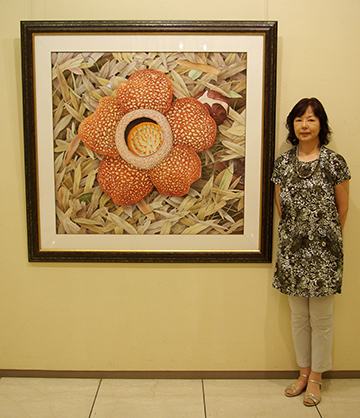
Mieko Ishikawa with painting at Exhibition at Keio Plaza Hotel, Shinjuku, Tokyo.
We generally are not able to go to the rain-forest; we just have knowledge through photos and videos. The plants in Mieko’s works are drawn actual size and look so lively, it makes you feel as if they are going to move right in front of your eyes. She also taught botanical painting to the people who work at the national park, but the papers were so moistened due to wet weather. She said it was extremely difficult to paint. Mieko hopes that botanical art will spread throughout their country. Her works are valuable records of the precious species in Malaysia. Mieko wants to be even more active in drawing Borneo plants, presenting their ecology and fascinating morphology in order to protect the nature in Borneo for many more years to come.
by Deb Shaw
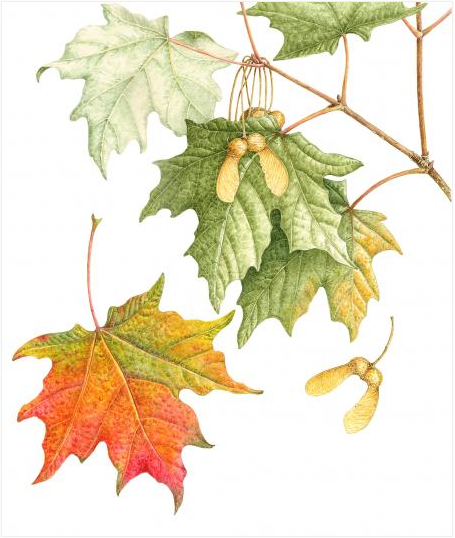
Acer saccharum, Sugar Maple, by Margaret Best, watercolor on paper, © 2012, all rights reserved.
BAGSC members Margaret Best and Akiko Enokido were selected to exhibit in the 15th Annual International exhibition for the American Society of Botanical Artists at The Horticultural Society of New York. The show is comprised of forty-three artworks by thirty-nine different artists from the US, Australia, Brazil, Canada, Japan and the UK.
Jurors Patricia Jonas, Kathie Miranda and Derek Norman had the difficult task of selecting from 192 entries. The artwork in the show can be viewed in the exhibition section on the new ASBA website. Be sure to read interviews with Margaret and Akiko about their work in the show on the website as well.
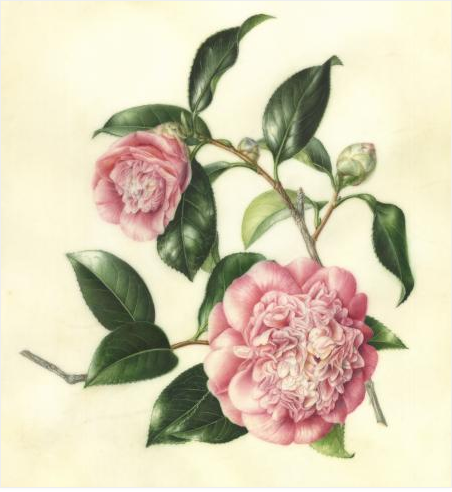
Camellia japonica ‘Chandleri Elegans’, Variegated Camellia, by Akiko Enokido, watercolor on vellum, © 2012, all rights reserved.
Want a catalog of the exhibition? Order from ArtPlantae for $20.
The exhibition will be on display from September 14 – November 21, 2012 at The Horticultural Society of New York, 148 W. 37th Street, 13th Floor, New York, New York, 10018. Gallery hours are Monday – Friday, 10 am to 6 pm.
Congratulations to all!
By Janice Sharp and Deborah Shaw

Akiko Enokido painted this watercolor of Chorisia speciosa, Floss Silk Tree, at the Los Angeles County Arboretum. The LA Arboretum has introduced four varieties of Chorisia speciosa. © Akiko Enokido, 2009, all rights reserved.
Starting in 1957 and continuing to the present, The Arboretum has been responsible for the introduction of plants to Southern California from around the world (click here to download a list of the plants: LaArboretumPlantIntros). Many of these plants are now indispensible elements in our Southern California Gardens.
Recently, BAGSC members donated cards to make boxed collections for Richard Schulhof (Arboretum CEO) to take as gifts for officials he met on a trip to South Korea. Most of the images used on these cards were of Arboretum Introductions. At the end of the trip a few remaining boxes were placed in the Arboretum Gift Shop for sale. The Gift Shop, Arboretum staff and Foundation Board members, as well as the general public, are very interested in having “Arboretum Plant” note cards stocked in the Gift Shop.
The Arboretum is a good friend of BAGSC, providing class space at very reasonable rates and access to a huge selection of plants. As a result, our members have already painted many plants on the Introduction list or will paint them in the future.
BAGSC is asking its Members to “donate” the use of images they may have, or will create, to be included in an “Arboretum Introduction” card collection. Deborah Shaw is setting up a project area for BAGSC members to upload their high-resolution images, or they can be mailed to her on disc. Each finished card will include:
- the Name of the Artist with the appropriate copyright notice;
- the plant name and the year it was introduced;
- a description of the Arboretum;
- and a description of BAGSC.
Images “donated” will be used ONLY for the purpose of this “Arboretum Introduction” card collection. BAGSC will produce and box the cards. They will be sold to the Arboretum Gift Shop at a modest markup over our costs of production. The profit will go to BAGSC’s general funds.
In addition, the Arboretum Library is to undergo an extensive facelift in the near future. When the work is completed we hope to have an art show featuring the Arboretum Introduction artwork.
If you are interested in participating in this project contact Janice Sharp or Deborah Shaw. Deb will email instructions for uploading images to the web project area.
posted by Deb Shaw
BAGSC member Margaret Best will be teaching classes in various parts of the globe for the remainder of 2012, and into 2013. See below for descriptions and links to more information:
Mixing Natural Green and Painting Leaves (SOLD OUT!)
September 26-28, 2012. Filoli, San Francisco.
Three-Day Weekend Workshops (and more) – October 12-14, 2012, and November 23-25, 2012
These intensive 3-day workshops involve assigned subjects or specific technical aspects aimed at assisting participants in the creation of traditional botanical art studies. The selected subjects range from introductory level to advanced study.
The locations of the 3-day Weekend Workshops will be in and around Calgary and will be indicated in the description of each individual workshop as it is confirmed. Please bring your own lunch and refreshments other than coffee and tea, which will be provided. More information, costs and payment by credit card or PayPal can be made on the Traditional Botanicals website. Various evening botanical workshops and Saturday workshops are available in Calgary as well. See the Traditional Botanicals website for details.
Fabulous Foliage – Watercolor
November 2-5, 2012
Bermuda Society of Arts, Hamilton, Bermuda
A 4-day intensive workshop using the incredible variety of shapes and colors of tropical and subtropical leaves of Bermuda, capturing natural green colors, and achieving realistic surface texture, venation, leaf curl, and foreshortening. If you have always wanted to master the art of painting leaves, this is a class not to be missed. For more information, costs and payment, contact the Bermuda Society of the Arts.
Painting in Morocco (including lectures by Ethnobotanist Gary Martin) – April 22-30, 2013.

BAGSC member Jan Clouse at Margaret Best’s Quench Trip Design Tuscany Workshop, 2012.
This incredible botanical art opportunity has been arranged in conjunction with Quench Trip Design. Gary Martin, renowned ethnobotanist and the author of Ethnobotany: A Methods Manual will give lectures. Enjoy five nights in luxury accommodations, three nights in a mountain retreat, meals prepared by gourmet chefs and highly personalized instruction from Margaret Best. More information, costs, and itinerary can be found at the Traditional Botanicals website (click on the “Blog” link for information) and at Quench Trip Design.
by Suzanne Kuuskmae, posted by Deb Shaw

Sala Tree Flower, by Suzanne Kuuskmae,

- Iris, by Suzanne Kuuskmae, © 2012 all rights reserved

© 2012 all rights reserved
Two botanical paintings by Suzanne Kuuskmae, Iris, and Sala Tree Flower, were selected for the upcoming Exhibition at the Palos Verdes Art Center at the Peninsula Center, Silver Spur Drive, Palos Verdes. The Gallery is open every day from 9:30 to 4:00 p.m. Selections were made for the Small Treasures Show at the same address and I was thrilled to see that yet another botanical of Hibiscus showing various parts of the flower was selected along with a pastel landscape of Lake Bled, Slovenia. If you get a chance, come on up to see this show that has drawn from a very varied array of art pieces. The reception was held Friday, August 31, from 6 – 8.
by Leslie Walker, posted by Deb Shaw

Anita Walsmit Sachs in her studio. © Anita Walsmit Sachs
Anita is an experienced Scientific Illustrator and teacher who is coming from the Netherlands to teach this very special class on October 12, 13, and 14. For a complete biography and an opportunity to see her work, visit her website.
Each student will select and bring to class a plant they wish to draw and get to know intimately.
The first day you will get to know the plant by study, making dissections, using a microscope and drawing.
The second day will be spent making a composition and deciding the technique you wish to work in. This can be in pencil, watercolor or pen and ink which will make it a scientific piece.
The last day we will try to finish our drawing or painting.
The teaching will be individual. Some experience would be nice.
The cost of this three day class on October 12, 13 and 14, will be $300. The cost for non-members is $350. Space will be held upon receipt of a $50.00 non-refundable deposit. Final payment is due to Leslie by September 28. A list of materials and a suggested reading list will be sent by email, upon payment of deposit. Checks should be made out to “BAGSC” and sent to Janice. Questions? Contact Leslie until August 31 or Janice after August 31.
The class will be held October 12, 13 & 14, from 9:30 to 3:30 each day at Sally Jacobs’ Studio.
You don’t want to miss this wonderful opportunity. Class size is limited, so register as soon as you can.
by Jan Clouse

Jesselyn Cyr, Norma Sarkin and Leslie Walker in Margaret’s class at the Huntington.
Sometimes a perfect composition presents itself like a gift from heaven, but more often than not it is like Jacob wrestling with the angel—a struggle for a blessing. In her three-day workshop at the Huntington Garden, Margaret Best repeatedly returned to fundamental principles of composition, guiding the class through basic do’s and don’t’s. Each morning began with a slide show, lecture, and discussion that both guided and inspired us to create a pleasing and dramatic painting.
As always, Margaret dispels the notion right away that we will walk out the door with a “finished painting.” Rather her aim is that each student will have a thoughtfully composed finished drawing ready for color. Many of us had done our homework: we had selected appropriate specimens; most had done preliminary sketches, and some had transferred the sketches to paper. Yet under her tutelage we all drew or rearranged our sketches to improve the placement of the focal point. First consideration was the “rule of thirds” or Margaret’s magic grid.
We also looked at examples from traditional to contemporary painters who in various ways illustrated the basics of planning, focal points, cropping, color placement, contrast, and the use of positive and negative space. Yet Margaret always sent us back to consider our own works.
Speaking for myself, the process of looking at a variety of paintings and discussing them with nine other keen-eyed artists who all offered perceptive comments sharpened my eyes to assess the potential strengths and pitfalls in my own composition. I appreciated the fact that Margaret drew on the skills and talents of her students: individuals offered plant information to others, and Christina Baltayian even did a spontaneous colored pencil demonstration. Margaret is an exceptional artist, but she is also a masterful teacher notable for her ability to create an atmosphere where knowledge is readily shared.
I will admit that painting at the Huntington was an inspiration in itself, and indeed I gathered a couple of fallen bits from an oak just outside the Botanical Building, which turned out to be compositional gifts from heaven.
by Deb Shaw

Color test chart by X-Rite
The X-Rite site has a new, nifty Hue Test they’ve developed. They report that 1 out of 255 women and 1 out of 12 men have some form of color vision deficiency. Their online color challenge, based on the official FM100 Hue Test is a fun way to see how well you see hue and value across the spectrum. Rearrange the squares in order of hue and then click on the “score test” button to see how well you do! Zero is a perfect score.
by Deb Shaw
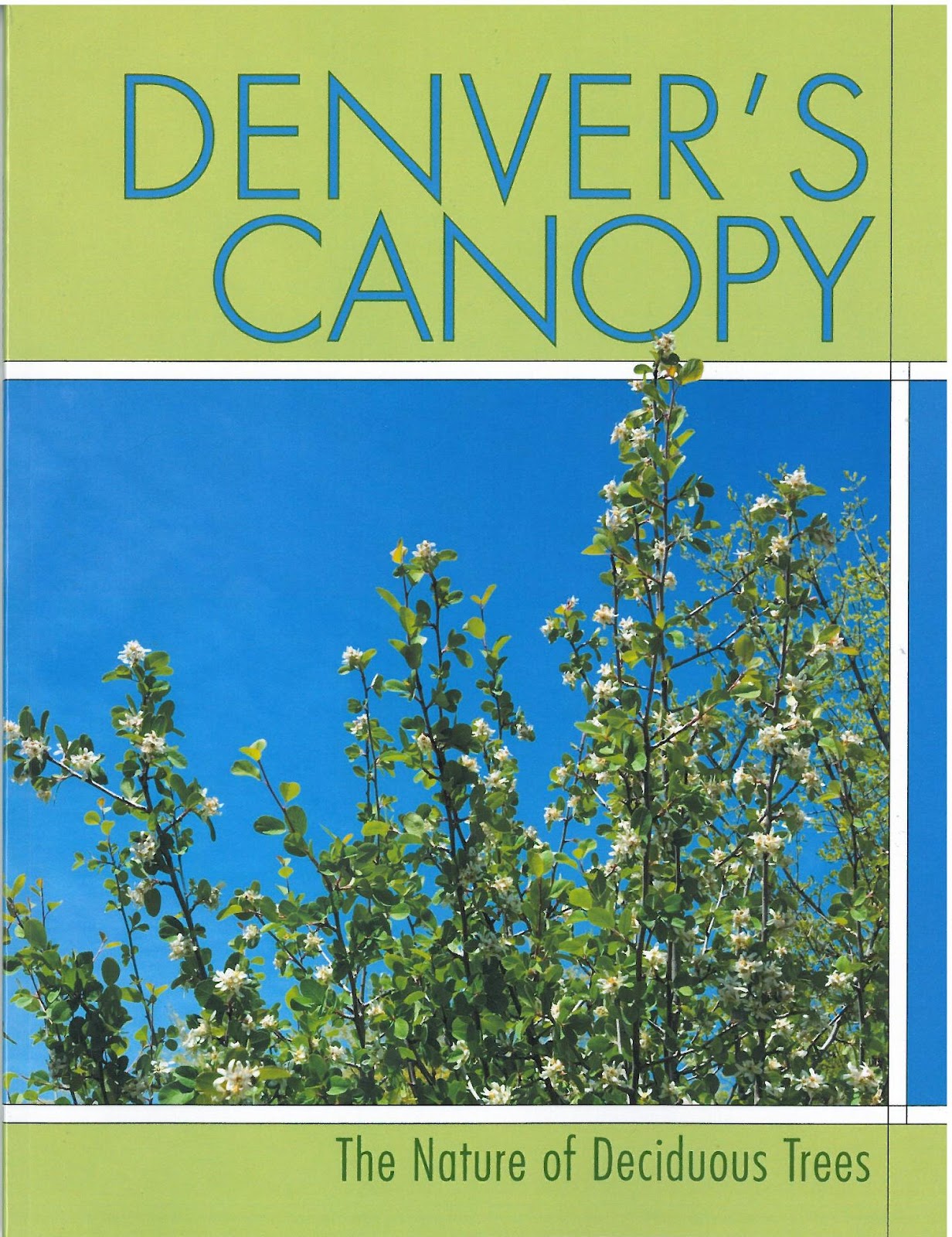 BAGSC Member Estelle DeRidder participated in the illustration of “Denver’s Canopy – The Nature of Deciduous Trees.” Released by the Denver Botanic Gardens, the publication is a tribute to Dr. Moras Shubert, in celebration of his 100th birthday and his service to the Denver Botanic Gardens and the Denver community. The deciduous trees of the Denver area have been a life-long passion of Dr. Shubert, who had the vision for this lavishly visual, limited edition book (225 copies).
The call for entries went out during the first week of February 2012 with a submission deadline of February 29, 2012. Artists had less than 4 weeks to create their illustrations!
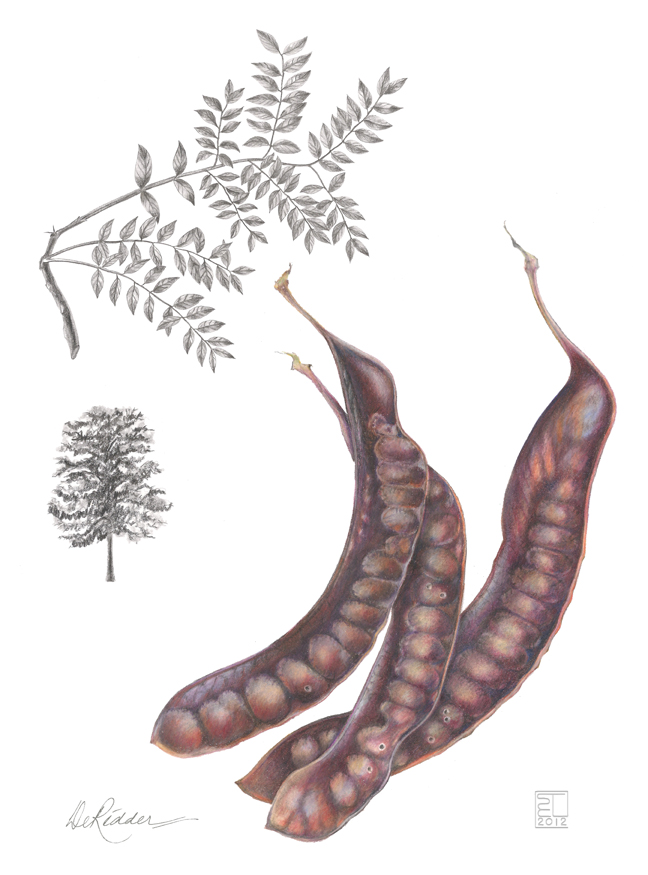
Honey Locust, by Estelle DeRidder, colored pencil, © 2012, all rights reserved
Estelle submitted two illustrations: a Liquid Amber, and a Honey Locust.
The senior author of “Denver’s Canopy” is Sonia John; contributing authors are Panayoti Kelaidis and Martin F. Quigley. The 86 pages feature photographs and more than 30 botanical illustrations by Estelle DeRidder, Jan Boyd Haring, Marjorie Leggitt, Katherine McCrery, Randy Raak, Heidi Snyder and Amy Weinstein. Illustrations were done in a wide variety of media, including graphite, colored pencil, watercolor and pen and ink.
Congratulations to the Denver Botanic Gardens and illustrators for a wonderful project! And a very Happy Birthday to Dr. Shubert!
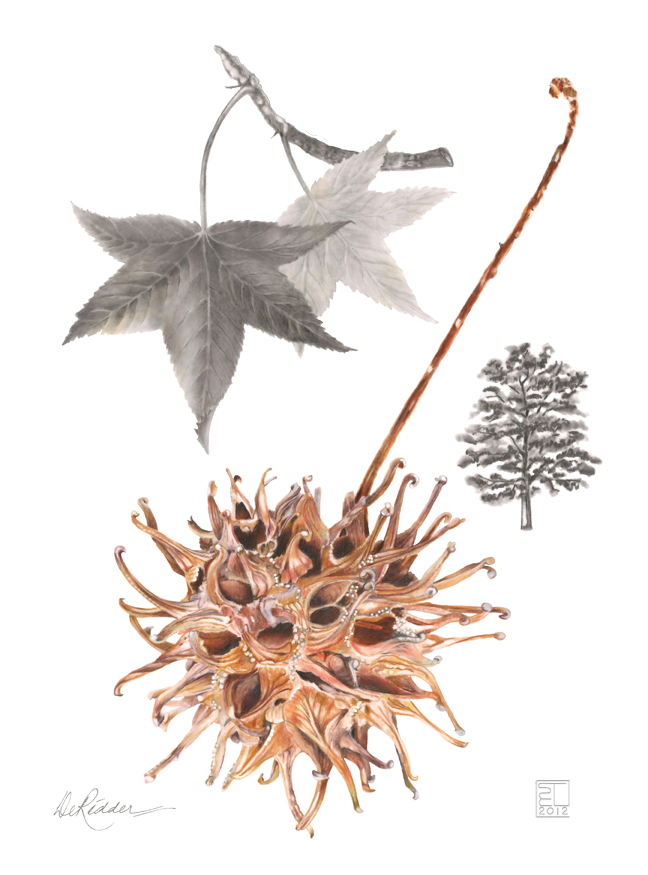
Liquid Amber, by Estelle DeRidder, colored pencil, © 2012, all rights reserved
by Clara Josephs and Deb Shaw
Many BAGSC members have been asking about where they can find information about drought-tolerant plants. You can find a lot of information about drought tolerant plants on the web. Here is a section from the Wikipedia entry I was directed to after googling “lemonade berry”:
Rhus integrifolia, the Lemonade Berry’s leaves are simple (unusual in a genus where most species are trifoliate), alternating, evergreen and leathery, ranging from two to four centimeters wide on reddish twigs; length of leaves is five to seven centimeters. Leaves are toothed with a waxy appearance above and a paler tone below. The flowers which appear from February to May are small, clustered closely together, and may be either bisexual or pistillate.[1]
These fragrant flowers exhibit radial symmetry with five green sepals, five white to rosy-pink petals, and five stamens. The small flowers are only six millimeters across. The ovary is superior and usually has a single ovule; although in pistillate flowers, the stamens are small and infertile. The mature fruit of Rhus integrifolia is sticky, reddish, covered with hairs, and about seven to ten millimeters in diameter. The elliptical fruit presents tight clusters at the very ends of twigs.
Young plants manifest smooth reddish bark, while more mature individuals have cracked, even scaly, grayish bark with the smooth red bark displayed underneath. Twigs are rather stout and flexible, and reddish bud ends are diminutive and pointed. There is often a multi-furcate branching structure from the base of the plant. A mature plant is large and thicket-like with a sprawling arrangement.
Notice how many painting cues for color and structure are in that entry! It also tells me when it flowers. Very useful and free information! Next, if I hit “images” for lemonade berry – bingo – what a selection!
The following is a list of California Native plants and their drought-tolerant adaptive strategies, compiled for us by Jennifer Funk, Assistant Professor of Biological Sciences, School of Earth and Environmental Sciences, Schmid College of Science and Technology. Please keep in mind that the exhibition is open to any drought-tolerant plants from around the world, not just California natives! This list was handed out at a BAGSC Quarterly meeting earlier this year. Future articles on the blog will list characteristics of drought-tolerant plants.
Let us know your questions, or any future articles you would like to see on the blog about drought-tolerant plants.
A few drought-tolerant species, all native to southern California:
Scientific name, Common name
Drought deciduous (plants that drop their leaves during dry season or periods of dryness)
Achillea millefolium, Common Yarrow
Calliandra eriophylla, Pink Fairy Duster
Encelia californica, California Bush Sunflower
Encelia farinosa, Brittlebush
Keckellia antirhhinum, Yellow Bush Penstemon
Ribes aureum, Golden currant
Small leaves (small leaves have a reduced surface area, and so lose less water)
Adenostoma fasciculatum, Chamise
Arctostaphylos species, Manzanita
Artemisia californica, California sagebush
Ceanothus species, Ceanothus
Cercocarpus minutiflorus, San Diego Mountain Mahogany
Epilobium canum, California Fuchsia
Ericameria cuneata, Wedgeleaf goldenbush
Eriogonum fasciculatum, California buckwheat
Hazardia squarrosa, Saw-toothed Goldenbush
Isocoma menziesii, Coastal Goldenbush
Isomeris arborea, Bladderpod
Lotus scoparius, Deer Weed
Lycium californicum, Coastal Boxthorn
Mimulus aurantiacus, Bush Monkeyflower
Prunus ilicifolia, Hollyleaf Cherry
Deep taproot (taproots find water sources deep below the soil surface, and are often thick and fleshy, so they can store available water)
Pinus species, Pine
Platanus racemosa, California Sycamore
Populus fremontii, Western Cottonwood
Quercus agrifolia, Coast live oak
Succulent leaves (succulent plants store water in their fleshy leaves, stems and roots)
Agave species, Agave
Cylindropuntia prolifera, Coastal Cholla
Dudleya species, Dudleya
Opuntia species, Prickly pear cactus
Yucca schidigera, Mohave Yucca
Yucca whipplei, Chaparral Candle
Pubescent leaves (pubescent leaves are covered with hairs, which may be tiny or long, and which help hold water and reflect the hot rays of the sun)
Asclepias californica, California Milkweed
Encelia farinosa, Brittlebush
Galvezia speciosa, Island Bush Snapdragon
Malacothamnus fasciculatus, Chaparral Mallow, Bush Mallow
Salvia apiana, White sage
Evergreen, sclerophylous leaves (evergreen leaves stay on the plant year-round; sclerophylous leaves have a hard surface and are frequently closely spaced together)
Arbutus menziesii, Madrone
Baccharis pilularis, Coyote brush
Eriodictyon crassifolium, Thick-laved yerba santa
Heteromeles arbutifolia, Toyon
Malosma laurina, Laurel sumac
Rhamnus species, Coffeeberry
Rhus integrifolia, Lemonadeberry
Rhus ovata, Sugar bush
Salvia leucophylla, Purple sage
Salvia mellifera, Black sage
Sambucus Mexicana, Mexican elderberry
Sources
http://www.cnpssd.org/plantlistlinked.html
 BAGSC News