You are currently browsing the tag archive for the ‘BAGSC’ tag.
by Deb Shaw with A LOT of contributing authors. Please see the contributors’ list at the end of this article.
I’ll begin with two apologies: the first is for the length of this article. There is a lot of information and misinformation about the disappearance of Kolinsky brushes from art suppliers in the US. It’s a complicated subject, and I’m attempting to gather everything together in one place. The second apology is for the delay in posting this article. Each month I’ve heard rumors that the stockpiles of brushes being held in US Customs were about to be released, and so I’ve erroneously concluded it was a moot point to publish. We’re still waiting, so I’ll dive in.
Background, History, Rumors and Facts
Kolinsky brushes are made with the hair of the Siberian weasel, Mustela sibirica. Some internet information about Kolinsky brushes states that the best brushes are made only with the hairs from the tip of the tales of male weasels, gathered in winter. Some sources claim the hair is gathered from wild populations where the weasels are a pest; some say the hair is a by-product of the fur trade; others state the hair is collected only from humanely and sustainably farmed animals. There is also information that says the animals do not do well in captivity, so it’s impossible to “farm” them. All sources agree that Siberian weasels are not endangered: the International Union for Conservation of Nature (IUCN) classifies these animals as “least concern for extinction.”
![Siberian Weasel (Mustela sibirica), Zoo Dresden, Winter 2002/2003, By Altaipanther (Own work) [Public domain], via Wikimedia Commons.](https://bagscblog.com/wp-content/uploads/2014/10/mustela_sibirica_sm.jpg)
Siberian Weasel (Mustela sibirica), Zoo Dresden, Winter 2002/2003, By Altaipanther (Own work) [Public domain], via Wikimedia Commons.
Weasel hair for brush manufacture typically comes from Russia, China, India and Japan. Mustela sibirica populations also are found in Bhutan, Korea, Nepal, Laos, Burma, Taiwan and Thailand. Once gathered, the hair is then made into brushes either in China or the country of origin, or is sent to Europe or the UK to be made into brushes there.
For us to be able to buy Kolinsky sable brushes in the United States, the appropriate paperwork is required for exporting the hair from the country of origin, and then “re-exporting” the brushes from the country of manufacture. The problems with our supplies of Kolinsky brushes started in 2012, when a US Fish and Wildlife Service inspector was requested to research paperwork and permits from Europe for “re-exporting” Kolinsky hair.
Research and interviews about the disappearance of Kolinsky brushes turned up a multitude of reasons, rumors and innuendos. I emailed the US Fish and Wildlife Service directly, and, much to my surprise, on February 14, 2014, received a reply from Craig Hoover, Chief, Wildlife Trade and Conservation Branch, Division of Management Authority. I’ll confess, I’m still impressed to have even received a response. I’ve edited Mr. Hoover’s reply slightly (for example, taking out my complaints about their website not working), but am posting his answers verbatim below:
Dear Ms. Shaw,
…We appreciate your inquiry and the concerns raised by the industry. We’ve had numerous consultations on this issue and are happy to share additional information with you. Please let me know if you have any additional questions.
Kolinsky hair brushes use hairs derived from the Siberian weasel (Mustela sibirica). This species was added to Appendix III of the Convention on International Trade in Endangered Species of Wild Fauna and Flora (CITES) in 1989 by India. CITES, as you may know, is a treaty to prevent species from becoming endangered or extinct because of international trade. Under this treaty, countries work together to regulate the international trade of animal and plant species and ensure that this trade is not detrimental to the survival of wild populations. Appendix III includes species for which a particular country has sought help to regulate international trade.
Under the terms of the Treaty, and US regulations implementing CITES, any export of an Appendix-III species from a listing country (in this case, India) requires the issuance of a CITES Export Permit after a determination is made that the specimens in question were legally acquired. Exports from a non-listing country (such as China) require the issuance of a CITES Certificate of Origin essentially indicating that the specimens did not come from the listing country.
Under CITES, member countries have an opportunity to take a reservation to a listing, essentially meaning that the country chooses not to implement the listing. With regard to Mustela sibirica, 22 European countries have taken a reservation to the listing. Neither the United States nor China has taken such a reservation.
Much of the Kolinsky brush hairs are produced in and exported from China to Europe where they are then made into brushes. Because the importing countries in Europe have a reservation to the listing, they do not require a CITES document from China. However, because we require a CITES document for import into the United States, European exporters have obtained CITES re-export documents to send shipments to the United States. However, it came to our attention that the shipments going from China to Europe were not accompanied by CITES documents. We have confirmed with Chinese CITES officials that they require a CITES export document and were not approached to issue one. Therefore, because the shipments were exported from China to Europe in violation of CITES requirements, the subsequent re-export to the United States was also in violation of CITES requirements here.
We have explained this to our European CITES counterparts and advised the industry that specimens that are not lawfully exported from China will not be accepted in the United States. It is incumbent upon Chinese exporters to obtain the necessary CITES Certificate of Origin for export to Europe or directly to the United States.
[In answer to my question as to when or if we can expect the brushes to once again be imported into the United States]:
There is no prohibition on imports to the United States either from Europe or directly from China. However, if the brushes are made with Mustela sibirica hair, then the specimens must comply with all CITES requirements.
[In answer to my question as to whether or not it is legal for an individual artist to receive a gift of Kolinsky sable brushes from a fellow artist in Europe]:
If your question relates to whether someone can receive a gift of such brushes in Europe and then import them to the United States, I would refer you to our CITES regulations for personal and household effects, which are found at 50 CFR 23.15 and are found at:
(d) Personal effects. You do not need a CITES document to import, export, or re-export any legally acquired specimen of a CITES species to or from the United States if all of the following conditions are met:
(1) No live wildlife or plant (including eggs or non-exempt seeds) is included.
(2) No specimen from an Appendix-I species is included, except for certain worked African elephant ivory as provided in paragraph (f) of this section.
(3) The specimen and quantity of specimens are reasonably necessary or appropriate for the nature of your trip or stay and, if the type of specimen is one listed in paragraph (c)(3) of this section, the quantity does not exceed the quantity given in the table.
(4) You own and possess the specimen for personal use, including any specimen intended as a personal gift.
(5) You are either wearing the specimen as clothing or an accessory or taking it as part of your personal baggage, which is being carried by you or checked as baggage on the same plane, boat, vehicle, or train as you.
(6) The specimen was not mailed or shipped separately.
[In answer to my request for information about whether these animals are farmed, are caught from the wild, and/or are in danger of extinction]:
The requirements described above apply regardless of the method of production or the status of the animal in the wild. The CITES Parties are obligated to implement the provisions of the Convention unless they have taken a reservation. Just as we would expect India to enforce CITES provisions for a U.S. native species for which we have sought assistance, we will do so. And the CITES document would in fact make clear whether the specimens were produced in captivity or collected from the wild as well as the country of origin. Thus, it would give the industry some level of assurance about the impacts of the trade on the species.
Other Explanations and Updates
Most of our art store suppliers belong to The International Art Materials Association (NAMTA). NAMTA has been working with the US Fish and Wildlife Service, CITES, Global Arts, and European brush companies to resolve the problem. They have been posting updates on their website page “What’s Going On With Kolinsky Brushes?” (although their last post was in February, 2014). Their update postings include links to a copy of NAMTA’s letter to CITES Secretariat-General John Scanlon, and email addresses for people on the NAMTA team who will respond to questions.
Some of our art supply retailers have posted articles and sporadic updates as well, although many have simply labeled their Kolinsky brush stock “indefinite back order.” Dick Blick has a posting on their facebook page from July 26, 2013, titled “Tip of the Week – Why can’t I get my favorite Kolinsky brush?”
Current Status as of Today
For the last few months, art store buyers I have been checking with have been clinging to a rumor that NAMTA had finalized negotiations with US Customs to release the back inventories currently being held. They thought the negotiations, however, only applied to the “back orders” and that there are ongoing negotiations for FUTURE deliveries of Kolinsky sable brushes. The days and months have dribbled by, and as of now there still are no brushes on the shelves. Perhaps we will find our store shelves filled to capacity soon.
So, Where Can I Buy Kolinsky Sable Brushes? (US and Canada)
Unverified rumor has it that Canadian art stores were cut off from Kolinsky brushes that came to Canada through the US, but that Canadian art suppliers could order directly from the UK and Europe and receive those brushes without problems. I don’t know whether or not they can then ship orders to the US. If you reside in the US and have a favorite Canadian art store, check with them before ordering.
There are art stores in England who have informed me and other contributors to this article that they can ship directly to customers in the US, either because they use a single-source hair supplier, and/or they have all the necessary documentation. Three wonderful UK resources are Rosemary and Company, L. Cornelissen & Son, and Ken Bromley Art Supplies. Each of these companies are great to work with, and have said they can export brushes from the UK to the US, no problem. Given how quickly the situation (and inventory) keeps changing, I highly recommend double checking before ordering. See the review of Rosemary and Company brushes below. If you’re ever in London, be sure to stop off at the L. Cornelissen & Son store, for a jaw-dropping treat of an art shop. It’s a wonderful step back in time, with an incredible array of supplies.
A Quick Review of Brush Options
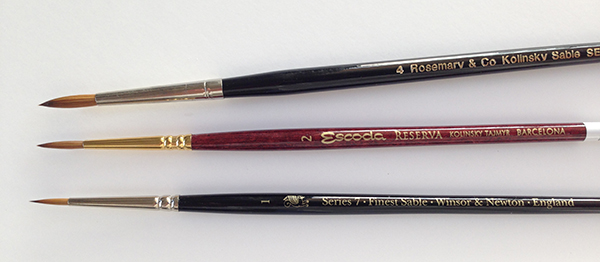
From top to bottom: Rosemary and Company, Series 33 Kolinsky Sable brush, #4; Escoda Reserva Kolinsky Sable Brush, #2; Winsor & Newton, Series 7 Kolinsky Sable Brush, #1. Photo by Deb Shaw.
As artists, we are not alone in our desperate search for Kolinsky brushes or substitutes. Art suppliers have been amazed at the wide variety of industries using sable brushes—industries they never knew they served. These include archeologists, the dental industry, various sciences, curators—the list is long. Some of the brush options described below have been well-loved in other industries. It may be time to look in new areas for supplies.
In the course of online discussions and correspondence, many of the participants discussed their favorite brushes, or new brushes they were trying out as substitutes for favorites that are no longer available. Please double check availability in the US and that the brushes meet international regulations. There are numerous brick-and-mortar art supply shops and online stores. The following is a brief, and by no means comprehensive, synopsis. There are other favorite online suppliers we did not have time to research.
Rosemary and Company: There are many wonderful hand-made brushes from Rosemary and Company, all top-notch quality. Kathleen Garness and Patricia Savage had enthusiastic endorsement of Rosemary brushes on the SciArt ListServ, comparing them to Winsor Newton Series 7. Holly Butlett liked the sable points, water holding capability and the feel. Bruce Bartrug endorsed their brights. (Added advantage for Bruce, “The brushes were also carefully packed in crumpled newspaper, and it was fun reading through the Yorkshire Post.”) Everyone commented on how quickly they shipped. Personally, I find the 33 series is a little long for botanical art (I tend to prefer shorter brushes anyway, especially for working on vellum). Margaret Best extensively tested the Rosemary 33 and 22 series. She thought the 22 series was too long; the 33 series seemed a touch long at first, but by the end of her painting it had become her favorite “go to” brush for botanical watercolors. Margaret also received a Series 323 Spotter she has yet to test. Rosemary and Company makes these for botanical artists, and Margaret reports that it looks like what she would call a miniature.
Pro Arte: I know a lot of folks who adore the Series 1 Pro Arte brushes. These are from the UK. Pro Arte also has a combination synthetic/sable brush called The Connoisseur, a blend of Prolene and Sable. Some artists are testing these out, but I haven’t heard any definitive feedback yet. The Pro Arte Connoisseur brushes are available in the US at Jerry’s Artarama, and other venues.
The Pro Arte brush above is not to be confused with the Connoisseur 007 brush. These are Kolinsky sable brushes, and, from their website, appear to be available in the US. Again, I know some artists who are testing these out, but I haven’t heard any results as of this writing. I also don’t know if they are readily available. Margaret Best will be testing this brush and reporting back. She says, “It is not a normal round brush length and also not a miniature. Somewhat in-between. May be better suited to vellum.”
One of the product buyers at Dick Blick, Nate, (who is also a watercolor artist), has been testing out synthetic brushes for his own work, using synthetics whenever he can to prolong the life of his Kolinsky brushes. He has the following recommendations for us to try: The first is the Escoda Versatil brush, a synthetic brush which is supposed to perform very much like the Escoda Kolinsky Sable brush. Nate also liked the Raphael Kaerell Synthetic—he said he even preferred the point on this brush to those on a real sable. He said that it would not be a great choice for those artists who need a fuller body for large color washes, but it has a good snap and keeps its point for a long time.
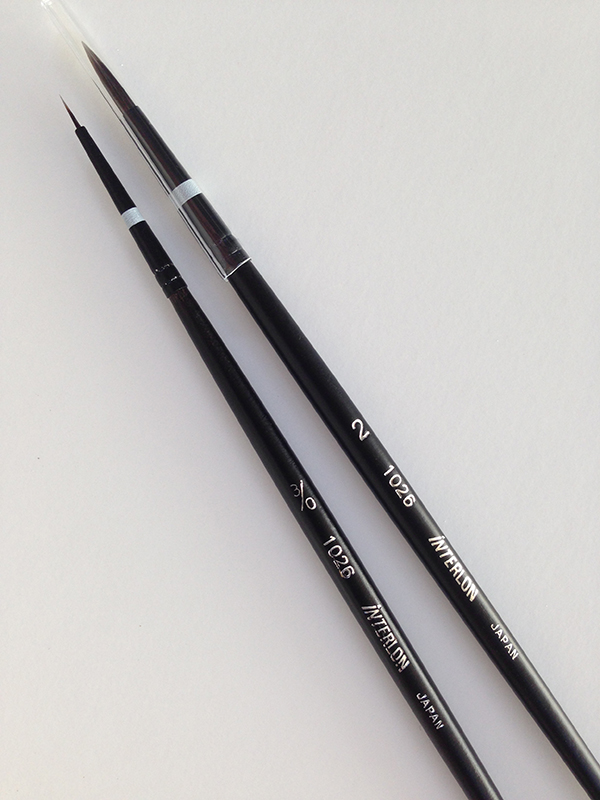
1026 Interlon synthetic brushes from Japan, in sizes #2 and 3/0. Photo by Deb Shaw.
At the ASBA conference in Chicago, 2012, Asuka Hishiki introduced her masking fluid workshop to a lovely synthetic brush, especially in the small sizes: the 1026 Interlon Brush Japan. It turns out that this is the go-to brush for the dental industry in Japan, used for whitening teeth. The brush keeps a sharp point, is great for dry brush work and is inexpensive (approximately $3.50)! Here in the States we were under the impression that the brush was only available in Japan, and we’ve been imposing on our Japanese colleagues to send us brushes. I just found them available at Best from Japan, who ships worldwide.
Several artists have reported decent results using Princetons for dry brushing, but I’m not sure which ones they used.
Cat Hair Brushes: In the September 2014 issue of “The Botanical Artist” (the Journal of the ASBA), Akiko Enokido wrote a techniques article in which she mentioned using a hand-made cat hair brush. She also mentions that these beautiful brushes, used in fine Japanese lacquer painting are not available for import into the US. Customs regulations for the United States bans importation of anything from any part of any cat. I haven’t investigated the reasons behind that ban…
Last, but not least, the beloved Winsor & Newton Series 7: I have heard many reports that the Winsor & Newton Series 7 brushes has been discontinued, and am embarrassed to confess that I had just accepted the news as fact. This too appears to be misinformation; we will have to ask Winsor & Newton directly. It looks like the Series 7 is still available in the rest of the world, and will continue to be manufactured, but Winsor & Newton pulled shipments to the US due to the Kolinsky Sable ban. Just goes to show we need to check everything from the source these days.
What We Can Do
- Make your voice heard. It’s time for us to start voicing our concerns to manufacturers, governments and international agencies. Speak up about safety, quality, availability and sustainability.
- Organize a “BRUSH OFF.” (My name—feel free to use it.) I spoke with our local art supply store about bringing our BAGSC botanical art chapter in to test various paint brushes for a nominal fee. They were enthusiastic, and it is something we will organize in the future. They don’t want to lose us as customers, and it’s expensive for each of us to test new brushes for the qualities we need as individual artists.
- Scour the internet and art supply stores for leftover brushes. Brick-and-mortar art stores have been allowed to sell the Kolinsky brushes they already had in inventory throughout the ban. I’ve found one or two of the last, lonely Kolinsky sable brushes in some out-of-the-way places.
- Let other artists know your finds. Have you discovered some new favorite brushes? Some suppliers for old favorites? Post comments to this article and let us know, or post to other online resources or publications.
The Big Picture: Green Art Supplies, Vegan Art Supplies, and Sustainability
An interesting side discussion has developed while talking about Kolinsky Sable brushes and the Siberian Weasel. Many of us didn’t realize where our brushes came from, or how they were made. Artists who wouldn’t think of wearing a fur coat are taking a second look at their supplies. There are efforts to recognize the impact of our art supplies, and artists are discussing balancing environmental and philosophical concerns against the use of synthetic materials (largely made with products derived from oil and plastic). It is worthwhile to have an ongoing debate about the responsibility, safety and sustainability of our materials. There are lots of resources on these topics—food for thought, and for another article.
Contributors:
There are a LOT of contributors to this article—more than I can possibly thank for sharing resources, opinions and information. It’s been a long process, and my apologies if I’ve forgotten to include your name here:
- Businesses and Agencies: Dick Blick, Ken Bromely Art Supplies, Mr. Craig Hoover, US Fish and Wildlife Service, NAMTA, Rosemary & Company
- ASBA and BAGSC members: Margaret Best, Akiko Enokido, Asuka Hishiki, Clara Josephs
- Facebook, Botanical Artists Group: Laura Dicus, Marilyn Garber, Kathleen Marie Garness, Vicki Lee Johnston, Jessica Rosemary Shepherd, Leslie Schramm
- GNSI SciArt ListServ: Karen Ackoff, Bruce Bartrug, Holly Butlett, Kathleen Marie Garness, Gail Guth, Mary Beth Hinrichs, Barry Kent MacKay, Kathleen McKeehen, Mali Moir, Lore Ruttan, Ph.D., Patricia Savage
by Diane Daly, posted by Deb Shaw

Treasurers’ student working on a beautiful watercolor of a sunflower. Photo courtesy of Bowers Museum/Council on Aging Orange County © 2014.
The James Irvine Foundation generously provides grants to the Bowers Museum Treasures Program. Bowers, in turn, uses the grants to reach out to the senior community. One way to engage older adults who may be feeling isolated is through art. The Treasures program reaches out to senior centers, community centers, libraries, social service agencies and residential communities by offering lectures, films, classes and tours.
The Council on Aging of Orange County is one of those agencies that works with the Bowers Treasures program. Since 1973, their mission has been to promote independence, health and dignity of older adults through compassion, education and advocacy. I have had the most rewarding experience and opportunity to teach a botanical drawing and painting class to the seniors at the Council on Aging. They provide translators since some of the seniors speak minimal English. I went home after the first class and brushed up on my Spanish and learned a greeting in Korean. The language differences seem to disappear when we are all involved in the art process of observing and drawing a fruit or plant. For eight sessions, we had a variety of specimens, starting with an apple and pear, a single tulip, a zinnia, a variety of peppers and chilis, a rose and finishing with a sunflower. It was pure joy to see the delight on their faces as they walked in and saw what the subject would be for the day.
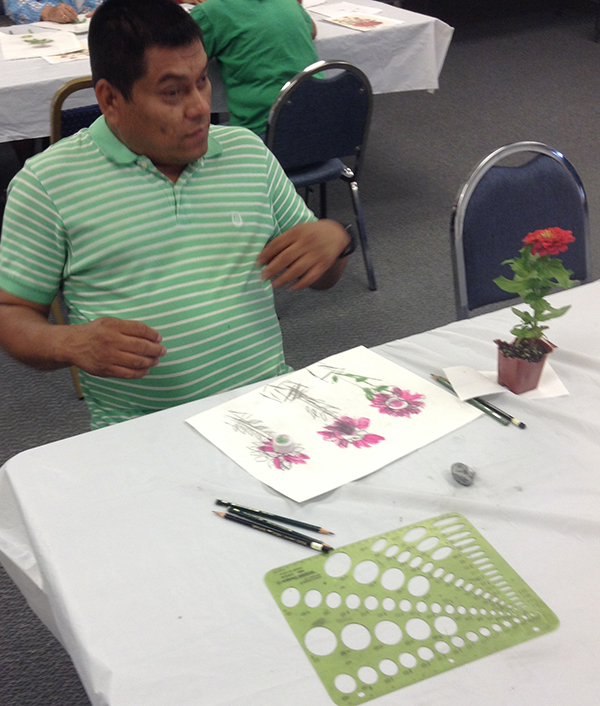
Students who are completely blind (but formerly sighted) were able to produce beautiful drawings. Photo courtesy of Bowers Museum/Council on Aging Orange County © 2014.
At first, when I was briefed on what the class should entail, I was told that there would be a few adults who were totally blind or had some sight impairment. Now, after all these years of trying to get as much detail in a botanical painting, I was truly baffled on how a blind person would be able to draw and how would I be able to teach them anything about drawing a flower. But, I was the one to learn a few things about drawing. They were able to feel the fruit or flower with their hands, emboss the paper with firm pressure on the pencil, use circle templates for guidance, and feel where to fill in the shape with color, with the aid of an assistant. I was amazed at the results. It is not botanical art as we know it, but is art that helps bring people together and give them pleasure and satisfaction. I made simple portfolios for them to take their drawings and paintings home on the last day.
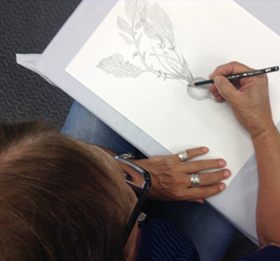
Treasures’ student drawing a radish in graphite. Photo courtesy of Bowers Museum/Council on Aging Orange County © 2014.
I had another opportunity through the Treasures program to teach a class on painting Asian flowers on parasols. Since there were 90 adults coming to this program, we used markers instead of paint. With 90 parasols opened and everyone drawing flowers on them, it was quite a challenge to move around to all the tables. Once again, I was delighted at the results; beautiful, original designs on all the parasols. The parasols were used for a display in the museum that weekend for a cultural event. They were able to take home the parasols, as well as all the other art projects that they created.
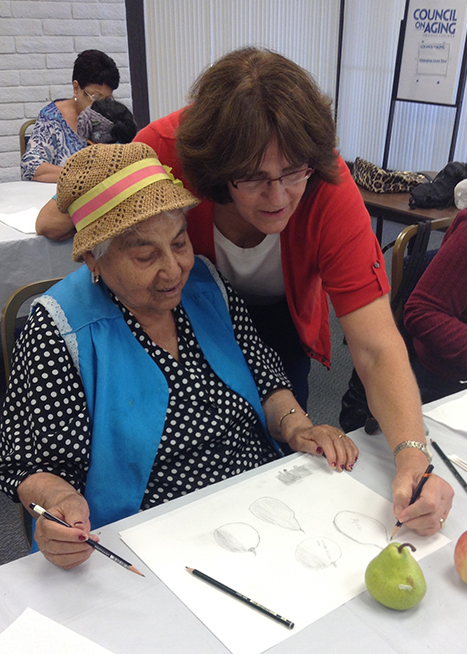
Diane Daly giving feedback to Treasures’ student. Photo courtesy of Bowers Museum/Council on Aging Orange County © 2014.
by Deb Shaw
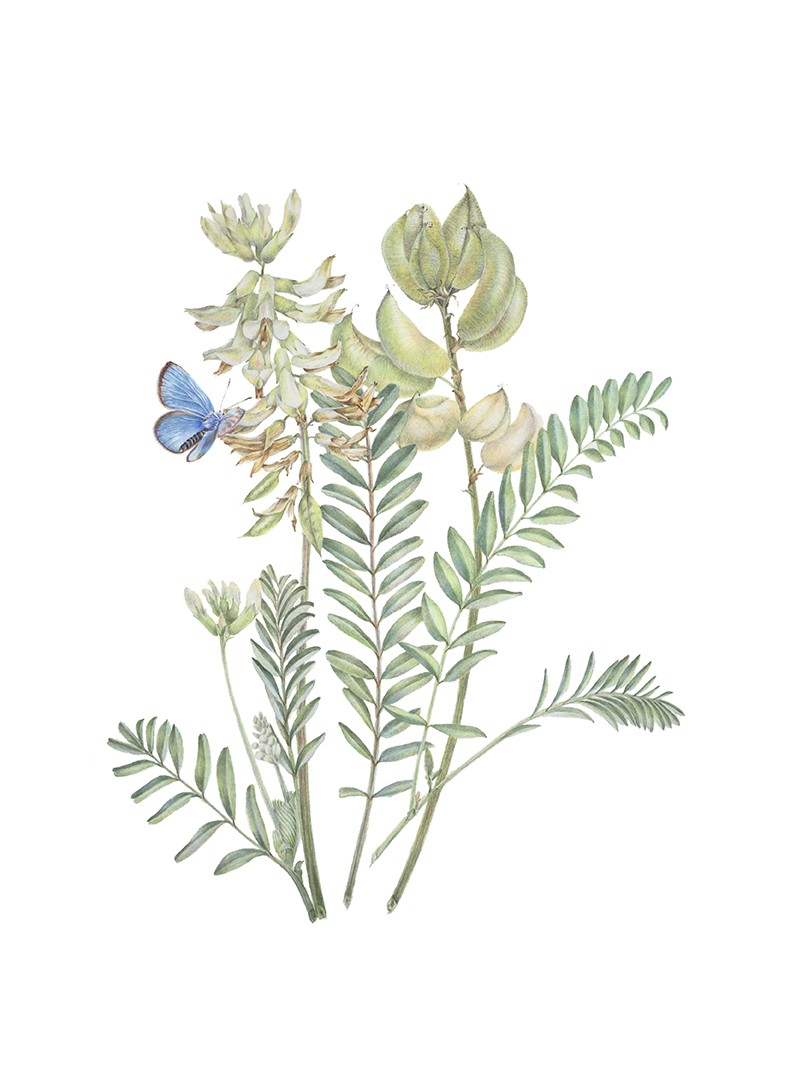
Astragalus trichopodus with Glaucopsyche lygdamus palosverdesensis, Common names: Locoweed with Palos Verdes Blue Butterfly. Estelle De Ridder, © 2014, all rights reserved.
In 2012, BAGSC member Estelle DeRidder was awarded an education grant from the American Society of Botanical Artists (ASBA) to assist with creating sets of reusable plant identification cards featuring native plant illustrations from the Madrona Marsh Preserve in Torrence, California.
The Madrona Marsh Preserve, in collaboration with the ASBA has announced the opening of an exhibition of Estelle’s completed artwork, “The Flora of the Madrona Marsh” on Sunday, December 7, 2014, from 2 pm to 5 pm.
The exhibition will run from November 19, 2014 – January 9, 2015. Estelle also will make two presentations at the Madrona Marsh Preserve, one on Saturday, December 6, 2014 and another on Sunday, December 14, 2014, discussing botanical illustration and its importance in our world.
Information about Estelle’s project will be presented at the ASBA Annual Meeting and Conference in Denver, Colorado during the ASBA Grant Presentations on Friday evening, October 17, 2014 from 4:30 pm to 6:30 pm.
The exhibition will then travel to the La Crescenta Public Library in La Crescenta, California from January 24 – February 28, 2015.
The Nature Center at the Madrona Marsh Preserve is located at: 3201 Plaza del Amo, Torrance, CA 90505. Phone: (310) 32-MARSH. The Madrona March is open Tuesday – Sunday, 10 am – 5 pm.
Congratulations Estelle!

Quercus Agrifolia, Coast Live Oak, by Estelle De Ridder, © 2014, all rights reserved.

Invitation to “The Flora of the Madrona Marsh,” original artwork by Estelle De Ridder.
by Deb Shaw
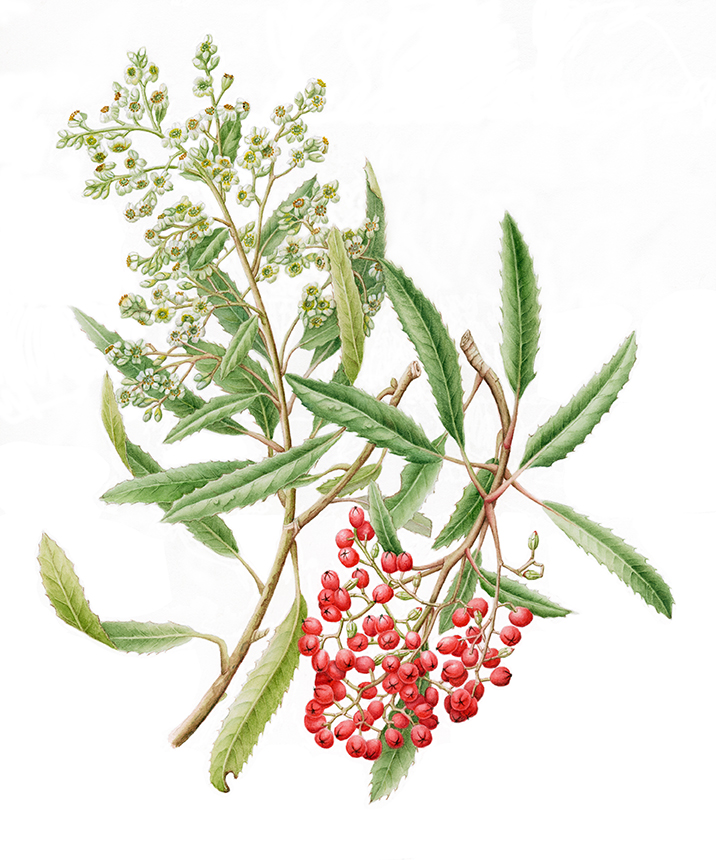
Joan Keesey, Heteromeles arbutifolia, California Holly, Watercolor on Paper. © 2013, all rights reserved.
The 17th Annual International American Society of Botanical Artists opened on September 17, 2014 at The Horticultural Society of New York. The exhibition will run from September 17 – November 26, 2014.
Jurors Patricia Jonas, Marco Polo Stufano, and Catherine Watters selected 42 artworks out of 215 submissions from around the world. The exhibition includes works by artists from the United States, Australia, Canada, France, Israel, Japan, and the United Kingdom. BAGSC members Joan Keesey, Lesley Randall, and Deborah Shaw have artwork in the exhibition. A full-color catalog with all of the artwork is available at ArtPlantae for $20, plus shipping.

Lesley Randall, Ma’o hau hele, Hibiscus brackenridgei, pen and ink on board. © 2014, all rights reserved.
The ASBA has posted the artwork and the artists’ stories behind each piece. Click on the artists’ names in this posting and on the ASBA website to see the artwork and read the artists’ stories.
Congratulations to all of the artists in the exhibition and to the following artists who received awards at the opening reception:
The Horticultural Society of New York Best in Show: Annie Patterson
Eleanor Wunderlich Award for Excellence: milly acharya (Purple Passionflower)
Helen Gray Garber Award: Constance Scanlon
Susan Frei Nathan Fine Works on Paper, LLC Award: Asuka Hishiki
Brooklyn Botanic Garden Award for Drawing & Prints: Lesley Randall
Honorable Mentions: Ingrid Finnan (Yellow Dahlia), Haruyo Kawashima, Carrie DiConstanzo, and Tomoko Ogawa

Deborah B. Shaw, Cucurbita maxima, Buttercup Squashes and Section, watercolor on paper. © 2013, all rights reserved.
Botanical art workshops are being held in conjunction with the exhibition, and a “Last Look” reception with featured artists and jurors will be held on Wednesday, November 19, 2014 from 6-8 pm.
The Hort is free and open to the public Monday through Friday, 10:00 am to 6:00 pm. For further information, please contact Chris Murtha at The Hort, 212-757-0915 (x121) or cmurtha@thehort.org, or Carol Woodin, Director of Exhibitions, ASBA, exhibitions@asba-art.org, 866-691-9080.
by Lesley Randall, posted by Deb Shaw

Watercolor by Clara Josephs, © 2014, all rights reserved.
The San Diego Botanic Garden and the Botanical Artists Guild of Southern California (BAGSC) will be holding an exhibition titled, Artists’ Favorites. These beautiful and unbelievably detailed works of art depict different plant species—several of which are found in the San Diego Botanic Garden. Forty-three works representing 18 different artists were carefully selected for this juried show. Each of the plants and paintings hold a special place in each artist’s heart.
Artists include: Cristina Baltayian, Melanie Campbell-Carter, Diane Daly, Estelle DeRidder, Linda Ericksen, Cynthia Jackson, Susan Jackson, Clara Josephs, Joan Keesey, Suzanne Kuuskmae, Lesley Randall, Kirsten Rindal, Mitsuko Schultz, Gilly Shaeffer, Deb Shaw, Janice Sharp, Gayle Uyehara, and Leslie Walker.
The exhibit will run from:
September 21, 2014 – November 16, 2014
at the San Diego Botanic Garden
in the Ecke Building
The exhibition is open for viewing daily, 9 am – 5 pm
Cost: Free with paid admission or membership
An Artists’ Reception will be held
Sunday, September 21, 2014
San Diego Botanic Garden, Ecke Building
4:30 pm – 7 pm
The Artists’ Reception is free, and is open to the public. Members, friends and family are welcome. Come and meet some of the BAGSC artists at the reception.
The San Diego Botanic Garden is located at 230 Quail Gardens Drive, Encinitas, California 92024. The phone number is 760.436.3036.
By Bonnie Born Ash, posted by Deb Shaw
Mark your calendars for BAGSC 2014 Quarterly Meetings plus our annual holiday party! As you’ll notice, this year we’re alternating Saturday and Sunday meetings to accommodate the schedules of more of our members.
March 9 (Sunday)
May 3 (Saturday)
July 20 (Sunday)
September 6 (Saturday)
December 6 (Saturday) – Annual Holiday Party
Before each meeting, a detailed email blast will be sent to all members with host’s address, links to maps, and RSVP phone numbers. Each meeting will include a special program or demonstration. We will also have our usual creative potluck lunch and everyone is welcome to bring a sample of recent work to show!
Happy painting!
By Leslie Walker, posted by Deb Shaw
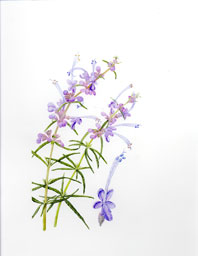
Trichostema by Lee McCaffree, © 2013, all rights reserved.
BAGSC is bringing Lee McCaffree to Southern California to teach this November. The subject of this class will be textures. We will explore patterns, textures, and other plant surfaces through color, light and shadow, and negative space. The balance between texture and form will be continually evaluated.
All media are welcome. Graphite will be used to establish a reference subject. Watercolor dry brush techniques will provide a method to represent many different surfaces while maintaining the subject’s form. Colored pencil techniques can be used the same way, but students using colored pencils will be responsible for their own color mixing. This class will develop artist’s confidence to attempt more complex subjects.
The class will be Saturday, November 9 and Sunday, November 10 from 9:30 am – 4:00 pm with a half hour to eat lunch in the classroom. Participants will bring their own lunch; coffee and tea will be provided and will be available all day. The cost for this 2-day class for BAGSC members is $200.00; the cost for non-members is $250.00.
A $50.00 non-refundable, down-payment is required to hold your place, with the final payment due October 12, 2013. All payments should be made by check, made out to BAGSC, with “McCaffree Class” noted in the memo line. Checks should be sent to Janice Sharp (email Janice if you need her address).
The class will be held in the LEED Platinum certified learning center at the Environmental Nature Center, (ENC), 1601 East 16th Street, Newport Beach, CA 92663. The beautiful ENC learning center has plenty of on site and street parking, and is nestled in a 3.5 acre landscape featuring 15 California native plant communities, wildlife habitats, and walking trails. For the past 40 years, the ENC has been a hidden gem in Orange County.
Lee McCaffree is a botanical artist specializing in watercolor. She has studied in London with Christabel King and Capel Manor Environmental College. She has received medals for her “Pinus” and “Plants in Peril” paintings at the Royal Horticultural Society exhibitions in London. Her work is included in the permanent collections of Kew Gardens, the Hunt Institute for Botanical Documentation and in the Filoli Florilegium, in addition to private collections. Previous exhibitions include: Longwood Gardens, the Horticultural Society of New York, the Denver Botanic Gardens, Strybing Arboretum, the New York State Museum, Oakland Museum, Filoli, and other venues. She teaches botanical art at Filoli and to private groups. She also has served on the Board of Directors for the American Society of Botanical Artists.
by Deb Shaw

Getty signage and flyer announcing the “Artist-at-Work Demonstration: Botanical Drawing,” © 2013 J. Paul Getty. Used with permission.
BAGSC members will be participating in a wonderful opportunity at the Getty this summer. To complement the Getty‘s “Gardens of the Renaissance,” BAGSC members will be demonstrating botanical art in a variety of media at the Artist-at-Work Demonstration: Botanical Drawing.
Join us in the Central Garden as we demonstrate the materials and techniques used to render plants and flowers. Learn about the botany of fruits, vegetables, and spices, and how explorations in the New World changed dinner tables around Europe. See the “Gardens of the Renaissance” exhibition, and explore Renaissance gardens and their stories (from scandalous to virtuous) in this beautiful exhibition of illuminated manuscripts. Meet botanical artists, ask questions, and get close to the action as you learn about materials and techniques seen in works of art on display at the Getty Center.
This is a free, drop-in program:
Sunday, July 7 & 21, and
August 4 & 11, 2013
12:30–2:30 p.m.
Participating BAGSC artists (on various days) include: Tania Marien, Deborah Shaw, Linda Erickson, Cristina Baltayian, Patty Van Ousterhoudt, Suzanne Kuuskmae, Jan Clouse, Arillyn Moran-Lawrence, Akiko Enokido, Lori Vreeke, Estelle DeRidder, Tania Norris, Alyse Ochniak, Leslie Walker, and Patricia Mark.
by Deb Shaw
The ASBA’s new website now has Online User Accounts for all current members — this includes all current BAGSC members (although very recent members may not yet be in the ASBA system). Your Online User Account allows you to access exclusive “member only” features on the site. You should have received an email from the ASBA with instructions on how to activate your Online User Account. Just in case you haven’t, you’ll find the instructions in this article below.
You must activate your Online User Account in order to register for the ASBA’s 2013 conference in Pittsburgh. Conference registration begins Saturday, 29 June at noon Eastern time, so be sure to activate your Online User Account now to be able to register in a timely manner.
INSTRUCTIONS: Activating your Online User Account is a two-step process:
1) You’ll activate your Online User Account, and;
2) You’ll review and update the information in your “ASBA Member Profile.”
This should take less than 10 minutes.
1) To activate your “Online User Account”
- Go to www.asba-art.org and click on the “Member Login” link in the upper right-hand corner of the homepage. OR, click on this link: www.asba-art.org/user
- Click on “Request New Password.”
- Type in your email address. (Be sure you use the email address you gave to the ASBA when you joined or renewed — that is the email address that was used to enter you into the database.)
- Click “Email New Password.”
- You will immediately receive an email message from asbaonline@asba-art.org, Check your email box. NOTE: there have been reported problems with Verizon email addresses. If you have a verizon.net email address and/or do not receive an email when requesting a new password, please contact webmaster@asba-art.org for assistance.
- Click on the link provided in the email.
- The link will bring you back to the ASBA website. Click on “Login,” enter and confirm a password, and set your time zone setting.
- Click “Save” which returns you to the same screen with the phrase “The changes have been saved.”
(If you ever forget your password, you can always make a new one by repeating the steps above.)
2) Review and update your “ASBA Member Profile”:
- Click on “Edit your ASBA Member Profile” in the list of links under the Individual Member heading.
- Review the information in your member profile. This information can ONLY be viewed by ASBA members:
- Basic Contact Information
- Directory Instructions
- Chapter and Artists’ Circle Affiliation
- Personal Webpage Options
- Optional Profile Information
- Add any missing information
- Correct any erroneous or outdated information
- If you’re unsure, read the hints below each item
- Still have questions? Contact webmaster@asba-art.org
Once you activate your Online User Account, you’ll be able to do the following:
Available NOW
- Update your own membership record: change your address, email, etc.
- Search an interactive list of classes
- Submit articles, class listings and calls for entry to the journal and for the website
- Make donations via credit card
- Renew your membership and pay your dues via credit card
- Search the member directory, by name, chapter, etc. (member-only access)
- Register for the Annual Meeting & Conference
Coming Soon
- Upload exhibition entries, pay the entry fee via credit card, and apply for Artists and Education grants
- View announcements of ASBA volunteer opportunities
- Take a video tutorial
- Update your own Teacher Directory & Member Gallery page
If you haven’t already done so, be sure to activate your Online User Account today!
by Tania Norris, posted by Deb Shaw

Akiko Enokido, Chrysanthemum morifolium “Kokka Seija”
© 2013
Watercolor, 11″ x 16″
Akiko Enokido is a long time member of the Botanical Artists organizations in America and Japan and has been accepted in major exhibitions. Her beautifully rendered paintings are known for their exquisite color, detailing and composition and are prized by their owners. Akiko has shown her work in the United States and Japan, including the ASBA/Horticultural Society of New York exhibitions, and the 13th Annual Exhibition of Botanical Art and Illustration from the Hunt Institute for Botanical Documentation.
In Akikoʼs words her class:
“will observe the shapes and shadows of leaves. You may be surprised to realize how often you are drawing from your own assumptions and not from how the object is actually expressing itself. I will demonstrate the approach of placing multiple layers of color, putting emphasis on capturing reflection of light and to show depth of the objectʼs dimensions.”
Classes will be held at Virginia Robinson Gardens, August 5, 6, and 7, 2013, from 9.30 am – 3.30 pm daily. A supplies list will be sent to all participants.
Coffee, tea and water will be provided, but please bring your own lunch. Fees for the three day session will be $375. for members and $450. for non-members. A deposit of $100. to hold space can be accepted but is non-refundable. Full payment must be made by August 1, 2013.
To make reservations, visit the Virginia Robinson Gardens website, or call (310) 550-2068.
Mail check to:
Friends of Robinson Gardens
1008 Elden Way, Beverly Hills, CA 90210
If you have any questions, please contact Tania Norris.
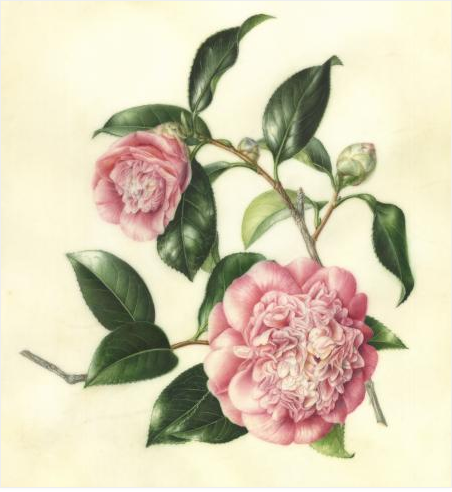
Camellia japonica ‘Chandleri Elegans’, Variegated Camellia, by Akiko Enokido, watercolor on vellum, © 2012, all rights reserved.
by Deb Shaw
The online, local newsletter, the “Newport Beach-Corona del Mar Patch” posted a great article about the “Day of Art” at Roger’s Gardens. Written by Rayna Jensen, “Art Blooms at Roger’s Gardens” has a quote from Tania Marien and photos of the drawing workshop taught by Tania and Deb Shaw.
Be sure to click on the accompanying photo to view all of the photos of the event that are included with the article, and their captions. Included in the photo album: Janice Sharp’s silverpoint demo drawing, photos of participants drawing in Tania and Deb’s workshop, and the brilliant colors of the fruit and vegetables on BAGSC’s interactive table.
by Deb Shaw
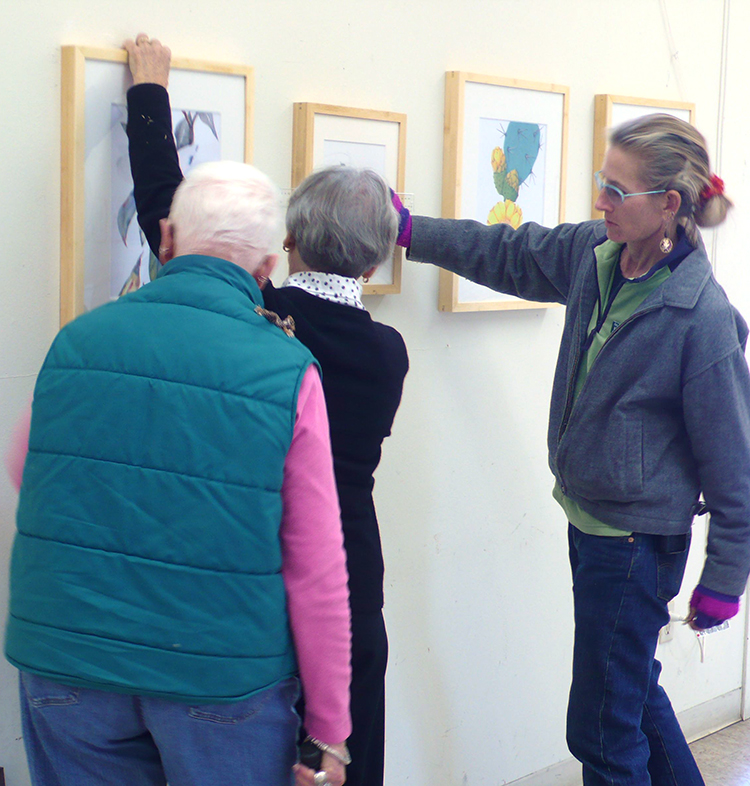
(left to right) Leslie Walker, Joan Keesey and Lesley Randall hang and straighten artwork, photo by John Keesey.
Botanical Visions, an exhibition of botanical art by the Botanical Artist Guild of Southern California opened on January 12th in the Ecke Building of the San Diego Botanic Garden.
The exhibit features paintings, drawings and prints in watercolor, pen and ink, graphite and colored pencil. BAGSC member Lesley Randall organized this wonderful exhibition of ten BAGSC artists: Estelle DeRidder, Linda Ericksen, Polly Jones, Joan Keesey, Lesley Randall, Gilly Shaeffer, Janice Sharp, Deborah Shaw, Mitsuko Schultz and Patricia Van Osterhoudt.

(left to right) Janice Sharp and Mitsuko Schultz hanging artwork, photo by John Keesey.
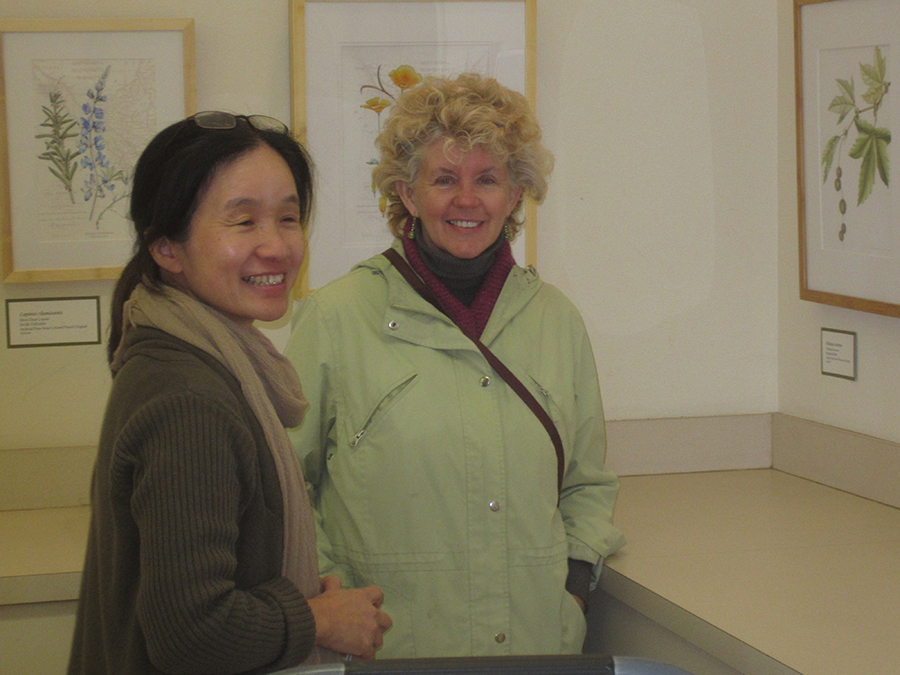
(left to right) Mitsuko Schultz and Patty Van Osterhoudt, photo by Deborah Shaw.
The artwork was hung the day of the opening artists’ reception in the Ecke Building. The light-filled, open-beamed room is used as a classroom, so the artwork will have lots of exposure for the duration of the show, from January 13 – March 23, 2013.
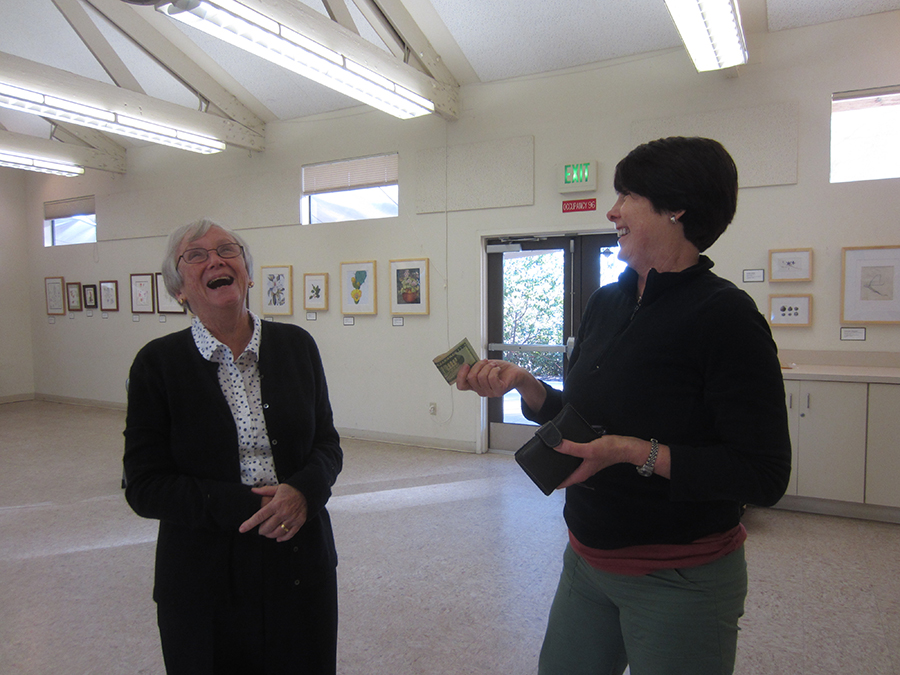
(left to right) Joan Keesey and Janice Sharp share a laugh before the Artists’ Reception, photo by Deborah Shaw.
Lesley Randall, Leslie Walker, Estelle DeRidder, Joan Keesey (and BAGSC helper John), Polly Jones (and husband), Patty Van Osterhoudt (and BAGSC helper Chris), Janice Sharp, Mitsuko Schultz and I were all on hand to hang the show. Linda Ericksen joined us for the reception.

(right to left) Polly Jones, Polly’s husband and Estelle DeRidder place artwork labels, photo by Deborah Shaw.
Formerly called “Quail Gardens”, the San Diego Botanic Gardens are absolutely beautiful, and this is a wonderful time of year to see them. Although the gardens are extensive, with different sections devoted to plants from different parts of the world, each section feels like an intimate treasure, with delightful surprises around each bend of the path.
A few attendees at the Artists’ Reception, photo by John Keesey.

A statue in the garden, San Diego Botanic Gardens, photo by John Keesey.
The exhibit will be open during regular garden hours January 13 – March 23, 2013.
Thank you Lesley!
by Deb Shaw
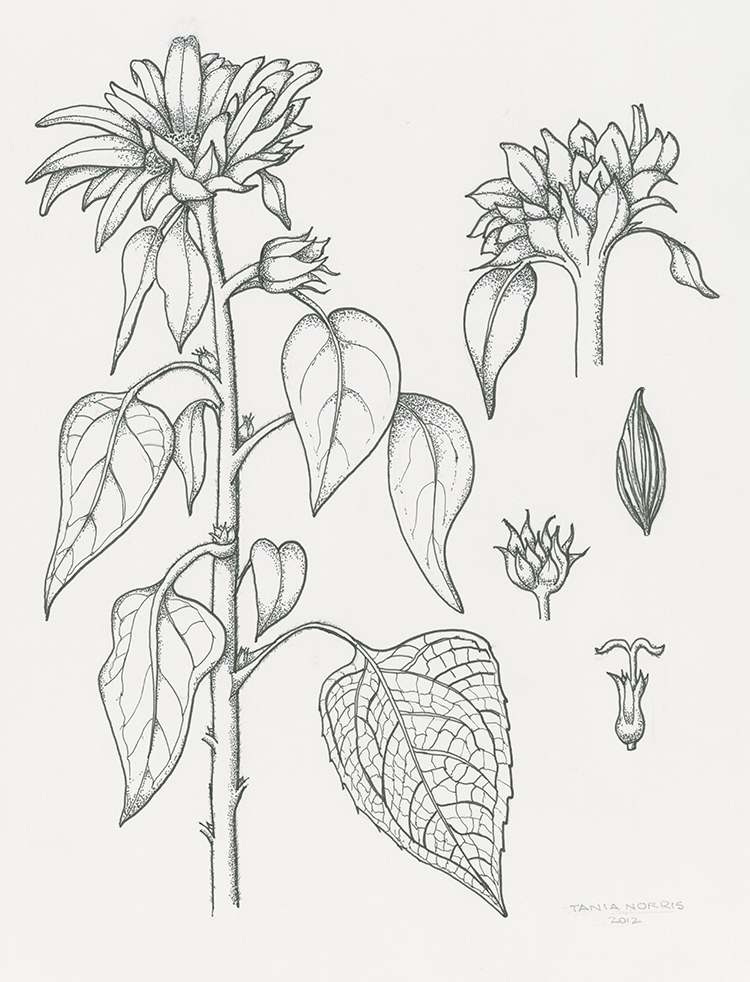
Sunflower, pen and ink by Tania Norris, © 2012, all rights reserved.
In October, 2012, when we posted the “Stipple, then Tipple” article about Anita Walsmit Sachs’ BAGSC class, we also posted a request for additional artwork as students completed their drawings. (See https://dbshaw.wordpress.com/wp-admin/post.php?post=1448&action=edit for the original article.)
Joan Keesey emailed Tania Norris’ pen and ink beautiful Sunflower from the class. Thank you Joan and Tania for sharing a wonderful drawing!
by Deb Shaw
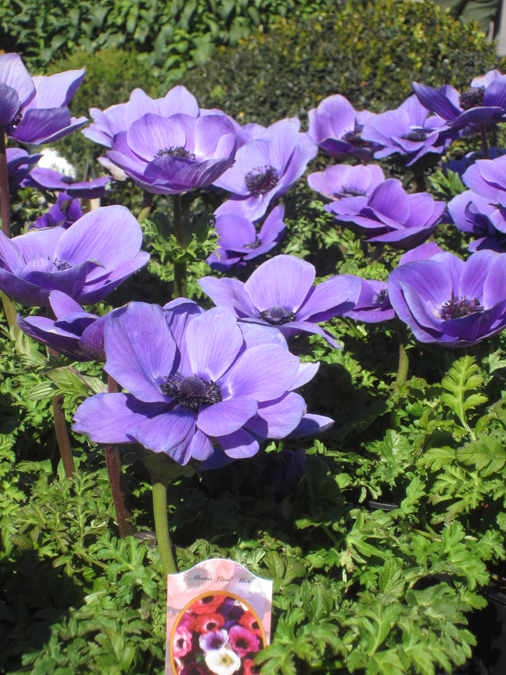 The first “Day of Art” at Roger’s Gardens, originally planned for January 26 was postponed due to rain. It will be held, however, this Saturday, February 2, from 9 am – 4:30 pm.
Fifty artists will be painting and demonstrating in the gardens, including BAGSC members Bonnie Born Ash, Diane Daly, Clara Josephs, Suzanne Kuuskmae, Tania Marien, Pat Mark, Arillyn Moran-Lawrence, Alyse Ochniak, Janice Sharp and Deb Shaw.
BAGSC will have a table about botanical art, as well as an interactive table to explore plants, fruits and vegetables. Tania Marien and Deb Shaw will teach a workshop to the public on drawing flowers and leaves in pencil.
Plein aire painters will also be painting and demonstrating in the garden, as well as leading workshops. The event is free, open to the public, and can be enjoyed by all ages.
Roger’s Gardens is located at 2301 San Joaquin Hills Rd., Corona Del Mar, CA 92625, 949.640.5800. “Bite Me Foods” food truck will be parked at the Victory Garden in the back parking lot from approximately 11 am to 2 pm.
 And, of course, the beautiful selection of plants in the nursery will be open.
Bring friends and family and see you there!
by Clara Josephs, posted by Deb Shaw
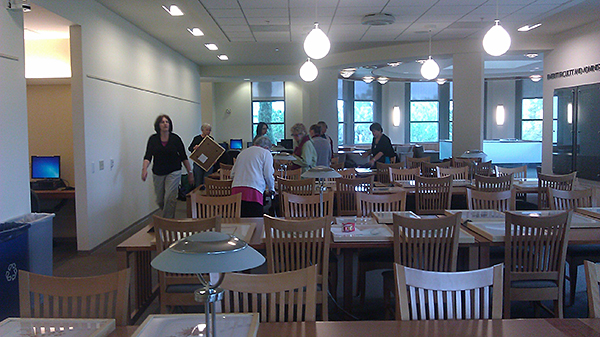
Before: The BAGSC crew arrives and unpacks artwork. Thank you to all the BAGSC members (and supporters) who came to help!
The Chapman show, “Drought Tolerant Beauty”, is up and it is stunning! There are 59 pieces by 18 of our members. The art is arranged through the gallery areas by drought tolerant mechanisms. Dr. Jennifer Funk’s students have written wonderful commentaries to accompany the groupings.
Our Artist Reception is Thursday evening, February 7 from 7 – 9 pm.
In addition to the tasty hors d’oeuvres and adult libations, Dr. Funk will talk briefly about her involvement with restoration ecology and drought tolerant plants.

Sorting artwork into drought-tolerant categories.
Plan to attend with your family and friends. Even if you don’t have a piece in the show, you will enjoy seeing this collection of works by our members. You will see work that was inspired by Anita Walsmit Sachs’ workshop, works in a variety of media, and some very unique ways of composing challenging subjects.
Take time to notice the framing. Almost all the paintings were framed to ASBA show specifications, using a blonde L profile frame. Many of the frames are the Dick Blick renewable bamboo frame we recommended. Several frames are “look-alikes” that blend perfectly with the Dick Blick frame. Do you like the standardized framing look? Proponents say it helps focus attention on the art, and give the art a more professional, less “décor” appearance. Let us know what you think!
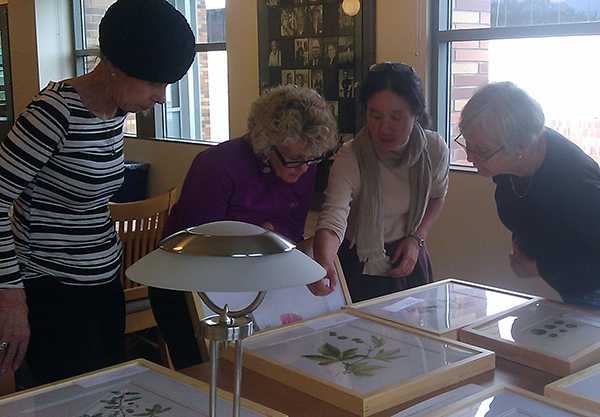
Pausing to admire the beautiful art.
If you would like to demonstrate during the reception, please call or email Diane Daly. If you weren’t able to paint for the show, demonstrating during the reception is another great way to participate!
Don’t forget to WEAR YOUR BAGSC NAME TAG! If you don’t have one, please let Deb Shaw know and she will bring one for you.
Looking forward to seeing everyone on the evening of February 7.

Dr. Jennifer Funk, ecologist with Chapman University, helps categorize the art.

Laurie Gates Cussalli, Chapman University, demonstrates the hanging wire system.

The “Succulent Leaves” Category is up on the wall, waiting for signage and labels.
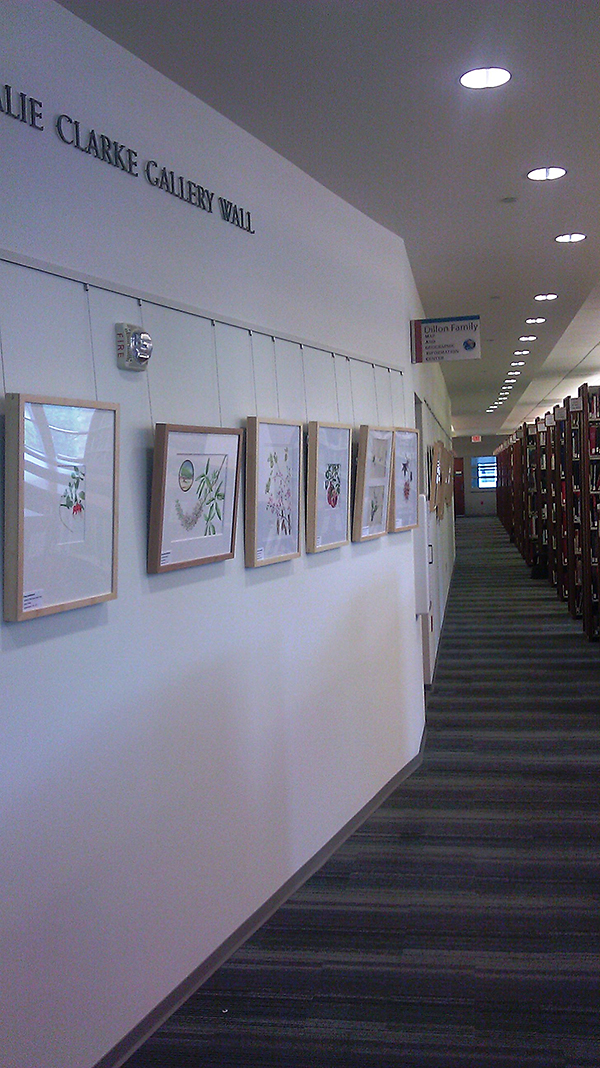
The exhibition continues on the other side.
 BAGSC News