You are currently browsing the category archive for the ‘Feature Articles’ category.
by Jan Clouse, posted by Deb Shaw
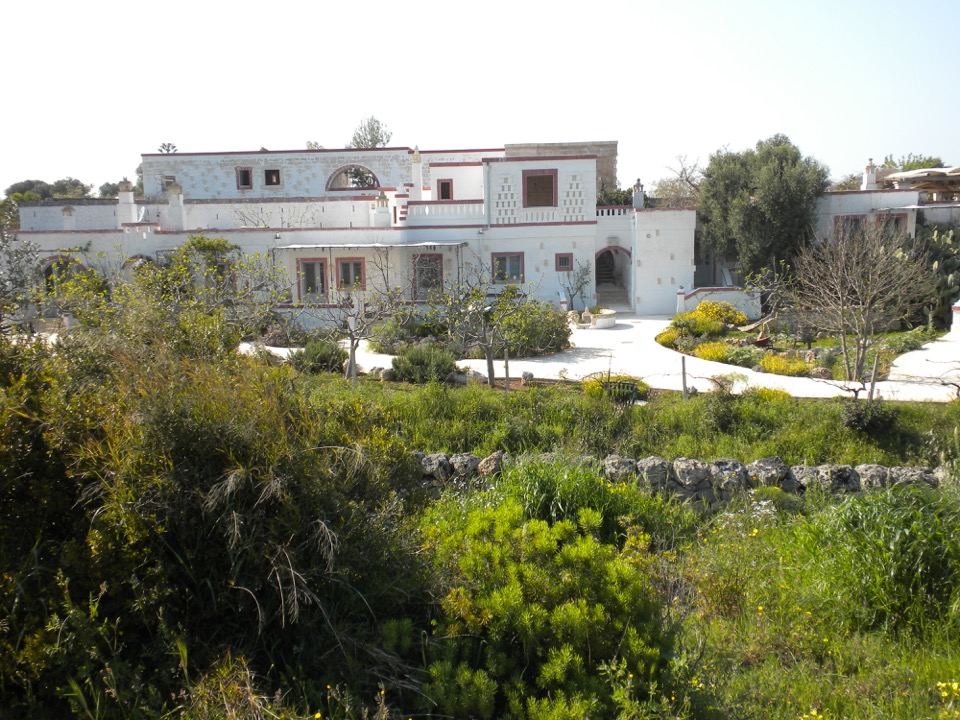
View of Masseria Montenapoleone, photo by Charles Clouse, © 2015, all rights reserved.
By tourist industry standards, Puglia is undiscovered territory. Situated down at the heel of Italy’s geographical boot, facing east to the Adriatic Sea, it is generally ignored in favor of the High Renaissance attractions of Rome, Florence, or Siena, the style consciousness of Milan and Venice or the casual flair of Naples.
Nevertheless, with its own earthy appeal and cultural heritage of pre-historic, medieval and Byzantine sights, Puglia can be irresistible for visitors ready to hike, bike, or drive through its bountiful landscape. It supplies the largest portion of Italy’s olive oil from its ancient trees, and its typical cucina povera depends heavily on delicious seafood, fresh, seasonal vegetables and the famous Pugliese hearth bread.
The olive groves and almond orchards, the rugged coastline and lush meadows filled with wild flora are a painter’s paradise. And this, in particular, was the attraction for Margaret Best’s latest botanical painting workshop/travel excursion. Five botanic artists (Ana Brito, Jan Clouse, Jane Maycock, Carole Schumacher and Leslie Walker) along with one husband/guitarist (Charles Clouse) and a guide (Kiloran McRae) joined Margaret for an 8-day immersion in art, food and visits to this land that time forgot.
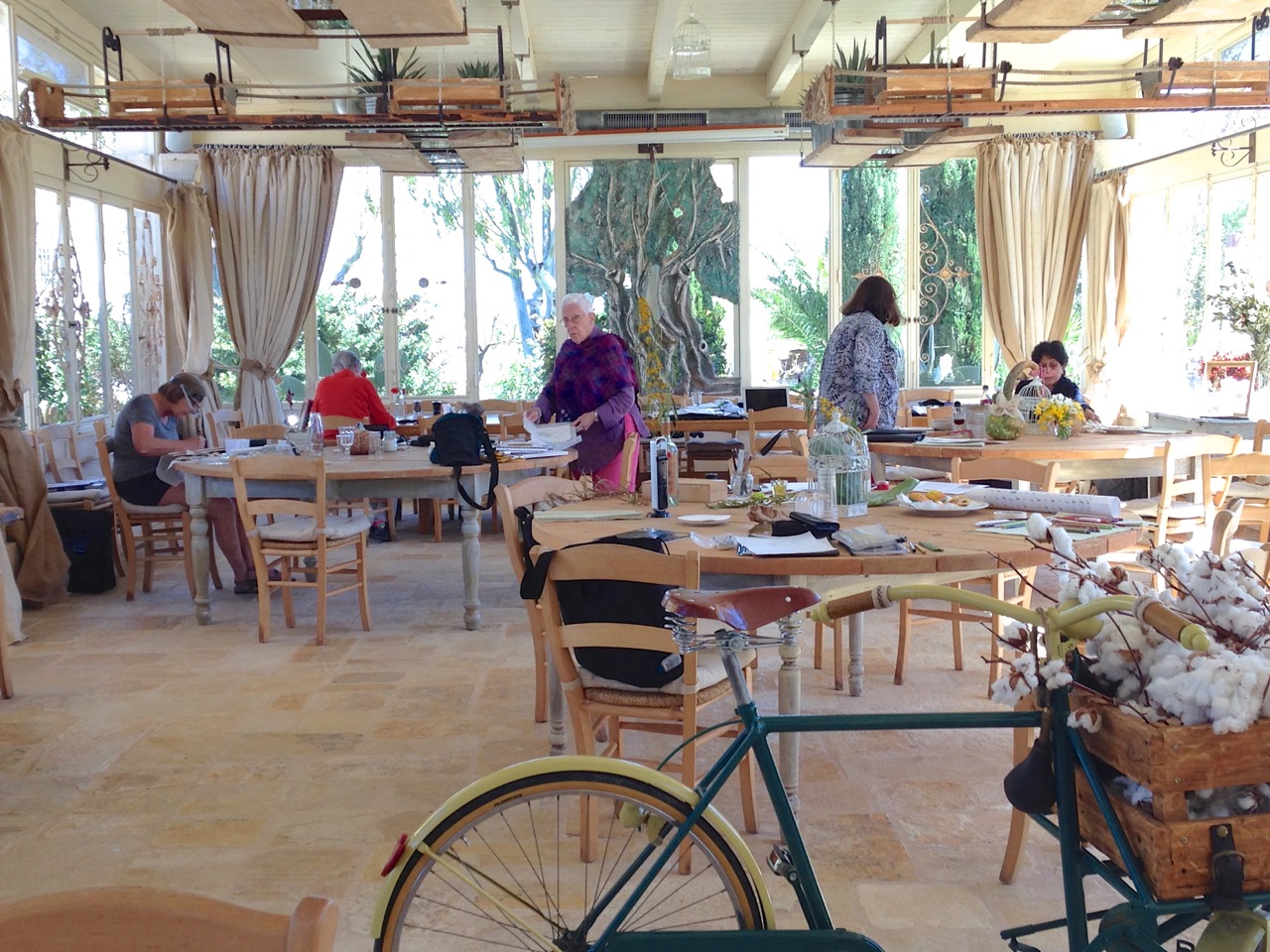
Artists’ studio at Masseria Montenapoleone, (featuring from L to R) Jane Maycock, Carole Schumaker, and BAGSC members Leslie Walker, Margaret Best and Ana Brito, photo by Jan Clouse, © 2015, all rights reserved.
The workshop was based at the rustically elegant agriturismo farm, Masseria Montenapoleone, which besides most comfortable accommodations, provided us with a large airy studio, well lit by walls of windows. At the opposite end of the room from the studio space was a huge fireplace right behind the table where we gathered for fabulous lunches and dinners.
We were introduced to the Masseria by our host, Guiliano Monteneve, who gave us a leisurely tour of the property with the assumption that along the way each of us could find an appealing botanical specimen to paint. Across the path from the main cluster of buildings was an almond orchard interspersed with fava bean rows, further on were olive trees, some many hundreds of years old, a meadow of wildflowers, a path leading to a pre-historic grotto, and everywhere unique indigenous blooms.
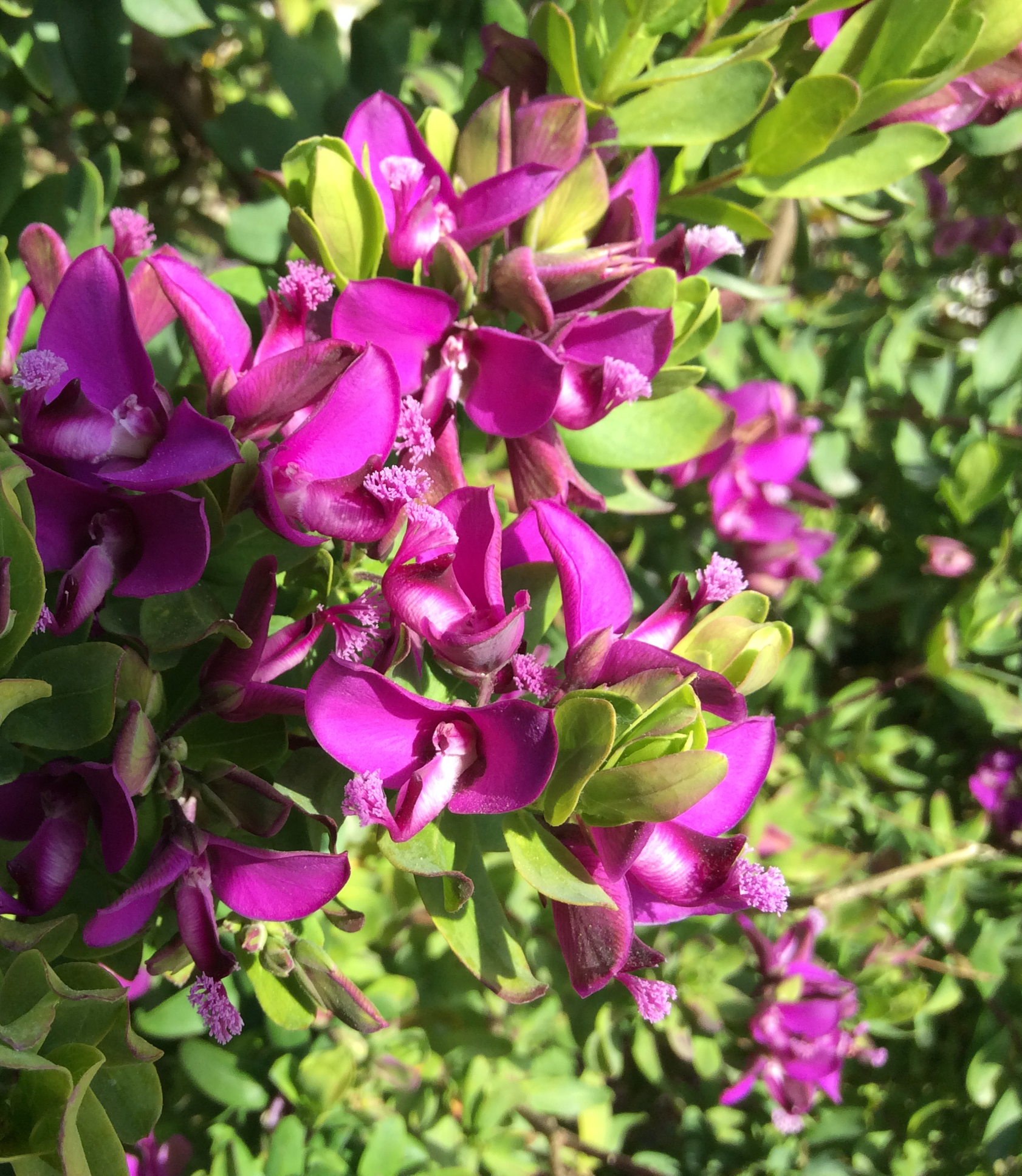
Leslie Walker found a beautiful Polygala myrtifolia to paint. Photo credit: Leslie Walker, 2015, all rights reserved.
Besides the ubiquitous red poppies scattered across the springtime fields, there were small pale lavender wild irises, a dark red orchid, a nameless neon blue ground cover, and furry borage everywhere–including on our dinner plates. Most of us spotted several possible specimens on the walkabout, and by the following morning in the studio everyone was ready to draw. As we settled in, each of us had a large table of our own, plenty of space to spread out, and our drawing pencils sharpened.
Margaret got us started on our first day with a meditation to bring us into the time and spirit for art. As always at her workshops, she had a spiral bound syllabus of information and instructions; this one appropriately titled “Postcards from Puglia.” Ahead of time she had emailed us a few instructions, among them was to rule off several “postcard-sized” formats on our favorite paper to help us compose our paintings, and to bring a few finished pieces with us. Personally I found the “ready format” a real help in focusing and cropping the blooming Acacia branch I had chosen, though my “postcard” turned out to be a double-wide affair. I was productive enough, though, to complete two additional postcards of dried acorns gathered on one of our field trips.

A montage of Leslie Walker’s subject: (clockwise from upper left) Polygala myrtifolia, dissection sheet; Leslie’s finished painting; Leslie concentrating on her subject. Photo(s) courtesy of Leslie Walker, 2015, all rights reserved.
We settled in to a comfortable routine. My husband, Charlie, played guitar to start us off on a couple of mornings, and then shifted to the back of the room or outdoors on the patio where Leslie was working, for her own private concert. Our quiet concentration was broken around eleven each morning when Michele, our personal waiter, laid out a couple of plates of sweets and took our coffee, tea and cappuccino orders.
Long, very productive days in the studio were a gift of undistracted time to draw, paint, and ask my mentor for advice, just when I needed it most. One of the real treats of the week was that Margaret could guide each of us in proportion to our skills and needs as both colored pencil and watercolor artists.
Interspersed with art time, were some extraordinary sights and experiences—an evening visit to the seaside town of Polignano a Mare, another to the rampart city of Ostuni with a dramatic view of the Adriatic. One morning we toured the Giardini di Pomona, where Paolo Belloni is dedicated to sustaining traditional fruit tree species, including over 350 varieties of figs. Another day we shopped the weekly farmer’s market in Locorotondo, buying assigned ingredients for a dinner to be prepared by celebrity chef Tiziano Mita, and finished the morning with a tour of the UNESCO World Heritage town of Alberobello, known for its concentration of curious conically shaped stone houses called trulli.

Hanging the Exhibition with Alessandra and Giuliano, photo by Jan Clouse, © 2015, all rights reserved.
The workshop week ended, not with a routine sharing of work within the group, but with an elegantly mounted evening exhibition that our host Guiliano had envisioned even before we arrived. Here we met a large gathering of neighbors, friends, and folks who had shown us the wonders of Puglia during the previous week. Guiliano and his family had ingeniously transformed our studio into an art gallery, with suspended panels that featured each artist’s bio, personal quotes and work, including the pieces we had brought with us. And the masseria’s chef, Antonio, prepared an incredible array of antipasti and desserts for a very social and international group of about 75 guests.

The “Vernissage,” Gallery opening exhibition, photo by Jan Clouse, © 2015, all rights reserved.
Altogether the week was an energizing and inspiring introduction to a botanically rich yet otherwise little-noticed part of Europe. Guidebooks should definitely make note for Puglia: “painters welcome.”
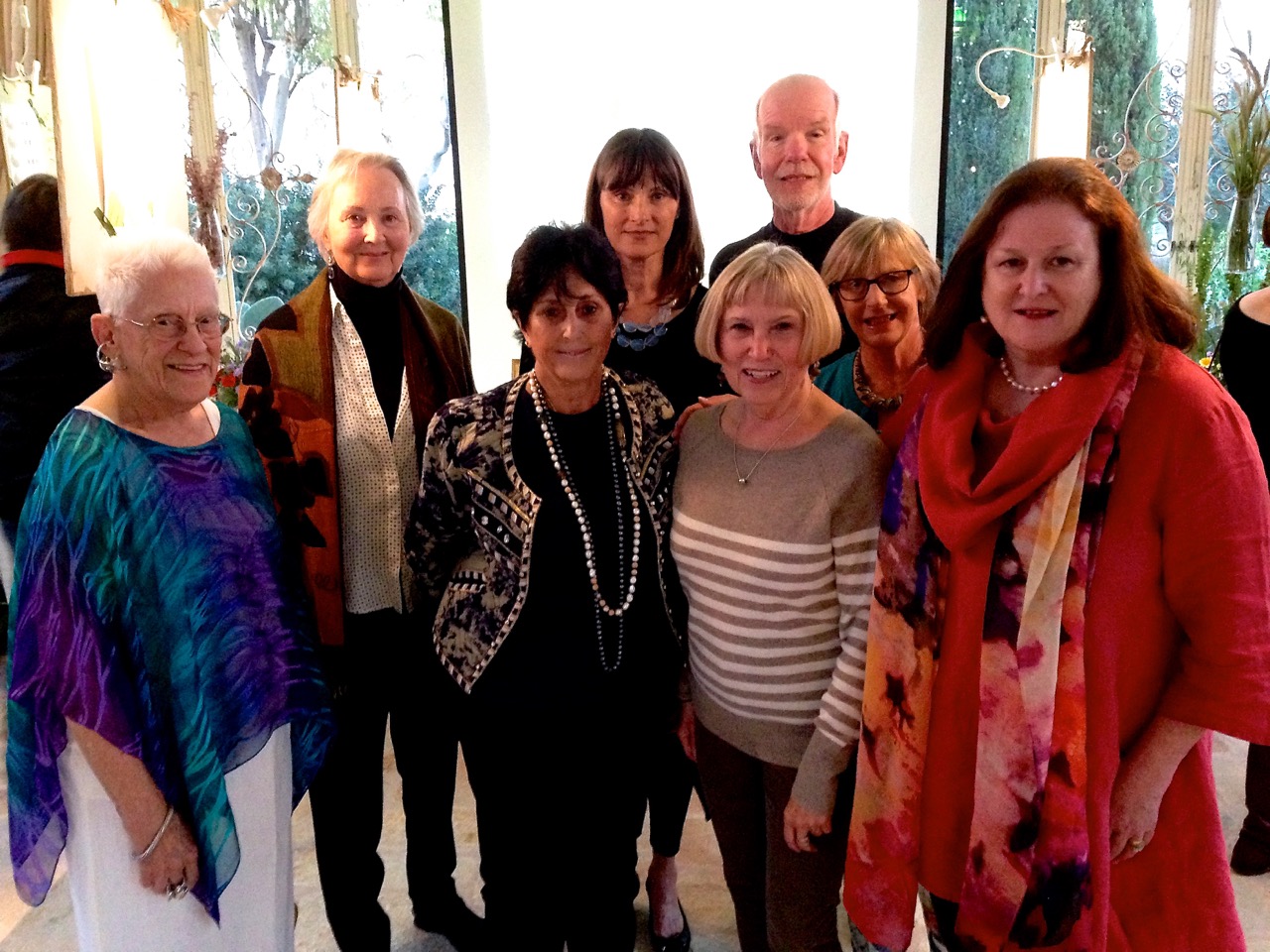
Leslie Walker, Carole Schumaker, Ana Brito, Kiloran McRae, Jan Clouse, Charles Clouse, Jane Maycock, Margaret Best, photo courtesy of Masseria Montenapoleone, © 2015, all rights reserved.
by Jan Clouse, posted by Deb Shaw

Quercus agrifolia, Coast Live Oak. colored pencil by Jan Clouse, © 2105, all rights reserved.
I am perpetually drawn to two particular subjects: eucalyptus and oaks. Two varieties of oaks are native to Santa Barbara. The Coast Live Oak grows everywhere in town, in fact, mighty examples anchor each end of my block. And over the Santa Ynez range of mountains the Valley Oak dominates the landscape. This particular branch came from a tree about 3 blocks from my house with summer acorns, green and fresh. For me, part of its charm was the sprinkling of empty brown caps from the year before.
Congrats, Jan!
The Botanical Art Exhibition at Filoli is open Tuesday, March 24 through Sunday, June 7, 2015. Visit their website for hours.
by John Keesey, posted by Deb Shaw
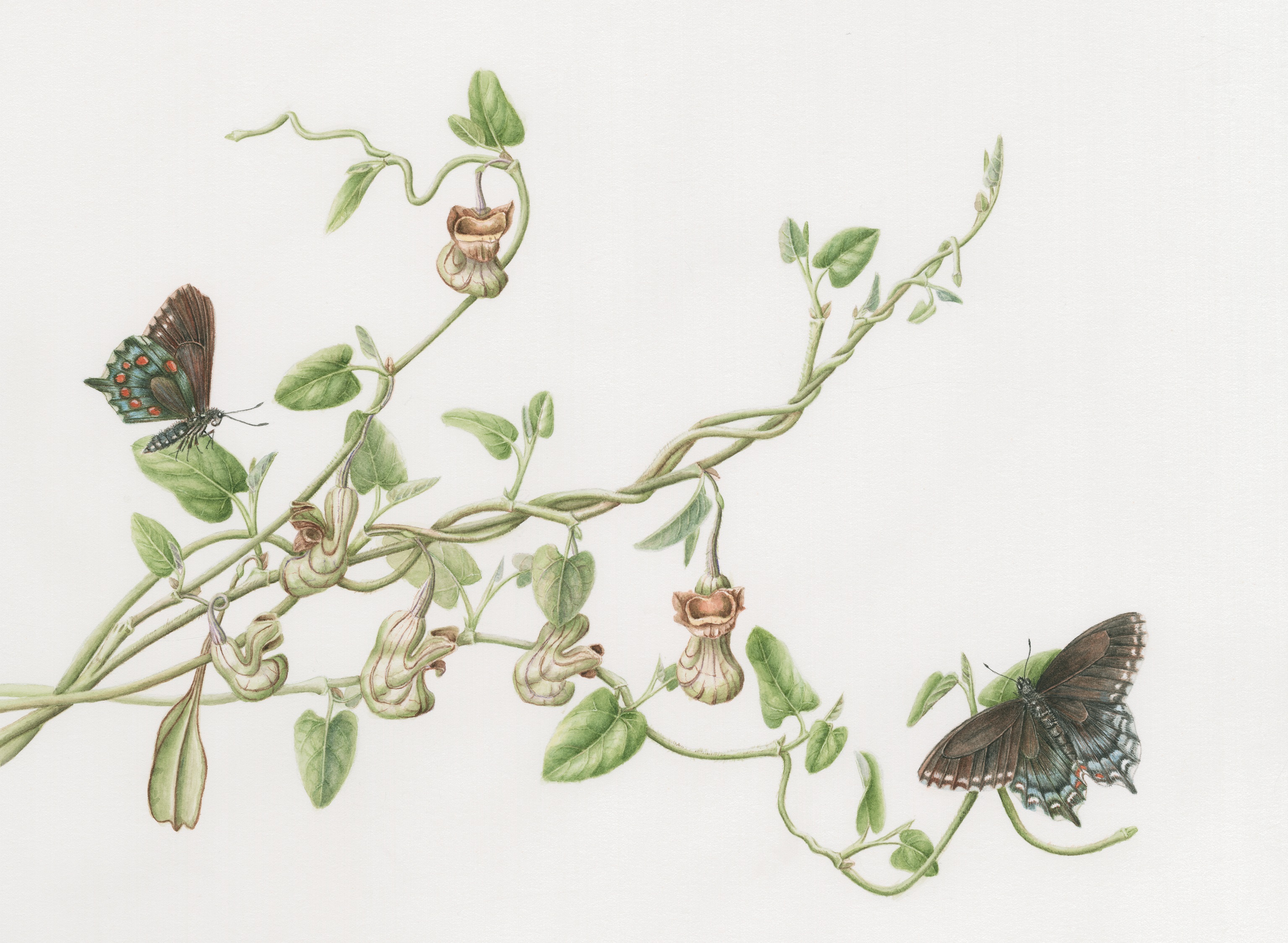
“Dutchman’s Pipevine with Pipevine Swallowtail Butterflies” (Aristolochia californica with Battus philenor), watercolor by Joan Keesey, © 2015, all rights reserved.
A watercolor painting of “Dutchman’s Pipevine with Pipevine Swallowtail Butterflies” (Aristolochia californica with Battus philenor) by BAGSC member Joan Keesey has been accepted into the 18th Annual International Show of the American Society of Botanical Artists (ASBA) at the HORT Gallery of The Horticultural Society of New York in mid-town Manhattan, September through November 2015. This seems fitting to me, because Joan first saw these butterflies and their caterpillars on pipevine during our first hike along Big Chico Creek in Upper Bidwell Park, Chico, a few years ago. In January 2015 we moved to Chico, and have discovered Pipevine and its inhabitants on our very own property. Recently two caterpillars (black with orange spikes) have each formed a chrysalis (what is the plural?) in a jar in our kitchen, and then soon emerged as beautiful Pipevine butterflies (black + iridescent blue with orange spots)! Truly miraculous!
The stress of moving was mitigated somewhat by learning that Joan’s “Hummingbird Sage” (Salvia spathacea) watercolor painting had been awarded First Place at the Botanical Art Exhibition of the California Native Plant Society’s 2015 Conservation Conference in San Jose, California, in January 2015. Then in March 2015, Joan’s watercolor painting of Matilija Poppy (Romneya coulteri) won the Roth Award “for distinction with an emphasis on traditional botanical art presentation” at the 17th Annual Botanical Art Exhibition at Filoli in Woodside, California.
Whooeee!!! Is it any wonder that I am proud of her? Thanks for letting me toot her horn!
from Deb: Congratulations Joan!
by Beth Stone
The call for entries has been sent (see email from Deb Shaw dated 5/5/15) for BAGSC ‘s very own adjunct exhibition to “Weird, Wild & Wonderful: The New York Botanical Garden Second Triennial Exhibition, Botanical Illustrations of Remarkable Plants” coming to The Huntington’s Brody Botanical Center.
BAGSC members of all experience levels are encouraged to enter at least one artwork (limit is 3 artworks per member). To date we have a list of nearly 50 subjects from 25 artists, we’re expecting many more.
Botanical oddities and curiosities could be those found locally, in natural surroundings or a botanical garden. If you’re looking for more inspiration, Dick Rauh, PhD offered ideas to artists on potentially pertinent plants: http://asba-art.org/article/weird-wild-and-wonderful-suggested-subjects. We’d like to include as many different species as possible.
So…what visually unusual, bizarre, beautiful (or not) subject have you chosen?
We have an important deadline, here’s how you can help:
Please email the complete botanical name of your choices ASAP but no later than Wednesday, May 27, 2015 to Beth Stone. Don’t worry, this does not obligate you to submit those works.
The cut-off date is when we will submit our “list of plant subjects” as best we know it to The Huntington so they can start planning on signage, related plants from the Garden, microscopes and more, linking our artworks to The Huntington’s vast plant collection in creative, and no doubt “wonderful”, ways.
by Janice Sharp and Beth Stone

Gilly Shaeffer demonstrating her watercolor technique. Gilly Shaeffer demonstrating her watercolor technique. Photo credit: Brad King (SCCS President).
In January of 2015 BAGSC staged a show entitled A Passion for Camellias in Van de Kamp Hall at Descanso Gardens. The exhibit was an exciting addition to the first Camellia flower show of the 2015 show season. BAGSC members were on hand all that weekend to answer questions and to provide demonstrations.
At the request of Descanso Gardens, 11 art works from the initial display of 20 have been re-hung in the historic and beautifully restored Boddy House where they are expected to remain well into 2016. Art works were selected to represent as many contributing artists as possible. The area where the botanicals are hanging invites close observation, along the interior hallway leading to and spilling into the kitchen.
You’ll want to set aside some time to bring friends and family to visit Descanso Gardens and see this lovely display in person. For an orientation to the Boddy House, please refer to the Descanso Gardens web site: https://www.descansogardens.org/explore/boddy-house
Artist Tania Norris chatting with Camellia enthusiast Hiromi Sato.
While you’re there, be sure to stop into the Sturt Haaga Gallery to see California Light opening May 3rd:
https://www.descansogardens.org/explore/upcoming-exhibition/
Many thanks to David Brown, Susan Armstrong and Cris Martinez of Descanso Gardens for welcoming BAGSC’s Passion for Camellias to the Boddy House.

Watercolor of C. japonica ‘Berenice Boddy’ by Clara Josephs, © 2015, all rights reserved.

Camellia Botanicals in Descanso’s Boddy House.
by Deb Shaw
BAGSC members Margaret Best and Melanie Campbell-Carter have been accepted into the 18th Annual International American Society of Botanical Artists at The Horticultural Society of New York.
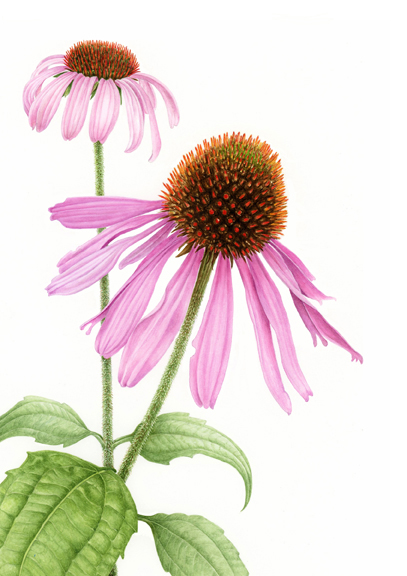
Margaret Best, Echinacea purpurea or purple cone flower, © 2015, All rights reserved.
Margaret’s 8.5 x 11 watercolour on paper is of a Canadian native Echinacea. She writes, “There are two Echinacea natives species in Canada. The one shown is Echinacea purpurea or purple cone flower—the species widely harvested for medicinal use. It has also become popular as a cultivated flower in Canadian gardens, as it brings a final splash of colour at the end of summer and into the fall. The specimens I used came from my daughter’s beautiful front garden that she inherited from the previous green-fingered owner of their new home in Ontario, Canada.”

Melanie Campbell-Carter, colored pencil, Pseudobombax ellipticum, shaving brush tree, © 2015, all rights reserved.
Melanie submitted a Pseudobombax ellipticum, also known as the shaving brush tree. She writes, “The tree was in its full blooming glory this past March on the island of Kauai. Depicting the sturdy strength of its stems and buds, and the delicate profusion of vivid pink stamens, was not only an enormous challenge but also a fantastic and joyful process. As we spent our days and weeks together, I developed a great affection for my ‘shaving brush.’ I am so thrilled to have been able to translate a gorgeous, living thing to paper in such a way that it continues to speak to others!”
Congrats to both of you!
Are there any more BAGSC artists who have been accepted? If so, please send me an email with an image.
A Little About the International ASBA/Hort Exibition
Each fall, the Annual International American Society of Botanical Artists at The Horticultural Society of New York exhibition is held at the Hort in mid-town Manhattan. It is the ASBA’s longest running collaboration. Past exhibitions are posted on the ASBA’s website; this year’s exhibition will be posted as well.
The Hort’s Gallery encourages gardeners and artists alike to appreciate the creative intersection between art and nature. Exhibitions showcase emerging and established contemporary artists inspired by horticulture, botany, landscape, and the environment.
by Deb Shaw
 Alain Touwaide will be one of the lunch hour keynote speakers at the “Weird, Wild & Wonderful Symposium,” July 23–26, 2015 at The Huntington Library, Art Collections, and Botanical Gardens. We can get a sneak peak with a different lecture by Alain this Saturday at The Huntington, when he gives a talk entitled, “Gardens for Health: A Walk through History.”
Alain Touwaide will explore how humans have recognized the therapeutic benefits of nature since ancient times, and have built gardens that helped restore health, both physical and spiritual. By reviewing some iconic sites in the Mediterranean world—Pompeii, Constantinople, Baghdad, Cordoba, Granada, and Padua, among others—Touwaide examines archaeological fields and early manuscripts that illustrate the relationship between humans and nature through time and space.
Tania Marien has posted blog articles about Alain Touwaide and Emanuela Appetiti on ArtPlantae Today. She encourages all of us to attend: “I have been to Alain’s presentations at the conferences of the Renaissance Society of America and the History of Science Society and can confirm without question you will leave enlightened and leave thinking about herbals in an entirely different way. How Alain and Emanuela interpret what is written in the herbals is fascinating.”
Touwaide is scientific director of the Institute for the Preservation of Medical Traditions and research associate at the Smithsonian Institution.
Gardens for Health: A Walk through History
Saturday, May 2, 2015
2:30 p.m.
Rothenberg Hall
The Huntington Library, Art Collections, and Botanical Gardens
Free; no reservations required
By Beth Stone, posted by Deb Shaw
Caltech is offering a lecture entitled “Watching Paint Dry and Colors Fade: The Intersection of Art and Science,” by Katherine T. Faber, the Simon Ramo Professor of Materials Science at Caltech. A part of the Earnest C. Watson Lecture Series, the lecture will explore the links between science, engineering and art about pigments, color, fading masterpieces and more.
Wednesday, May 20, 2105
8 pm
Beckman Auditorium
Caltech
Presented by Caltech Committee on Institute Programs
Description and more online on the Caltech Public Events Calendar.
by Deb Shaw

Erythrina caffra, Coral Tree, original watercolor by Joan Keesey, © 2015, all rights reserved.
The Botanical Artists Guild of Southern California (BAGSC), in conjunction with Dr. Jennifer Funk and students from the School of Earth and Environmental Sciences at Chapman University, will be opening an exhibition of botanical art entitled “An Illuminating Look at Legumes.”
Held in conjunction with the 10th Anniversary of the Chapman University Leatherby Libraries, the exhibition explores the large, economically important plant family Fabaceae or Leguminosae, commonly known as legumes, peas, or beans.
Exhibit dates:
Thursday, February 19 – Wednesday, March 25, 2015
Artists’ Reception and Demonstrations:
Wednesday, February 25, 2015
5:30 p.m.
Doy and Dee Henley Reading Room
Leatherby Libraries, 2nd Floor, Chapman University
One University Drive, Orange, California 92866
Legumes are the third largest flowering plant family on earth, after orchids (Orchidaceae) and daisies (Asteraceae). They are incredibly diverse, ranging from huge trees, twining, vigorous vines to small delicate annuals and even a few aquatic plants. They grow all over the world, except in Antarctica and the high Arctic.
Many legumes have a unique ability to fix atmospheric nitrogen through their root nodules, and, in doing so can replenish our soils and colonize barren areas.
Accompanied by interesting descriptions of the plants by Dr. Funk, her students and BAGSC members, the artists have depicted members of this family that are important agriculturally; thrive in desert and semi-arid environments; are weedy and invasive; and grow as trees.
Artists include: Cristina Baltayian, Melanie Campbell-Carter, Diane Daly, Estelle DeRidder, Cynthia F. Jackson, Clara Josephs, Joan Keesey, Suzanne Kuuskmae, Patricia A. Mark, Arillyn Moran-Lawrence, Terri Munroe, Alyse Ochniak, Robyn Reilman, Mitsuko Schultz, Janice Sharp, Deborah B. Shaw, and Jude Wiesenfeld.
This exhibition has been sponsored by BAGSC, Chapman University Leatherby Libraries, and Chapman University Schmid College of Science and Technology.
For exhibit hours please visit: www.chapman.edu/library/info/hours.html
Visitor parking near the Leatherby Libraries is available for $2.00 – $3.00 and may be purchased from the permit dispenser. For more detailed parking information, fees, maps and directions to Chapman University, please visit: www.chapman.edu/map
By Beth Stone and Janice Sharp

The BAGSC information and sales table, with some of the Camellia botanical artwork.
The Camellia Societies of Southern California (Kern County, Pacific, Southern California and San Diego Camellia Societies) held their first Camellia show of the 2015 season at Descanso Gardens on January 17 and 18, 2015. As part of the show, members of BAGSC were invited to hang “Camellia” art works. Ten artists, Diane Daly, Estelle DeRidder, Clara Josephs, Joan Keesey, Suzanne Kuuskmae, Patricia Mark, Mitsuko Schultz, Gilly Shaeffer, Janice Sharp, and Beth Stone submitted a combined total of 20 artworks.

The craftsman style elegance of Descanso’s Van de Kamp Hall filled with beautiful Camellia blooms was a beautiful setting for botanical artwork.
The craftsman style elegance of Descanso’s Van de Kamp Hall filled with table after table covered with wildly diverse Camellia blooms was a beautiful setting for botanicals. The art of our members was well received by Camellia flower exhibitors and the public alike as a refreshing addition to the floral display.
Descanso Gardens was also enthusiastic to use the art to complement the current Camellia blooming season and has agreed to hang all 20 painting in the Boddy House where they will remain on display for the next several months.

In addition to participating in the botanical art exhibition, Beth Stone won five prizes for her outstanding Camellia flowers.
In addition, Beth participated in the Camellia show where she won five prizes for her outstanding Camellia flowers.
Many thanks to David Brown and Susan Armstrong of Descanso Gardens and George Harrison and Tom Gilfoy of the Pacific Camellia Society for making this collaboration with BAGSC possible.
Thanks also to Clara Josephs for encouraging this project from the beginning and to Deb Shaw for creating the publicity flier and attending to multiple necessary details. Thank you to Gilly Shaeffer for demonstrating watercolor techniques during the exhibit and to Melanie Cambell-Carter, Diane Daly, Clara Josephs, Patricia Mark, Tania Norris, Veronica Raymond and Mitsuko Schultz for volunteering to set-up, staff and take down the exhibit.
by Lesley Randall (reporting from the conference) and Deb Shaw
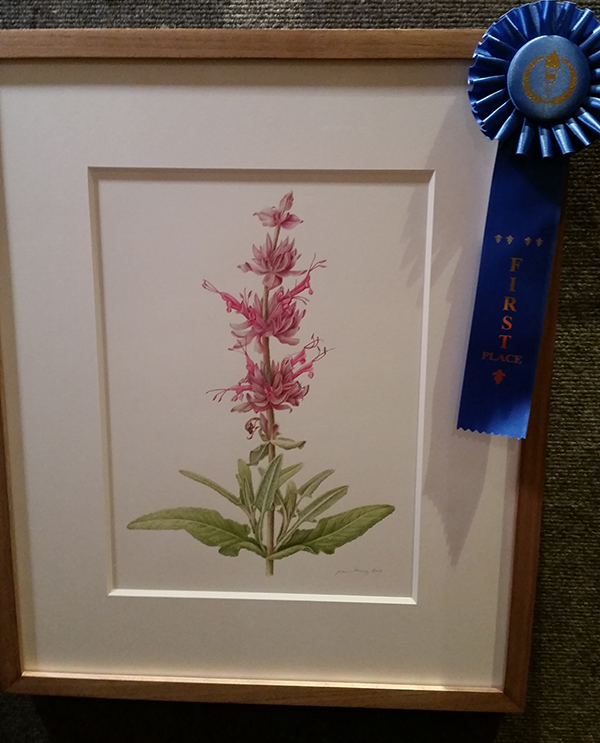
First place winner, Joan Keesey, Salvia spathacea, watercolor. © 2014, all rights reserved.
The California Native Plant Society (CNPS) held their Conservation Conference in San Jose, California this past January 15 – 17, 2015. BAGSC members Joan Keesey won first place in the Botanical Art Exhibition with her watercolor of Salvia spathacea, and Lesley Randall took third place with her pen and ink drawing of Malva assurgentiflora. CNPS awards cash prizes of $500 for first place; $300 for second place; and $200 for third place, plus publication in the CNPS magazine, Femontia.
The CNPS conference was attended by about 1200 people—all of whom are passionate about California’s native plants. Bernard Halliwell and Kristin Jakob worked very hard to put the botanical art exhibit together and did a magnificent job. Although they had only a small space with which to work, the exhibit flowed very nicely. As always the standard of work was exceptionally high.
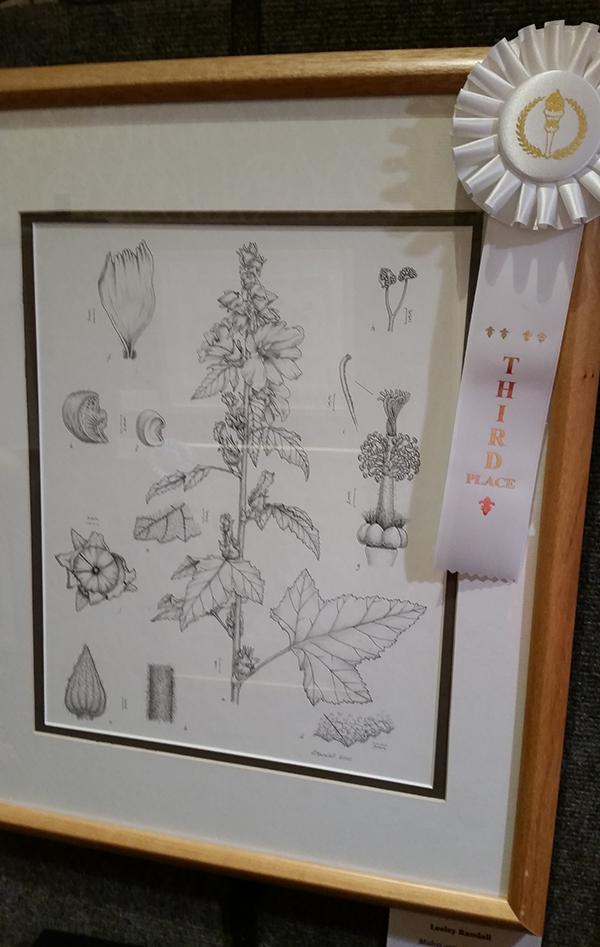
Third place winner, Lesley Randall, pen and ink of Malva assurgentiflora. © 2014, all rights reserved.
This year, the conference also included botanical art talks and demonstrations. Pria Graves gave a talk about The History and Tradition of Botanical Art; Lesley Randall taught a workshop on Pen and Ink Drawing of Plants; Nina Antze taught a workshop on Drawing Plants with Color Pencils; and Maria Cecillia Freemen taught Getting Started in Botanical Drawing and Painting.
Watch the blog as more images and information about the conference comes in. Congratulations to all for a successful conference, and kudos to Joan and Lesley!
by Deb Shaw
Our dear Jill Berry at the Los Angeles Arboretum will be retiring shortly. BAGSC sends out a BIG THANK YOU to Jill for all your years of help, service, and support.
Many of us got our start in botanical art at the LA Arboretum, in classes taught by Olga Eysymontt. Jill was a big part of our experience there, and we will miss her. Jill, congratulations on your retirement, and we wish you all the happiness and fulfillment in the years ahead. Thank you!
Our collaboration and support of the Arboretum will continue, of course. The schedule for Cristina Baltayian’s classes has been announced for January – June, 2015 at the Arboretum. These classes will be exploring color pencil, graphite, pen and ink, and watercolor on various papers, vellum and other surfaces. The emphasis will be on plant observation, drawing, composition, color theory and matching, and medium techniques.
Tuesdays, 2015 (10 am – 2 pm)
January: 6, 13, 20, 27
February: 3, 10, 17, 24
March: 3, 10, 17, 24
April: 7, 14, 21, 28
May: 5, 12, 19, 26
June: 2, 9, 16, 23
Cost: $275 Arboretum members per month; $295 non-members per month (includes Arboretum admission)
To register: Pre-registration required; please call the Class Registration line at 626.821.4623. Class participation is limited to a minimum of five students and a maximum of 12. A supply list will be provided upon registration. You may bring your lunch or purchase it at the Peacock Café.
Additionally, this year continues the “Arboretum Plant Introduction Project.” Cristina’s students, along with BAGSC members will be studying and portraying many of the Arboretum plant introductions from the last 50 years. The goal is to build a collection of paintings that will celebrate and document the invaluable contribution of the Los Angeles Arboretum to the state of California.
About the Instructor
Cristina Baltayian has a background in drawing (graphite, charcoal, pen and ink), two-dimensional design, watercolor, and colored pencils. Her work has been shown at Filoli, the Los Angeles County Arboretum, and Chapman University Leatherby Libraries. She is a member of the American Society of Botanical Artists, and The Botanical Artists Guild of Southern California.
by Beth Stone, posted by Deb Shaw
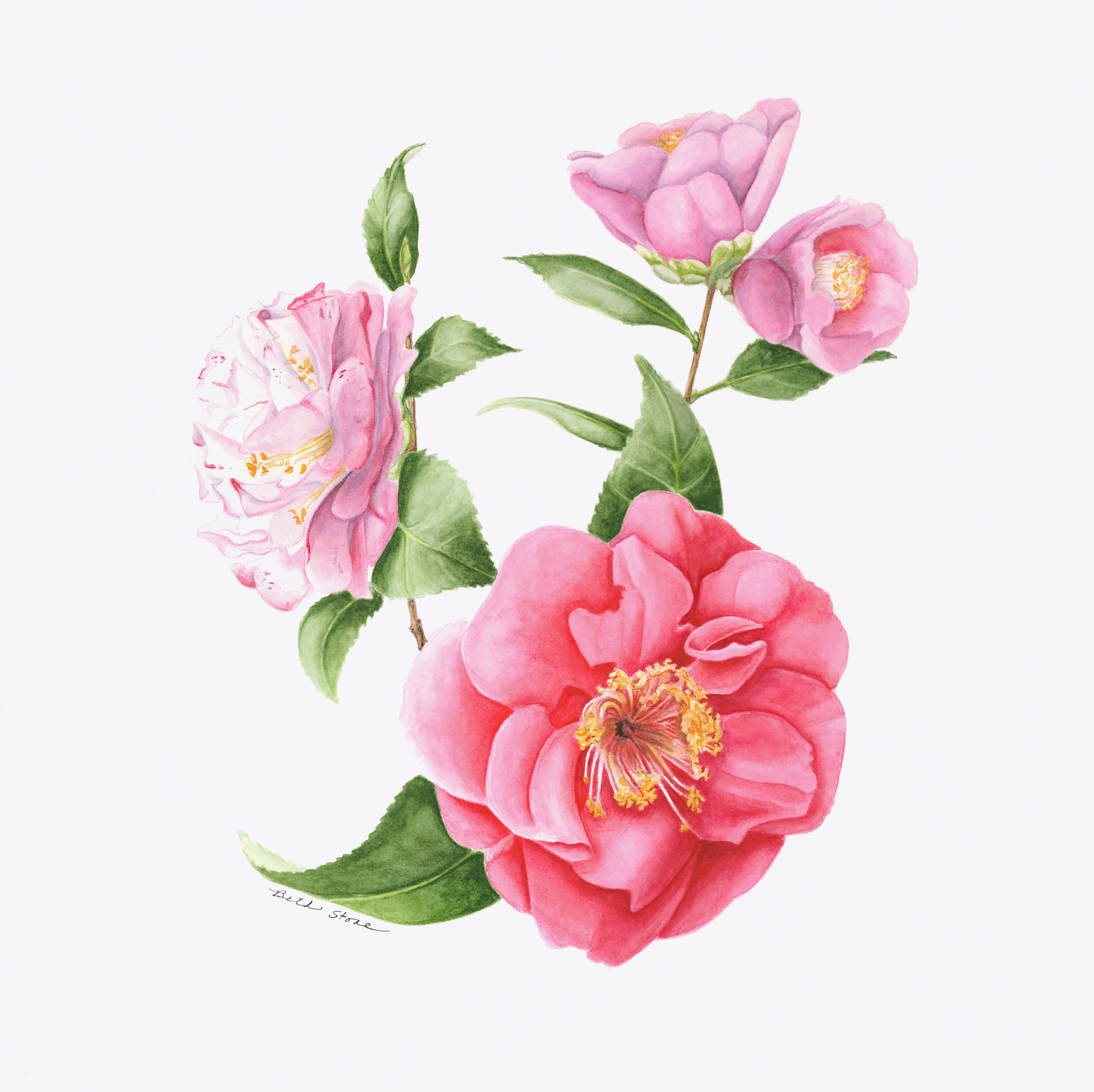
Camellia japonica ‘Guilio Nuccio’ with Camellia japonica ‘Horkan’ and Camellia wabisuke ‘Sukiya’, watercolor by Beth Stone, © 2104, all rights reserved.
The winter months are Camellia show season. This year, BAGSC members will have a Camellia Painting Exhibition at Descanso Gardens, Saturday, January 17 and Sunday, January 18, 2015.
The BAGSC Camellia Painting Exhibit will take place in Van de Kamp Hall, just inside the main entrance, in conjunction with the first Camellia flower show of the 2015 season. Camellia shows are exhibitions of hundreds of individual Camellia blooms presented for judging by amateur Camellia growers. Blooms are placed into classes based upon Camellia Species and characteristics such as nominal bloom size and culture conditions.
Each show has about 25 individual classes. Each class is judged by one of several teams of three judges. The teams select first place blooms of each cultivar entered in the class. They also choose multiple first place blooms from each class that merit further judging. All judges present, typically about 20, then vote for the top blooms in each class, evaluating the first place cultivars against one another. The ballots are tallied and a 1st, 2nd and 3rd place from each class is determined. Winners may choose crystal “trophies” or may accumulate points throughout the show season, which are then converted into a gift certificate redeemable at Nuccio’s Nurseries.

Camellia Grand Prix, by Janice Sharp, colored pencil, © 2014, all rights reserved.
Southern California has a consortium of five different Camellia Societies which conduct Camellia flower shows nearly every weekend from mid-January to mid-March each year in locations ranging from Bakersfield to San Diego. The January 17 and 18, 2015 exhibition at Descanso is the Pacific Camellia Society’s 50th annual show.
The Camellia Painting Exhibit and Flower Show will be open to the public:
Saturday January 17, 2015 1:00 PM (pending completion of the flower show judging) to 4:30 PM
Sunday January 18, 2015 9:00 AM to 4:30 PM
Admission to the Camellia Painting Exhibit and Flower Show is included with admission to Descanso Gardens. General admission is $9. Seniors 65 and over and students are admitted for $6. Children (5 to 12 years) are $4. Descanso members and children under five are admitted for free. There is ample parking at Descanso and you can also get a quick, easy and tasty lunch at their café.
Descanso Gardens is located near the intersection of the 210 and 2 freeways at 1418 Descanso Drive, La Cañada Flintridge, California, 91011. It is a 20-minute drive from downtown Los Angeles, depending on traffic.
Allow time on your visit to Descanso Gardens to take a walk through the Camellia Forest and visit the Camellia room in the Boddy House. You may also want to explore the newly opened natural Oak Woodland.

Minato-no-haru Camellia, by Clara Josephs, watercolor, © 2014, all rights reserved.
More information about the Camellia Societies and Camellia culture can be found at http://www.socalcamellias.org.
Nuccio’s Nurseries will also have an exhibit in Van de Kamp hall for the duration of this show which will be packed with examples of everything currently blooming in their Nursery. If you haven’t been to Nuccio’s, you owe it to yourself to see one of Southern California’s nursery treasures. Everything Camellia and Azalea can be found at Nuccio’s.
Want to volunteer to help with the Camellia Exhibition?
BAGSC volunteers are needed to help
- Stage and hang the show on Friday, January 16, 2015.
- Stay with the exhibit all weekend while it is open to the public on Saturday and Sunday, January 17 and 18, 2015. BAGSC volunteers supporting the exhibit will provide information to the public about BAGSC and our art form and will handle any sales. [There will also be at least one Camellia Society volunteer on hand at all times while the exhibit is open to talk with the public about the Camellias on display.] All BAGSC members are invited to volunteer and help support the show; you may volunteer regardless of whether or not you have work in the exhibition.
- Help with taking down and packing up the exhibit on Sunday, January 18, 2015.
An email blast went out to all BAGSC members with a call for volunteers. If you’re interested in volunteering, please contact Beth Stone.
See you there!
by Deb Shaw

Exhibition catalog cover, “Following in the Bartrams’ Footsteps”
ASBA’s traveling exhibition, Following in the Bartrams’ Footsteps has arrived at its final venue in Northern California, in the beautifully restored Julia Morgan-designed Girton Hall at the University of California Botanical Garden at Berkeley. The exhibition will be on display from December 15, 2014 – February 15, 2015. Consisting of 44 original works shows the native plant discoveries made by father and son, John and William Bartram throughout the Eastern United States from the 1730s through the 1790s. This exhibition at UC Botanical Garden at Berkeley is the only West Coast showing.
View the artwork on the website and see a list of the artists and artwork in the exhibition. The Garden is also offering three notecards from the exhibition in mixed packages of six or individually, sold in their Garden Shop. All proceeds benefit the Garden.
Three lectures are being offered as part of the outreach around the exhibition: Carol Woodin, ASBA Exhibitions Director, is giving a lecture today, December 19 about The Legacy of the Bartrams. Dr. Peggy Fiedler will present Fathers & Sons: A Journey with the Bartrams, Hookers and other Famous Families in Western Botanical Science, Art and Exploration on Saturday, January 31, 2015 from 1 pm – 3pm. The third lecture, titled Maria Sybilla Merian: A Passion for Plants & Insects will be given on Thursday, February 5, 2015. To register, and for more information, visit Bartrams events page on the garden website. Additionally, Catherine Watters will teach An Introduction to Botanical Art with graphite, colored pencil and watercolor on Thursday, January 22 and Friday, January 23 from 10 am – 4 pm each day. All levels are welcome. Registration for this workshop is also located on the Bartrams events page.
Catherine Watters, ASBA Director, developed a fundraising campaign that enabled the exhibition to come to California. A catalog of the exhibition may be purchased from ASBA’s website through ArtPlantae.
Exhibition hours for Following in the Bartrams’ Footsteps are 10 am – 4pm daily during days when the garden is open. Driving directions, admissions information and other information are available on the garden’s website. The University of California Botanical Garden at Berkeley is located at 200 Centennial Drive, Berkeley, CA 94720-5045. Phone: 510-643-2755.
While you’re visiting the Bartrams’ exhibition, be sure to stop in and see Plants Illustrated: Following the Garden’s Path, the 6th Annual exhibition of botanical art, featuring work by the Northern California Society of Botanical Artists. This year’s exhibition focuses specifically on plants in the Garden’s collection. The exhibition will be on display January 7 – February 15, from 10 am – 4 pm. There is an opening reception on Saturday, January 24 from 4:30 pm – 6:30 pm where you can sip wine, meet the artists, and see the show. Registration is required, and can also be found on the Bartrams events page on the garden website.
 BAGSC News